 |
 6 April 2012 – 10m
 6 April 2012 | by
 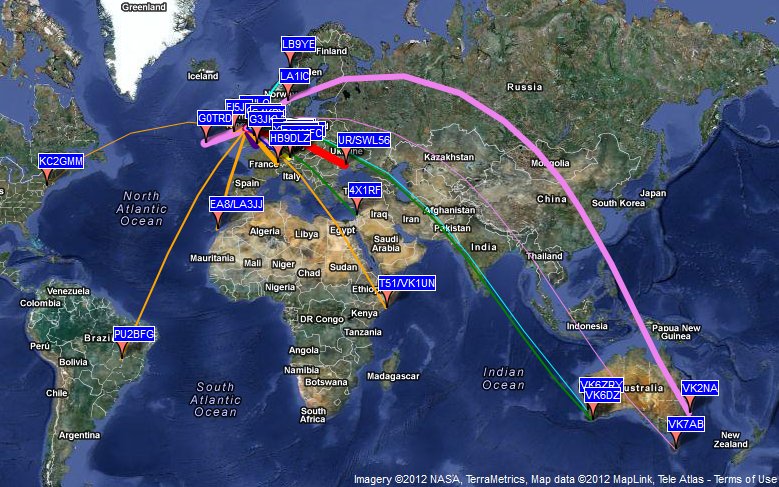 |
| 10m WSPR spots for G4ILO – 6 April 2012 |

Julian Moss, G4ILO, is a regular contributor to AmateurRadio.com and writes from Cumbria, England. Contact him at [email protected].
Activation Alert: W0/FR-194 (Genesee Mtn.) –2520m / 8268ft
Date: 7 April 2012
Time: Approx. 2000 UTC – 2300 UTC
Region: CO-Front Range
Elevation: 2520 m / 8268 ft – 2 Points
Call Sign: KDØBIK
Frequencies: 14.342.5-ssb, 18.157.5-ssb, 28.327.5-ssb, +/- 146.52-fm
Equipment: FT-817ND / Buddipole versatee vertical
(still anxiously awaiting delivery of the KX3)
APRS Track: On Road / On Trail
This will be my first SOTA activation in 2012 and my third since being bitten really hard by the SOTA bug back in the fall of 2011. I’d like to say it was the harsh, Colorado winter weather that kept me away. But it’s actually been a mild winter with many weekends suitable for an activation. But if you’ve followed my recent blogging, you know I’ve also been actively working on the new basement ham shack. Anyway, this activation will be slightly different than my previous two solo activations. More about this in a minute.
Steve Galchutt, wGØAT invited me to assist him in the WØ region by serving as the regional manager for the central Colorado area. I proudly accepted and part of my role is to help promote Summits On The Air throughout the Greater Denver Metro area. If you missed my blog post from earlier in the week. Please visit and book mark our new WØ-SOTA.org website.
The 285 Tech Club has invited me to present SOTA this coming Saturday at their monthly meeting with the option to do an activation after the meeting. When I originally agreed to do this (about two months ago) I wasn’t sure what sort of weather conditions we might face. Thankfully, Mother Nature must also be a SOTA enthusiast and looks to bless us with a beautiful Easter weekend.
Here’s why this SOTA activation will be slightly different. The meeting starts at 10 AM local (1600 z). I will begin my SOTA presentation around 11AM and plan to wrap by 12 (12:30 at the latest). Those who are planning to attend the activation demonstration will leave the meeting facility, stop for a quick bite to eat and then drive to Genesee Mountain.
Genesee Mountain is located just outside of the Denver Metro area. It is accessible off of I-70 as the highway begins to gain in elevation through the foothills of the magnificent Rocky Mountains. As you can see from the image below, Genesee Mountain Road goes all the way to the top.

I’m told to expect an interest from our older generation of hams and with this in mind, will take advantage of the road to the top. We’ll take a casual stroll down 100’ and then back up to make the activation legal. So this is why I can’t with any high degree of accuracy predict exactly when we’ll be on the air.
We plan to setup two HF stations. One on 20m and the second on 17m. We will also monitor and attempt QSO’s on 146.52. I have also listed 10m as a possible option. Depending on time and interest, we may or may not get to that band.
I’m really excited to be able to share all the wonderful aspects of the Summits on the Air program with this amateur radio club. If you listen to my amateur radio podcast, the practical amateur radio podcast, you know I take my Elmer role very seriously and passionately. I’m truly honored to have been given the opportunity to show others just how fun SOTA actually is. Please listen towards Colorado for us.
Well that just about does it for this activation alert. All that is left to do is…well go and activate Genesee Mountain. Besides this activation alert, I’ll post my activation intentions in all the usual places. But I’m also going to Self-Spot via Amateur Radio to Twitter. If you want to know more about what I’m talking about…please make sure to read this blog post.
Until next time….
73 de KDØBIK (Jerry)
Jerry Taylor, KD0BIK, is a regular contributor to AmateurRadio.com and writes from Colorado, USA. He is the host of the Practical Amateur Radio Podcast. Contact him at [email protected].
Good Friday – 2012


Larry Makoski, W2LJ, is a regular contributor to AmateurRadio.com and writes from New Jersey, USA. Contact him at [email protected].
Personal Growth
Each year I post an article with tips for Field Day organizers, but admittedly most folks who volunteer to lead such events already know how to organize a good Field Day event. Something I see year after year but is rarely talked about is personal growth from these events. What does personal growth have to do with Field Day, you ask? By personal growth, I mean learning new things, becoming more technically proficient, and become an overall more skilled operator. You see some folks who come one year who are nervous about getting on the mic, they observe others operate, and during a slow period they may get coaxed into operating awhile. They get the hang of it after an hour or two and do fairly well. Next year when they come back to Field Day, they readily volunteer to operate and can belt out 60 or 70 QSOs an hour, with someone logging alongside. The next year they can operate and log all by themselves. Perhaps later they will branch out and do digital modes or CW. There’s a learning process going on, and it extends outside of Field Day where skills and techniques learned are applied to everyday operating or perhaps casual contest operating. Ultimately these people become a key part of the Field Day organizing process, readily becoming a resource and providing expertise to others.
Unfortunately there tends to be an element at annual Field Days who don’t grasp this concept. They don’t listen during the demonstrations of the logging program during the preparation meetings or at the final pep talk before Field Day operating kicks off. They don’t want to know how the rigs work, they will depend each year on someone setting up the band, mode, and tuner before they operate. Some may drive into the site several hours into the event, hop in an operating position in prime time hours, eat some food, and leave. Now I’m not saying it’s wrong to be a casual operator, but if you’ve been at your local club’s Field Day for the past decade, you owe it to yourself and those who are putting a lot of effort into the event to help out, learn, grow, and contribute.
Get to know the logging program. Most clubs these days tend to use free logging programs. You can download them from the Internet, install them, and get to know how they work. Undoubtedly you’ll be able to use the Field Day logging program in your own shack.
Learn about antennas. There’s a reason why Miracle Whip or Buddipole antennas, while very portable, easy to setup, and convenient, are horribly lousy antennas for Field Day. Yes, everyone does believe you worked Europe with one, which by the way, was on 10 meters when it opened up one day ten years ago.
Watch others making QSOs. Some guys can’t make a QSO to save their life, and others can stack up QSOs like cordwood. Band conditions certainly help, but you’ll notice some ops just take the mic and do short CQs, they skillfully adjust their verbaige in order to make the best use of frequency time, they manage pileups well, and they use proper phonetics and at the right times. They amass QSOs effortlessly. Other operators just can’t seem to get it together. They do long 40 second CQs in which they say CQ numerous times, but say the callsign only once or twice. They’ll wait a long time in between CQs. When someone does answer they’ll waste time giving their own callsign, perhaps multiple times. If they don’t copy the station on their first call, they’ll spend 30 seconds telling the station how weak they are, wasting precious time that could be used for the station to try again. While no one is asking people to have the communications efficiency of an air traffic controller, you can have a lot more fun with less effort by adopting a few simple techniques.
Learn about the equipment. Field Day is a great opportunity to see new rigs in operation you’re not familiar with. Ask the owner of the equipment to show you how the menus work and find out what they like and don’t like about the rigs.
Bring a pair of headphones, a “Y” adapter, a notepad and pen, and ride shotgun on the CW station. CW contesting is probably one of the most intimidating things in amateur radio, if you’ve never experienced it. Sit alongside someone running CW on Field Day and just listen and try to copy callsigns. After you attempt to copy a callsign, look up at the logging program screen and see what call the lead operator copied. You will be amazed at what you can pick out and how you eventually get the “rhythm”. Before you know it, you’ll want to hop on the keyboard and give it a try. It’s addictive.
Network and help out. While most clubs welcome people to come for a short period of time and operate, if you’re a regular annual attendee, you owe it to your club to stick around longer and talk with folks, get to know new members, and help with the clean up. If you’re a seasoned amateur, you owe it to the hobby to help others become seasoned operators.


OAFS redux
A couple of days ago I decided to take another look at the Spectrum Communications Off-Air Frequency Standard (OAFS). It had been suggested that its failure to work might be the result of a solder bridge or similar error. I had a good look at the board using a high power magnifier and found a pair of pads that were suspiciously linked to ground. A moment’s work with the desoldering braid and sure enough there was a solder bridge exactly the width of a PCB track.
Having found a fault I was optimistic that the board would work. The setup adjustments were completed OK. But instead of hearing BBC Radio 4 in the speaker as the instruction sheet suggested I received a loud heterodyne with some speech faintly in the background, like listening to an AM signal in SSB mode with the BFO a couple of kHz off-tune.
I was looking at the Spectrum Communications advert in Practical Wireless to check how the ferrite rod was mounted and noticed that the description said “Background heterodyne whistle at 2kHz confirms lock condition.” That is exactly what I was getting. Odd that the instructions didn’t mention it though. Nevertheless I gave a cheer and went ahead with installing the board in its box.
My happiness was short-lived when I put my frequency counter on the output. It was 10MHz sure enough, but it was not phase locked to anything. I was only receiving the output of the uncontrolled 10MHz crystal oscillator which could be tuned a few tens of Hz either side of 10.000MHz. No adjustment I could make would cause lock to occur.
Comments made to my original post about this suggested that I might have problems with the OAFS as I am not in a good location to receive a strong signal from BBC Radio 4. I’m unhappy with the amount of time I’ve wasted on this. I think it would be best to write it off and forget about it. I’d rather not be bugged by it or have it taking up scarce space in the G4ILO shack. If anyone would like to have it and see if they can make it work then it’s yours for the cost of the postage.

Julian Moss, G4ILO, is a regular contributor to AmateurRadio.com and writes from Cumbria, England. Contact him at [email protected].
Picked up one of these
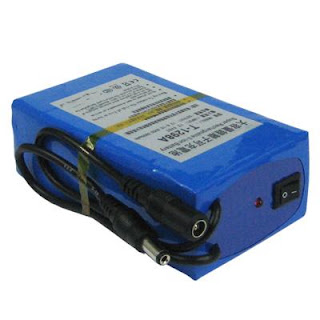
from e-Bay, after being inspired by Jim W1PID. A 12V 9800 mAh Lithium Ion battery to have for the KX3. It’s smaller and lighter than the 12V Sealed Lead Acid battery I am currently using. It will be coming from overseas. So now it’s a race – which will arrive first the KX3 or the battery – the chicken or the egg?
Any bets?
72 de Larry W2LJ
QRP – When you care to send the very least!

Larry Makoski, W2LJ, is a regular contributor to AmateurRadio.com and writes from New Jersey, USA. Contact him at [email protected].
Flight of the Bumblebees 2012
After a couple of private e-mail inquiries, I’ve decided to address this here.
To be honest with you all, the fate of FOBB 2012 is unclear at best.
I sent an e-mail off to Rich Fisher KI6SN asking if he wanted me to manage it again this year. So far, I have received no response. Also the ARS Wiki and the pages containing last years’ results and those of prior years seem to have vanished.
Maybe Rich has decided to do something different with FOBB for 2012 – not sure what is going on.
If I hear anything, you all will be the first to know.
72 de Larry W2LJ
QRP – When you care to send the very least!

Larry Makoski, W2LJ, is a regular contributor to AmateurRadio.com and writes from New Jersey, USA. Contact him at [email protected].
 Ham Radio Deluxe |
 W5SWL Electronics |
 Ham Radio Prep |
 KB3IFH QSL Cards  Hip Ham Shirts  HamRadioAuctions HamRadioAuctions Reliance Antennas Reliance Antennas Enigma Shop Enigma Shop |  morseDX  Ni4L Antennas  R&L Electronics R&L Electronics antennas.us antennas.us QRV QRV |
- Matt W1MST, Managing Editor
