 |
 DXLab’s software
 21 April 2012 | by
 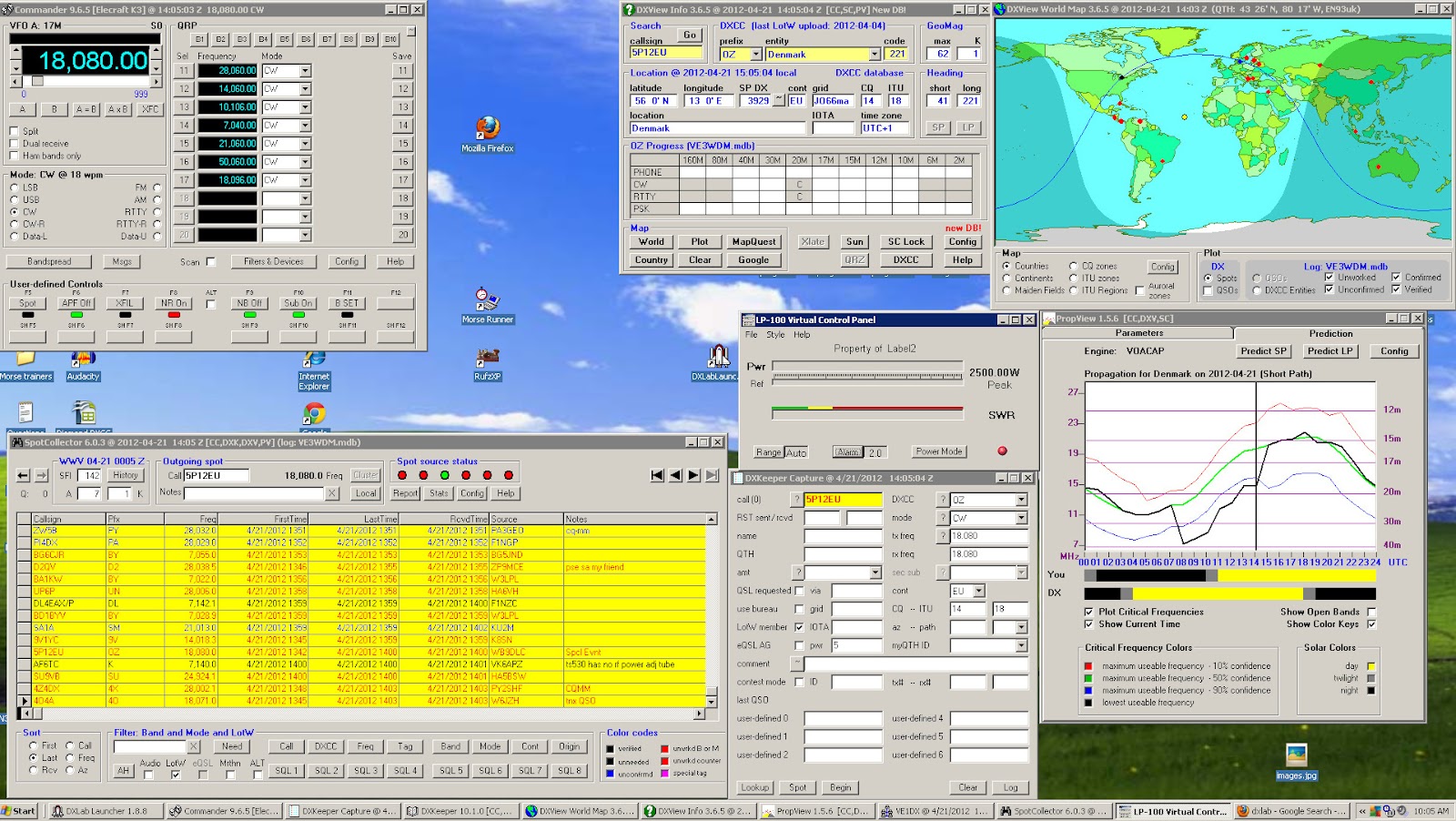 |
| My DXLab's desktop |
- You can pick and choose what applications you want to install.
- Once an application is installed you are able to customize it to your needs.
- Great support, the short time I was running DXlabs they released fixes and upgrades.
- Running all 8 applications did not seem to take up much of the PC's processor.
- Each Application has over the top documentation in great detail.
- It will start up 3rd party applications to run with DXLab. For me so far I have my LP-100A virtual meter starting up within DXLab.
- Make sure you read the documentation to fully understand what each app can do.
- The first application you want to download is called Launcher. This app when up and running at the push of a button install each app you want to try. It also (when configured to) will check for updates of all the programs each time it opens. It will also with one click start-up and shut down all DXLab app's. I made the mistake of not using this program and I manually unzipped, created a folder and installed each application. The Launcher makes installation a painless experience.
- Join the DXLab yahoo group for outstanding support. I posted a questions and it was answered in 20 minutes.

Mike Weir, VE9KK, is a regular contributor to AmateurRadio.com and writes from New Brunswick, Canada. Contact him at [email protected].
KX3–The first 24 hours
As previously mentioned, my KX3 shipped from the Elecraft factory on Tuesday afternoon and was delivered to me in Denver, Colorado via USPS Priority Mail Service. I’ve gotta say for the price, USPS Priority service is the best way to go in most cases. Of course this blog post is not about shipping services and I’ll move on.
Over the past couple of weeks I’ve seen some awesome Youtube videos from hams who have received their new KX3. I see no reason to re-invent the wheel, just search Youtube for Elecraft KX3 and you’ll find these.

My Elecraft KX3 is serial number 57. Perhaps s/n 59 would have been cool, but I’m happy nonetheless. I spent a little bit of time with my KX3 the first evening. I took the time to attach Anderson Powerpoles onto the supplied power cable. I adjusted the tilt legs on the back. Which by the way, in recent days I’ve noticed a lot of discussion on the Yahoo KX3 reflector dedicated to the discussion of the tilt legs. I’ve seen no issues with any binding of the thumb screws. You just need to gently loosen the thumbscrew, lower the tilt leg into position and then re-tighten the thumbscrew. Repeat for the other side. It really is that simple.
I grabbed a short coax jumper and connected the KX3 to my Hustler 6BTV. I clicked the band switch until the KX3 was in the 40m band and turned the VFO. While doing so I read through the manual and tried out many of the features of this remarkable radio.
For the most part, my KX3 will be used for SOTA or Summits On The Air and will replace my Yaesu FT-817. At this time, I’m not planning to purchase the Elecraft amplifier which would most certainly turn this little radio into a nice shack rig. I already own a Yaesu FT-950 which I use primarily for SSB and run digital modes from my Yaesu FT-897. I’m happy with what both of these transceivers do for me in the ham shack.
In all honesty, I was also pleased with my Yaesu FT-817 for field use. I purchased it new about 4 years ago and it’s been a trusty companion for both SOTA activations as well as general portable use. So why purchase the Elecraft KX3?
Like many of you, I began hearing about the KX3 around Dayton 2011. I watched the videos and did some research into Elecraft. Everything I read, heard and watched pointed to the KX3 being a fantastic radio. Then in the fall of 2011, I was bitten by the SOTA bug. Chasing quickly turned into activating and now I’m lucky to have the opportunity to assist one of the coolest SOTA activators I know. Of course, I’m talking about Steve Galchutt wG0AT. Steve appointed me as the Central Colorado regional manager. My role is to promote the Summits On the Air program as well as amateur radio. To date, I’ve conducted three face to face SOTA presentations to local amateur radio clubs in the greater Denver area. I’ve conducted one via Skype to a club in Washington state and I have many more lined up. This opportunity has truly allowed me to broaden my Elmer opportunities beyond my blogging and podcasting efforts. Thank you Steve.
So as I learned more, I realized the KX3 would become a much better SOTA performer for me than the 817. Allow me to point out a few of the differences.
Weight – Advantage KX3
My Yaesu FT-817 weighs in at a little over 2.5 pounds. This includes the internal FNB-85 9.6v battery pack.
The KX3 with 8 AA batteries weighs in slightly less than 2 pounds. While I don’t plan to operate the KX3 solely on internal power, I may not install internal batteries. Note: I didn’t purchase the optional KXBC3 charger.
Size – Advantage KX3
The size differences between the 817 and KX3 are minimal. The 817 measures in at 7 3/4 x 5 1/2 x 1 1/2 inches. The KX3 is much more compact with measurements of 8 x 3 1/2 x 2 3/4. Unfortunately, the comparisons I did a few weeks ago with my 2×4 prototype don’t match real KX3 comparisons. I can still use the Lowepro Apex bag but will not pack the battery pack in side.
Durability and Ruggedness – Advantage 817
I’ll admit this was one category I thought long and hard about. The Yaesu FT-817 is a rugged little radio just like it’s big brother the FT-897. I handle all my gear with care, but accidents do happen and certainly portable operations increase this chance greatly.
Now please don’t confuse this with poor construction or design. The KX3 design just has a larger control panel footprint. This is great and what leads to my next category. However, a little more surface area to get damaged from an accidental drop or other mishap. I’ll just be extra careful.
LCD Display and Control Panel– Advantage KX3
I’m 45, will turn 46 in October. I’ve been using reading glasses for the past 4-5 years. Each year my prescription is bumped up a little. I’m to the point where I can’t read anything without either holding it at arms length away from me or making sure I have my reading glasses with me.
The LCD display on the 817 is a tiny 1.5 x 1.0 (rough measurement) screen. However, the LCD on the KX3 is 4.75 x 1.25. I can read the frequency or any of the other items without my reading glasses.
Portability and SOTA Readiness – Advantage KX3
While the Yaesu FT-817 is an all mode transceiver including HF, VHF and UHF operations as compared to the KX3 which today is HF/50MHz only (internal 2m module coming soon). The lack of 2m or 70cm operations does not impact me and the way I will use the rig. I carry the Yaesu VX8 for APRS tracking and will use that radio for any V/UHF operations.
Speaker Audio Output – Advantage 817
Elecraft has stated from the beginning that headphones or external speakers would be a must for a noisy environment. The speaker in the KX3 is tiny and I honestly don’t see how this could have been avoided. However, I view this as a non-issue. I use a lightweight pair of over-the-ear ear buds for SOTA activations. This is important as in windy conditions or even noisy band conditions, a headset or ear buds will help.
Other Features and Functionality – Advantage KX3
I’ve truly enjoyed operating QRP and have honestly gained much more respect for QRP operations in general since being active in SOTA. Working DX from on top of Mt. Herman (W0/FR-063) opened my eyes to what a little bit of power and a properly tuned antenna can accomplish.
While the KX3 does offer extra transmit power from the 817, I will keep it set at 5 watts and only increase to 10 or 12w when needed. In addition, while I’ve never packed my LDG Z-100 Auto tuner on a SOTA trip, I did order the internal ATU in the KX3. However, I firmly believe a successful SOTA activation starts with a properly tuned antenna and will continue to stick to that process.
The VFO knob is most certainly a major difference between the KX3 and 817. You can really crank up or down the bands with much greater precision and speed on the KX3. In addition, the KX3 allows for direct frequency entry. This makes easy work of tuning up and down the bands.
Of course, another feature set that completely blows the 817 out of the water is the ability for the KX3 to decode PSK/RTTY and CW signals. I’ve played around with this and the PSK decode is spot on. The only problem is watching the text. The text is displayed in an 1.5 x .5 inch area of the LCD screen. It goes by pretty quick. I’m experimenting (with much success) using the PSKer iOS app. I plan to blog soon about this testing.
In closing, and in all fairness to the Yaesu FT-817, the 817 is a great little SOTA rig. There are many SOTA activators and other portable enthusiasts who will continue to benefit from the performance the 817 can deliver. Just how much improved performance I’ll gain from the KX3 on a typical SOTA activation has yet to be seen. I plan to correct this and schedule a SOTA activation in the near future.
Until next time…
73 de KD0BIK
Jerry Taylor, KD0BIK, is a regular contributor to AmateurRadio.com and writes from Colorado, USA. He is the host of the Practical Amateur Radio Podcast. Contact him at [email protected].
Activation Alert: WØ/FR-185 (Centennial Cone) –2640m / 8661ft
Date: 21 April 2012
Time: Approx. 1600 UTC – 1800 UTC
Region: CO-Front Range
Elevation: 2640 m / 8661 ft – 2 Points
Call Sign: KDØBIK
Frequencies: 14.342.5-ssb, 18.157.5-ssb, 28.327.5-ssb, +/- 146.52-fm
I may also try PSK31 on 20m (14.070)
Equipment: Elecraft KX3 (maiden activation / Buddipole versatee vertical
APRS Track: On Road / On Trail
The more I played around with my brand new (less than 48 hour old) Elecraft KX3, the more I knew I had to plan an activation for this weekend. This will mean I’ll probably miss the combined QRPTTF + SOTA event scheduled for Saturday, 28 April.

Centennial Cone is a two point SOTA summit and is located just slightly NW from Genesee Mountain (WØ/FR-194) that I activated just a few weeks ago. At the present time Centennial Cone has had no other activations. So this will be my second summit where I was the first to activate.
I’m going to setup and operate on 20m SSB. However, I may also attempt to operate PSK31 via my iPad and the PSKer iOS App.
Well I need to wrap this up as I need to double check my gear and get it all ready to go. I look forward to working you on my fourth SOTA activation.
73 de KDØBIK
Jerry Taylor, KD0BIK, is a regular contributor to AmateurRadio.com and writes from Colorado, USA. He is the host of the Practical Amateur Radio Podcast. Contact him at [email protected].
W1PID – at it again!
Jim W1PID proves that it doesn’t have to be a long outdoor session in order to have success.
http://www.w1pid.com/quickie/quickie.html
I need to remember this. There are times when I am guilty of being lazy, I guess. I hesitate sometimes, to set up the station even with the fast mobile setup, because I convince myself that “there’s not enough time”.
Jim proves that if you know what you are doing, that even 15 minutes can be enough. And that’s a good habit to get into. In his case though (and I say this with my tongue firmly planted in my cheek) I have to admit the local scenery sure can make up for things even when the bands are dead. Who wouldn’t want to spend time out in the New Hampshire countryside? The QSOs are the icing on the cake!
As always, thanks for sharing, Jim. Another FB job, OM!
72 de Larry W2LJ
QRP – When you care to send the very least!

Larry Makoski, W2LJ, is a regular contributor to AmateurRadio.com and writes from New Jersey, USA. Contact him at [email protected].
Woo Hoo!
No it’s not what you might think. I did NOT get an e-mail from Elecraft telling me that my KX3 is on its way.
But I did find a slip in the mail asking me to come to the Post Office to sign for a package. I checked out the tracking number and it’s the Lithium Ion battery that I got via eBay. I know I have to be very careful charging it and all; but the smaller size and lighter weight will be a whole lot nicer than carrying around that sealed lead acid battery.
There is also the provision for using the internal battery holders; but I always get the heebie jeebies about batteries leaking and making a mess. I don’t use them in my PFR3A. I did have them in my K1; but ended up taking them out. When using internal batteries in the K1, you had to use a different speaker other than the original stock one. It was smaller to accommodate the space that the batteries took up and I didn’t like the way that it sounded. My K2 is always used with an external source.
Yes, it would be a lot more convenient to use the internal battery holders while out on a day hike; but the idea just doesn’t sit right with me. Silly, I know; but what can I say? I have repaired too many circuit boards in my day where the copper traces were eaten away from leaky electrolytic caps. My brain knows the likelihood of that happening inside a KX3 are probably close to nil; but I still feel that I don’t need to tempt fate.
So for in home shack use, I rely on my Astron RS-35 power supply. Yes, I know that a 35 Amp power supply is way overkill for QRP. But it’s a fantastic analog power supply and I’ve had it for years. I’ve even repaired it myself a couple of times. I like to think of it as an old car with a carburetor that I can service myself, if need be. Way easier than dealing with a switching power supply.
I had my fill repairing those back in the days when I was in the photo industry. The Broncolor studio strobes that I used to repair had switching power supplies. They were good; but did they ever generate RFI! I suppose that switching power supplies are a lot better than they used to be; but I know for a fact that my Astron generates no RFI at all – period. As long as it delivers stable DC Voltage, it will be at the bottom of my bench.
72 de Larry W2LJ
QRP – When you care to send the very least!

Larry Makoski, W2LJ, is a regular contributor to AmateurRadio.com and writes from New Jersey, USA. Contact him at [email protected].
Show Notes #080
Introduction:
- Tornado season has begun in Texas! Check out the videos at kcares.info
Announcements:
- The donations for the LHS to Dayton Hamvention fund have stalled. If you’d like to see LHS return to the Hamvention this year, please make a donation in the next week or two. All donations will go toward the cost of the booth in the vendor exhibition hall. If we fail to raise enough to attend, then the funds will go toward the expenses of producing LHS.
Topics:
- Richard’s Linux Adventures
- Thank You Kubuntu, for once again obliterating Richard’s boot sectors.
- Russ suggests using dd to perform what is essentially a low-level format of the drive. For example,
dd bs=1m if=/dev/zero of=/dev/sda
NOTE: This will totally erase your hard drive! Use caution!
- Matthew, KC8BEW, in the chat room, suggests using Spinrite to repair a hard drive.
- Richard declares that Debian is the Jesus Christ of Linux distributions, as it raised his hard drive from the dead, at least temporarily. It was the only distro he found that managed to install grub on the drive.
- Richard also declares that Linux Mint sucks… at least for him. Audacity caused 100% CPU usage, spell check didn’t work, and it crashes.
- Also discussed: CentOS, Scientific Linux, Fedora, PCLinuxOS, Xubuntu, lubuntu.
- Richard is writing an ebook on the National Traffic System.
- Russ again suggests Richard try Debian, but Richard says it won’t let him install Firefox. Maybe there’s a hardware issue? (Perhaps memtest might find a memory error? -Ed.)
Donations:
- We received several donations from visitors to the Dalton Hamfest and the KARC Hamfest. Thank you to our ambassador Ronny (K4RJJ) and to everyone who stopped by our booth at those events.
- Russ hoped to interview Roy, KK4ATD, our ambassador to the RARSfest last week. Apparently, the LHS booth was a great success.
- If you’d like to be an ambassador for LHS at an event, email us at [email protected] and visit the Ambassadors link on the web site.
Feedback:
- Fab, co-host of Linux Outlaws, left a couple comments on the website expressing his gratitude for being on the show.
- Bob (W9YA) offers Russ some suggestions for entering the contact exchange information in YFKtest.
- LinuxCanuck left a comment saying he enjoyed the episode with Fab, asks for help getting the feed links on the web site to work, and offers some thoughts about Kubuntu.
- Roy, KK4ATD, the LHS ambassador to RARSFest, calls in to the show and describes the event. He’s also building a repository of ham radio packages for CentOS, called Hamux.
Contact Info:
- Contact Richard at [email protected], Russ at [email protected], or both at the same time at [email protected].
- Listen to the live stream every other Tuesday at 8:00pm Central time. Check the LHS web site for dates.
- Leave us a voice mail at 1-909-LHS-SHOW (1-909-547-7469), or record an introduction to the podcast.
- Sign up for the LHS mailing list.
- Sign up for the MAGNetcon mailing list.
- LHS merchandise is available at the Merch link on Web site. Check out the Badgerwear or buy one of the other LHS-branded items at PrintFection.com/lhs or Cafe Press. Thanks!
- Thanks to Dave from Gamma Leonis for the theme music.
Russ Woodman, K5TUX, co-hosts the Linux in the Ham Shack podcast which is available for download in both MP3 and OGG audio format. Contact him at [email protected].
Back seat ham
It has been a long time since I mustered up the time to post but there’s been a lot going on in West Cumbria and unfortunately most of it hasn’t had anything to do with radio. I did manage to get a day out last Sunday to the Norbreck Rally, thanks to Noel G4PEW for the driving, to help out with the club stand and pick up a couple of goodies for the portable enthusiast. I’ll post about them later when the work dust has settled.
You may remember that a while ago I bought a 2 element lightweight 50Mhz antenna that is currently sitting in a 95% completion state so that will need a bit of finishing off and talking about.
I also purchased a Prowhip 5 band fishing pole antenna on a bit of a whim, partly because I was going to make one and thought I wouldn’t have the time to do it this side of the summer and partly because it was so cheap I doubt I could have got the parts and made one up myself for much cheaper. It calls itself a multiband antenna but its really a 1/4 wave vertical in a fishing rod that will tune to 40m and a few higher bands with a tuner. More on that later.
The other thing I’m involved with is helping with the Workington club (MX0WRC) to try and help out some of the novices and non home brewers to make a simple 3 element 2m band antenna out of ‘stuff from a hardware shop’. There are some well established designs that work but the focus is on getting the guy’s and girl’s to make their own.
I’ll also be helping out with the Fred Whitton Cycle Challenge with the local Raynet group shortly so weekends are looking quite busy .So as you can see, plenty on the plate but no time to get on the air. Something is going to have to stop, my vote is work but I doubt the mortgage will get paid, mores’ the pity.
Alex Hill, G7KSE, is a regular contributor to AmateurRadio.com and writes from Cumbria, UK. Contact him at [email protected].
 Ham Radio Deluxe |
 W5SWL Electronics |
 Ham Radio Prep |
 KB3IFH QSL Cards  Hip Ham Shirts  HamRadioAuctions HamRadioAuctions Reliance Antennas Reliance Antennas Enigma Shop Enigma Shop |  morseDX  Ni4L Antennas  R&L Electronics R&L Electronics antennas.us antennas.us QRV QRV |
- Matt W1MST, Managing Editor
