 |
 A great day = portable op’s
 5 May 2012 | by
  |
| Portable op's QTH |
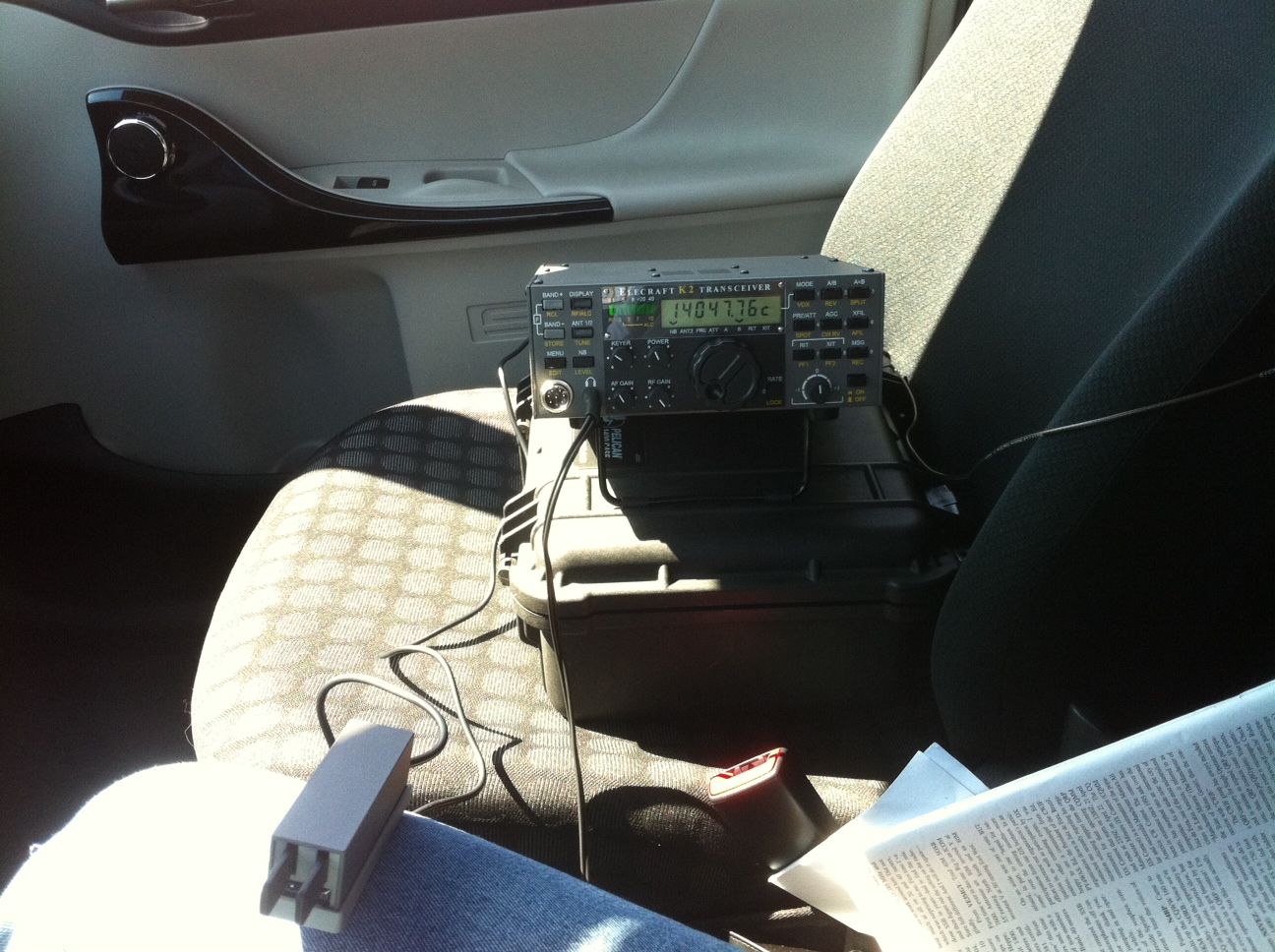 |
| VE3WDM portable in action |
stuff I really don't use anymore thus it will be sold for "ham bucks". Cleaning up the shack gave me the warm fuzzes once is was all done and long over due for sure. I just hate looking for
 |
| all packed away in trunk |
- NN7ZZ Mendon UT 14.047
- K7EAR Solomon AZ 14.040
- IQ0PG Italy ARI contest 14.031 880 miles per watt.
- IZ1A Italy ARI contest 14.022 QRZ.COM can't find maybe incorrect copying
- DL5AXX Germany ARI contest 14.010 810 miles per watt.
- IK2HDF Italy ARI contest 14.011 834 miles per watt. I was very happy with the how the antenna and rig worked and was surprised at the distance I was able to get. I know for sure next time I am going to lower the output and start making some 1,000 miles per watt potable contacts. Some things that have to be worked on before next time......remember all the items to bring, some bottled water, longer cable for Palm paddle key and some adjustments to the Palm paddle key are needed. Well it's time to spark up the BBQ and get some dinner...cheers!!!

Mike Weir, VE9KK, is a regular contributor to AmateurRadio.com and writes from New Brunswick, Canada. Contact him at [email protected].
Olivia — the Magic Mode
I have to give credit to Gary L. Robinson, WB8ROL, for the title of this post. I met him on the air tonight using Olivia 500/16, and pretty soon I was reading his article about this mode . . . but I’m getting ahead of myself.

Olivia 500/16. Image obtained from http://www.oliviamode.com.
My introduction to Olivia took place yesterday afternoon at a meeting in a little coffee-shop in Marshall between the MN ARES® ASEC, Section 5 DEC, Lyon Co. EC, and myself (at which I accepted the position of Yellow Medicine Co. EC, but that’s another story). They explained that FLDIGI is the software they are training people on, that every Thursday evening at 8:00 P.M. there is a MN ARES® digital net on 80 meters, and that they are using Olivia 500/16 for this net.
Well, my power of recall being what it is, I’d forgotten all about it till I heard the clock chime 8:00 while I was doing the dishes (after dining on my wife’s fabulous slow-cooked chicken). “Honey,” I asked, “would you mind if I left the rest of the dishes to you? I’d like to go check out a net on the radio.” I sure am blessed with a sweet wife — she took over without batting an eye while I dashed downstairs and started hooking up my laptop to the interface while firing up FLDIGI.
Sure enough, there was the net. I “listened” (How do you say it? Read?) for nearly an hour, and finally checked in right as the net was closing.
Well, tonight before going to bed I decided to try it again. This time I went up to 20 meters where I had a nice ragchew with Gary, WB8ROL (my first “real” QSO). We hit it off right away — his career path took him from law enforcement to programming just like mine did, we both have bad backs, and we both like cats and penny-whistles — but what really got my attention was his website: www.oliviamode.com. This fellow is a veritable evangelist for this mode! If you haven’t read his QST article about Olivia, click here and enjoy “Ghost QSOs — Olivia Returns from the Noise.”
I can attest to what Gary writes about in that article. As the band began to fade, his signal dropped until I couldn’t hear it at all. All I could hear was static; I assumed I’d lost him. Not only couldn’t I hear him, I couldn’t see anything on the waterfall display. But incredibly, letter after letter appeared on the screen as Gary typed his last message!
Olivia really is “the Magic Mode!”


Todd Mitchell, NØIP, is a regular contributor to AmateurRadio.com and writes from Minnesota, USA. He can be contacted at [email protected].
Wow!
I saw this on eBay today:
Someone in Spain is auctioning off NorCal Doublets. This particular one has 12 bids on it with about 2 1/2 days to go. High bid is $31.00 US.
Holy Shamoley! I have to start getting busy building NorCal Doublets and posting them to eBay !! I have built several of these from ribbon cable as well as light gauge speaker wire. They do work decently well, and they are cheap to make. For what I paid in materials, $31.00 would be a serious return on investment.
The handing out of Skeeter numbers is going well. If you hit the extreme right tab above, entitled “NJQRP Skeeter Hunt“, you’ll get the rules and you’ll be able to see the roster as it currently stands. I am going to update it as often as I can. As of this very second, 39 Skeeter numbers have been handed out.
Ward Silver of the ARRL has been notified, so The Hunt will appear in the August “Contest Corral”. I will send an e-mail to CQ this weekend, also.
Ahhh! My birthday present arrived in the mail today – the DCP paddles from American Morse. Tiny little package for a tiny little key. I hope to start the build this weekend and will post some photos.
The kids (including yours truly) want to see “The Avengers Assemble” this weekend. Hope I can get tickets – all local shows around here for tonight are already sold out.
72 de Larry W2LJ
QRP – When you care to send the very least!

Larry Makoski, W2LJ, is a regular contributor to AmateurRadio.com and writes from New Jersey, USA. Contact him at [email protected].
Show Notes #081
Introduction:
- Loctite… not just for noisy children any more.
Announcements:
- The Fourth Annual Southeast Linuxfest is scheduled for June 8-10, 2012 in Charlotte, NC.
- Please sign up for the LHS mailing list.
- Please join our new Subreddit and contribute news stories, discussion topics, and any other items that may be of interest to our listeners.
- Scott, N8VSI, has tentatively agreed to be our ambassador at the Ohio Linux Fest in Columbus, Ohio in September, 2012.
- It looks like LHS will be at the Dayton Hamvention, May 18-20, 2012 in Dayton, OH. If you’d like to help make that happen, please donate!
- LHS is syndicated by the Kamiak Butte Amateur Radio Association, KB7ARA. The linked repeater sites cover almost all of Washington State, some of Oregon, and a bit of Canada as well. They are IRLP and Echolink connected.
- Ronny, K4RJJ, will be our ambassador at the Knoxville Hamfest on June 8th, 2012. Ronny calls in to discuss the upcoming Knoxville Hamfest, and his previous experiences as LHS ambassador.
Feedback:
- David, KE0AZ, writes to ask if LHS will be at Ham-Com, June 8-9, 2012, in Plano, TX.
- LinuxCanuck writes to defend Kubuntu against Richard’s recent tirades.
Topics:
- IRSSI Tips and Tricks
- Irssi is a terminal based IRC client for UNIX systems. It also supports SILC and ICB protocols via plugins. Russ offers some tips on making Irssi a bit friendlier.
- The functionality and ease of use of Irssi can be extended by installing and using third-party scripts. These scripts are written in Perl and available at scripts.irssi.org.
- Once you download the script file, which we’ll call “dlfile” in the example below, you can install it and have it automatically run with Irssi by performing the following steps:
# Create the scripts and autorun directories:
linux> mkdir -p ~/.irssi/scripts/autorun
# Move the downloaded script file to the scripts directory:
linux> mv  ~/.irssi/scripts
# Change to the autorun directory:
linux> cd ~/.irssi/scripts/autorun
# Create a link to the downloaded script:
linux> ln -s ../ .
- Some interesting scripts Russ is using:
- nicklist-away.pl – provides a nick list and shows away status.
- screen_away.pl – sets the away status when screen detaches.
- nickcolor.pl – assigns a different color to each nick.
- Our hosts discuss the new release of Linux Mint Debian Edition (LMDE) with the MATE and Cinnamon desktops.
More Feedback:
- Stefano, IZ3NVR and KD2BGM, asks for help finding a good Linux contest logging program that supports SO2R (single operator, two radios) and CW keying. We don’t know of any, but perhaps one of our listeners can offer a suggestion.
- John, KD7AAT, offered a bit of criticism about the political content of episode 79 with Fab.
- Mike writes to extol the virtues of Linux Mint Debian Edition with the XFCE desktop, and hopes Richard will find it a suitable alternative to Linux Mint or Kubuntu. He also suggests Crunchbang Linux. Richard and Russ respond.
Donations:
- Don sent a nice donation for the Hamvention fund. Thanks, Don! We also received donations from Bob K., Charles H., Scott P., Craig B., and Harrison K. Thank you, everyone!
Contact Info:
- Contact Richard at [email protected], Russ at [email protected], or both at the same time at [email protected].
- Listen to the live stream every other Tuesday at 8:00pm Central time. Check the LHS web site for dates.
- Leave us a voice mail at 1-909-LHS-SHOW (1-909-547-7469), or record an introduction to the podcast.
- Sign up for the LHS mailing list.
- Sign up for the MAGNetcon mailing list.
- LHS merchandise is available at the Merch link on Web site. Check out the Badgerwear or buy one of the other LHS-branded items at PrintFection.com/lhs or Cafe Press. Thanks!
- Thanks to Dave from Gamma Leonis for the theme music.
Music:
- “Gold and Steel” by Isaac Graham from the album Empty Vessels.
- “Charly” by Higgins from the album Zs.
Russ Woodman, K5TUX, co-hosts the Linux in the Ham Shack podcast which is available for download in both MP3 and OGG audio format. Contact him at [email protected].
No GO at G4ILO
From May 5 until June 10 British amateur radio stations that have been granted permission to do so may use the prefix GQ, MQ and 2Q0 in place of their regular G, M or 2×0. For the duration of the 2012 Olympic Games British amateurs may use GO, MO and 2O0 instead of their normal calls.
As a sport-hating republican (and I don’t mean the American political party of the same name) G4ILO will continue to use the callsign that has declared me to be an ENGLISH amateur radio operator for the last 30-odd years. So now you know!

Julian Moss, G4ILO, is a regular contributor to AmateurRadio.com and writes from Cumbria, England. Contact him at [email protected].
LHS Episode #081: Chicken Licker Bumpy Bumpy
 Welcome to the latest installment of Linux in the Ham Shack. It’s almost time for Hamvention 2012! We hope that we’ll be able to see our listeners and friends at the Hara Arena in Dayton, Ohio from May 18th through the 20th. With your donations, the thermometer at left has almost exploded. If you can spare a dollar or two, we’ll be at our goal in no time.
In this episode, our trusty [sic] hosts talk with an Ambassdor. Richard’s interview with Ronny is so good it would make Anderson Cooper–well, throw up probably. They also discuss Linux topics like Mint-based distributions and irssi, an IRC chat client, as well as ham radio topics from HSMM to Winlink to contest loggers. The guys respond to a bunch of listener feedback and talk about some new features of the show.
A quick heads up: The interview audio is a little rough with some weird background anomaly. It won’t drive you mad, just make you wonder what was going on on Ronny’s side of the line. We suspect dinner and a seance.
73 de The LHS Guys
Russ Woodman, K5TUX, co-hosts the Linux in the Ham Shack podcast which is available for download in both MP3 and OGG audio format. Contact him at [email protected].
Finished With First Half of the Electronics Learning Lab (with Guest Blogger Antonio)
My son, Antonio, has reached the midpoint of his work with the Radio Shack Electronics Learning Lab I wrote about last November. Just a few days ago he finished the first of the two workbooks (click here to view PDF). I really liked the second-to-last of the labs — a “fully adjustable siren.” Here’s the schematic, followed by my son’s take on this part of his homeschooling curriculum:

The End of Book One of the Learning Lab
The last lab of book 1: a frequency meter using 555 & 4046 chips.
I have reached the end of book one. It has taken me six months to complete the book. The things that I have learned are both great and valuable. To be able to understand parts (such as resistors, capacitors, and different types of ICs) has been a great help.
It has been a real joy to have my dad help me with my projects. We both learn something new each time we do a lab. With this lab you learn how to put together circuits. You also learn to think about what the circuit is doing. Once you really start to understand the basics you are able to figure out parts of the projects without looking at the step-by-step instructions.
Grade: A!
This lab kit has so many neat and interesting projects. You get to build things like light-dark meters, adjustable sirens and so much more. By using this lab I am able to build a code oscillator and many other useful things. Anybody who wants to know more about electronics or who has never learned about them should consider getting one of these lab kits from Radio Shack. Once again let me just say that I have really enjoyed working with this lab.


Todd Mitchell, NØIP, is a regular contributor to AmateurRadio.com and writes from Minnesota, USA. He can be contacted at [email protected].
 Ham Radio Deluxe |
 W5SWL Electronics |
 Ham Radio Prep |
 KB3IFH QSL Cards  Hip Ham Shirts  HamRadioAuctions HamRadioAuctions Reliance Antennas Reliance Antennas Enigma Shop Enigma Shop |  morseDX  Ni4L Antennas  R&L Electronics R&L Electronics antennas.us antennas.us QRV QRV |
- Matt W1MST, Managing Editor
