 |
 Icom IC-E92D – Why This Is My ‘Staple’ Handheld
 8 May 2012 | by
  |
| Icom IC-E92D |
 |
| Built for the outdoor life - with HM-175 GPS Speaker-Mic |
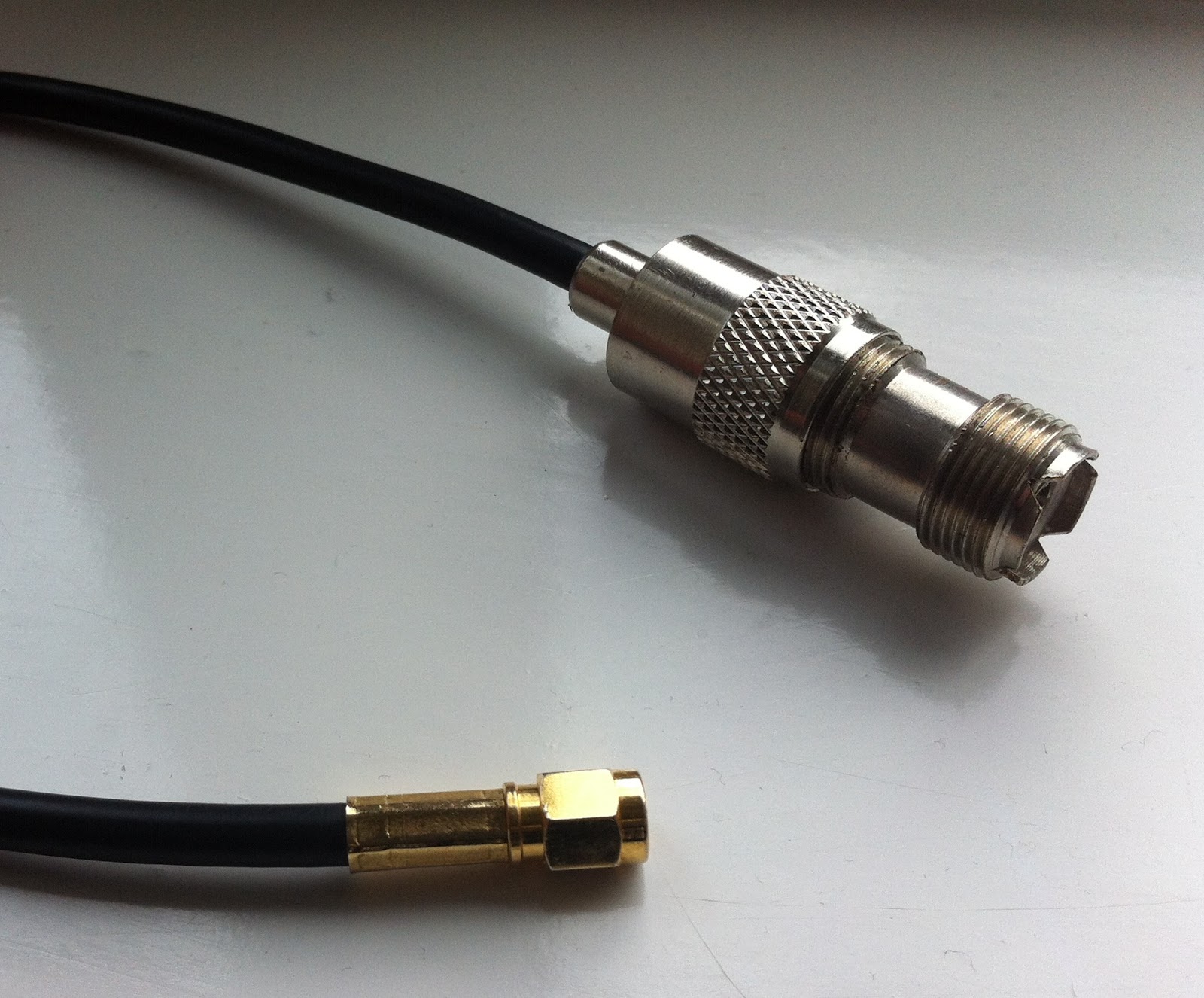 |
| SMA - SO239 adaptor |

Rob Law, MW0DNK, is a regular contributor to AmateurRadio.com and writes from Anglesey, Wales. Contact him at [email protected].
KX3 on its way?
I opened my mailbox this morning to discover the email that hundreds if not thousands of hams worldwide have been waiting for – a shipping notification from UPS to say that a 5lb package from Elecraft is on its way!

A 5lb package from Elecraft? What could that be? Ah. it must be the KX3 I didn’t order.
That’s right. Didn’t order. I haven’t ordered a KX3! I’m not saying I’m never going to, but I am not even going to think about it until such time as orders are fulfilled off the shelf. At the moment I believe that the lead time for an Elecraft KX3 ordered today is about 4 months. These days I just don’t plan that far ahead.
I forwarded the email to Elecraft Sales in the hope that they can figure out who this notification should really have gone to and why it came to me. But for a brief moment this morning I thought this was going to be my lucky day!

Julian Moss, G4ILO, is a regular contributor to AmateurRadio.com and writes from Cumbria, England. Contact him at [email protected].
Quick Announcement
The official Web presence for the NJQRP Skeeter Hunt will be:
Pardon how it looks for now. I’ll be working on it soon; but right now, helping my two harmonics with their science fair presentations is taking precedence.
It looks pretty crude as of right now; but hopefully I’ll be able to figure out how to make it more elegant looking by the end of the week.
72 de Larry W2LJ
QRP – When you care to send the very least!

Larry Makoski, W2LJ, is a regular contributor to AmateurRadio.com and writes from New Jersey, USA. Contact him at [email protected].
The Bank Holiday weekend at G4VXE
It’s been a busy but good long weekend here. On Saturday, we had a visit from John, G3WGV. It was great to catch up with him. John flew to Abingdon airfield in the SportCruiser aircraft he had built himself.
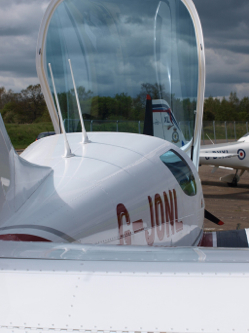
John was kind enough to take me up for a flight in G-JONL. What a splendid craft it is! We flew west from Abingdon, just to the south of Longworth and then south across the Ridgeway, across the M4 to just south of Newbury where we turned around and headed back to Abingdon.
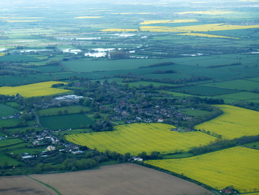
The picture below shows our village from the air.
On Sunday, John, Julie and I went to the Abingdon Air Show which we all enjoyed.
Today has been a busy day. I wrote the VHF column for Practical Wireless as well as a review of three handhelds which should be published in the magazine soon. That did require a little bit of portable operating with the handhelds from Windmill Hill, just south of Hinton Waldrist, our neighbouring village.
Just as I was pressing send on the VHF column, I caught a quick 50MHz Es opening to the south to Spain and Portugal. I was particularly pleased to work Mark CT1FJC who is a regular correspondent for the VHF column.
This evening I have been doing a little reading and particularly enjoyed Ross G6GVI’s 1296MHz pages

Tim Kirby, G4VXE, is a regular contributor to AmateurRadio.com and writes from Oxfordshire, England. Contact him at [email protected].
Skeeter Questions
Questions about the NJQRP Skeeter Hunt have been filtering in. Here’s some answers:
Question – “I have a question that you or someone else may have the answer to. At one time, several years ago wasn’t there a transmitter project that was called a ‘MOSquito’? It possibly was a transceiver. If I recall it was in one of the magazines, CQ, 73, or Ham Radio.”
Answer – I think you’re thinking of the Miss Mosquita – The DL QRP Project still has that kit available:
http://www.qrpproject.de/UK/missmosquita.htm
Question – “Do I have to be a resident of NJ to get a NJQRP number?”
Answer – I’m assuming you mean a Skeeter number. Certainly not! Anyone worldwide, who desires a Skeeter number can have one. And as far as I know, NJQRP numbers are still given out when you join NJQRP – anyone can join that fine organization, also. For the record, W2LJ’s NJQRP number is 47.
Question – “Any thought about multiop or multi multi stations? A couple of us are thinking of a cookout and contest afternoon.”
Answer – No, I hadn’t, but it sounds like a cool idea to me! Want to get a group together and have a cookout and get some radio in? Sure! All I ask is when you submit your log, to list the operators who participated. Of course, this will be considered a separate operating class – but no problem with that. I will make note of it when I update the rules.
Question – “You’ll probably need to add some clarification on the “Kit” points. Some of the other “homebrew” contests are not counting modular kits like the K3 and KX3 as homebrew anymore, does this contest?”
Answer – This might rankle a few purists. But as far as I am concerned, for the Skeeter Hunt, here’s the definition of “kit built”. The operator’s hands were involved in more than 50% of the building of the kit. Solder need not necessarily be involved. If you built a K3 or KX3 with your own hands, it counts. If you finished a kit (half of it or more, I will let the entrant judge that for himself) that someone else started, it counts. If you’re using a PFR3A or a KX1 or whatever and you didn’t build it yourself? Consider it commercial equipment. The idea here is to have fun and not get too trapped in the details. The honor system will rule – there will be no checking. If anyone homebrews a key or paddle for the Skeeter hunt, please send a photo with your entry!
Question – “I am assuming it is ok for skeeters to operate in the field for the event?”
Answer – That’s the whole idea! Get out with your gear, get on the air and then share your tale of adventure with the rest of us!
72 de Larry W2LJ
QRP – When you care to send the very least!

Larry Makoski, W2LJ, is a regular contributor to AmateurRadio.com and writes from New Jersey, USA. Contact him at [email protected].
On The Road Again
When I left for Korea, I had to pull out the HF installation on my truck… as the truck was staying in Kansas and I was not. Pulling out the rig and tuner was easy. The Tarheel antenna was also fairly simple. A disconnect at the base and then I coiled up the feedline and the cable that powers the screwdriver so they would be mostly out of the elements.

I returned back to Kansas last June but did not reinstall my HF setup in the truck. My only real modification was swapping out my VHF/UHF antenna with a fold-over. The new house afords me the opportunity to park in the garage(!) but rather than unscrewing the antenna every time I enter the garage, now I just have to pull it down. Works great.
My assignment here in Kansas has me traveling quite a bit and this week I am headed up to Wisconsin. I have only driven through Wisconsin once so instead of flying, I am going to make the 9 hour drive. This had me thinking that if I am on the road for 9 hours, I need my HF rig. So today I put the radio back in and reattached the Tarheel antenna.
Everything was set – I fired up the rig and heard the Turbo Tunner beep that it was on and ready. I hit the 706′s tuner button but the screwdriver failed to turn. Troubleshooting time. I took the base of the antenna down to the bench. Then I dug out the original rocker switch that came with the Tarheel. I hooked it up to the bench power supply and then hit the switch. Nothing. After a bit of jiggeling and wiggeling, the screwdriver engaged. I guess the almost two year siesta had taken a bit of a toll.
After a test drive today, it appears as if the mobile HF rig is working FB!… one QSO with North Carolina and another with Massachusetts. So look for me (AD7MI-9) as I make my way to Fort McCoy, Wisconsin and maybe I will catch you on 20M.
Scott Hedberg, NØZB, is a regular contributor to AmateurRadio.com and writes from Kansas, USA. Contact him at [email protected].
Win 500 Free Full Color QSL Cards

AmateurRadio.com is offering a free prize drawing!
With the help of our generous sponsor, KB3IFH QSL Cards, we’re holding a drawing for 500 free full-color photo QSL cards.
This is a US$75 value and open to all licensed hams worldwide.
Matt Thomas, W1MST, is the managing editor of AmateurRadio.com. Contact him at [email protected].
 Ham Radio Deluxe |
 W5SWL Electronics |
 Ham Radio Prep |
 KB3IFH QSL Cards  Hip Ham Shirts  HamRadioAuctions HamRadioAuctions Reliance Antennas Reliance Antennas Enigma Shop Enigma Shop |  morseDX  Ni4L Antennas  R&L Electronics R&L Electronics antennas.us antennas.us QRV QRV |
- Matt W1MST, Managing Editor
