 |
 A Book of Ideas For New Hams
 4 June 2012 | by
  Noted amateur radio author and blogger Dan Romanchik, KB6NU, has released a new Kindle e-book titled 21 Things to Do After You Get Your Amateur Radio License.
Romanchik said that many people rush headlong into the hobby only to stall out. “The main reason that I wrote this book is that it was frustrating to me that so many people get their Tech licenses and then never do anything with them,” he said. “They never really get involved in the hobby for whatever reason. I am hoping that if they read this book — and actually try some of the things that I suggest — they will be inspired to really get into ham radio.”
If you have a Kindle or the Kindle app for iOS/Android, you can download his book for $2.99 from Amazon. There are also Nook and PDF versions available on his website. Don’t forget to check out his blog at http://www.kb6nu.com (and while you’re there, check out his No-Nonsense Study Guides!)
Matt Thomas, W1MST, is the managing editor of AmateurRadio.com. Contact him at [email protected].
The Johnson 275W Matchbox Antenna Tuner
I had purchased a Johnson Matchbox from an estate a while back & decided that while I was home with the flu I would open it up and check on its condition.
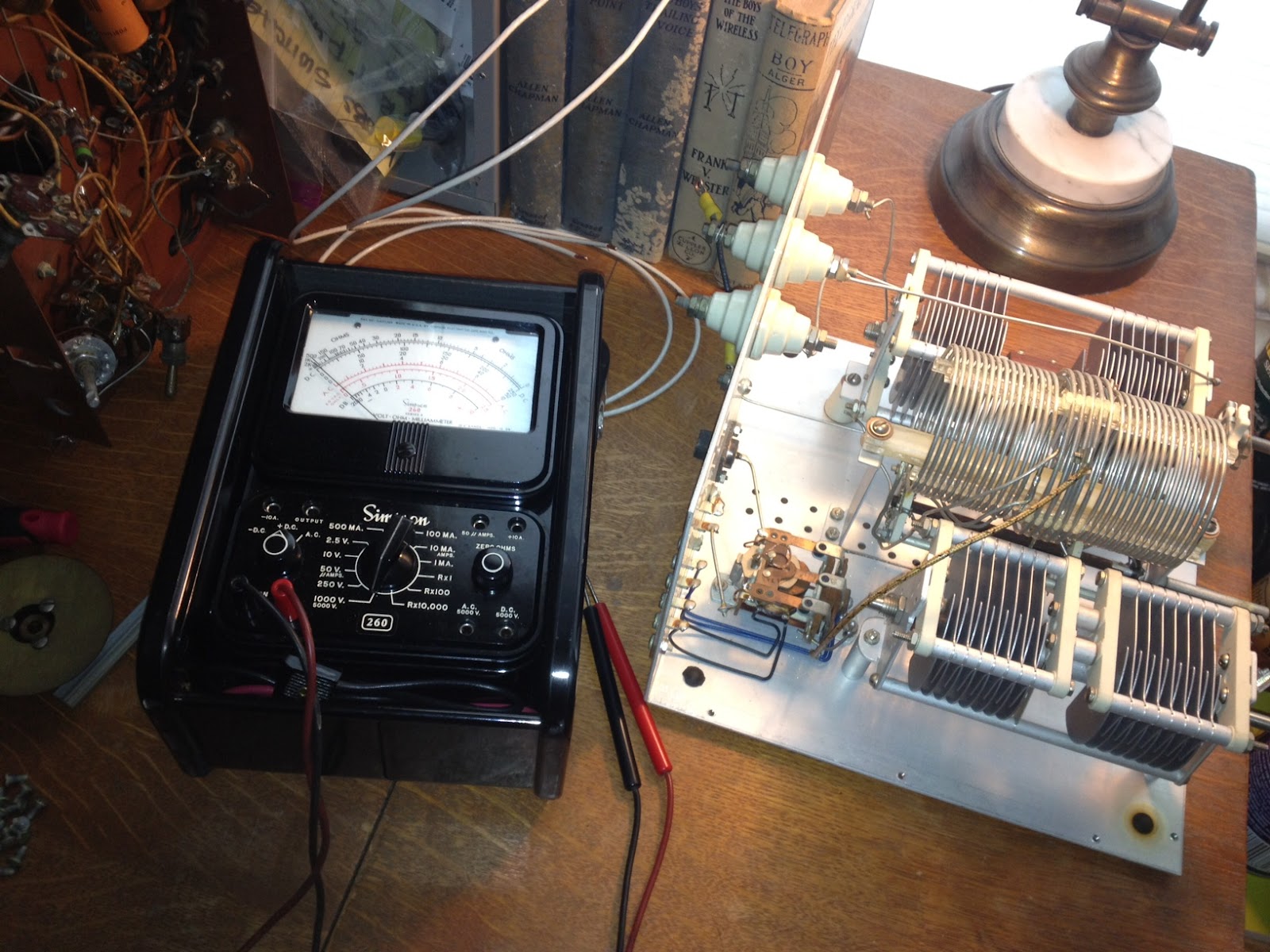 The Johnson Matchbox is found most commonly in two versions, the smaller “275W” unit and the larger Kilowatt Matchbox. Why did I use quotation marks around 275W? Well, these units were manufactured back in the good old days when men were men and transmitting voice meant using AM, not single side band. The conservative rating of 275W of AM translates into roughly 800W of peak SSB (Not really but close enough so you get the idea)
Unlike many who own a Matchbox I was hoping to keep it 100% original and that it would contain all its original components, including the antenna change-over relay and wiring for the high-impedance receiver antenna connections. I plan to use this Johnson Matchbox with a Heathkit AT-1 transmitter and Hallicrafters SX-25 receiver so the inclusion of an antenna change over relay and 300 Ohm receiver connections will make life MUCH easier. Something I didn’t realize until I had the unit apart (There are a LOT of screws holding this thing together) is that there is also a receiver control contact on the relay to break HT and mute the receiver during transmit which will work with my SX-25.
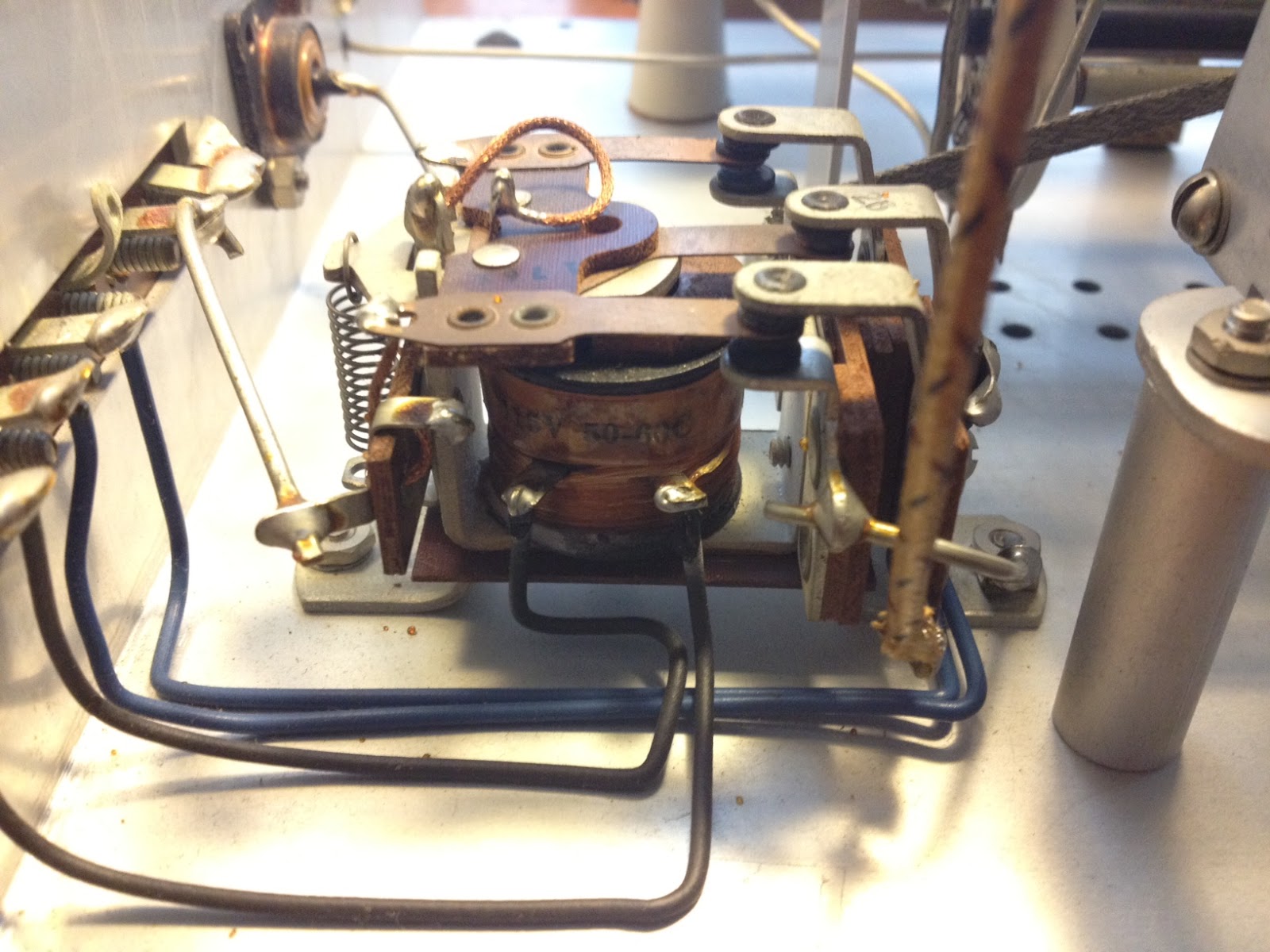 An initial inspection showed that the only modification was a small piece of plastic wedged into the relay contacts that held the relay in the transmit position. It was easily removed and the relay coil and contacts tested for continuity. The contacts seem a bit dirty which, from the little I have read online, seems to be a common problem.
Once the relay contacts and band-switch are cleaned I will button the unit back up and connect it to the loop antenna I have recently run around the eaves of the house. The loop has been a huge improvement to the long-wire and magnetic antennas I have run in the past, at least as far as reception goes … but that is a topic for another post.
Owen Morgan, KF5CZO, is a regular contributor to AmateurRadio.com and writes from Texas, USA. Contact him at [email protected].
Soft66LC4 SDR – initial impressions
I received a Soft66LC4 SDR receiver for evaluation. The review of this radio will be in 3 parts, initial impressions, usage test, and full technical test. Here are my initial impressions.
The Soft66LC4 is the newest SDR receiver from Kazunori Miura JA7TDO. There have been several revisions of this inexpensive

Soft66LC4
SDR over the last couple of years. The evaluation unit came in about a week from Japan in a plain envelope with no documentation or software. You are expected to refer back to JA7DTO’s website for help. Although the setup is a bit complicated, it wasn’t too bad for me since I deal with a lot of control software that uses USB-to-serial connectivity. I was pleasantly surprised to find out that my Dell laptop’s internal sound card can process at 192khz, giving me a full 192khz of visible bandwidth.
The Soft66 is a bit larger than an Altoids tin. JA7TDO’s eBay store states that you have to finish the case yourself and drill holes, but it seems that he is doing this for you now. There is an SMA antenna connector, a mini USB port, and an indicator light on one end. On the other end is a 3.5mm audio jack, and a hole for access to an adjustment pot for RF gain. I found that my sample needed a slightly longer mini USB plug as the first one I tried did not stay in well.
Driver installation can be quite complicated but I intend to help him with this by writing up some easy-to-follow instructions. One issue that exists with this SDR for now, but will probably be resolved soon, is that there isn’t a way to control the SDR with WinRAD yet. You have to use the separate control application which makes the process a bit clunky. I believe that once more of these newer LC4 models are out there there will be support for WinRAD and other SDR Applications, as there were for the previous Soft66 radios.
Initial usage tests at my location were favorable, considering my lack of a decent antenna (about 10M of wire in a tree outside my window), and excessive RFI at my location. I hope to get out to a more remote site to perform the detailed usage review in a more interference-free environment. Coverage is from 500 khz to 70 Mhz. For now, the control app does not warn you if you enter a frequency outside that range, but simply crashes. Luckily, this does not lockup the controller, and you simply need to relaunch the application. I was able to receive MW AM stations, CW, SSB, data, and AM on the amateur bands, and plenty of SW BC. I did not try WinRAD’s DRM feature yet.
I’ll try to get this set up for remote access if possible, but for now, with no way to control it other than with the supplied application, I will hold off. Special thanks to Kazunori Miura for supplying the test sample so quickly, and to my friend WA2CDL, who offered to perform the technical testing.
On JA7TDO’s eBay store these radios sell for $108 plus shipping, and are fully assembled. Well worth the money as long as the proper DLL files are made available for using it with WinRAD. A more extensive test will follow.
eBay store link: http://stores.ebay.com/HAMShopJapan?_rdc=1
Soft66 page: http://zao.jp/radio/soft66lc/
–Neil W2NDG
Neil Goldstein, W2NDG, is a regular contributor to AmateurRadio.com and writes from New York, USA. Contact him at [email protected].
On yer bike….to the hilltop – bicycle portable on 28/50/144 and 432MHz
It seemed ages since I’d taken the FT-817 and a whip antenna out on the bike. After a very wet Jubilee day yesterday, although there were some dark clouds about I decided to get out this morning before any rain could fall.
My simple 28/50/144/432MHz setup carried on the bike is the FT-817 and an ATX Walkabout antenna which I use on 28 and 50MHz. This morning, I took the Baofeng UV-5R for 144/432MHz FM.
A favourite spot to cycle to is Windmill Hill which is a couple of miles from our house. It’s not that high, but it’s open, quiet (both electrically and not too many passers by) and it’s also a pleasant place to sit for an hour or so.
There’s usually something to listen to. This morning 28MHz was pretty quiet. I heard beacons from Finland and Norway quite weakly and IK8JWY was heard CQing weakly on CW – not strong enough to work. 50MHz was quiet too, but interesting to hear the GB3MCB beacon on 50.042 from IO70. I don’t hear it from home, so just goes to show what difference a quiet band can make.
Just as I thought I was going to have to pack up without making a contact, Matthew 2E0RNM popped up on the GB3WH repeater so it was good to chat with him.
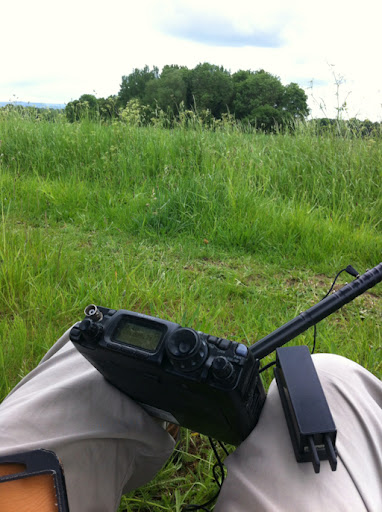
Picture shows the relaxed operating position – and the Palm Paddle used for CW.

Tim Kirby, G4VXE, is a regular contributor to AmateurRadio.com and writes from Oxfordshire, England. Contact him at [email protected].
Bugger!
Or….how I almost ruined my own birthday present.
I had it planned so well: on Friday night I put in all the resistors and capacitors on the Opentracker+ PCB. On Saturday I soldered them on, then put in the other components and soldered them on too. Did a pretty good job, with neat soldering joints. Then last were the two DB-9 connectors. Piece of cake, until I decided to hook the cables up: Bugger! I had switched the male and female DB-9 connectors, so I couldn’t hook up anything!
An hour, a meter of soldering wick and some strong words spoken to myself later they were off. Have I ever mentioned that I don’t like double sided PCBs? No? Well, here it is: I DON’T LIKE DOUBLE SIDED PCBs!!! From a designers point of view I can understand that double sided or multi-layered PCBs are easier to work with and much more efficient. But from a tinker’s point of view they are horrible if you want to (ex)change some components. I noticed that too with the Hi-Per Mite PCB which I made last time.
And yes, I did damage the PCB a bit when removing the connectors and moreover, Murphy paid a visit because it was the most important connection on the data side of the board. After I had figured that one out I carefully soldered a by-pass and I had communication going on between the tracker and my PC. (The Opentracker software is running under Wine on Linux and had no problems with my KeySpan USB-to-serial adapter). The new Baofeng UV-5R was connected to the laptop running Xastir and my other HT, a Kenwood TH-F7E was connected to the tracker. And guess what? It worked! The GPS module found a satellite signal and tracker happily broadcast it to the world, telling it where BX2ABT was located at Sunday afternoon. It was a small world, because I was only running 50 milli-Watts, so the only one who heard it was myself.
But that doesn’t matter. The first steps of BX2ABT on the APRS path are a success and soon Taiwan will have another APRS beacon to track.
Hans "Fong" van den Boogert, BX2ABT, is a regular contributor to AmateurRadio.com and writes from Taiwan. Contact him at [email protected].
On the air
It rained and thunder stormed here today, on and off, in fits and starts. That prevented me from doing the yard work that I was planning to accomplish – boo hoo! 🙂
So I spent some time on the air, getting used to the new radio. Fate would have it that band conditions would be on the less than optimal (read that as: crappy) side today. But I did manage some QSOs both foreign and domestic. Hungary, Italy, and England were successfully worked. The domestic QSOs were brief QSO Party contacts for the most part. They let me know that I was getting out and being heard; but not very satisfying.
I did have another short QSO with Terry W9UX last night on 30 Meters. I was calling CQ and he answered me and asked, “Larry, is that your new KX3?”. Obviously, Terry is a regular reader of this blog. I answered him that yes, it was and he was my first “real” QSO – something other than “UR 599 TNX QRZ?”
I’ll have to send him my QSL card – the funny thing is that my QSL cards have the image of my K1 on them. I still have a bunch, so I am not going to discard these just because of that. It’s still QRP, which is what the idea behind the card is supposed to be about.
The KX3 is really cool and I’m getting used to it rather quickly. It has really great features like the APF or Audio Peaking Filter that will really help to dig a weak CW signal buried in the noise. I like being able to decode RTTY and watch it scroll at the bottom of the LCD display. I also like the CW Tuning Aid, where you tap a button and the KX3 automatically zero beats the person you’re trying to work.
As the radio is configured now, as a strictly QRP radio, I cannot hook up two antennas like I can on the K2, and I use that feature a lot to switch back and forth between the Butternut and the wire. I suppose I could always go back to using a mechanical manual coax switch; but by going that route, I would be incurring some signal loss, and I would rather not do that.
There is a button on the KX3 that will allow you to switch between two antennas, but that is enabled only when the 100 Watt autotuner is used. As of right now, I have no plans to make this a QRO radio, so the main shack radio will be the K2, unless a K3 should come waltzing into my life for some unforeseen reason.
The other thing that I am looking forward to in the near future is making some contacts on 6 Meters, which I have never done in the 34 years that I have been a Ham. This is the first radio that I have ever owned that is 6 Meter capable. The other thing I want to do is hook this netbook up the the KX3, just to see how Ham Radio Deluxe interfaces with it. I never installed the RS232 option in the K2, so I was never able to have rig control until now, either.
Lots to look forward to!
72 de Larry W2LJ
QRP – When you care to send the very least!

Larry Makoski, W2LJ, is a regular contributor to AmateurRadio.com and writes from New Jersey, USA. Contact him at [email protected].
ICQ Podcast S05 E12- Buying 1st Amateur Radio Rig (3 June 2012)
Series Five Episode Twelve of the ICQ Podcast has been released. News Stories include :-
- Operators needed for Canal Festival
- Volunteers wanted for RSGB Centenary Working Group
- Yaesu FT1D Digital Handheld
- Italian radio amateurs help out after quake
- New transatlantic 144MHz beacon GB3WGI
- Radio transmitter causes bomb scare
- Cuba's Radio Hams get new Digimodes
- Balloon Crossband Repeater Payload over USA
- ACO exam pass = Amateur Radio Foundation pass
- Change in IRTS 40 Metre News Frequency
- 2012 Torch route tracked on APRS
- Worked All Britain Olympic flame award
Chris Howard (2E0CTH and N4CTH) discusses Buying your first amateur radio rig.
Colin Butler, M6BOY, is the host of the ICQ Podcast, a weekly radio show about Amateur Radio. Contact him at [email protected].
 Ham Radio Deluxe |
 W5SWL Electronics |
 Ham Radio Prep |
 KB3IFH QSL Cards  Hip Ham Shirts  HamRadioAuctions HamRadioAuctions Reliance Antennas Reliance Antennas Enigma Shop Enigma Shop |  morseDX  Ni4L Antennas  R&L Electronics R&L Electronics antennas.us antennas.us QRV QRV |
- Matt W1MST, Managing Editor
