 |
 Holy Hannah!
 19 June 2012 | by
 I looked at the weather forecast for the next two days – 96F tomorrow (35C) and 102F on Thursday (39C). Wow! I guess it is no coincidence that tomorrow is the first day of summer.
And wouldn’t you know it ?!? Band conditions seem to be headed right into the toilet as Field Day weekend approaches. The Sunspot number is 66 and declining. We’ll get to see of Amateurs create their “own” propagation this weekend. Maybe with that much RF heating up the ionosphere, we won’t need so many Sunspots.
The past few nights have been very good on the bands. Tonight, the noise floor seemed to be higher and it sounded like there was less activity. FG5FR was booming into NJ from Guadeloupe; but I worked Frantz about a week ago, so it’s time to let other stations have at him.
Looks like some reading tonight and then sack time.
72 de Larry W2LJ
QRP – When you care to send the very least!

Larry Makoski, W2LJ, is a regular contributor to AmateurRadio.com and writes from New Jersey, USA. Contact him at [email protected].
Great day at the Air show
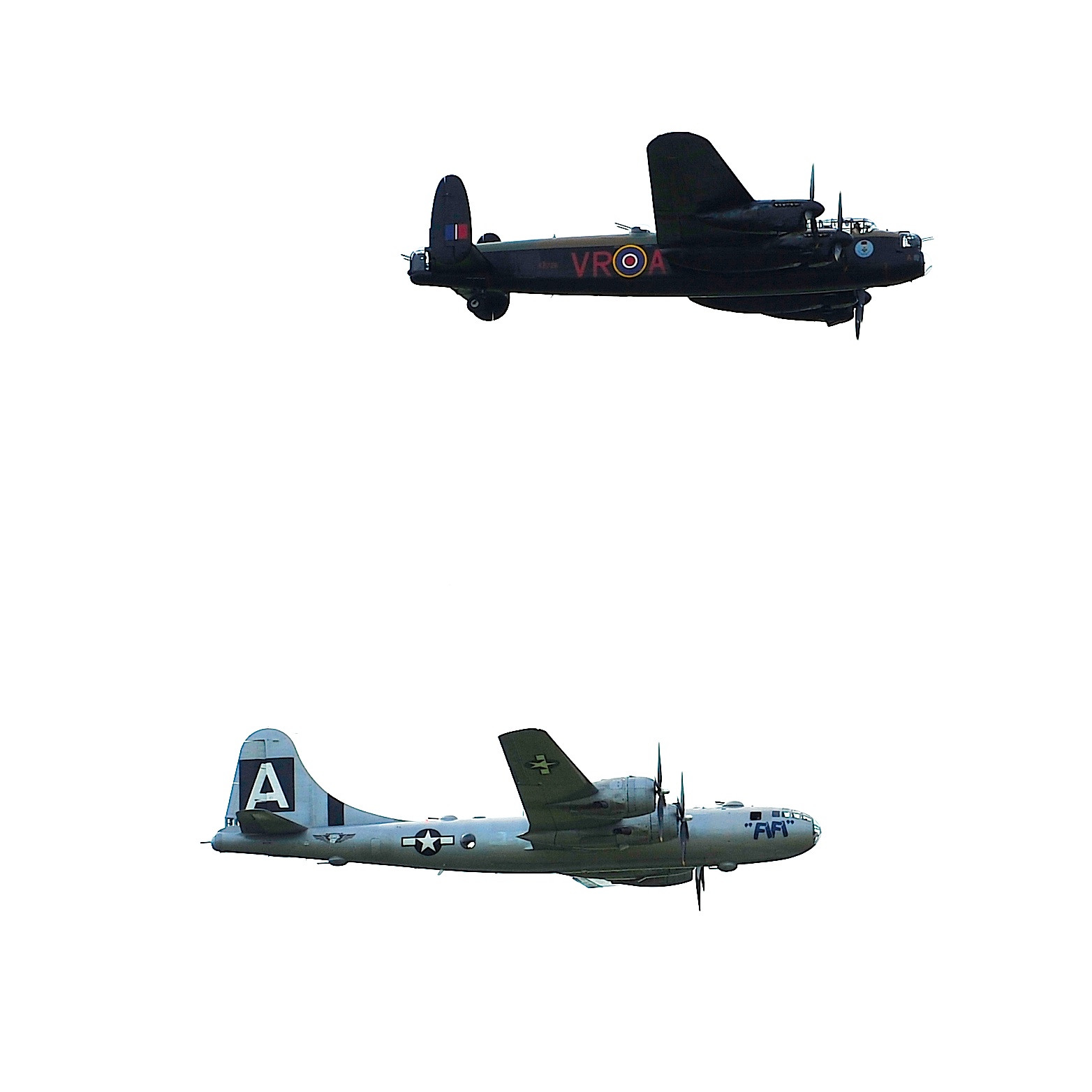 |
| The Lancaster and Super-fortress together (click on all images to enlarge) |
Julie's relatives are over from England for a few weeks and to start off the holidays on June 16th it was off to Hamilton Air show loaded with vintage aircraft. It was a nice sunny day with a temperature around 27C.
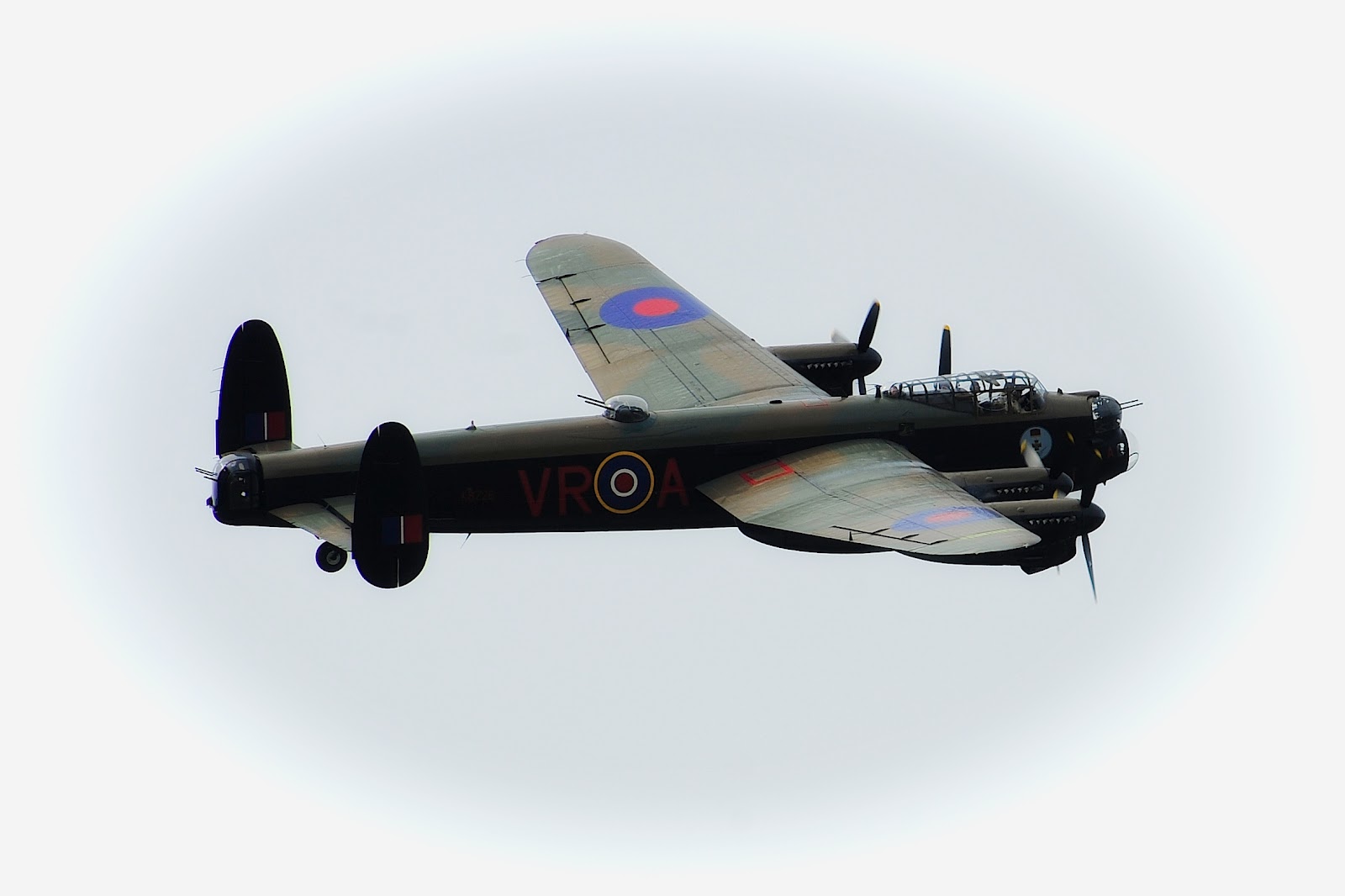
The air show lasted 6 hours which included a nice lunch also table and chairs down by the runway....so we were close to the action. The air show hosted the Avro Lancaster this plane is only one of two that are still flying today the other one is in England. Also the B-29 Super-fortress and this one at the air show being the
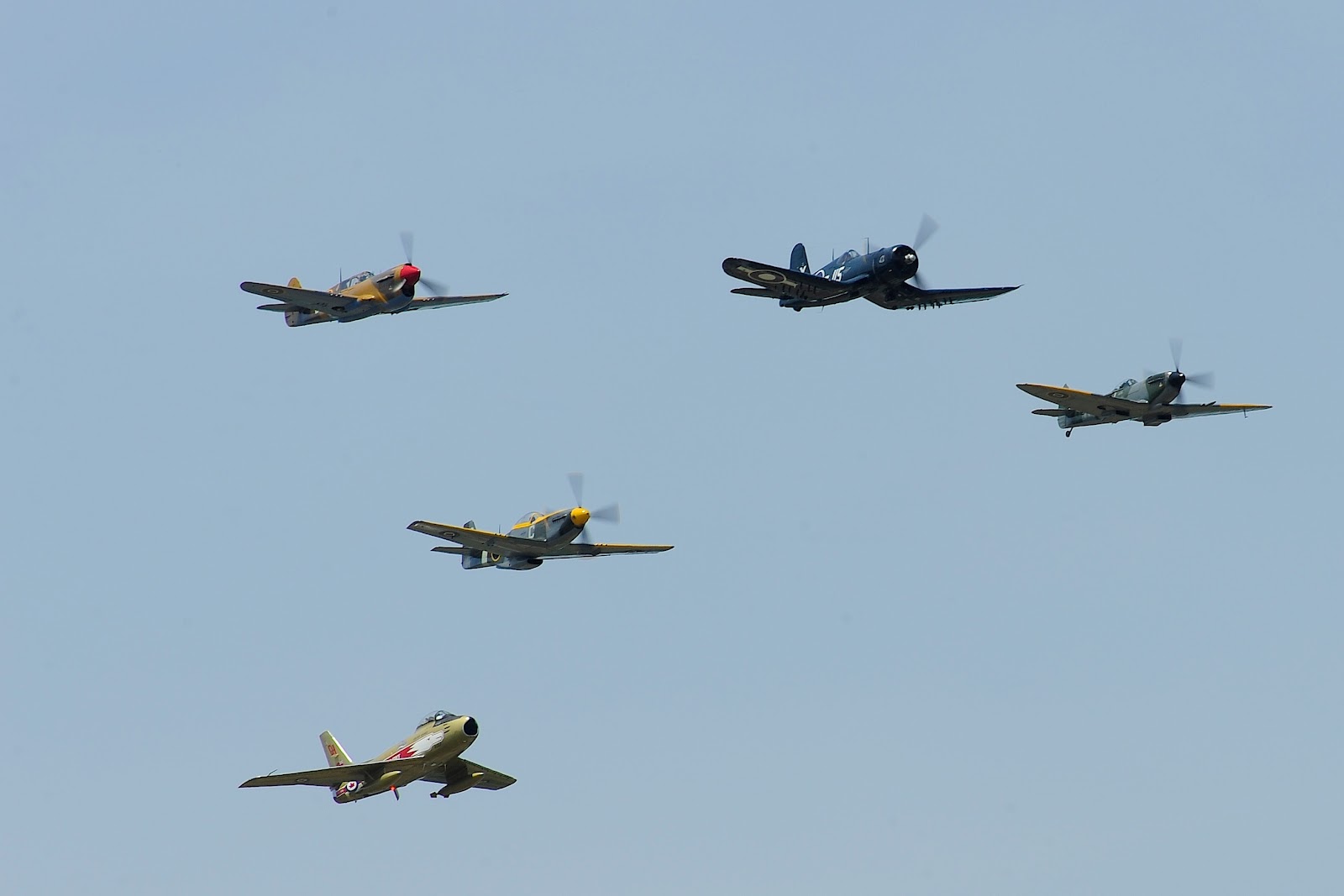 |
| Corsair, P40, Spitfire, Mustang, Sabre |
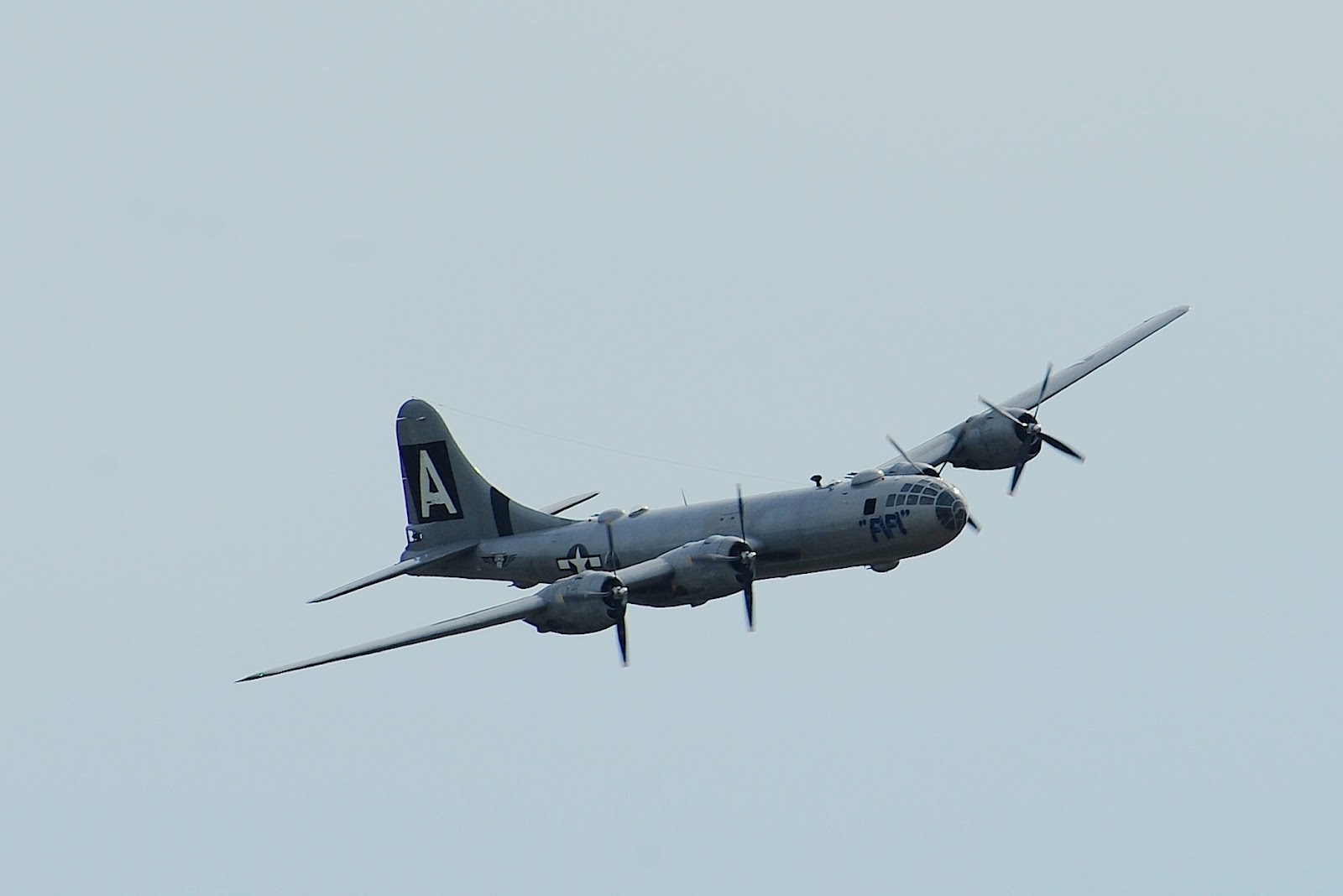 |
| B-29 |
wireless operator. The transmitter/receiver used was the R1155 and T1154. As for the B-29 they had a multi radio setup check this link out for info and great pictures of the B-29's radio op's rigs. Now an air show would not be an air show wit the the JETS!!! Becuase this was a vintage aircraft show 99% of the aircraft were WWI and WWII. BUT there is always an exception to the rule and the exception this year was the CF-18 fast, loud and proud!! All photo's were taken by my wife Julie the shutter bug!!
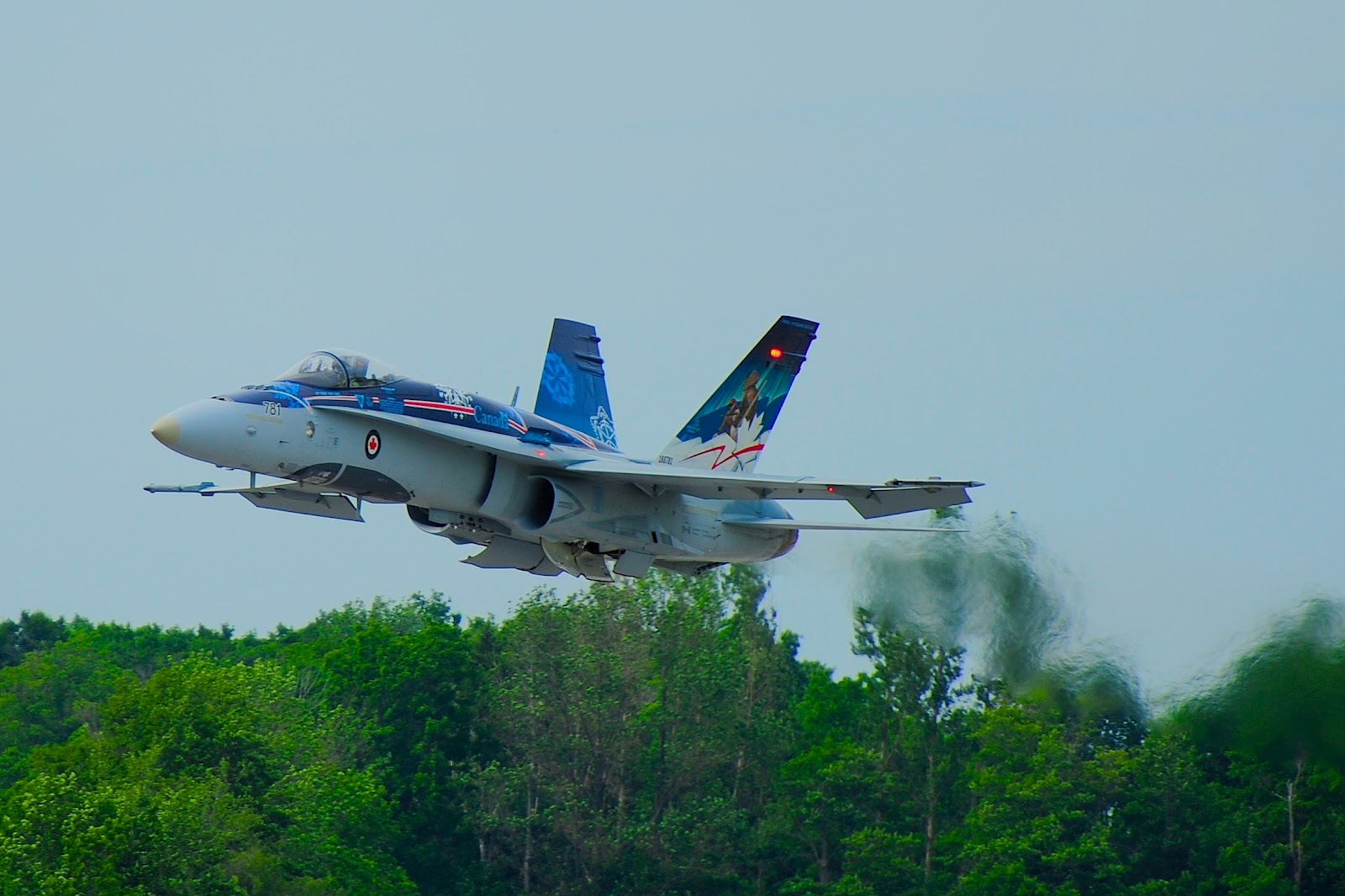 | |||||
Low level 1,000 km per-hr pass. Below flying dirty ( gear down) almost stopped then afterburners!!!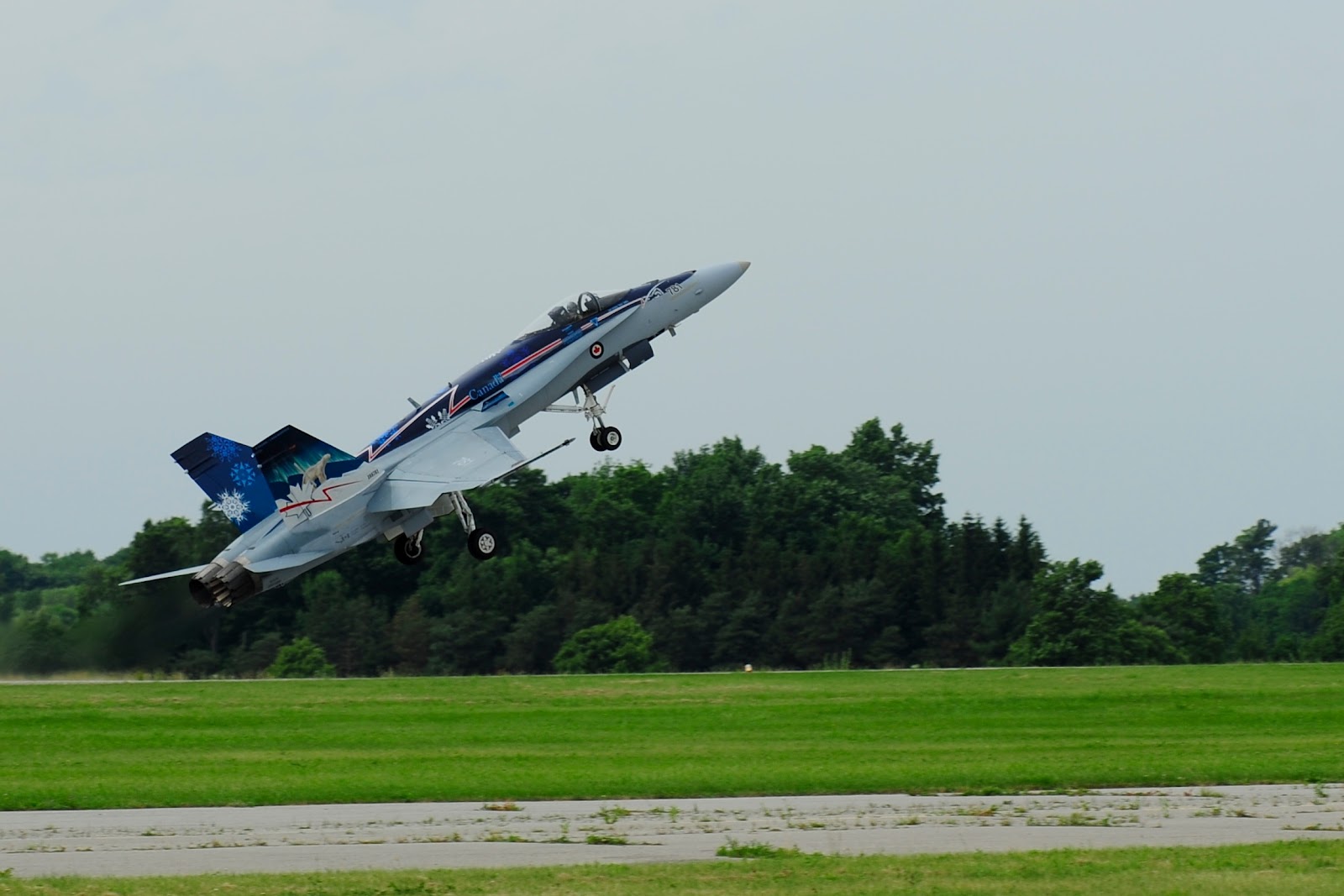 |

Mike Weir, VE9KK, is a regular contributor to AmateurRadio.com and writes from New Brunswick, Canada. Contact him at [email protected].
Colorado Fires
If you’ve listened to the news or picked up a newspaper in the past week, you’ve probably heard about the forest fires in Colorado. There are several popping up across the state as our temperatures continue to soar and very little to no moisture is falling. The immediate weather forecast doesn’t look promising.
The High Park Fire is the big one which is grabbing the most media attention. At the present time the High Park Fire has burned more than 59,500 acres, destroyed 189 homes and there has been one fatality. The over 1800 personnel have done an outstanding job to get this fire 50% contained. Below is a current map of the burn area. This fire has earned the title of most destructive fire in the history of Colorado.

Many Colorado Hams are assisting to fill in communication gaps and this was recently recognized by the Denver Post. It’s great to read about amateur radio participating in such activities.
I’m proud to call Colorado my home. I’ve lived here for almost 14 years and the beautiful Rocky Mountains have become my playground for all sorts of activities, even including many related to amateur radio. We all know Mother Nature has a way of healing and in time the forest will return. However, this destructive fire has taken a toll on those living in the area.
The various media outlets in the Greater Denver area are advertising the following link to iGivefirst. Through the iGivefirst website, you can donate to either the Larimer County Humane Society (currently housing over 200 animals displaced by the fire) or the Salvation Army and American Red Cross. This link will take you to the iGivefirst website.
On behalf of all the residents of Colorful Colorado, Jerry Taylor – KD0BIK thanks you for your prayers and any help you can provide.
Until next time…
73 de KD0BIK
Jerry Taylor, KD0BIK, is a regular contributor to AmateurRadio.com and writes from Colorado, USA. He is the host of the Practical Amateur Radio Podcast. Contact him at [email protected].
Hate to do this.
I hate “stealing” material from my fellow bloggers. I saw this referenced on John N8ZYA’s extremely good blog and I thought that it could withstand repeating:
This is such a good video for promoting Amateur Radio!
It not only shows some of the “cooler” things you can do with the hobby; but it also stresses that Amateur Radio still serves as an important communications back up role.
A very big tip o’ the hat to John N8ZYA – cool beans, John!
72 de Larry W2LJ
QRP – When you care to send the very least!

Larry Makoski, W2LJ, is a regular contributor to AmateurRadio.com and writes from New Jersey, USA. Contact him at [email protected].
Is There An App for That?
We’re hearing talk these days of the “Post-PC Era” when devices like the iPad, tablet PCs, and smartphones along with cloud-based applications will ultimately replace the PC. I don’t totally buy into this as these devices don’t have the form factor or horsepower to replace the PC, at least in business environments. I do think that the venerable tower PC, outside of gamer circles, will die. It used to be standard to select a tower PC based on the number of expansion slots and bays, and it was once common to upgrade processors for more horsepower. Those days are gone and more people are using one-size-fits-all laptops or appliance-like desktop machines, and when they’re three or four years old they’re tossed out for the latest model that can run Microsoft’s latest OS and office suite.
For over the last 15 years, when you bought a PC you by default got Microsoft’s OS, Windows and usually Microsoft Office or Works. This symbiotic relationship has been dubbed “Wintel”, symbolizing the combination of Windows and Intel-based hardware. Of course Linux has made inroads over the years but despite what Linux advocates say, it’s never passed the philosophical litmus test, being able to be run by your grandmother. It continues to be the darling of techies’ desktops and runs the Internet behind the scenes.
With applications heading to the cloud and developers needing to support multiple devices running different operating systems, applications are more and more running in virtual machines such as Java rather than on the bare OS. HTML 5 is supposedly going to revolutionize web applications, bringing functionality that was previously limited to Flash applications into HTML, an open language that is universally supported.
Amateur radio in my opinion has always had an odd relationship with software, that somewhat has its roots in the mindset of 1980′s DOS PC computing. It wasn’t until the early 2000s that some of our most widely used logging and contest programs offered Windows replacements of their DOS ancestors. Our free software authors never quite embraced open source, opting more for free-as-in-beer / freeware. Nearly all notable amateur software is Windows/PC based. There is some software for Mac and Linux, but it’s more a novelty. I’ve found Linux ham radio software, especially logging programs, to often be someone’s experiment with making a database frontend rather than a concerted effort to build a major software application, like Ham Radio Deluxe or DXLab. I know this will raise the angst of Linux users, but if you want to run amateur radio applications with full functionality, it’s tough to not use a PC running Windows. I’ve tried about five times to switch to Linux in the shack and gave up. I would love to buy a Mac, but I would still need a PC to run my amateur apps.
There is a paradigm shift in software coming. The PC/Windows world is coming unseated. It’s not going away, but it’s not going to be the default “no-brainer” choice that it used to be. While we have many fine commercial and free software offerings, we’ve failed miserably in making cross-platform applications. Even our networks like Winlink, D-STAR, IRLP, and APRS are vertical “silo” applications, some tied to specific OSs or hardware, or just outright ignore open standards.
Enter the Raspberry Pi, a very inexpensive single-board computer that is for supporting economical computing in third world countries. It’s quickly turning into the latest geek fad. Never has such a small board had such computing power at such a low price, and despite being a full-fledged computer it may very well displace the popular Arduino on many experimenter’s benches. It should be a very hot commodity in amateur radio as it’s cheap and open, and ideal for hardware hackers like us. Here’s the kicker. It has an ARM processor and it can’t run Windows. The best programs we have can’t run on this device.
I don’t see the PC world ending very soon, but I have to question at what point we’re going to start sacrificing some opportunities due to our lack of cross-platform software and systems. In the past when considering software compatibility, one used to ask whether you ran a PC or Mac. Today you hear questions like, “Can I get that in my app store?”, or “Does it run on Android?”

The Six Metre vertical is full of surprises!
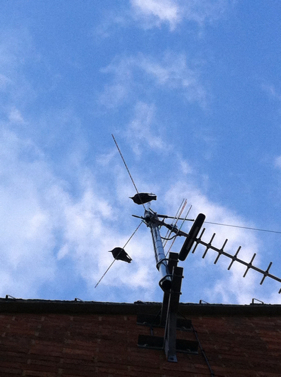
With the IARU Region 1 50MHz contest over the weekend, I heard a few grumbles that conditions weren’t that good. Certainly it wasn’t end-to-end Es but I thought it was interesting.
For me, I worked a few 9A, YU, E7 and S5 stations at the outset and then it went quiet. Actually, that was interesting as I could concentrate on working some of the more distant UK stations on ‘tropo’. GJ6YB/P was a nice one – I waited for signals to fade up and worked them on CW on a peak of QSB. Typically, their signals were much louder on Sunday! Whilst I was listening to them GM2T called and worked them. What propagation was that? Not Es or MS, but very solid. Tropo scatter? Impressive copy on the vertical.
GW2OP/P in IO71 was another nice one over a decent distance, as was the Five Bells Group, G5B.
On Sunday morning IF9/I2ADN came up and caused a stir (and some not great operating from people who clearly spend their time in HF pileups. Nuff said).
By the time we got back from family visiting, the contest was over, but there was a little Es with 4O3A, 4O4A and IW4AOT worked amongst others and a weak IK4 heard on 70MHz.
And the birds find the vertical useful too.

Tim Kirby, G4VXE, is a regular contributor to AmateurRadio.com and writes from Oxfordshire, England. Contact him at [email protected].
I Love It When a Plan Comes Together

Three of Mr. Fagen’s beautifully-restored, award-winning aircraft. Photo copied from fagenfighters.com.
Weeks ago I called Fagan Fighters & Warhawks, Inc. inquiring if they could use help with communications at the Ray Fagen Memorial Airshow on Saturday, June 16. The answer was yes! They had a gap in their communications between the airport and their remote parking lots. I put out a request for volunteers and started doing some tests. The challenges I faced were:
- Terrain and distance: The first overflow lot was at a casino located quite close to the airport but down in a valley. The other overflow lots were located in the City of Granite Falls itself, down in a valley and far enough away to make it impossible for handhelds to communicate with the airport.
- Intermod: The AWOS (Automated Weather Observing System) station on the airport blows away my handheld on some 2 meter frequencies.
- Manpower: Out here in the sticks finding ham-volunteers is not easy.
Repeater coverage is patchy out here and not an option for handhelds at the airport. It quickly became apparent that to conquer terrain and distance we would need to set up a station on high ground running either as a net control station or as a cross-band repeater. Since I wanted to run a net anyway, I elected to simply run a simplex net. CTCSS would be necessary to combat intermod at the airport. I drove around until I found a likely spot at the top of a bluff roughly midway between the airport and the City of Granite Falls (where some overflow lots were located), and I secured permission from the property owner to set up a net control station for the airshow. After tests demonstrated significantly better performance on 70cm than 2m, I settled on 70cm, specifically MN ARES simplex channel HU-CHARLIE, 443.000 PL 203.5. I worked with a fellow at the airport and tested to make sure we would not interfere with their radios, then announced the plan by email to the group of volunteers who were forming up.
I was overwhelmed by the willingness of these volunteers (KCØPMF, ABØRE, KDØQEA, KCØQNA, KØNUT, KCØYBG and KCØYFY) to drive all the way out here, especially considering that they knew they’d be stuck in parking lots during the airshow. We needed their help since there aren’t very many active hams around here that I know of. Including myself we had eight hams lined up for Saturday morning.
After filling a cooler with water bottles, pop and ice I zipped over to the airport early on Saturday to find out who was in charge of parking. When I introduced myself to him I found out he had not heard anything about our involvement. I gulped, then explained that a ham would be assigned to shadow him and relay messages between him and remote lots. I encouraged him to ask anything he wanted of his shadow and we’d try to get it done for him.
 When I set up as net control high on the bluff around 10:30 A.M., I assigned tactical call signs to make things easier: the ham shadowing the parking-director was AIRPORT-1, his partner was AIRPORT-2, the hams at the hayfield lot were HAYFIELD-1 and HAYFIELD-2, the hams at the gate were GATE-1 and GATE-2, and the ham at the casino was CASINO-1. At first I wasn’t sure just how helpful we would really be, but pretty soon we were very busy! Without us the parking-director had no way of knowing how full the lots were getting (information he needed to redirect traffic to the next lot) nor where the greatest demand for buses was at any given moment. We helped him with these things as well as a couple of miscellaneous tasks, including a search for two missing children (who were soon found). We finally shut down at 4:00 P.M. after the flow of traffic died, and then we all met at the airport office for a debriefing.
The parking-director said that at first, when I introduced myself to him that morning, he was a little irritated because he had no idea we were coming. I don’t blame him! My fault for not tracking him down. But after having worked with us, he said, “I don’t ever want to do another airshow without you guys!” He was positively glowing as he continued to praise us. I credited the volunteers who did the real work that day, and I encouraged the parking-director to spread the news about what we can do. This was a great opportunity to demonstrate our capabilities and work out some kinks in communicating in this area, too.
So many things came together to make this happen. Not only did these volunteers drive in from up to 80 miles away, but several others helped me prepare. Alfio Levy, KJ6JGS, went the extra mile and priority-shipped the Kenwood TM-V71A rig I bought from him last week so that I could get it installed in my pickup in time for the airshow. Caleb Streblow, the fellow who is courting my daughter, machined a bracket for me last week so that I could get a dual-band antenna mounted on my pickup. And Andrew Rosenau, KCØYFY, lent me his crimper, supplied me with Anderson Powerpole connectors, zipcord and fusing, and helped me with testing our radios around the area prior to the event. My thanks to all!


Todd Mitchell, NØIP, is a regular contributor to AmateurRadio.com and writes from Minnesota, USA. He can be contacted at [email protected].
 Ham Radio Deluxe |
 W5SWL Electronics |
 Ham Radio Prep |
 KB3IFH QSL Cards  Hip Ham Shirts  HamRadioAuctions HamRadioAuctions Reliance Antennas Reliance Antennas Enigma Shop Enigma Shop |  morseDX  Ni4L Antennas  R&L Electronics R&L Electronics antennas.us antennas.us QRV QRV |
- Matt W1MST, Managing Editor
