 |
 Skeeter hunting fun
 12 August 2012 | by
 I had a real good time during the 1st Annual Skeeter Hunt today, although the outlook appeared bleak from the very beginning. Just as I was heading out the door to go to the park, our vacuum cleaner decided to give up the ghost. It made a real funny noise and a burning smell. I tried troubleshooting it quickly; but it turned out we needed a new one. Of course, my XYL didn’t want to wait; so it was off to Target to buy a new one.
That chore taken care of, I headed to the park (dressed in my WGØAT “Old Goats Rule – QRP Adventures” T-shirt!) – nearly an hour and a bit into the contest. Fortunately, everything after the vacuum cleaner incident went as smooth as butter!
The weather here in Central NJ was gorgeous! A high of about 84F with sunny, blue skies and lots of white, puffy clouds. The humidity was not bad, and the only Skeeters that I had to worry about were the ones on the airwaves.
The wrist rocket got a line up over a pretty high tree branch on my first attempt. The PAR antenna went up without any trouble at all and and didn’t even cause the KX3’s autotuner to even so much as burp – 1:1 SWR on both 20 Meters and 40 Meters. The little box to the right of the KX3 is the PAR matchbox. I used my Whiterook single lever paddle today. And of course, you can see Ol’ Blue, my battery, up there in the upper left hand corner of the camping table.
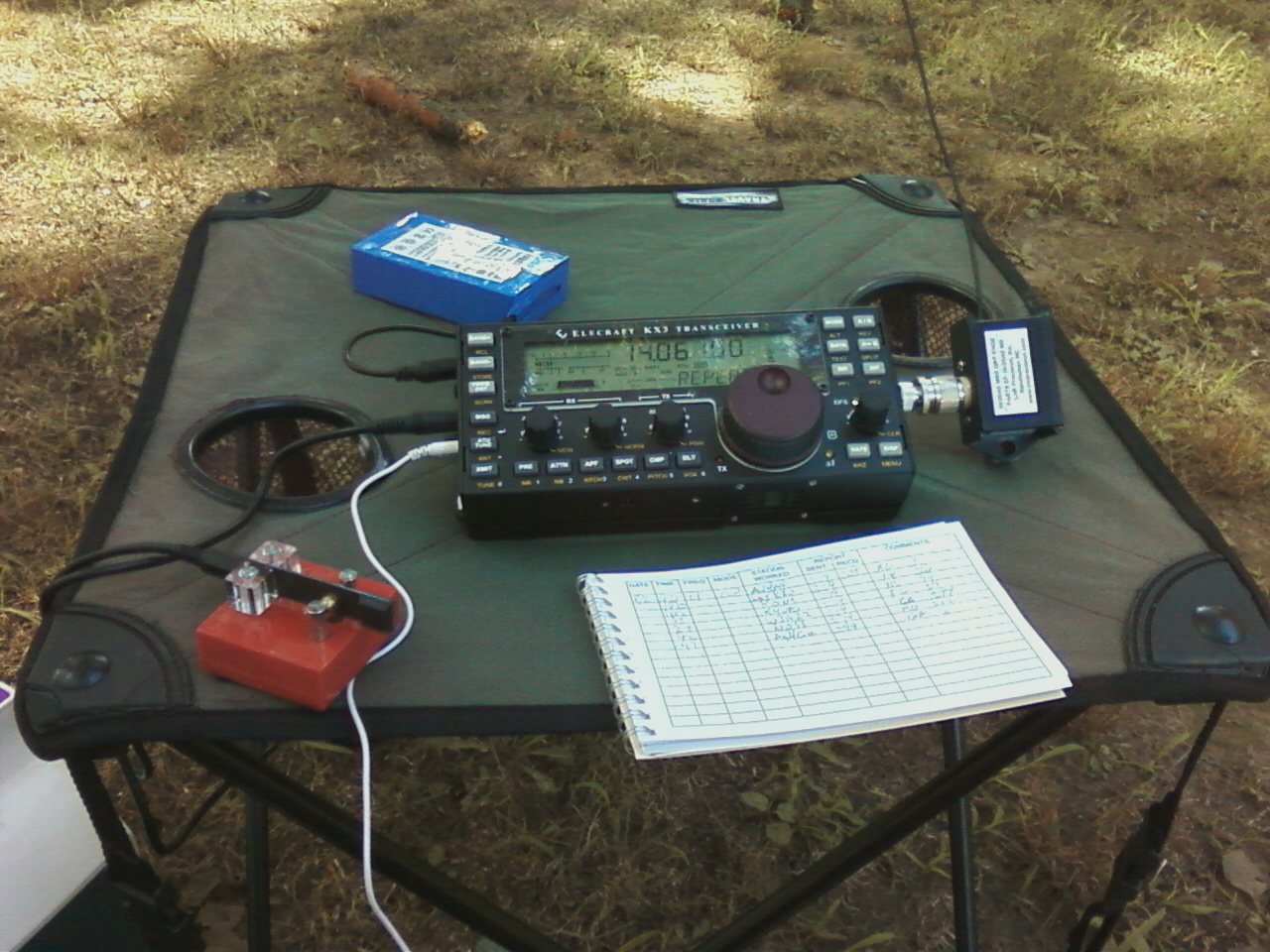
And the good SWR on 20 and 40 was a very good thing, because unlike the Flight of the Bumblebees, I was to find a lot of activity on 40 Meters. In fact, a little after 20:00 UTC, 20 Meters became dominated by European stations and I was barely able to hear any Skeeters on that band after that point.
In all, I managed 28 QSOs – 13 were on 20 Meters and 15 were on 40 Meters. Best DX was working Mike DJ5AV from Germany on 20 Meters at 18:55 UTC. I only got a 529 from him; but there were a lot of strong signals on both bands and I received quite a few 579s to 599s in addition to the “normal” 559s.
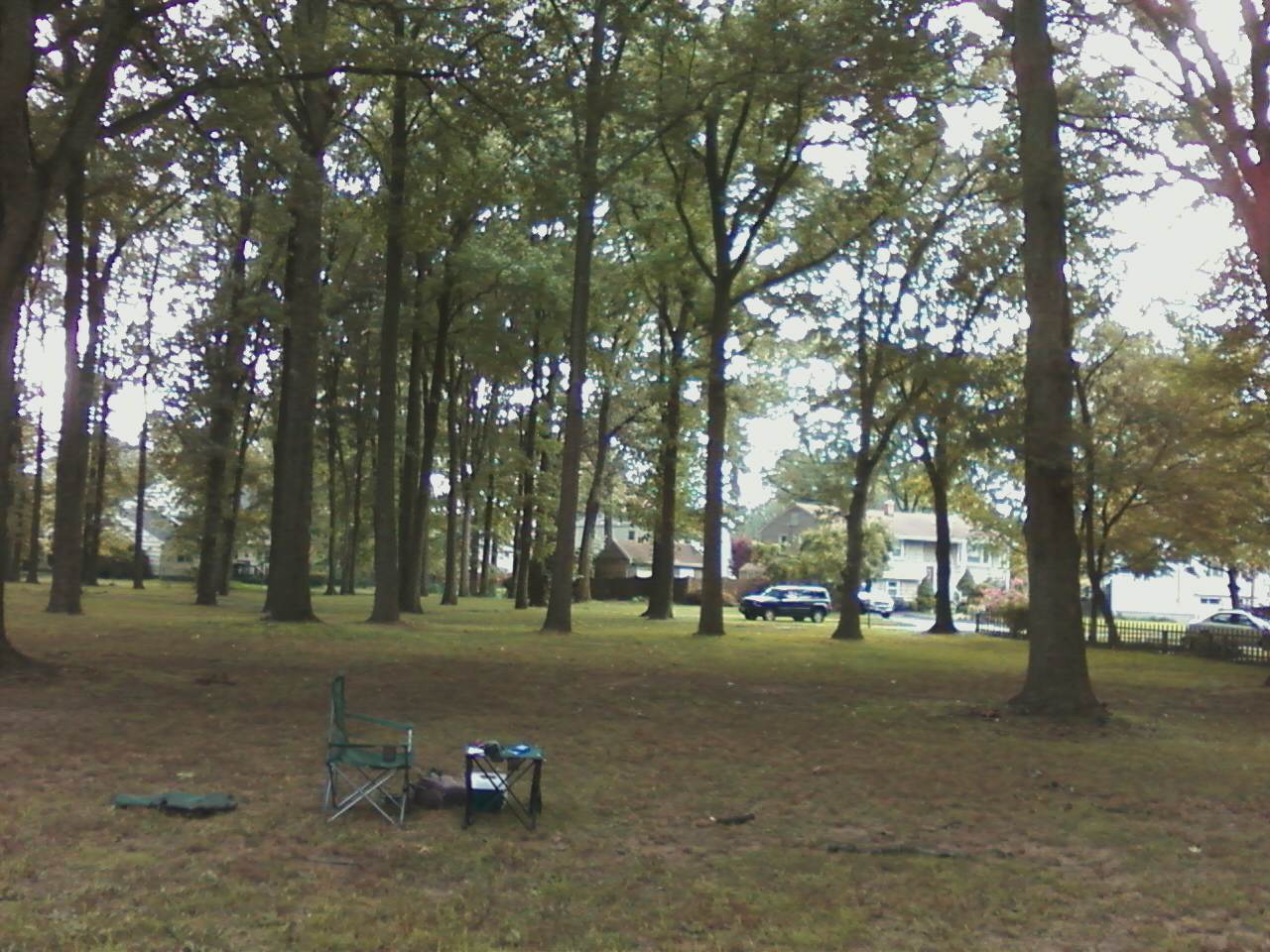
Tear down was just as easy as set up. After the contest ended, I was able to pack up things and be out of the park in less than 10 minutes.
I would like to thank all of you who took the time to participate in this first ever NJQRP Skeeter Hunt. I think a good time was had by all; and this will definitely become an annual Summer QRP event.
Remember, logs are due by September 12th, after which I will post results. Log summaries are fine – details of each QSO are not necessary – but if you want to send a log in that way, that’s OK, too! And any pictures, especially those of you who home brewed keys for the event will be greatly appreciated!
I’ve gotten a few logs in already and I hope to get many, many more. In fact, Jim W1PID, posted another of his great stories today – this one about the Skeeter Hunt:
http://www.w1pid.com/skeeter/skeeter.html
72 de Larry W2LJ
QRP – When you care to send the very least!

Larry Makoski, W2LJ, is a regular contributor to AmateurRadio.com and writes from New Jersey, USA. Contact him at [email protected].
The first annual skeeter contest….done!!
 |
| Packing up for the contest |
 |
| The weather to look forward too |
watts with me calling CQ and not searching and pouncing.
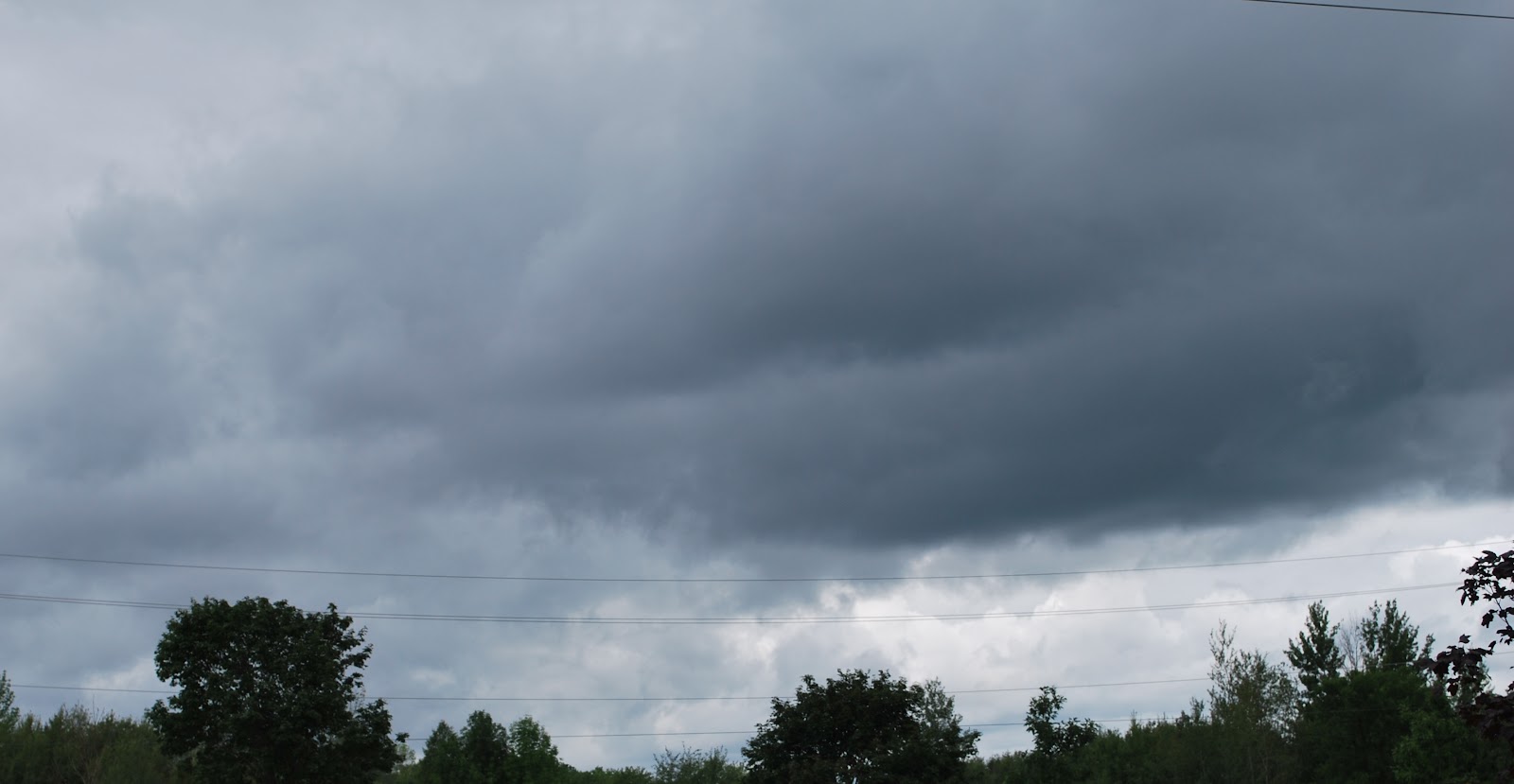
The weather was a mixed bag from nice sunny skies (very rare) to very threatening overcast that did let go
 |
| The setup...with a bit of rare sunshine |
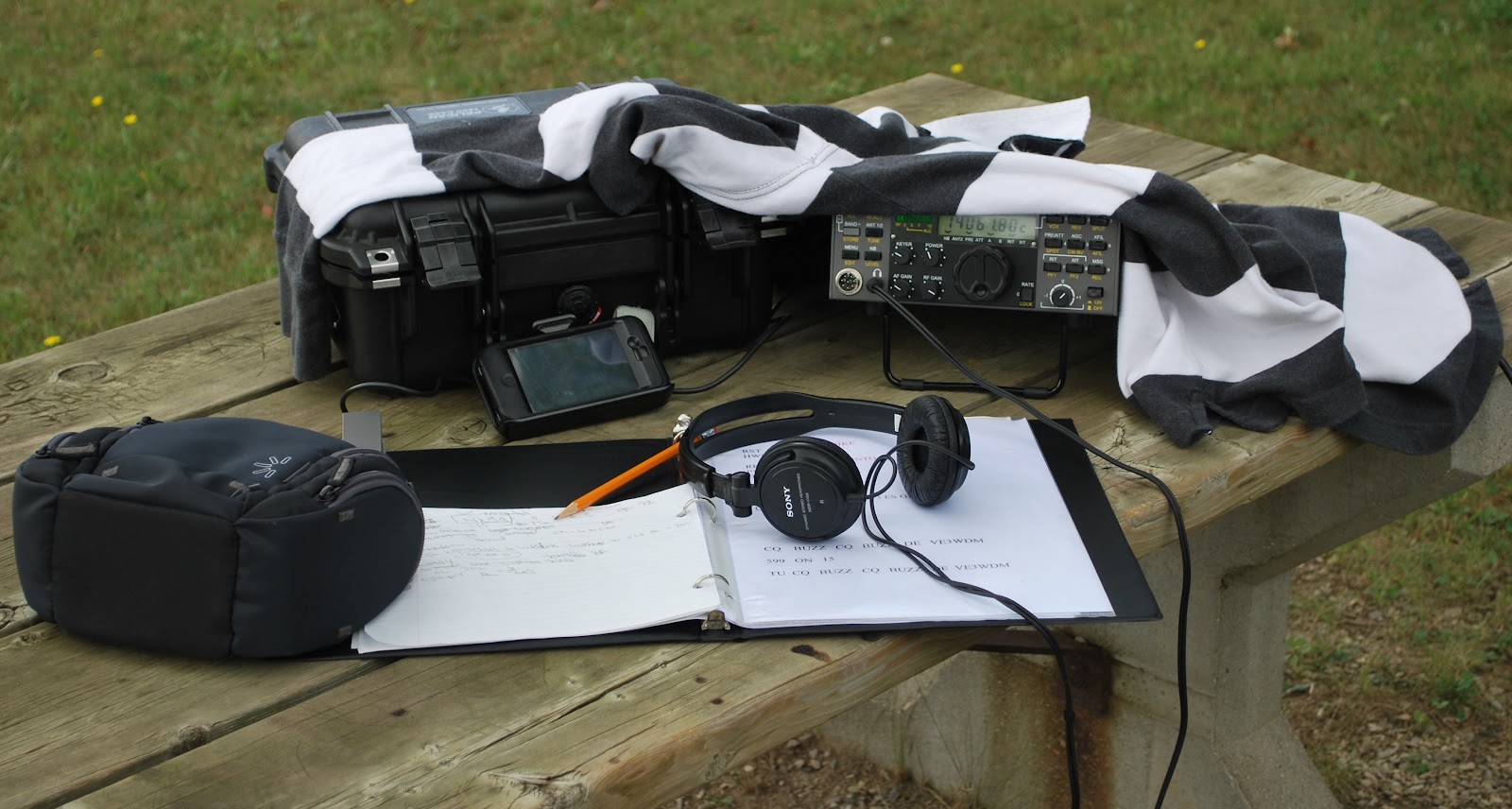
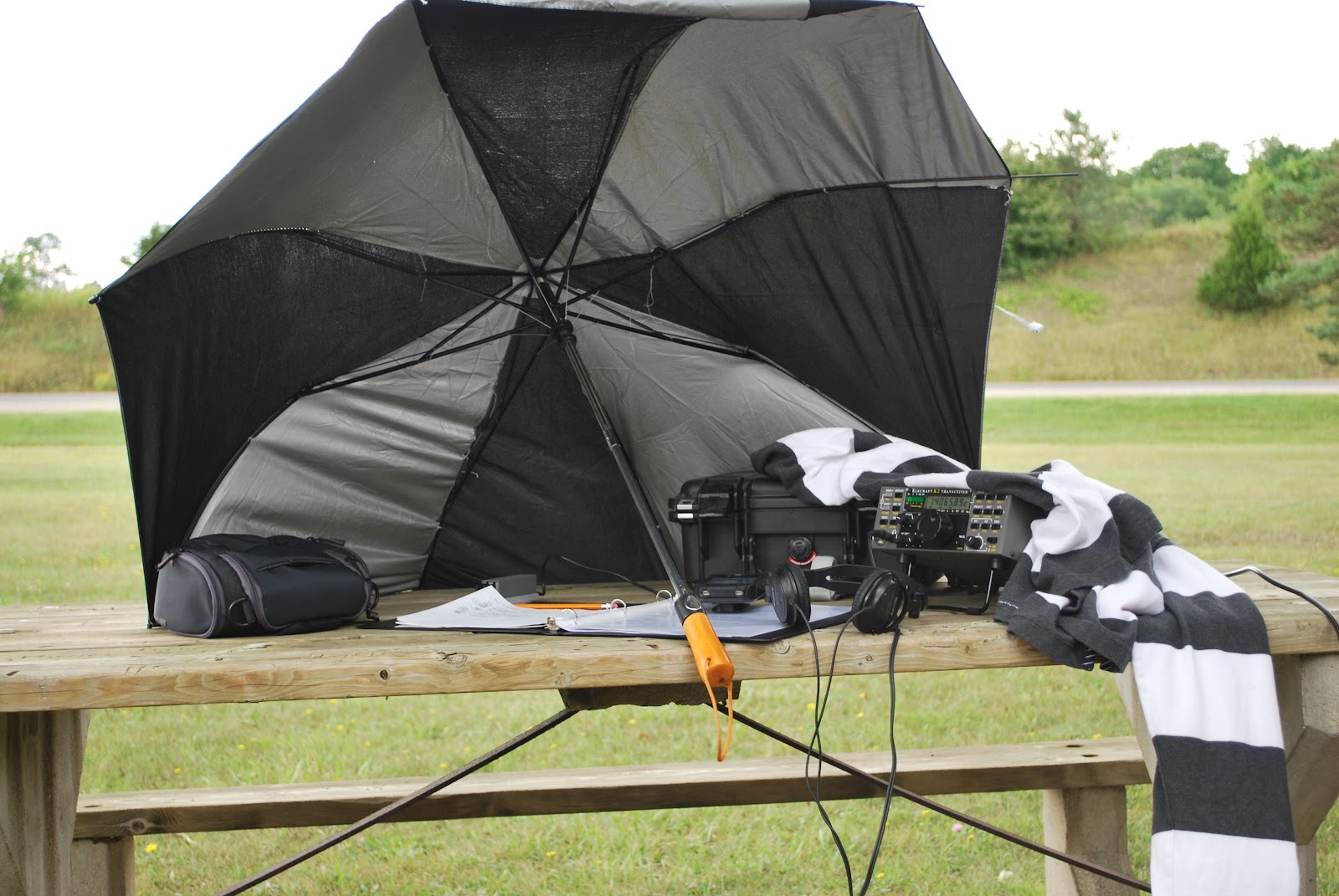
with rain at times.Over the last month the temperatures have been in the upper 30's and low 40C...today it was nice and cool almost to the point of putting on a long sleeve shirt (which was used to cover the rig during light rain). The location I chose was about 15 minutes from my home and offered a pic-nick table, trees and what I consider a luxury when operating out and about a portable washroom!! The bands were busy with not only the Skeeter contest but the WAE contest as well. I did have some European stations involved in the WAE contest respond to my "CQ Buzz contest" Thats ok they gave me their report and serial and I asked for their power output and then they moved on this made it a skeeter contact....I believe anyway???
 |
| Covering for rain drizzle |
 |
| When it really rained |
 |
| Finally...a must have!!! |

Mike Weir, VE9KK, is a regular contributor to AmateurRadio.com and writes from New Brunswick, Canada. Contact him at [email protected].
Sometimes the interesting QSOs aren’t the long-distance ones
I think I’ve reflected before that sometimes it isn’t always the really long distance contacts that catch your imagination. Yesterday was an interesting day, although I didn’t really have any contacts that I would have called DX – but they were still interesting from a propagation point of view.
It started off on 70MHz with a QSO with John, G3VHH on MB7FM, the 70MHz parrot in Tring. It was an interesting QSO and one of the first I had on FM using the new transverter setup. Just after lunch, I noticed on Twitter that Ken G0PPM said that he was in Wales and calling CQ on 50.150. I nipped upstairs and to my surprise could just hear Ken. Not well enough to do much other than exchange reports, but not bad for a mobile to – vertical contact at just over 110km. Ken then asked if I could try on 28MHz. I said I could, but didn’t really expect to hear him. Although I couldn’t hear him on SSB, we were able to complete a rudimentary QSO on CW quite easily which was fun.
Later on, Julie and I decided to go for a walk up White Horse Hill and I threw the IC-E92 in. As we were sitting, enjoying the view from the top of the hill, I had a tune around and could hear M0JLA/P talking to Stewart, G0LGS in Cheltenham. After they signed, I rather hopefully called Rod, M0JLA and was pleased when he came back. It turned out that he was on a SOTA summit near Presteigne in Herefordshire, not far from the Welsh border – a distance of 120km or so. Rod was using a beam, but I was just using the little rubber duck antenna, so felt quite satisfied with the contact.
All interesting contacts and a little bit out of the ordinary.

Tim Kirby, G4VXE, is a regular contributor to AmateurRadio.com and writes from Oxfordshire, England. Contact him at [email protected].
Perseids 2012 on 144MHz
I haven’t really got myself out of 50 and 70MHz Es mode yet, so still really only looking for those openings – which are getting a bit less frequent now. However, realising yesterday that it was the peak of the Perseids meteor shower, I thought it would be a good time to see what I could hear using the digital modes – as now have the interface mentioned earlier in the year.
Last night I setup the FT847 on 144.370 which is the FSK441 frequency and set the WSJT software running in monitor mode to see what would happen. When I looked at the ‘log’ this morning there was plenty of interest and quite a number of stations heard:
DK1CO
S55AW
PA0BWL (tropo or backscatter?)
DK1KH
F1JQM
EA3AXV (one of the outstanding signals for me – copied many times)
DG1WEH
PA3BIY
DL3MBJ
S51WO
YU7TRI
IN3FFN
S50C (another outstanding and consistent signal)
YO2LAM (probably the best DX)
DL0HOF
PA5KM (tropo or backscatter)
I1RJP
F1HQM
SP2HMR
F6APE
SP2OBQ
Well, I probably should have spent some time trying to make some QSOs, but actually I was quite happy to see what I heard and I am delighted with this haul. The antenna here is just the little 5 element, so this was probably more about strong short reflections rather than longer but quite weak ones that you get when you aim closer to the horizon with a long yagi.
It’s not all over yet though and it will probably be worth setting the receiver going again this evening.

Tim Kirby, G4VXE, is a regular contributor to AmateurRadio.com and writes from Oxfordshire, England. Contact him at [email protected].
ICQ Podcast S05 E17 – Olympic Torch & 2O12L Special Event Station (12 August 2012)
Series Five Episode Seventeen of the ICQ Podcast has been released. The latest news, listener mailbag and Chris Howard, 2E0CTH reports from the last day of the radio special events station for the Olympic torch relay and Pete M0PSX reports from 2O12L, the special event station for the London 2012 Olympic Games.
- Tethersat-1 & 2 to test Electrodynamic Tether Propulsion
- German needed for Madeira contest team
- Ofcom licence exempt consultation
- New Russian Satellite RS-40
- New version of CWWAV
- SA Electronic Communications Amendment Bill
- GB2EIJ Essex International Jamboree
- Writtle Calling celebrates 90th anniversary of 2MT
- Lasting Moments of First Excitement
Listener mailbag and Chris Howard, 2E0CTH reports from the last day of the radio special events station for the Olympic torch relay and Pete M0PSX reports from 2O12L, the special event station for the London 2012 Olympic Games.
Colin Butler, M6BOY, is the host of the ICQ Podcast, a weekly radio show about Amateur Radio. Contact him at [email protected].
ICQ Podcast S05 E17 – Olympic Torch & 2O12L Special Event Station (12 August 2012)
Series Five Episode Seventeen of the ICQ Podcast has been released. The latest news, listener mailbag and Chris Howard, 2E0CTH reports from the last day of the radio special events station for the Olympic torch relay and Pete M0PSX reports from 2O12L, the special event station for the London 2012 Olympic Games.
- Tethersat-1 & 2 to test Electrodynamic Tether Propulsion
- German needed for Madeira contest team
- Ofcom licence exempt consultation
- New Russian Satellite RS-40
- New version of CWWAV
- SA Electronic Communications Amendment Bill
- GB2EIJ Essex International Jamboree
- Writtle Calling celebrates 90th anniversary of 2MT
- Lasting Moments of First Excitement
Listener mailbag and Chris Howard, 2E0CTH reports from the last day of the radio special events station for the Olympic torch relay and Pete M0PSX reports from 2O12L, the special event station for the London 2012 Olympic Games.
Colin Butler, M6BOY, is the host of the ICQ Podcast, a weekly radio show about Amateur Radio. Contact him at [email protected].
The pursuit of The Elser-Mathes Cup
 The story of the Elser-Mathes Cup may be familiar to many of you. For those of you who are not in the know, you can get all the details from the article by Fred Johnson Elser, W6FB/W70X, in the November 1969 issue of QST. To summarize, the establishment of the Elser-Mathes Cup in 1929 was directly inspired by the leaps and bounds up to that point in radio technology combined with Hiram Percey Maxim’s fascination with the planet Mars. The cup is to be awarded in recognition of the first amateur radio two-way communication between Earth and Mars. I would bet that the cup’s initial establishment was somewhat tongue-in-cheek. Although Fred Johnson Elser’s QST article, on the tail of the success of Apollo 11, gave the cups existence and purpose a good deal more veracity.
How close are we to finally awarding the Elser-Mathes Cup? Lets look at some recent milestones:
Earth-Moon-Earth Bounce
In January 1953, Ross Bateman, W4AO, and Bill Smith, W3GKP successfully bounced at 2M signal off the Moon.
Signal reception of Voyager 1

On March 31, 2006, German radio amateurs successfully received transmissions from Voyager 1 which was already well outside the Solar System (~7,436,464,581 miles away from Earth).
Earth-Venus-Earth Bounce

On March 25, 2009, German radio amateurs achieved another first by bouncing a 2.4 GHz CW signal off of Venus – which at its closest point to Earth is a mere 24,000,000 miles away and 162,000,000 miles at its furthest.
Earth-Mars-Earth Bounce?
Mike Brink, ZR6BRI, has definitely done his homework to show the feasibility of radio amateurs bouncing a signal off of Mars (which has a distance from Earth that varies from 36,000,000 miles to 250,000,000 miles).
However, bouncing a signal off of Mars will not win The Elser-Mathes Cup. The amateur contact must be two-way.
 Could the Mars Science Labratory (Curiosity) fulfill the role as the second party of an amateur QSO?
Curisoity does have UHF communication capability. One of Curiosity’s antennas is nicknamed “Big Mouth” and is used to send large data sets to one of three orbiters around Mars: the Mars Reconnaissance Orbiter (which will probably do most of the work), Mars Odyssey Orbiter, or the European Space Agency’s Mars Express orbiter. The orbiter then relays the data via the Deep Space Network (DSN) back on Earth using X-Band.
“Big Ear” is Curiosity’s high-gain, directional X-Band antenna that can be used to communicate directly with the DSN on Earth. “Little Ear” is an omni-directional, X-Band antenna that is designed to be used primarily to receive low data rate transmissions from the DSN.
Putting aside the fact that Curiosity’s X-Band frequencies are outside the authorized US amateur frequency allocation and given the German amateurs success with Voyager and Venus – amateur communication with Curiosity looks possible (but probably not with my Arrow II antenna).
So, if it is possible for Joe Amateur (along with a heap load of expensive gear) to have a QSO with Curiosity – what would prevent the actual hacking of Curiosity?
Damon Poeter’s August 9th article “How to Hack NASA’s Curiosity Mars Rover” takes a look at this proposition. Mr. Poeter all but dismisses the possibility of a private citizen contacting Curoisty and instead focuses at actually hacking through NASA’s control system. Then on August 10th, Mr. Poeter submits “Unknown Actor Soliciting Partners for Mars Rover Hack”. Now, possibily, there are individuals who are actually trying to hack their way through NASA by soliciting help in determining what frequencies are used to communicate with the orbiters above Mars.
Here on an IT secuirty forum, a question is asked concerning the secuirty of Curiosity. One of the responses is from a former controller who is somewhat familiar with NASA’s general communications protocal with spacecraft and identifies the transmission of bogus communications to Curiosity as a possibility. Although the post’s author identifies that the capability to conduct such an act would have to be another country (…. and everyone loves pointing the finger at China).
It is easy to forget that radio amateurs have been intercepting space communications for sometime, with Sputnik’s signal on 20.007 MHz and Apollo 11 communications being primary examples.
All this being said, I think The Elser-Mathes Cup will continue to gather dust for a bit longer.
Scott Hedberg, NØZB, is a regular contributor to AmateurRadio.com and writes from Kansas, USA. Contact him at [email protected].
 Ham Radio Deluxe |
 W5SWL Electronics |
 Ham Radio Prep |
 KB3IFH QSL Cards  Hip Ham Shirts  HamRadioAuctions HamRadioAuctions Reliance Antennas Reliance Antennas Enigma Shop Enigma Shop |  morseDX  Ni4L Antennas  R&L Electronics R&L Electronics antennas.us antennas.us QRV QRV |
- Matt W1MST, Managing Editor
