 |
 Happenings over the last few weeks
 9 September 2012 | by
 D3AA from Angola: I had seen for many evenings D3AA on the spotting networks, I found either there was a huge pileup trying to contact him OR he just was not there even after laying in wait on the frequency for 15 minutes or so. Then one evening as I was looking at my Elecraft P3 pan-adapter, I noticed a signal to one side of the frequency I was monitoring. I spun the VFO and to my surprise it was D3AA calling CQ!!! He was just above the noise and I could copy him fine so I called and he came back to me first call with a 559 and he is in the log.
UPDATE....I UPLOADED THE WRONG SOUND FILE....ALL IS GOOD NOW.
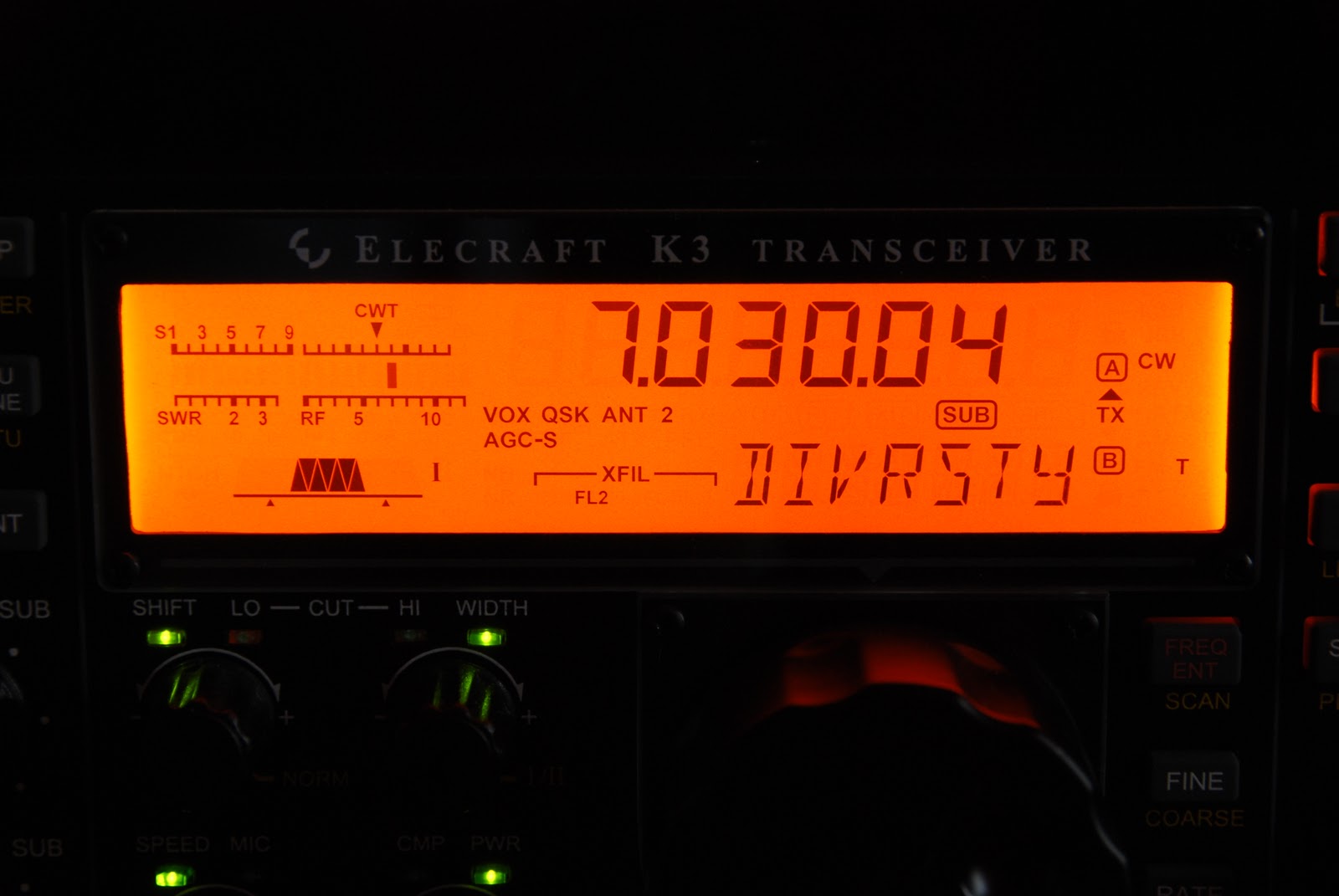
Here is an audio sample from my K3 of a DX-pedition operating split ( calling on one frequency and listening on another frequency) using the main and sub-receiver. You can very clearly hear the pileup in one ear and the DX in the other ear...you have to have some headphones on to hear this. There is a point were a station is calling on the DX's calling frequency.
This is just but another feature of the k3 that allows me to snag DX-peditions and add them to my DXCC count.

Mike Weir, VE9KK, is a regular contributor to AmateurRadio.com and writes from New Brunswick, Canada. Contact him at [email protected].
ICQ Podcast S05 E19 – Good audio – Julius D Jones, W2IHY (9 September 2012)
Series Five Episode Nineteen of the ICQ Podcast has been released. News Stories include :-
- Emergency Network in Dominican Republic activated
- Hams come online to help with Asia disasters
- Philippine Radio Hams get 7200-7300 kHz
- PB100, Netherlands Special Event
- Dublin Bus celebrates its 25th birthday
- Region 1 EMC WG to asked to reconsider PLT policy
- Repeater Directory Android App now available
- Coastal station VIP marks its 100 years
- Broadcaster vacates 40m amateur band
- Has 2O12L broken a world record?
Listener mailbag and Martin (M1MRB) interviews Julius D Jones (W2IHY) about good audio.
Colin Butler, M6BOY, is the host of the ICQ Podcast, a weekly radio show about Amateur Radio. Contact him at [email protected].
A must read!
If you are a QRPer and are serious about it, especially when it comes to working DX or participating in the QRP Fox hunts (or any radio contest, for that matter) then the following IS A MUST READ.
http://www.ae5x.com/blog/2012/09/07/from-sardine-sender-to-dxcc-honor-roll-in-10-years-qrp/
This post on John AE5X’s blog, is an absolute gem. I have rarely read posts that are more pragmatic, to the point, that are dead on and hit the ball over the wall.
Pay particular attention to the passage that begins with, “There is a common misconception that the heavy lifting in a QSO containing a QRPer is done by the non-QRP station” and then ends with, “rather than using a strategy, are simply calling on unproven frequencies within the split range, thereby eliminating themselves as valid competitors.”
This part is what I consider to be the “meat and potatoes” of this post, and I can think of no better words of wisdom to impart upon ANY Ham, let alone a budding QRPer.
John, thanks so much for writing this and sharing it with the radio and QRP community. Words to live by!
72 de Larry W2LJ
QRP – When you care to send the very least!

Larry Makoski, W2LJ, is a regular contributor to AmateurRadio.com and writes from New Jersey, USA. Contact him at [email protected].
The Curious Case of IARU’s .radio Endorsement
An interesting news item popped up on the ARRL website last week.
The International Amateur Radio Union (IARU) has expressed public support for a .radio top-level domain name. Under the proposal as put forth by the European Broadcasting Union (EBU), registration will be available via the EBU to all eligible radio representative organizations and broadcasters, Internet radios, radio amateurs, radio professionals and their respective representative organizations, as well as companies providing radio-specific products and services in order to create a worldwide radio community.
The International Amateur Radio Union (IARU) welcomes dot-radio, the Internet Top Level domain that the European Broadcasting Union (EBU) proposes to create for the global radio community.Created in Paris, France, the IARU has been the watchdog and spokesman for the world Amateur Radio community since 1925 and counts with over 160 members from many different countries and territories.The IARU believes that the dot-radio proposal to be submitted by the EBU could provide an unique opportunity to standardize Radio domain names on the Internet.
The use of a specific global online name such as dot-radio can help create a unique space worldwide, a place where the global radio community can gather.
Am I the only one who thought to themselves, “what does this have to do with Amateur Radio?”
What does the European Broadcast Union, a group that represents the interests of broadcasters (especially on radio spectrum issues), have anything to do with ham radio? Anyone? I can hear the crickets chirping….
What does it mean to “standardize radio names on the Internet”? How about “a place where the global radio community can gather”? I mean, is anyone feeling like this sort of thing is missing on the Internet?
Has anyone had any trouble getting their callsign domain name in .com, .net, .org, or .co.uk? From an Amateur Radio perspective, this whole thing seems like a solution in search of a problem.
Others have also weighed in the potential conflict of interest in EBU’s application. Julien Mervyn Dedier filed this comment with ICANN:
Dot. Radio the Internet top Level domain that EBU proposes to create for the global radio community is not in the best interest of amateur radio operators worldwide. The International Amateur Radio Union’s (IARU) support for Dot. Radio by EBU does not reflect the views of all amateur radio operators globally.
Apparently he’s not alone in raising the conflict of interest concern. Kevin Murphy, editor of the domain name blog DomainIncite, wrote:
The European Broadcasting Union, which is one of four applicants for the .radio top-level domain, has asked to join ICANN’s Governmental Advisory Committee as an observer.
It is believed that its request is likely to be accepted.
The move, which comes just a couple of weeks after ICANN revealed its list of new gTLD applications, could raise conflict of interest questions.
While several GAC governments and observers are backing new gTLD bids – the UK supports .london, for example – they’re generally geographic in nature and generally not contested.
I’m not suggesting that there is some grand conspiracy here. There may be very valid reasons why IARU believes that this is fundamentally in our best interest. They just aren’t clear to me from the press release.
I e-mailed Mr. Ellam, the president of the IARU, a week ago for comment. I asked specifically for an example of how the approval of EBU’s .radio application would benefit the Amateur Radio community. I ‘m still awaiting a reply.
Matt Thomas, W1MST, is the managing editor of AmateurRadio.com. Contact him at [email protected].
DX Magazine’s ‘Most Wanted’ survey
If you’ve read this blog for a while, you’ll know that I have mixed feelings these days about HF DXpeditions and some of the behaviour that they engender on the bands. Nevertheless, there is a great deal of pleasure derived by many in chasing the DXCC entities.
Carl, N4AA, Editor of ‘DX Magazine’ has been organising the ‘Most Wanted Survey’ of countries over many years and over the last 10 years or so, it has been my pleasure to assist in a small way with the IT to analyse the results. If you are interested in helping Carl with the survey, you might like to read the following press release
“Effective immediately the 2012 Most Wanted Survey form is available on the DX Publishing web site.
“Please go to: www.dxpub.net and under the heading MOST WANTED SURVEY you will find a link to the form. Click on ‘2012 SURVEY’.
“Several prefixes are in BOLD type. These are ones which may cause confusion due to their similarity, i.e. 3D2, VK9, VK0, etc. Please use care when marking these to be sure the correct one is counted.”
“There are a few shown in RED. These indicate either an addition to the list from last year or a change in the prefix (ZK2 is now E6). “There is a ‘block’ at the bottom of the form for you to send along any comments, or to include any country that you need which is not on the list.”
“Please pass the word to your friends and to any DX clubs in your area that the survey will be available until October 15th. Thanks for your participation. 73, Carl, N4AA”
Arguably, with the much greater use of systems such as LOTW, ClubLog and so on, there will be reduced need for surveys like this – as analysis of the database behind LOTW and ClubLog reveals in an instant the ‘needed’ countries. Nevertheless, the ‘Most Wanted’ survey still provides a valuable indication towards the wishes and needs of the HF DX community.

Tim Kirby, G4VXE, is a regular contributor to AmateurRadio.com and writes from Oxfordshire, England. Contact him at [email protected].
Which ham sites would you really miss?
This morning I received an email to warn me my subscription to eQSL.cc will run out next month. Forgetful as I am becoming, I thought that this time I’d better get on and renew it right away before I forget.
The amount asked for Bronze membership is $20.00 US. But if you think that’s too much you can pay any amount, even as little as $5. You could probably get away with $1 but surely nobody is that cheap?
Bronze membership is really worth it because it allows you to use your own QSL design. Free members only get a plain text card which is pretty boring.
I’m glad eQSL allows free membership because it’s better to have as many hams as possible registered with the system (and hopefully take the steps needed to become Authenticity Guaranteed) even if they don’t pay a cent. According to eQSL nearly 90% of members never donate any money. I’m not very good at mental arithmetic but if every user paid something then the minimum membership fee would be about $2 a year I think.
It’s always tempting to freeload, to put off donating until another day, but I think everyone should donate to help keep running the sites they use most.
Here’s my list of sites I use most every day and would really miss:
There are a couple of omissions that may surprise you. But those big sites you’re thinking of must make enough from advertising to get along without my help. I probably visit them less than once a week, so I wouldn’t miss them as much as the sites in my list.
Which ham radio sites would you really miss if they closed tomorrow?

Julian Moss, G4ILO, is a regular contributor to AmateurRadio.com and writes from Cumbria, England. Contact him at [email protected].
TALARC
A tip o’ the cap and a smart salute to NS8R for making me aware of The American Legion Amateur Radio Club.
http://www.legion.org/hamradio

If you’re a US Armed Forces veteran and belong to the American Legion – please be sure to check it out. It looks really, really nice.
Oh, and if you’re a veteran and a Legion member or VFW member, or not a member of any organization at all – thanks for your service!
On another note, QRP DXing can be a mixed bag. Some days, when the band conditions are right, it can be like shooting fish in a barrel. Other days, when the bands and the sun are not very cooperative, it can be akin to having a root canal. But either way, it’s fun. Hey, even trying for “the one that got away” is more fun than being at work!
But I really have to give credit to my brother and sister QRPers who go about it using SSB. They have just that smidge more of patience and endurance than most of us. Sometimes, it seems like it just can’t be done – but here’s proof that it can.
Thanks, John K7HV for posting to YouTube.
72 de Larry W2LJ
QRP – When you care to send the very least!

Larry Makoski, W2LJ, is a regular contributor to AmateurRadio.com and writes from New Jersey, USA. Contact him at [email protected].
 Ham Radio Deluxe |
 W5SWL Electronics |
 Ham Radio Prep |
 KB3IFH QSL Cards  Hip Ham Shirts  HamRadioAuctions HamRadioAuctions Reliance Antennas Reliance Antennas Enigma Shop Enigma Shop |  morseDX  Ni4L Antennas  R&L Electronics R&L Electronics antennas.us antennas.us QRV QRV |
- Matt W1MST, Managing Editor
