 |
 DX from the Old Range Road
 18 October 2012 | by
 Today I hiked on the old east-west range road in Sanbornton. The fall colors were fantastic and so was the DX. I worked Dominica, Germany, Czech Rep., and a research ship off the coast of Africa.

The day was glorious… a tad over 60F with clear blue skies. The hike was less than a mile, but the views and the fall colors were grand. I stopped in a field on the Swain Farm, a little north of Hunkins Pond. I tossed my line into a huge maple tree. In the spring, it’s tapped for maple syrup. Today, it provided glorious color and a great antenna support.

Even though my throw went nearly 50 feet high… I only needed 22 feet. I set up on 15 meters with the ATS-4 and used a half wave wire. I powered the setup with 8AA batteries that I solar charged this morning.
The band was remarkable. Very quiet with a handful of very strong signals. My first contact was with Volker, J79WE in Dominica. He gave me a 549 and we finished a quick exchange easily. Next I answered a CQ from CM8CAD in Cuba. Carl gave me a 559. I sat right in the grass under the tree and enjoyed a view of the Belknap range to the south.

My third QSO was with Hardy, DL1VDL in Dresden. He gave me a 579. Hardy reminded me that we had worked before. Checking my log, I noted that I had worked him in 2008 from the cabin at Knox Mountain! “UR FB 4W is great,” he sent. “Have fun hiking.” With that we signed and I packed up to continue the hike. I went east over the side of the hill, and set up once again. This time on 20 meters.

I sat down in a second field after throwing a 33 foot wire over another maple branch. This time I looked across the high field into a glade below. Mt. Rowe is in the background. I called CQ on 14.060 and received a quick reply from Jan, OK2BUT in the Czech Rep. Jan gave me a 569 and sent “FB sig from UR 4W.” He was running 100 watts with a 3 element yagi. I dropped down to 14.017 and was just in time to hear the end of a QSO. I called GM0HCQ/MM and Mike returned my call. He gave his QTH as 28N – 20W. Mike was on the Royal Research Ship James Clark Ross near Gomera Island off the north east coast of Africa. Here’s a picture of the ship at anchor in the Antarctic:

You can find out more about the ship and Mike’s station at: http://gm0hcq.com
After this QSO I packed up and walked out of the field onto the old range road. The sun was falling rapidly and illuminated the trees as I headed west.

These glorious fall days are numbered, with November just around the corner. The forecast for tomorrow is rain.
Jim Cluett, W1PID, is a regular contributor to AmateurRadio.com and writes from New Hampshire, USA. Contact him at [email protected].
Ham Nation 69

http://dts.podtrac.com/redirect.mp4/twit.cachefly.net/video/hn/hn0069/hn0069_h264m_1280x720_1872.mp4
http://dts.podtrac.com/redirect.mp4/twit.cachefly.net/video/hn/hn0069/hn0069_h264m_864x480_500.mp4
http://dts.podtrac.com/redirect.mp4/twit.cachefly.net/video/hn/hn0069/hn0069_h264b_640x368_256.mp4
http://www.podtrac.com/pts/redirect.mp3/twit.cachefly.net/hn0069.mp3
Hosts: Gordon West (WB6NOA) and George Thomas (W5JDX).
We go on the road with Gordo and Don!
Guests: Cheryl Lasek (K9BIK), Don Wilbanks (AE5DW), Julian Frost (N3JF)
Download or subscribe to this show at http://twit.tv/hn.
Submit your own video to Ham Nation! See the Video Guidelines, http://www.frozen-in-time.com/guide/
We invite you to read, add to, and amend our show notes at wiki.twit.tv.
Thanks to Joe Walsh who wrote and plays the Ham Nation theme.
Thanks to Cachefly for the bandwidth for this show.
Dr. Bob Heil, K9EID, is the founder of Heil Sound and host of TWiT.tv's Ham Nation which streams live each Tuesday at 6:00pm PT (9:00pm ET) at http://live.twit.tv. Contact him at [email protected].
Nagoya holograms rumbled!
I’ve written on the subject of fake HT antennas on eBay before. It’s a matter of concern whether an antenna is fake or genuine. Lately the antennas sold under the Nagoya brand name have come under suspicion. Recently purchased antennas have blue lettering printed directly on to the base, similar to some fake antennas purporting to be made by the reputable Diamond Antenna company.
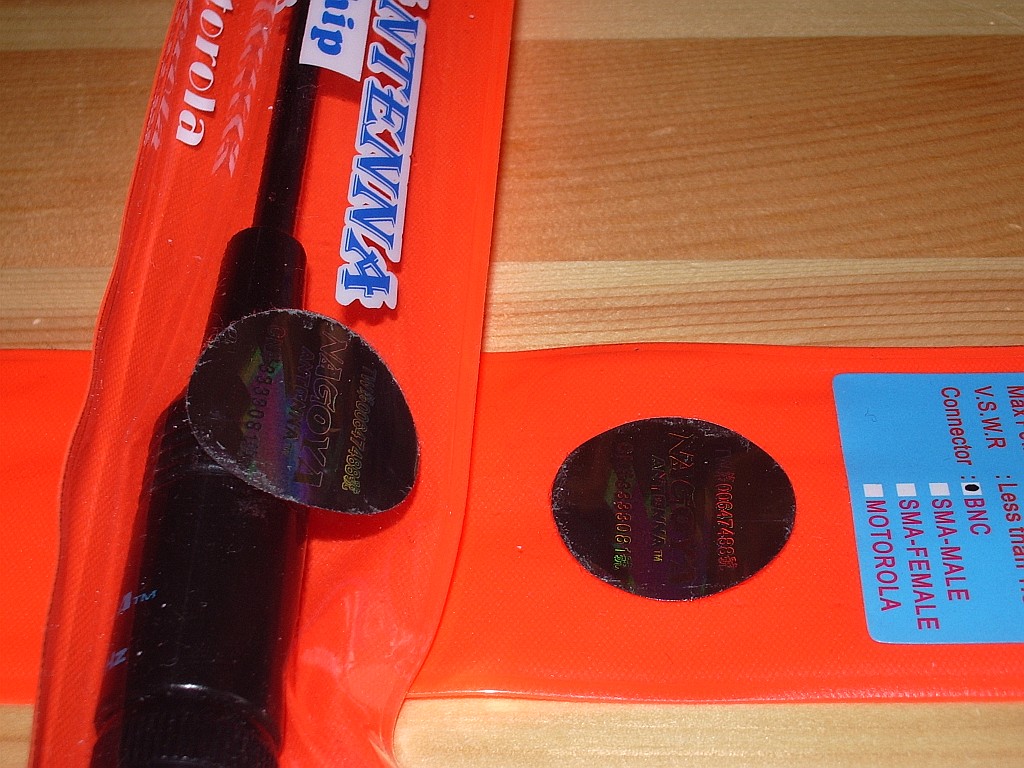 |
| Two identical fake hologram labels |
These new Nagoyas come in an orange plastic sleeve rather than a yellow one. The sleeves carry a silver hologram label with two serial numbers on them. Presumably the idea is that if you want to check an antenna is genuine you can contact the manufacturer, give them the numbers and they will confirm or deny that the product is genuine.
Today I read in a Yahoo group that someone had obtained an antenna with an identical hologram sticker to another member. I have two such antennas but I had never thought to check the stickers. When I did, I found that the stickers that came with two different Nagoya antennas were identical!
You probably can’t read the numbers off the picture above (try clicking the picture to see the full-size version) but the top number is TWx00647488x where x is a Chinese character. The lower number is CNx3333081x. If you have recently purchased Nagoya antennas and got ones with the silver sticker, I bet they have the same serial numbers!
It seems that the only way to get an HT antenna that works is to buy a Diamond branded antenna from your reputable US, UK or EU dealer! Better still, take an antenna analyzer with you and test it before handing over any money.

Julian Moss, G4ILO, is a regular contributor to AmateurRadio.com and writes from Cumbria, England. Contact him at [email protected].
And now for something completely different.
Courtesy of Rem K6BBQ – questions that I guarantee you have never been asked before!
72 de Larry W2LJ
QRP – When you care to send the very least!

Larry Makoski, W2LJ, is a regular contributor to AmateurRadio.com and writes from New Jersey, USA. Contact him at [email protected].
Falling Leaves at Knox Mountain
It’s a perfect fall day… sunny and nearly 60F. I head to Knox Mountain to enjoy the fall air and make a few QSOs. I work France and Georgia.

The trail is a carpet of color. The air is glorious. Most of the leaves are on the ground. Afternoon sunlight still dances between the bright yellow beech leaves.

The brook tells the story without a word. Gold leaves mingle with golden sun and green moss. The season is changing as rapidly as the running water. There is a certain nostalgia that comes with the season.

The trail follows the brook, and as I approach the cabin, I must jump across the rocks to the other side. The old bridge has rotted, and the caretaker has removed the ancient timbers.

The pond is full, not only with water… but of stories and images that lay mysteriously upon the fragile surface.
I sit in my favorite place in the sun on the east side of the cabin… beneath a cherry tree. Everything is still except the tapping of a woodpecker. Even the crickets are quiet now. But I see them hopping in the grass around me. The clouds are but wisps… the day a poignant reminder of the changing season.
I heave a line about 40 feet over a cherry branch and pull up a half wave wire for 20 meters. The band is muted… I think many of the stalwarts are on 15 and 10 meters today. I should have brought the ATS-4 so I could operate on 15. I am using the HB-1B with 4 watts. Signals are down here and I get poor reports from the stations I work. First I call F8BPF in the northwest of France. It takes Sylvain a few tries to get my call correctly. He gives me a 419, but copies my name and QTH the first time. He is running 100 watts to a 3 element yagi. I can hear him easily.
Next I work a county hunter operating mobile in Georgia. Greg, NM2L/M only gives me a 339, but again he copies the exchange first time.
I pull down the wire and prepare to leave. Today radios take second place. The air, the sky, the water, the leaves and the quiet rule the atmosphere.
Jim Cluett, W1PID, is a regular contributor to AmateurRadio.com and writes from New Hampshire, USA. Contact him at [email protected].
That downward “ham radio” trend line
There’s an interesting discussion ongoing on some of the amateur radio blogs (including this one) about how an analysis of the number of searches in Google using the term “ham radio” is trending. No doubt about it, if you simply look at the graph, it shows the hobby I love so much–and that I fully credit for getting me into a career in media–is trending more and more southward:
This could mean a number of things:
— People are getting their info about ham radio in other ways besides searching for that specific term on Google.
— They are searching for info on the hobby using other keywords, such as “amateur radio.”
— Nowadays, people search initially for information on a subject and then, if they find what they seek, they bookmark it/make it a favorite and don’t search anymore on Google.
— As we have gotten more sophisticated in how we use the search engines–often merely using the address bar in our browsers to type in odd terms that more closely match what we are seeking–the big, all-inclusive search terms are not used so often.
— Interest really is declining.
You know what my heart tells me. Licensing backs me up in that belief. We have more licensed amateurs in the country now than ever before in the 100-year history of the hobby. My sense is that the hobby is vibrant and growing, and, before you slap on me me that “rose-colored glasses” brand, be aware that I am pretty good at looking at things such as reliable research data realistically.
On the other hand, I still believe it behooves those of us active in the hobby, those who want to see it continue to grow, expand, and become even more exciting and diverse, to be evangelistic about it. We have to do what we can to recruit potential hams into our little “cult of the airwaves.”
That was one reason I wrote the book RIDING THE SHORTWAVES: EXPLORING THE MAGIC OF AMATEUR RADIO. I want people to understand that the hobby can be much more than sitting in a basement sending Morse code or trying futilely to hit repeaters with a handheld and a rubber-ducky antenna. As with most technology, our avocation has dramatically changed, and for the better. It offers so much to younger people who have grown up with cable, satellites, computers, and smart phones. True, those folks might think amateur radio is still what their weird uncle used to do in his back room with all that spittin’ and sparkin’ radio junk. We need to make them more aware of what the hobby is these days. And make sure they know that it absolutely can lead to a career in a technical field, including computers, communications, engineering, meteorology, media and more.
We won’t panic about that trend line. We will continue to do what we should be able to do best: COMMUNICATE!
Don Keith N4KC
www.n4kc.com
www.donkeith.com
Don Keith, N4KC, is a regular contributor to AmateurRadio.com and writes from Alabama, USA. Contact him at [email protected].
First steps towards a 29MHz AM QSO…
Coming home from the station this evening I noticed 10m was still open. Bypassing the SSB segment I headed up to 29000kHz and turned the mode switch to AM.
To my surprise, I heard N3GEG in QSO with F6KHM (who was inaudible). Up 10khz there were some more US stations but much weaker. I could see where the CB expression ‘in the back of the box’ came from. Back down on 29000khz WA8ATF was now working into France. Using an FT101F and a Collins amp, it sounded amazing!
Operating mobile on AM is not without challenges. You hear every powerline, every noisy house, every bus…
Brilliant fun though!

Tim Kirby, G4VXE, is a regular contributor to AmateurRadio.com and writes from Oxfordshire, England. Contact him at [email protected].
 Ham Radio Deluxe |
 W5SWL Electronics |
 Ham Radio Prep |
 KB3IFH QSL Cards  Hip Ham Shirts  HamRadioAuctions HamRadioAuctions Reliance Antennas Reliance Antennas Enigma Shop Enigma Shop |  morseDX  Ni4L Antennas  R&L Electronics R&L Electronics antennas.us antennas.us QRV QRV |
- Matt W1MST, Managing Editor
