 |
 Handiham World for 31 October 2012
 31 October 2012 | by
 Pat Tice, WA0TDA, is the manager of HANDI-HAM and a regular contributor to AmateurRadio.com. Contact him at [email protected].
The ultimate ham radio vacation rental

Prince Edward Island, in Eastern Canada, is a popular vacation destination for New Englanders. Just about 11 hours by car from Boston, it’s within easy range and offers immense beauty and a special kind of charm.
I’ve been going there since I was a child and have many great memories. The red sand beaches are unforgettable and despite it’s northern location, the ocean water is the warmest on the east coast north of the Carolinas.
Well, needless to say as I was browsing vacation accommodations, this place caught my attention! Purchased in 2002 by California attorney Ken Widelitz, K6LA / VY2TT, the ham radio shack at the 4-bedroom, 3,000 square foot PEI DX Lodge features some amazing amenities including an Elecraft K3, ICOM 7800, and ICOM IC-756 PRO III.

Oh, and did you notice the antenna farm? There are five towers: 30 feet, 84 feet, 140 feet, 145 feet and 150 feet.
They’re all yours for the duration of your stay. Amazing!

If you’re interested, check out the reservations page for rental rates or contact Ken at [email protected].
Matt Thomas, W1MST, is the managing editor of AmateurRadio.com. Contact him at [email protected].
10m WSPR spots 31 Oct 2012
 |
| 10m WSPR spots @ G4ILO 31 October 2012 |

Julian Moss, G4ILO, is a regular contributor to AmateurRadio.com and writes from Cumbria, England. Contact him at [email protected].
Lucky
Last night was a rather sleepless night. As Larry W2LJ mentioned, the rain wasn’t so bad, but the wind was downright scary. Up until about midnight I periodically went outside and walked around the house looking for damage, keeping my back and weight to the wind in order to not get pelted in the face or get blown over. The wind sounded like a freight train coming over the ridge. I was so glad I put temporary guy lines on the tower. Other than some siding on corners popping out, there was no permanent damage occurring, however I noticed my HF tribander and 6 meter beam misaligned on the tower. Under the force of the wind the tribander was beginning to turn and go off azimuth. I rotated the antennas in an attempt to use the wind to true up the tribander.
About 3 AM I awoke to metal banging against the house. I got dressed, went outside and found a 10 foot piece of aluminum flashing or trim dangling from the roof eave which shortly fell to the ground. Other than that, no more damage. Amazingly we still had electricity.
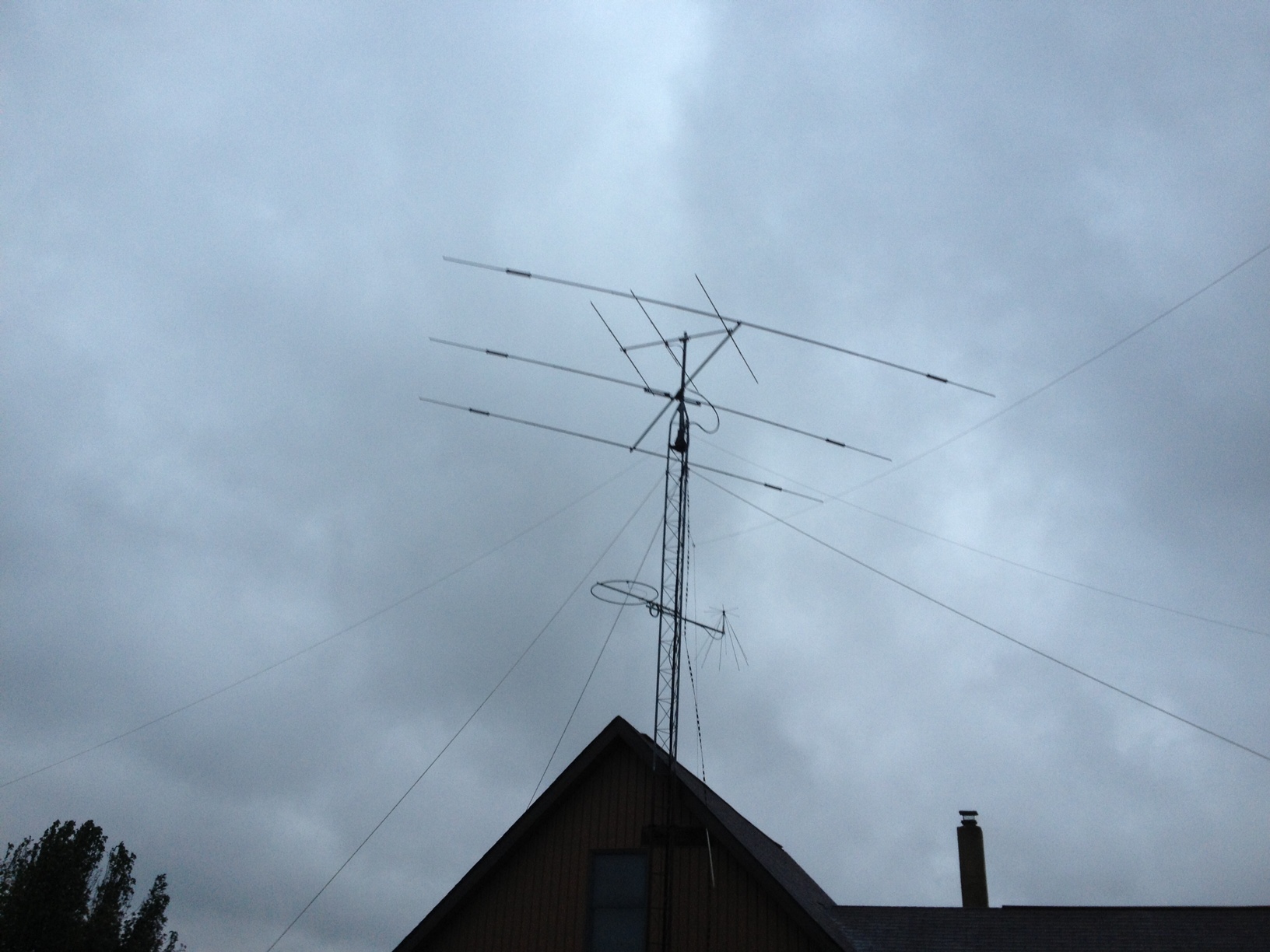
This morning when I awoke it was still quite windy and blowing the rain sideways, though not as violent as last night. There was no further damage to the house, but the antennas were more misaligned than before. So we were lucky here in Pennsylvania, and are thankful for having power and a home. A lot of people in New York, New Jersey, and to the south and west of us in PA did not fare so well.

WSJT-X for LF: Now I really will have to look at a top band antenna…
A couple of days ago, I read a post that the wonderful Joe Taylor, K1JT was working on a new mode for use on LF. It wasn’t until this evening that I read up a little more.
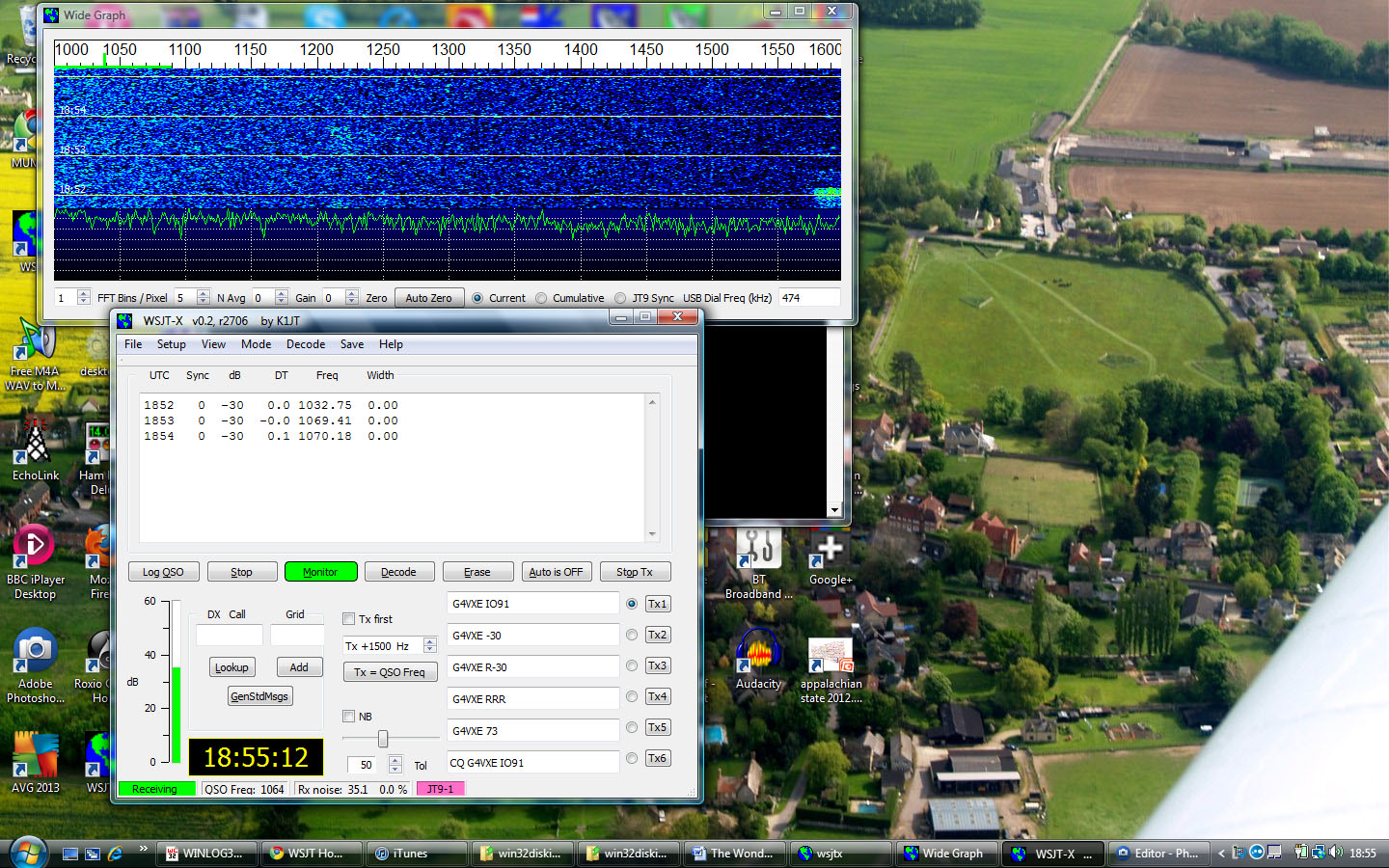
Joe says, on wsprnet.org
“If you are on 160 meters, or perhaps on 472 or 137 kHz, you may be interested in a new mode called JT9, designed especially for making QSOs on these bands. JT9 uses the structured messages introduced in 2003 for the JT65 mode, now widely used for EME and for QRP operations at HF. JT9 can operate at signal levels as low as -27 dB (in a 2500 Hz reference bandwidth), with one-minute timed transmissions. It also offers slower transmissions of 2, 5, 10 and 30 minutes duration, and the slowest mode can decode signals as weak as -40 dB. With one-minute transmissions, submode JT9-1 has a total bandwidth of 15.6 Hz — less than one-tenth the bandwidth of a JT65A signal. The other submodes are narrower still: a JT9-30 signal occupies about 0.4 Hz total bandwidth.
http://www.physics.princeton.edu/pulsar/K1JT/WSJT-X_Quick_Start_Guide.pdf ,
and an early version of WSJT-X can be downloaded from
http://physics.princeton.edu/pulsar/K1JT/WSJTX_01r2695.exe .
Tim Kirby, G4VXE, is a regular contributor to AmateurRadio.com and writes from Oxfordshire, England. Contact him at [email protected].
10m WSPR spots 30 Oct 2012
 |
| 10m WSPR spots @ G4ILO 30 October 2012 |
Sorry, Tim!

Julian Moss, G4ILO, is a regular contributor to AmateurRadio.com and writes from Cumbria, England. Contact him at [email protected].
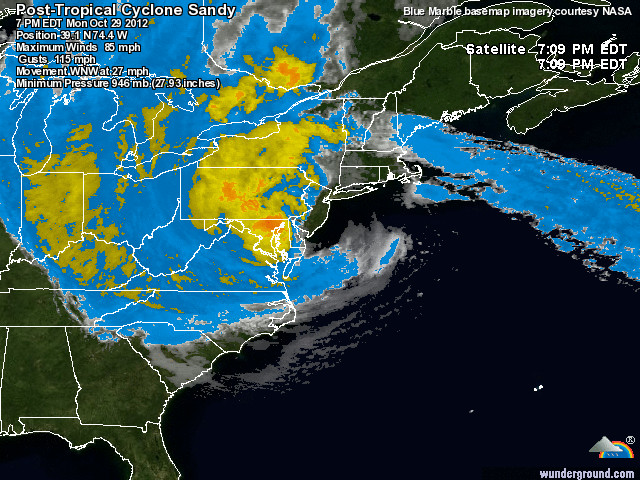
Landfall !!!
Hurricane Sandy has doubled her speed from 14 MPH to 28 MPH and has made landfall around the Cape May area of New Jersey.

Larry Makoski, W2LJ, is a regular contributor to AmateurRadio.com and writes from New Jersey, USA. Contact him at [email protected].
 Ham Radio Deluxe |
 W5SWL Electronics |
 Ham Radio Prep |
 KB3IFH QSL Cards  Hip Ham Shirts  HamRadioAuctions HamRadioAuctions Reliance Antennas Reliance Antennas Enigma Shop Enigma Shop |  morseDX  Ni4L Antennas  R&L Electronics R&L Electronics antennas.us antennas.us QRV QRV |
- Matt W1MST, Managing Editor
