 |
 Farewell Firefox
 12 November 2012 | by
 After many years as a stalwart Firefox user I have today made Google Chrome my default web browser.

I had tried Chrome once before. It was probably too early a version as I could not get on with it and missed too many of my Firefox extensions. Since then I have grown less dependent on those extensions and Chrome has become compatible with or has gained alternatives to those I need.
I installed Chrome a second time in an attempt to solve a problem that I thought was an issue with Firefox and turned out to be something else entirely! The installation was quick and easy. Chrome imported all my Firefox bookmarks with ease, reminding me to close Firefox so it could access them. I didn’t allow the installer to make Chrome the default browser initially, but after half an hour I was ready to take the plunge.
This won’t be news to those of you already using Google Chrome but the new browser feels much faster than Firefox. I see that 20% of visitors to G4ILO’s Shack are using the Chrome browser. I think it won’t be long until it overtakes the 27% of my visitors using Firefox.

Julian Moss, G4ILO, is a regular contributor to AmateurRadio.com and writes from Cumbria, England. Contact him at [email protected].
How do you sell an Elecraft K2
 |
| My first K2 serial 6613 |
developed a kit that allows the K2 to be setup and ready for any add on you want to put in the K2. Let me clear the waters a bit......if you build a bare bones K2 with no options but later you want to add some options, it my require you to remove some components from the K2 in order to add the option.
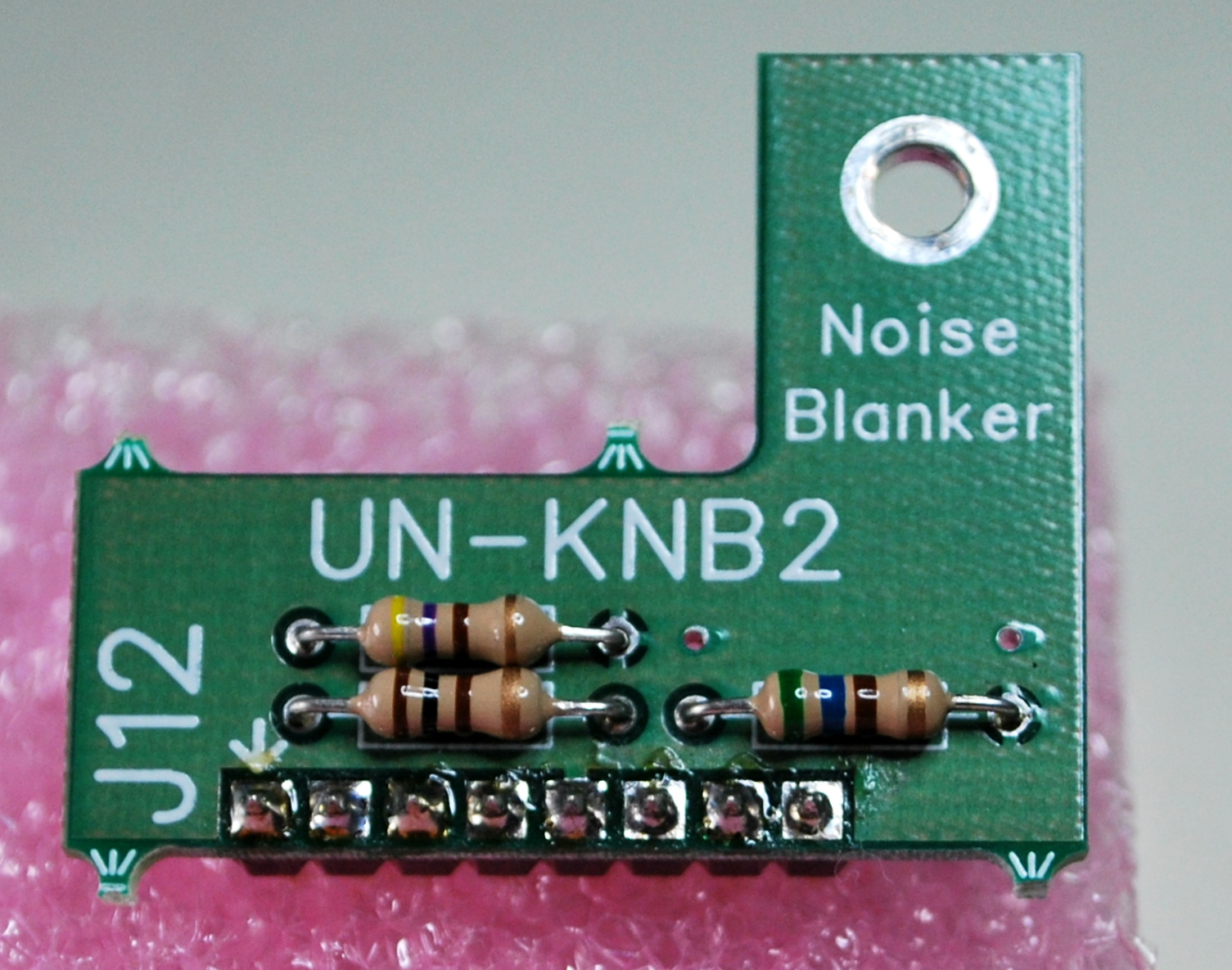 |
| NB rework board top view |
From the post I received great suggestions on options that should be added while building the kit. The one idea I am leaning toward is to just leave the radio "option free" and
 |
| NB rework bottom view showing header |
Mike Weir, VE9KK, is a regular contributor to AmateurRadio.com and writes from New Brunswick, Canada. Contact him at [email protected].
28MHz WSPR November 11th
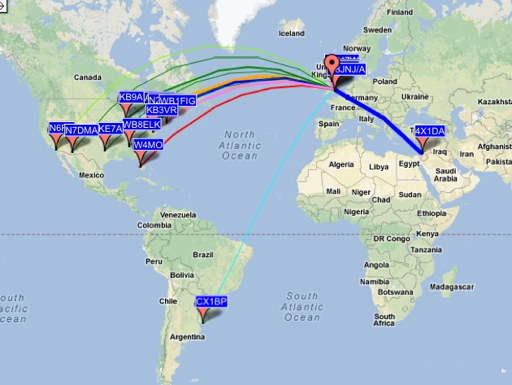
I was busy writing the PW column this morning and doing some other work on the computer, so I didn’t set the 28MHz WSPR running until around 1330z. I was running 1W as per normal.
There are some nice west coast spots today – though they didn’t hear me – but good to have copied some W6/7s.
Tim Kirby, G4VXE, is a regular contributor to AmateurRadio.com and writes from Oxfordshire, England. Contact him at [email protected].
10m 11 November 2012
 |
| 10m WSPR spots @ G4ILO 11 November 2012 |
Ten metres seems to have perked up a bit today, though conditions don’t seem as good as they were a week or so ago.
During the afternoon on PSK31 I heard, but didn’t work, Mexico and Panama. No WSPR monitors there so they don’t show up on the map.
Calling CQ resulted in contacts with some East coast USA stations. Propagation to Europe can’t have been that good. I think this is the first time that I didn’t get called by European and Russian stations.
I heard several USA stations working in a 10-10 contest. I don’t have a 10-10 number so I didn’t try to contact them. As a fan of 10m I like the idea of 10-10 but to be a member you have got to be sponsored by several existing members and then pay a membership fee. That’s way too much hassle and expense just to get a number to send people. The European PSK Club has the right idea. Membership is free to anyone and communication with members is via a web site.

Julian Moss, G4ILO, is a regular contributor to AmateurRadio.com and writes from Cumbria, England. Contact him at [email protected].
LHS Episode #093: Eating Crackers in Bed
 Hello and welcome to a very late release of LHS Episode #093. Recorded about a month ago, I finally found the time to get this one edited and put out so the world can experience it. I’d like to thank our loyal listeners for their patience, and I sincerely hope that this episode stands up to the fine quality (*snicker*) that you’re used to from LHS. We get a visit from one of the show’s ambassadors in this episode who tells us all about his experience ambassadoring for a Linux event in Ohio. You know the one. Surrounding that are some interesting Linux topics, a ham radio discussion or two and a very informative bit of feedback from the Old Texas Engineer. You don’t want to miss it.
73 de The LHS Guys
Russ Woodman, K5TUX, co-hosts the Linux in the Ham Shack podcast which is available for download in both MP3 and OGG audio format. Contact him at [email protected].
Veteran’s Day – 2012
A most sincere and humble “Thank You so much!” to all those who have and continue to serve our Nation in the Armed Forces. We will never be able to adequately repay your service.

72 de Larry W2LJ
QRP – When you care to send the very least!
Larry Makoski, W2LJ, is a regular contributor to AmateurRadio.com and writes from New Jersey, USA. Contact him at [email protected].
The Android HT – Part 2
 My article on the Android HT generated some interesting comments and ideas. Thanks so much! One of the main themes in the feedback is to have the radio be “faceless”, with the user interface done on a mobile device (i.e., smartphone or tablet). The mobile device would communicate to the transceiver via Bluetooth (or maybe WiFi). This approach has the advantage of separating the radio hardware (which probably doesn’t need to change very often) from the compute/display hardware (which is on a faster-paced technology path). I went ahead and hacked together a concept photo of such a device (click the photo to enlarge it). This device could interface with any mobile device that has a Bluetooth interface, so it would be independent of OS on the mobile device (yes, you could use your iPhone).
Such an approach opens up a variety of use models. Imagine sticking the transceiver in your backpack and using an app on your smartphone to enjoy QSOs when hiking. Alternatively, the radio could hang on your belt. At home, the radio could be left in some convenient location, connected to an external antenna on the roof and operated from the mobile device. (Low power Bluetooth is said to have a range of about 10 Meters.) These are just a few thoughts…I am sure you can think of others.
I would expect the original Android HT concept to be easier to use for casual operation, due to the All-In-One Design with dedicated hardware volume control, channel select and PTT switch. I am assuming those functions would be implemented in software in the faceless implementation, which would likely be less convenient. Most mobile devices have their own GPS system included, so that would mean one less thing that has to be in the radio.
The other idea that surfaced in the feedback is using Software Defined Radio (SDR) technology to implement the transceiver. This would provide a higher degree of flexibility in generating and decoding signals, enabling additional areas of innovation. That is a great idea and will require a whole ‘nuther line of thinking.
73, Bob K0NR
Bob Witte, KØNR, is a regular contributor to AmateurRadio.com and writes from Colorado, USA. Contact him at [email protected].
 Ham Radio Deluxe |
 W5SWL Electronics |
 Ham Radio Prep |
 KB3IFH QSL Cards  Hip Ham Shirts  HamRadioAuctions HamRadioAuctions Reliance Antennas Reliance Antennas Enigma Shop Enigma Shop |  morseDX  Ni4L Antennas  R&L Electronics R&L Electronics antennas.us antennas.us QRV QRV |
- Matt W1MST, Managing Editor
