 |
 Handiham World for 21 November 2012
 21 November 2012 | by
 Pat Tice, WA0TDA, is the manager of HANDI-HAM and a regular contributor to AmateurRadio.com. Contact him at [email protected].
QRZCQ Update
I have just uploaded a couple of new images to QRZCQ.com, the new ham radio database site.

If you wondered where the nice QSL images in recent blog posts came from, I took them from those ham’s profile pages on QRZCQ.com. I thought it was a good idea to use a QSL image for the page, so I scanned one of my printed QSL cards and uploaded it to my own profile on the site. You are allowed two pictures, a main one and a secondary one, so I uploaded a photo of me in the shack for the secondary image. It’s good that the site developers allow decent sized high resolution images.
Somebody will probably take me to task for stealing images from a web site. But in my opinion (for what that’s worth) a QSL image should be okay. If I received it from the bureau what’s to stop me from scanning and uploading the image of cards I receive? I’m just anticipating receiving it. 🙂
I have also uploaded my contact log to QRZCQ.com. That was a simple matter of exporting the log to an ADIF file from KComm. The most up to date copy of my log will always be the one at G4ILO’s Shack, though, because that is taken directly from the off-site backup copy of my log, uploaded automatically whenever I close KComm.
Julian Moss, G4ILO, is a regular contributor to AmateurRadio.com and writes from Cumbria, England. Contact him at [email protected].
Huh?
Just by chance, I happened to look at the stats for visits here.
Yesterday, there was a very sharp spike – a lot of visitors – over twice the norm.
Was I mentioned somewhere?
72 de Larry W2LJ
QRP – When you care to send the very least!
Larry Makoski, W2LJ, is a regular contributor to AmateurRadio.com and writes from New Jersey, USA. Contact him at [email protected].
Thanksgiving – Part 1
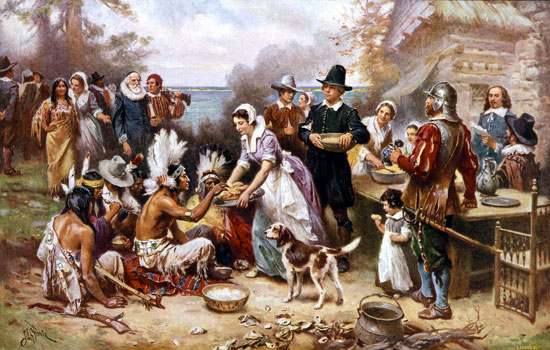
I really like Thanksgiving – it is my favorite holiday.
I know that I have many readers that are not from the US, who might have heard of Thanksgiving; but might not be familiar with the history behind the holiday. Here’s a short and by no means authoritative version, of the US version of Thanksgiving. Our Canadian friends also celebrate Thanksgiving (on the second Monday of October); but the historical basis behind their celebration is different than ours.
In the year 1620 a small ship named the Mayflower, left Plymouth, England and headed for “The New World”. The passengers were mainly a group of people known as Pilgrims, who had left England to come to a new land where they could practice their religion publicly without oppression or harassment. The rest of the passengers were people who wanted to come and settle a new land and make a life for themselves.
The Mayflower landed at what is now known as Plymouth, Massachusetts in November of 1620. Shortly after landing, the settlers came in contact with an Indian (read – Native American for the PC crowd) who was a member of the Abenaki tribe. A few days later this Native American returned with a friend named Squanto, who was a member of the Pawtuxet tribe. Earlier in his life, Squanto had been kidnapped by an English sea captain who had sold him into slavery. Squanto escaped and managed to get to London for a time, where he was able to successfully find a way to get back to America (and learn the English language in the process). Squanto introduced the Pilgrims to the nearby Wampanoag tribe. With Squanto’s help, an alliance was formed between the Wampanoag and the settlers which lasted for a period of over 50 years. If this alliance hadn’t been formed, the settlers probably would have totally perished that first harsh Winter. Even though the Wampanoag chief, Massasoit had donated food and provisions to the settlers to see them through that first brutal and snowy cold Winter, almost half of the passengers of the Mayflower perished from scurvy, malnutrition and other disease.
The following Spring, Squanto and the Indians taught the surviving Pilgrims where to fish, how to catch eels, how to plant corn, barley and other crops, which indigenous plants were poisonous and which were not, among other things. The planting and growing season of 1621 proved to be exceptionally good, ending with a bountiful harvest that would, without a doubt, be more than enough to sustain the Pilgrims through the next Winter. The leader of the settlement, Plymouth Plantation, declared that a feast be held that November. It lasted three days and the Native Americans were invited to celebrate the bountiful harvest; and 90 came. The Pilgrims had just completed a “Fowling mission” and the Wampanoag brought five freshly killed deer – so the menu from the First Thanksgiving feast (according to written records) consisted of venison, turkey, goose, duck, various fish (cod and bass among them), eels, clams (quahogs), and fruits and vegetables. As the Pilgrims stores of sugar were used up, there was probably not much in the way of pies or cakes!
Days of Thanksgiving have been proclaimed on and off throughout our history, beginning during the Revolutionary War. But Thanksgiving, as we come to know it, came into its own when a national Thanksgiving Day on the last Thursday of November was proclaimed by Abraham Lincoln in 1863. And since that time, it has been celebrated annually.
On a radio note – last weekend, I tried hauling up the W3EDP without much success. Trying to bring down the short end of the frayed and snapped Zepp was futile as it is unmercifully snagged in my neighbors trees and bushes. So a new plan evolved, which I will try to implement this coming weekend. Instead of using the mast on that side of the yard, I will run the W3EDP from the house to the maple, horizontally (actually sloping slightly upwards). Then from the maple, I will allow it to slope down towards the privacy fence post in that far corner of the yard and will tie it off with however much antenna rope I will need – probably no more that 5 -6 feet worth.
I am hoping that the old saying will hold true – “Where there is a will, there’s a way!”
72 de Larry W2LJ
QRP – When you care to send the very least!
Larry Makoski, W2LJ, is a regular contributor to AmateurRadio.com and writes from New Jersey, USA. Contact him at [email protected].
Some things to avoid and include in contests
Never update your contesting software the day of the contest....... "Software surprise" is not needed during a contest.
Never assume your contest station is running great just because it was last time. ..........Give the station a workout a few days before the contest.
Never update the rigs firmware just before a contest.......firmware glitches will throw your contesting off.
Never forget about the family during a contest weekend.......an hour away here or there can be a refreshing break.
Never get upset and frustrated......it's a contest have fun, know from the outset there is going to be poor op's out there.
Never think you are NOT going to get board at times.....there will be slow times have other things planned.
Never forget about non-contesters and respect mode allocations on the bands.......it's not intentional most times we just get carried away.
Always make sure the YL's "honey do" list has no outstanding promised items for that weekend.
Always understand that things never go as planned.
Always have some exercise, break times and eating times planned, a crock pot menu is a great way to have good dinners with very little work.
Always use headphones (especially CW contests) it may sound like sweet music to you but to the rest of the family (pets included) it's NOISE!!
Always have some goals for the contest.....and understand they can change.
Always make sure you are comfortable....cool in summer, warm in the winter, good chair and operating position just to mention a few things.
Always investigate if other major contests are going on the same weekend.......it can get frustrating when two stations from separate contests are giving exchanges neither can understand.
Always read and understand contest rules before the contest..........self explanatory.
Contest on!!!
P.S.....please leave your comments with more includes or avoids
Mike Weir, VE9KK, is a regular contributor to AmateurRadio.com and writes from New Brunswick, Canada. Contact him at [email protected].
The Oxford Museum of the History of Science
A couple of weekends ago, I had the opportunity to take a look around the Museum of the History of Science in Oxford. There were lots of interesting exhibits but here are a few that caught my eye.
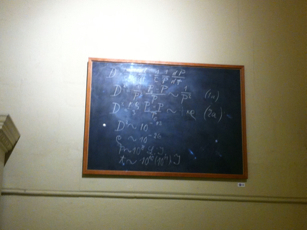
First, a blackboard. A smart scientist called Albert Einstein visited Oxford. During his lecture – he used this blackboard. I was really thrilled to see Einstein’s writing.
The formula? I’m not an expert, but I believe it shows the age of the Universe. The result of which holds up pretty well.
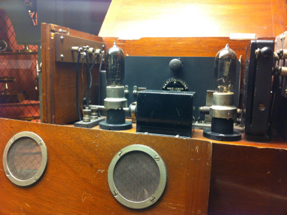
Here’s a beautiful Marconiphone receiver.
And a Marconi transmitter!
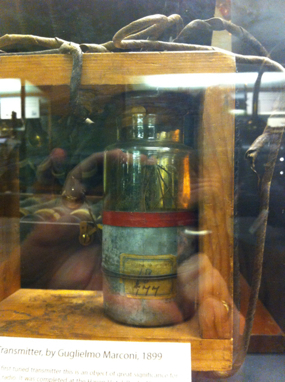
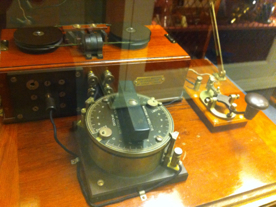
Look at this gorgeous morse key! A ‘grasshopper’ design. Never seen anything like it.
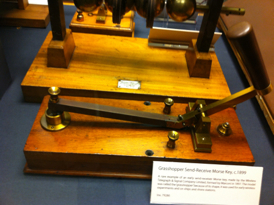
An excellent visit! Highly recommended if you’re in the Oxford area.
Tim Kirby, G4VXE, is a regular contributor to AmateurRadio.com and writes from Oxfordshire, England. Contact him at [email protected].
Beacon pages
The NCDXF beacon network may not be as popular now that WSPR has hit the mainstream but I think it still has a purpose.
For me, the benefit of programmes like Faros gives life to a receiver that wouldn’t otherwise be used. Yes, you can do the same with WSPR but because it’s a more robust system means that just because my pc can hear a station. Doesn’t mean I can work them.
Beacons,on the other hand , give you a reason to listen out. For example, if I can’t hear the Northern Ireland 2m beacon, GB3NGI on 144.482Mhz then chances are I will not be successful putting out a CQ call and expecting to get some DX (DX for me is probably a lot less in mileage terms than you might think at my QTH).
So I’ve resurrected the NCDXF beacon monitor and the results are on the Beacon pages. I hope they are still useful. Time will tell but it looks like the soundcard / rig combo isn’t working too well as its reporting 100% QSB and nowhere near as many spots as I would expect it to. I remember the software being quite precise about the signal input and I spent many hours waiting then adjusting.
Alex Hill, G7KSE, is a regular contributor to AmateurRadio.com and writes from Cumbria, UK. Contact him at [email protected].
 Ham Radio Deluxe |
 W5SWL Electronics |
 Ham Radio Prep |
 KB3IFH QSL Cards  Hip Ham Shirts  HamRadioAuctions HamRadioAuctions Reliance Antennas Reliance Antennas Enigma Shop Enigma Shop |  morseDX  Ni4L Antennas  R&L Electronics R&L Electronics antennas.us antennas.us QRV QRV |
- Matt W1MST, Managing Editor
