 |
 A Work in Progress
 29 November 2012 | by
 I was visiting AmateurRadio.com today and happened to see Tim G4VXE’s post about a new logging program, called PZT Log.
I’m a sucker for logging programs and my search for the “perfect” one continues. I do not have the knowledge or expertise to write one that would 100% suit my needs, so I go from logging program to logging program, like Diogenes. He searched the world for an honest man – I am looking for my ideal logging program.
This one by Charlie MØPZT looks like it has the potential to be a winner in my book. Not overly complicated – not too many unnecessary bells and whistles; but it might have to wait before I try it out in earnest. So far, there is no ability to import ADIF files, so I cannot load my current logbook into it. Once Charlie comes up with that fix, I am more than willing to give his program serious consideration as my primary logging program.
Currently, I am using AC Log by N3FJP. I really don’t have many complaints with it; but there are a few things in Charlie’s program that I like. Here’s what I would like in an “ideal” logging program – and yes, if wishes were nickels I would be a rich man.
Easy to use – very intuitive, with no encyclopedia needed to use it – if a logging program requires its own Yahoo group, that’s more than likely more software than I need (I can be quite the dunce, at times).
Should include the following:
Capability to monitor TelNet Clusters
WWV information
Capability to interface with Google Earth
Import/Export capability of ADIF files
A world map with current day/night grayline display would be nice.
Be able to import QSL information from QRZ or some other such source.
Other than that, my needs are few. Computer control of the rig, Digital Mode capability, and all the other fluffy type things are not required by me. At the same time, I want the program to “look good” on my computer – I got tired of Win-EQF’s UNIX look and that’s why I switched to AC Log. I was using Ham Radio Deluxe for a while and liked it; but when they decided to charge for future upgrades (none of which I would probably be using) I decided to switch back.
Free is not a priority, but I have to admit that the concept is nice.
I am not technically savvy enough to fully describe my “prefect” logging program; but I would know it if I saw it!
72 de Larry W2LJ
QRP – When you care to send the very least!
Larry Makoski, W2LJ, is a regular contributor to AmateurRadio.com and writes from New Jersey, USA. Contact him at [email protected].
Ham Nation 75

http://dts.podtrac.com/redirect.mp4/twit.cachefly.net/video/hn/hn0075/hn0075_h264m_1280x720_1872.mp4
http://dts.podtrac.com/redirect.mp4/twit.cachefly.net/video/hn/hn0075/hn0075_h264m_864x480_500.mp4
http://dts.podtrac.com/redirect.mp4/twit.cachefly.net/video/hn/hn0075/hn0075_h264b_640x368_256.mp4
http://www.podtrac.com/pts/redirect.mp3/twit.cachefly.net/hn0075.mp3
Hosts: Bob Heil (K9EID) and George Thomas (W5JDX).
Leo joins us for our 75th anniversary, Bob fires up an original 1956 Harvey-Wells, and more.
Guests: Leo Laporte (W6TWT), Don Wilbanks (AE5DW), and Cheryl Lasek (K9BIK).
Download or subscribe to this show at http://twit.tv/hn.
Submit your own video to Ham Nation! See the Video Guidelines, http://www.frozen-in-time.com/guide/
We invite you to read, add to, and amend our show notes at wiki.twit.tv.
Thanks to Joe Walsh who wrote and plays the Ham Nation theme.
Thanks to Cachefly for the bandwidth for this show.
Dr. Bob Heil, K9EID, is the founder of Heil Sound and host of TWiT.tv's Ham Nation which streams live each Tuesday at 6:00pm PT (9:00pm ET) at http://live.twit.tv. Contact him at [email protected].
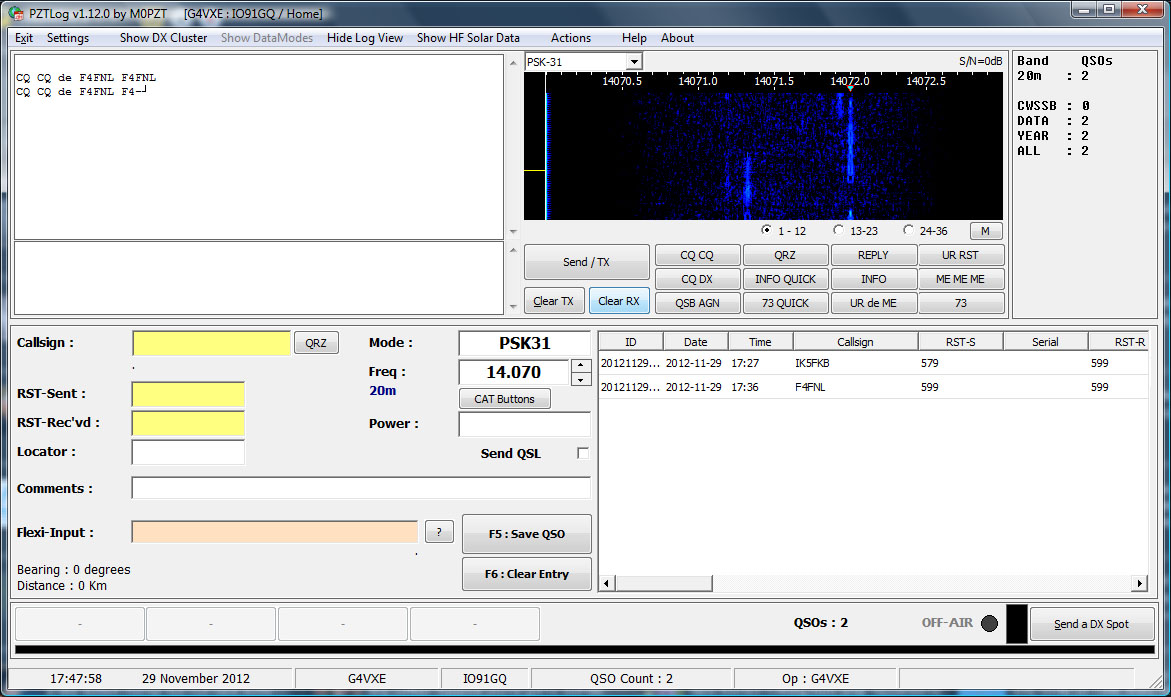
Trying out PZTLog
Tim Kirby, G4VXE, is a regular contributor to AmateurRadio.com and writes from Oxfordshire, England. Contact him at [email protected].
Found it!
The source of all my Faros problems…..The netbook itself. I hadn’t actually checked the obvious and that was what it was. The noise generated by the netbook was stopping it from finding signals in all the noise. Hence the 100% QSB. When I disconnected and unplugged everything the noise level dropped massively and that was the end of the problem.
Trouble is I sort of need that to run the program. Oh well, I suppose I can try and run it under wine with Linux and put it on the RPI as that makes little or no noise. I feel some hours being used up ahead!
Alex Hill, G7KSE, is a regular contributor to AmateurRadio.com and writes from Cumbria, UK. Contact him at [email protected].
Show Notes #095
Introduction:
- Welcome to episode 95 of Linux in the Ham Shack. Episode 100 looms on the horizon, and we’d like to do something a little special. Call in to the LHS voice mail line at +1-909-LHS-SHOW (1-909-547-7469), or send an email, and share your thoughts about the show.
- LHS recommends this LOL Cat image.
Announcements:
- Kevin O’Brien, Publicity Director of the Ohio LinuxFest, is looking for someone to step up and take on the role of Volunteer Coordinator. If anyone is interested please reply to [email protected].
- We now digress into a ramble about censorship.
- On page 45 of the December 2012 issue of QST has an article on vertical vs. horizontal antennas, a topic we discussed in episode 91. In the same issue, on page 52, there is also an article about the NorthWest Digital Radio UDR56K, a topic we discussed in episode 90. Are we seeing a pattern here?
- Also in that issue is a description of several FCC Proposed Rule Changes, and our hosts discuss each of them:
- Reduction of license expiration grace period from 2 years to 6 months.
- Reduction of vanity call waiting period from 2 years to 6 months.
- Reduction of the number of Volunteer Examiners at test sessions from 3 to 2.
- Possible allowance of “remote testing” facilities using video and audio over a network that allows for proper administration of tests.
- Allow single-slot TDMA transmissions.
- The 2012 Fort Wayne Hamfest is this weekend, November 17-18, in Fort Wayne, Indiana. This is also the ARRL Convention for Indiana. This launches Richard into reminiscing about the presentation of The Last Voice from Kuwait.
Topics:
- Symbolic (or soft) Links vs. Hard Links
- Russ and Richard offer a discussion of the difference between soft, or symbolic, links and hard links in Linux.
- A symbolic link is a pointer to another file name. Symbolic links can be created with the ln -s command:
ln -s [original file] [link name]
- Symbolic links can point to files on other volumes or file systems.
- Hard links, on the other hand, are pointers to the data of another file, just like a directory entry is a pointer to the first block of data for the file. Hard links are also created with the ln command, but without the -s switch.
- Hard links can only be used on the same file system.
- A symbolic link is equivalent to a Windows shortcut, a pointer to the name of another file. A hard link is a reference to the data (first inode) of another file, and thus must be created on the same file system.
- When the original file with associated hard links is deleted, the data remains until all of the hard links are also deleted. Deleting the original file with associated soft links will delete the file and the data, but the soft links will remain, now orphaned.
- More information about links is available here.
Feedback:
- Listener Dave left a comment on the web site expressing his appreciation for the show, and also became a subscriber. Thanks, Dave!
- Jeremy, KD5HQN, also commented on the web site, claiming he’s actually learning something from the shows! He also corrected Richard about the proper location of Orthanc. Thanks, Jeremy.
- Bill, KJ4KNI, asked, via Richard’s Facebook page, for suggestions about the best Linux distribution for a beginner. (Linux Mint 13 is a good choice.) He also wonders why a ham might use 75-ohm RG6 coax as an antenna feedline. Our hosts discuss the possibilities.
Contact Info:
- Contact Richard at [email protected], Russ at [email protected], or both at the same time at [email protected].
- Listen to the live stream every other Tuesday at 8:00pm Central time. Check the LHS web site for dates.
- Leave us a voice mail at 1-909-LHS-SHOW (1-909-547-7469), or record an introduction to the podcast.
- Sign up for the LHS mailing list.
- Sign up for the MAGNetcon mailing list.
- LHS merchandise is available at the Merch link on Web site. Check out the Badgerwear or buy one of the other LHS-branded items at PrintFection.com/lhs or Cafe Press. Thanks!
- Thanks to Dave from Gamma Leonis for the theme music.
Music:
- “Easier As Us” by Michael McEachern, courtesy of Jamendo.
- “Wicked” by Fresh Body Shop, from their album Bring Me Down, courtesy of Jamendo.
Russ Woodman, K5TUX, co-hosts the Linux in the Ham Shack podcast which is available for download in both MP3 and OGG audio format. Contact him at [email protected].
Handiham World for 28 November 2012
Pat Tice, WA0TDA, is the manager of HANDI-HAM and a regular contributor to AmateurRadio.com. Contact him at [email protected].
Radio Mobile Online
Its probably not news to many people but whilst I was thinking about a suitable site for the UKAC 144Mhz contest next Tuesday (4th December) I remembered about a coverage prediction programme called Radio Mobile.
Now seeing as things on the internet are steadily replacing things on the desktop I had a go with comparing sites with the model outputs. As a contest novice I am entering in ‘in the spirit of’ contesting. Any site needed to be quite close to home and easily accessed / operated from.
Radio mobile confirmed what you’d expect, the site closest to home that I can get to with the car isn’t the best but its a whole load better that operating from the house. So armed with the knowledge that I’ll get some contacts at least I’ll take the plunge and aim not to be at the bottom of the pile.
The key kit will be
1. A warm coat (its 20.00UTC – 22.00 UTC) – So it’ll be chilly
2. FT817 and extra power supply – Seeing as it runs out of puff within a few minutes
3. Sotabeams 3 element yagi and fishing pole
4. A flask of tea and chocolate hobnobs
The output from a 4w Tx at the Sandwith site is below. More than enough to get a couple of contacts I hope.

We’ll have to see how I get on next week, but if you’re in earshot listen out for the weedy signal from Cumbria (rather than the stronger on from G4VFL, who has nabbed the Corney Fell site – perhaps I should tramp up Scafell Pike to out do him on height!)
Alex Hill, G7KSE, is a regular contributor to AmateurRadio.com and writes from Cumbria, UK. Contact him at [email protected].
 Ham Radio Deluxe |
 W5SWL Electronics |
 Ham Radio Prep |
 KB3IFH QSL Cards  Hip Ham Shirts  HamRadioAuctions HamRadioAuctions Reliance Antennas Reliance Antennas Enigma Shop Enigma Shop |  morseDX  Ni4L Antennas  R&L Electronics R&L Electronics antennas.us antennas.us QRV QRV |
- Matt W1MST, Managing Editor
