 |
 PZTLog – much goodness
 8 December 2012 | by
 After my initial blog about Charlie M0PZT’s PZTLog, I have been using it more and more and finding it very enjoyable to use and very good.
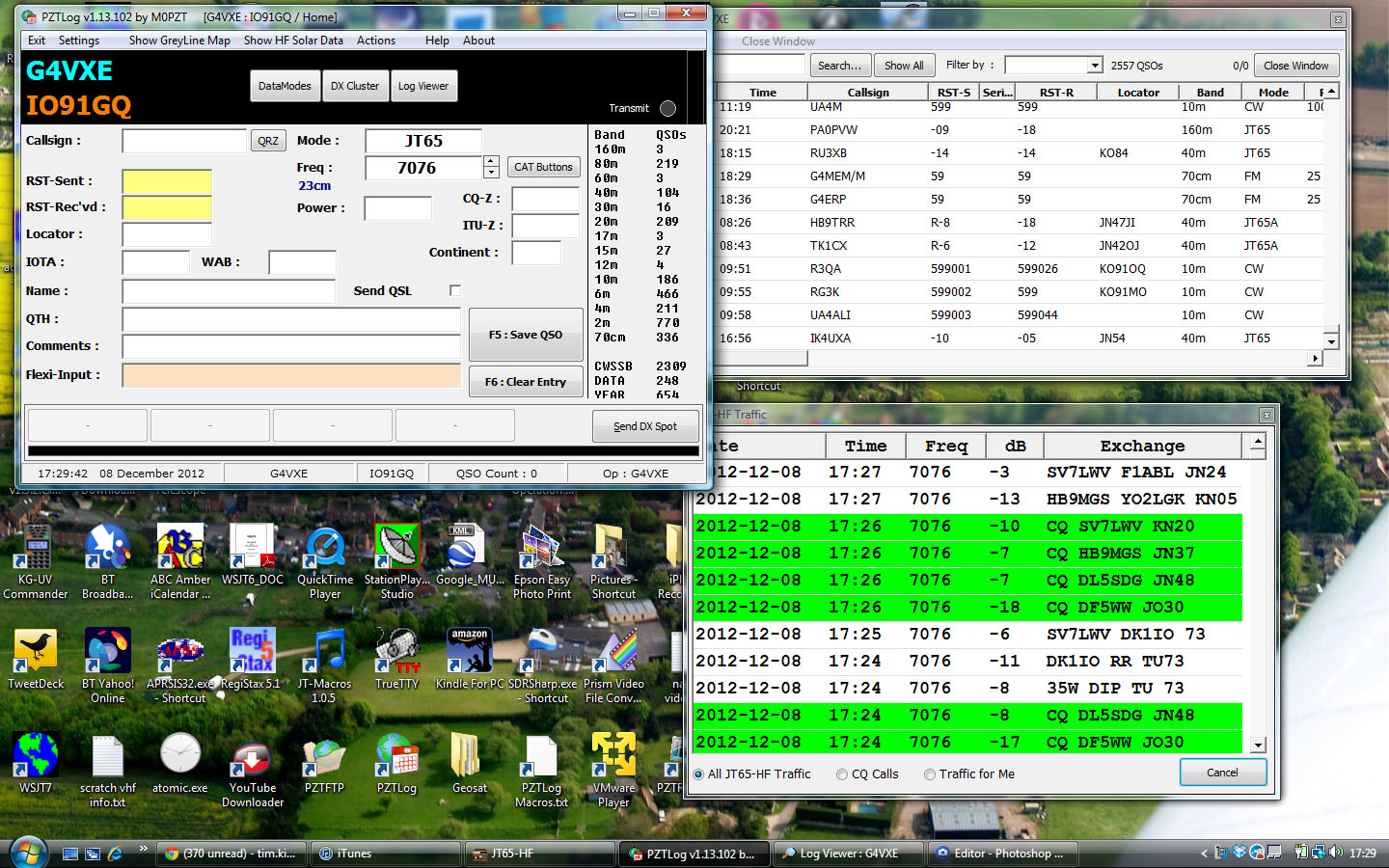
Of course I have been finding out more about the program, and Charlie has been busy adding new functionality to the software. The ADIF import now seems pretty robust and I’ve been able to import my log from Winlog32 into PZTLog.
There’s Locator Square listings, so you can see which locators you have worked on various bands – HF as well as the VHF bands – ideal if you enjoy chasing the grid squares on HF JT65A, for example. I like the integrated Grey Line Map display
Being a keen JT65-HF user, I particularly like the ability to display the JT65HF traffic within PZTLog. And best of all, double clicking on a line in the JT65 Traffic window will bring various details into PZTLog, so you don’t need to worry about doing a separate ADIF import to bring the QSOs in.
I can’t say enough nice things about Charlie’s responsiveness to questions and suggestions – updates appear very frequently- fixing issues – or adding new features.
PZTLog has become the default station logging software here at G4VXE – I’m delighted with it! Thanks for all your hard work, Charlie!
Tim Kirby, G4VXE, is a regular contributor to AmateurRadio.com and writes from Oxfordshire, England. Contact him at [email protected].
Pearl Harbor

“Getting the Message Through: A Branch History of the U.S. Army Signal Corps” by Rebecca Robbins Raines
CENTER OF MILITARY HISTORY, UNITED STATES ARMY, WASHINGTON, D.C., 1996 (pgs 242-244)
During 1940 President Roosevelt had transferred the Pacific Fleet from bases on the West Coast of the United States to Pearl Harbor on the Hawaiian island of Oahu, hoping that its presence might act as a deterrent upon Japanese ambitions. Yet the move also made the fleet more vulnerable. Despite Oahu’s strategic importance, the air warning system on the island had not become fully operational by December 1941. The Signal Corps had provided SCR-270 and 271 radar sets earlier in the year, but the construction of fixed sites had been delayed, and radar protection was limited to six mobile stations operating on a part-time basis to test the equipment and train the crews. Though aware of the dangers of war, the Army and Navy commanders on Oahu, Lt. Gen. Walter C. Short and Admiral Husband E. Kimmel, did not anticipate that Pearl Harbor would be the target; a Japanese strike against American bases in the Philippines appeared more probable. In Hawaii, sabotage and subversive acts by Japanese inhabitants seemed to pose more immediate threats, and precautions were taken. The Japanese-American population of Hawaii proved, however, to be overwhelmingly loyal to the United States.
Because the Signal Corps’ plans to modernize its strategic communications during the previous decade had been stymied, the Army had only a limited ability to communicate with the garrison in Hawaii. In 1930 the Corps had moved WAR’s transmitter to Fort Myer, Virginia, and had constructed a building to house its new, high-frequency equipment. Four years later it added a new diamond antenna, which enabled faster transmission. But in 1939, when the Corps wished to further expand its facilities at Fort Myer to include a rhombic antenna for point-to-point communication with Seattle, it ran into difficulty. The post commander, Col. George S. Patton, Jr., objected to the Signal Corps’ plans. The new antenna would encroach upon the turf he used as a polo field and the radio towers would obstruct the view. Patton held his ground and prevented the Signal Corps from installing the new equipment. At the same time, the Navy was about to abandon its Arlington radio station located adjacent to Fort Myer and offered it to the Army. Patton, wishing instead to use the Navy’s buildings to house his enlisted personnel, opposed the station’s transfer. As a result of the controversy, the Navy withdrew its offer and the Signal Corps lost the opportunity to improve its facilities.

Though a seemingly minor bureaucratic battle, the situation had serious consequences two years later. Early in the afternoon of 6 December 1941, the Signal Intelligence Service began receiving a long dispatch in fourteen parts from Tokyo addressed to the Japanese embassy in Washington. The Japanese deliberately delayed sending the final portion of the message until the next day, in which they announced that the Japanese government would sever diplomatic relations with the United States effective at one o’clock that afternoon. At that hour, it would be early morning in Pearl Harbor.
Upon receiving the decoded message on the morning of 7 December, Chief of Staff Marshall recognized its importance. Although he could have called Short directly, Marshall did not do so because the scrambler telephone was not considered secure. Instead, he decided to send a written message through the War Department Message Center. Unfortunately, the center’s radio encountered heavy static and could not get through to Honolulu. Expanded facilities at Fort Myer could perhaps have eliminated this problem. The signal officer on duty, Lt. Col. Edward F French, therefore sent the message via commercial telegraph to San Francisco, where it was relayed by radio to the RCA office in Honolulu. That office had installed a teletype connection with Fort Shafter, but the teletypewriter was not yet functional. An RCA messenger was carrying the news to Fort Shafter by motorcycle when Japanese bombs began falling; a huge traffic jam developed because of the attack, and General Short did not receive the message until that afternoon.
Scott Hedberg, NØZB, is a regular contributor to AmateurRadio.com and writes from Kansas, USA. Contact him at [email protected].
Print me an enclosure
 |
| Picture from nextdayreprap.co.uk |
Jason, NT7S has just posted an article entitled “3D Printed Enclosures” on his blog. As a ham with a drawer full of unboxed projects who has often spent hours searching for suitable enclosures for a project and only finding ones that are either a wee bit too small or miles too big, the idea of being able to make my own custom enclosures is very appealing.
I had heard about 3D printing before, but thought it was either an April Fool spoof gone wild or one of those blue sky ideas that never become reality. My (admittedly cursory) searching has so far failed to turn up any articles that explain how it works, who makes 3D printers or what they cost. (However the site from which the picture was taken, nextdayreprap.co.uk, looks like a good place to start.)
Julian Moss, G4ILO, is a regular contributor to AmateurRadio.com and writes from Cumbria, England. Contact him at [email protected].
A radio on every port
I left Faros running overnight. I needn’t have bothered: Nothing whatever was heard on the bands 14 – 28MHz from 1730 yesterday until 0730 this morning. Even now, the Finland beacon OH2B is the only one making much of a showing on the lower 3 bands, though there is a flicker of a signal from VK6RBP on 15m. I haven’t interrupted beacon monitoring to take a listen on 10m yet but prospects for the ARRL 10m contest don’t look very good.
I am going to have to interrupt beacon monitoring some time soon. I need to yank the shack computer out to install a spare 2-port RS232 board to give me two more real serial ports. I should have left it in instead of replacing it with the 4-port board whose four serial ports are now all used up (K2, K3, TM-D710 TNC for 2m APRS and TM-D710 Echolink control, since you ask.) I want to use my FT-817 for beacon monitoring as it is a bit of overkill to use my K3 for this, and the FT-817 CAT cable I have has a DB-9 for a real serial port. I could always use a USB to serial adapter of which I have three, or even make up a USB cable using a wire-ended USB-to-serial plug. But USB ports are in equally short supply, as you might imagine. Whilst the cover is off the computer I will take the opportunity to hoover out the inside which has an amazing ability to attract dust!
Being able to use the 817 for beacon monitoring won’t solve the conflict between monitoring and operating as I still have only one suitable antenna for both tasks. But it will allow me to give the K3 a rest!
Julian Moss, G4ILO, is a regular contributor to AmateurRadio.com and writes from Cumbria, England. Contact him at [email protected].
Pearl Harbor Day
December 7th, 1941, “A date which will live in infamy”. These words were uttered by Franklin Delano Roosevelt, the 32nd President of the United States, after the Imperial Japanese Navy attacked Pearl Harbor. Eight US Naval battleships were damaged, four of them were sunk. In addition, three cruisers, three destroyers, a mine layer and one anti-aircraft training ship were all destroyed or sunk. 2,402 Americans lost their lives, and 1,282 were wounded.

The very next day, The Congress of the United States declared a state of war with Japan, and three days later declared a state of war with the Axis powers of Europe.
World War II, which was to last until 1945, was a period of time where electronics and electronic innovations blossomed. Because of the war effort, radios became smaller, lighter, tougher and were built to withstand all kinds of battle conditions.
The Amateur Radio Service in the United States was shut down for the duration of the war, with the exception of drills and excersizes conducted by the Radio Amateur Civil Emergency Service, or RACES as we still know it today. Many Hams, young and old alike, volunteered for duty in the Armed Forces, serving in the Signal Corp in the Army and as radiomen in the Navy.
But there were other operators, too.
These were clandestine radio operators, who put their lives in peril. Some lived behind enemy lines. Others parachuted into or otherwise secretly gained access to territory that was behind the enemy lines in the European Theater of Operations. They volunteered their radio skills to get critical information from behind those lines to the Commanders of the Allied Forces. The average lifetime of one of these brave radio ops was about six months. They were either extricated, or lost their lives as they were ruthlessly hunted by the German and other Axis armies.
These were the original QRPers, operating tiny little radios, often putting out less power than we QRPers are accustomed to today. Because of their mission, their antennas were also stealthy, and not because they were worried of upsetting their neighbors. No, these antennas were stealthy because if they were discovered, it cost the operators their lives. The “go kits” of these valiant operators often included cyanide or other poison pills, as while discovery meant death, it also meant a period of gruesome torture before that end.
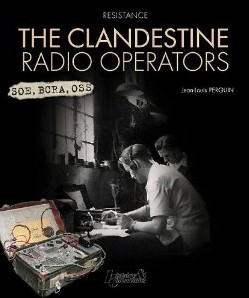
Some of the stories of these clandestine radio operators, as well as the equipment they used were chronicled in a book called, fittingly enough, “The Clandestine Radio Operators” by Jean-Louis Perquin. It is still available at Amazon.
So the next time you’re operating your “flea power” radio, whether it be from the comfort of your shack, or in the grandeur of the great outdoors, say a silent prayer for those who went before us – on a mission that had life and death consequences. Their valiant efforts helped to preserve the freedoms that allow us to continue operating our “clandestine radios” today.
72 de Larry W2LJ
QRP – When you care to send the very least!
Larry Makoski, W2LJ, is a regular contributor to AmateurRadio.com and writes from New Jersey, USA. Contact him at [email protected].
A Strange and Wonderful Experiment
Today Hanz W1JSB and I went out for a hike. We wanted to make a couple of QSOs on 40 meters. We worked New York and Pennsylvania and didn’t even bring a rig with us! Huh? Hanz used his cell phone to operate his FT-817 remotely at home. It was strange and wonderful.
We hiked east from the Sanbornton dump toward Giles Pond. It was about 33F, but sunny. We hiked around the back side of this field and stopped along the trail about a half mile from the pond.

Hanz pulled out his Samsung cell phone and started pressing buttons. First he connected to his Windows box in the shack and fired up Ham Radio Deluxe. Then he established a link using Skype so we’d have audio. Then he got CWType running so he could key the rig. His FT-817 at 5 watts was hooked up to a center fed dipole through an LDG auto tuner.

Hanz had a grin on his face as keyed “KA2KDJ de W1JSB” onto the cell phone keyboard. Gary answered right away from New York. It was magic. Then Hanz told him how he was operating.
For a video of the QSOs see http://www.w1pid.com/strange/strange.html
“FB CPY,” Gary sent back. “UR 579” Gary was a 599 and clear as a bell. They chatted for about 5 minutes. Hanz’s fingers were getting cold, so he sent 73 and TNX. As we started walking back down the trail we heard another station calling Hanz! “W1JSB de AA3OI/QRP” What the heck? we thought. A pileup. So Hanz answered Joe AA3OI and they had a quick QSO.
Pretty cool… what started as a goofy experiment actually worked. Are we going to stop bringing rigs and antennas on our hikes? No way, this was just a proof of concept, and not really very practical. But it sure was a hoot and Hanz demonstrated that he could certainly do a pedestrian mobile operation without lugging radio, batteries and antennas.
-end-
Jim Cluett, W1PID, is a regular contributor to AmateurRadio.com and writes from New Hampshire, USA. Contact him at [email protected].
Tough 80 Meter QRP Fox hunt tonight
It was a tough go on the 80 Meter QRP Fox hunt tonight.
First off, I never heard TJ WØEA in Iowa at all. This was not a surprise; as Iowa is a tough haul for 80 Meters. I really wasn’t expecting to hear TJ at all. What did surprise me was that I didn’t hear any of his pursuing Hounds, either.
I did manage to get into Lee AA4GA’s log. A QSO between Georgia and New Jersey is way more realistic for 80 Meters. But there was a ton of QRM and some pretty loud QRN which made it a bit tougher than it should have been. I got in Lee’s log with 11 minutes to go – these hunts last 90 minutes. So there was 79 minutes of trying to figure out Lee’s listening sequence, dealing with QRM, etc.
One thing that made it a lot easier was using the KX3 tonight and making use of the “Dual Watch” function. For those of you who don’t have a KX3, this is where you use both the main receiver and the sub-receiver together. You turn on the Dual Watch function and plug in a pair of stereo headphones. The main receiver goes to one ear while the sub-receiver goes to the other ear. This makes it a breeze to find where the last successful Hound was transmitting, tune the sub-receiver there and then go to town with operating split. As long as the two frequencies do not exceed a 15 kHz split, the Dual Watch function takes a lot of the guess work out of operating split.
The W3EDP served me in good stead again tonight, getting me a “one-fer” – one out of two Fox pelts. Hey, if I was a Major Leaguer, a .500 batting average would make me a very wealthy man!
72 de Larry W2LJ
QRP – When you care to send the very least!
Larry Makoski, W2LJ, is a regular contributor to AmateurRadio.com and writes from New Jersey, USA. Contact him at [email protected].
 Ham Radio Deluxe |
 W5SWL Electronics |
 Ham Radio Prep |
 KB3IFH QSL Cards  Hip Ham Shirts  HamRadioAuctions HamRadioAuctions Reliance Antennas Reliance Antennas Enigma Shop Enigma Shop |  morseDX  Ni4L Antennas  R&L Electronics R&L Electronics antennas.us antennas.us QRV QRV |
- Matt W1MST, Managing Editor
