 |
 Cobwebb at a price
 11 December 2012 | by
 Lamco have added a new product to their range. A Cobwebb antenna. It goes under the name of a MyHam HF-7B and it is specified as an antenna with a useful range of 20/17/15/12/10/6/4m bands.
I noticed this in the latest Practical Wireless and thought I’d email a copy to Mike Corke, ZS1RJQ who has now made 6 of these. We are both users of the Cobwebb but both of us have homebrewed versions. I was interested to see how much his cost to make and like me, he spent about £40 making each of his. Mine was a little dearer on account of me making a few experiments along the way. We both had a little chuckle at the cost of this commercial version at £249.
If you need an HF antenna then it seems that the commercial versions are very expensive and homebrew antennas cost a bit in time but a lot less in terms of £. I buy my bits and pieces from all sorts of places but AMTools / Spratreader on eBay has all the bits you need for the hardware for a much lower price. If you don’t see what you need then just email him and I’m sure he’ll be able to help.
If homebrew isn’t your thing then there isn’t much of an option. But it seems it’ll cost you for a simple piece of hardware. I’m sure if I were to every build my own rig it’ll look like a dogs breakfast and perform in a similar fashion but simple bits of wire shouldn’t cost that much.
(Just to clarify I’m not singling out any one supplier, but just observing that off the shelf stuff can cost a fortune compared to home made stuff.)
Alex Hill, G7KSE, is a regular contributor to AmateurRadio.com and writes from Cumbria, UK. Contact him at [email protected].
My take on 63 Degrees of Propagation: The 2012 ARRL 10 Meter Contest
My take on 63 Degrees of Propagation: The 2012 ARRL 10 Meter Contest – Like Eggnog: In the end, I made well under half of the contacts I did last year. I’m certain I did not work anything new to me this weekend but I was sure hoping. Running low power, I sure had plenty of stations CQ’n in my face but that’s all part of the challenge when the bands are tough. But a bad day of contesting is still better than a great day in the office!
Contest on, Brother!
My 10,000 Hour RadioSport Challenge | 9,398 – 20 = 9,378 To Go
 |
| 2012 ARRL 10 Meter Mixed Mode Results |
Good morning from the #hamr shackadelic zone where I’m listening to Hans Zimmer score from The Dark Knight film. If any one composer can establish a mood for writing then Zimmer’s passionate heroic tracks gets my, “Roger, that.”
RadioSport Pain
Sometimes, RadioSport is a game of pain, when hours seem to punish my lower back, muscles stiffen, and my brain rings from automated CQs generated by N1MM Contest Logger. Meanwhile sunny skies beckoned and I wondered if the challenge is worth my time? This weekend was remarkable because I experienced propagation vagaries especially skewed path toward South America, radio black outs, and long path out of no where.
Friday Night
Friday night was a radio frequency adventure because Australia and New Zealand started populating my log as SL’s five element beam pointed 75 degrees toward the East coast of the United States. Likewise, Japan and China are in sun light however not a signal heard inside the cans. This was the start of strange propagation where I did not beam energy in otherwise normal directions.
Am I logging Victor Kilowatts and Zulu Limas via long path? Where is Japan and China? I have not heard a single Yankee Bravo either? Fascinating.
Waterfall
I paid attention to the position of the sun in the southern hemisphere. It was like a gargantuan magnetic pulling electromagnetic waves over the equator. The rush of energy probably surprised many Papa Yankees, Lima Uniforms, Charlie Whiskeys, Hotel Kilowatts, and Charlie X-rays. My situation was a midwest-to-easterly radio blackout throughout Saturday with zero signals radiating out of the Caribbean basin and vapor out of Europe.
I’m thinking this is remarkable because my normal strategy does not apply.
Es
South American stations carried my log all day Saturday after a brief opening to the East coast shortly before West coast noon. In contrast, perhaps, an E cloud of significant size focused my signal toward the south eastern section of the United States specifically Georgia and Florida. I realized six straight Georgian stations and seven Floridian stations in the log within an hour after sunrise.
The record for consecutive state Qs goes to Florida. Amazing! In contrast, I logged only one 0-land station from Colorado during my 20 hours of operation. It was complete radio silence from the heartland including Texas.
South America Roars
Perhaps mid-western latitude and longitude significantly impacted by the lack of ionospheric ionization created a skip zone between both coasts? Wireless skip did not approach a latitude of 60 degrees or greater throughout Saturday at least from the central coast of California. Additionally, I pointed SL’s 5 elements at 310 degrees in the afternoon instead of 110 degrees or greater and South America roared inside my cans. Skew path is fascinating.
I was grateful that so many in South America kept the game in the game for North America especially for this operator on the central coast of California!
It is evident that the go-to mode this weekend was definitely Morse code. I could not establish any ionospheric traction using single side band and calling human generated CQs was punishing enough. Instead, with less ionospheric absorption soaking up energy, I focused on the code. My hours matched the rush of shooting Class V white water with peaks at 4 Qs per minute or 1 Q every 15 seconds.
In Sum
Yes, as painful as a RadioSport weekend can be this was one, however; let’s not overlook the lemonade from lemons. It was strange propagation that made 20 hours in the pilot’s seat a learning experience. The reward was knowledge gained from practice, practice, practice.
Contest on!
Show Notes #096
Introduction:
- Welcome to another edition of the Super Happy Crappy Hour!
Announcements:
- The Black Sparrow Media mobile app is again hosted thanks to listener donations. Visit the BSM website to download the app and enjoy all of the BSM affiliated shows.
- CafeNinja and the Tin Foil Hat Show have joined the Black Sparrow Media network.
- If you’d like to participate in the chat room, point your IRC client at the irc.freenode.net server, and join the #lhspodcast channel.
- You can listen to the live show by pointing your media player (VLC, Totem, or whatever) to http://stream.blacksparrow.net:8008/lhslive.
- Our live recording night will be moving to Wednesday evenings (CST) beginning with Episode 97, scheduled for December 12th, 2012.
- Welcome Gnorman to the LHS staff.
Topics:
- TLF Contest Logger.
- Our hosts then embark on several digressions about Gnorman, Lua, and other podcasters.
Feedback:
- Torsten, DL1THM, sends an email describing his use of a Raspberry Pi as an APRS digi using aprx software and as a D-Star repeater using a DV-RPTR board. Thanks, Torsten.
- Greg responded to episode 94 about uses for the Raspberry Pi, including a media PC with Raspbmc and perhaps as a weather station. Thanks, Greg.
- Russ and Richard also talk about D-Star stuff, and D-RATS. (D-RATS has been mentioned in LHS episodes 17, 32, 56, 71 and 90.)
- Comment from the Web site from Leif, KC8RWR, in response to episode 91 where Russ rants about the lack of speakers in the head units of mobile radios. Thanks, Leif.
- Fred, DH5FS, sent a suggestion to consider TLF as a Linux contest logger. Thanks, Fred. Your email inspired tonight’s topic.
- Bill, KJ4KNI, on Facebook expressed his appreciation for help getting Linux Mint 13 with the MATE desktop running on his main computer. He also provides several reasons a ham might wish to use RG6 (75 ohm coax) in radio applications. Thanks, Bill.
Contact Info:
- Contact Richard at [email protected], Russ at [email protected], or both at the same time at [email protected].
- Listen to the live stream every other Tuesday at 8:00pm Central time. Check the LHS web site for dates.
- Leave us a voice mail at 1-909-LHS-SHOW (1-909-547-7469), or record an introduction to the podcast.
- Sign up for the LHS mailing list.
- Sign up for the MAGNetcon mailing list.
- LHS merchandise is available at the Merch link on Web site. Check out the Badgerwear or buy one of the other LHS-branded items at PrintFection.com/lhs or Cafe Press. Thanks!
- Thanks to Dave from Gamma Leonis for the theme music.
Music:
- “Crooked Smile Girl” by Heather Pierson, from her album Make It Mine.
- “Agnostic” by Daniel Bautista from the album 15, courtesy of Jamendo.
Russ Woodman, K5TUX, co-hosts the Linux in the Ham Shack podcast which is available for download in both MP3 and OGG audio format. Contact him at [email protected].
Contest Skeeter Hunt wallpaper
 |
| Just waiting to be framed and hung on the "I love me" wall |
Mike Weir, VE9KK, is a regular contributor to AmateurRadio.com and writes from New Brunswick, Canada. Contact him at [email protected].
Beacon monitor failure
After wasting most of the weekend trying to get it to work I have abandoned the idea of monitoring the IBP beacons using Faros. Although I did have it working with my Elecraft K3 I did not want to tie up this expensive transceiver on such a task. But my efforts to get my FT-817 working with this software came to nothing.
The first problem was getting Faros to control the FT-817. It uses a program called Omni-Rig to do this. The solution – no thanks to the developer who has still not replied to my plea for help – turned out to be a bad FT-817.ini file installed with Omni-Rig. I tried other programs to verify that my FT-817 CAT interface was working properly. I even ran the same developer’s CW Skimmer software which also uses Omni-Rig, and which controlled the FT-817 just fine. The idea of looking to see if there was a different FT-817.ini file was just a flash of inspiration.
Having got Faros controlling the radio the second and final problem was getting it and the Yaesu talking to the same sound card. This did work if I used the computer’s built-in sound card, but that is normally used by my K3. I have several radios in my shack, most of which are connected to the shack PC and all of the others use various USB sound devices. Whilst all of my other software – including my own program KComm – produce a drop-down list showing distinguishable names of all these devices, Faros displays a list showing three lines that all say “USB Sound Device.” I tried selecting each one of them in turn, but I could not get Faros to talk to the sound device that was actually connected to the FT-817.
If it was confusing for me trying to choose from identically named devices, it also seemed to confuse Windows, which ended up sending PSK31 audio out of the PC speaker instead of to my K3! I had to reboot the computer to get sound using the correct devices again. At this point I threw in the towel and admitted defeat. Some things just aren’t worth the hassle.
So endeth my attempt at beacon monitoring.
Julian Moss, G4ILO, is a regular contributor to AmateurRadio.com and writes from Cumbria, England. Contact him at [email protected].
So here’s the deal ……
I was sitting in the shack Thursday night, working the Fox hunt and I was looking at my K2. It looks kind of lonely, sitting there idly, while my K3 and KX3 get all the duty time. So I made a decision – my baby needs to go to a home where it will be the “star” and get the usage it deserves. This radio deserves better than “back up” status. It really, really, really kills me to do this – but unlike others, I realize there are only so many radios that I can reasonably have and put on the air at any given moment.
This is K2 – serial number 4090. It has the latest version of the main board in it. It also has the following:
K160RX – allows 160M operation.
KNB2 – Noise Blanker
KAF2 – Audio Filter
KAT2 – 20 Watt built in auto tuner.
My K2 is CW only – no SSB module and it is the QRP version, it is NOT a K2/100.
Here’s a picture:
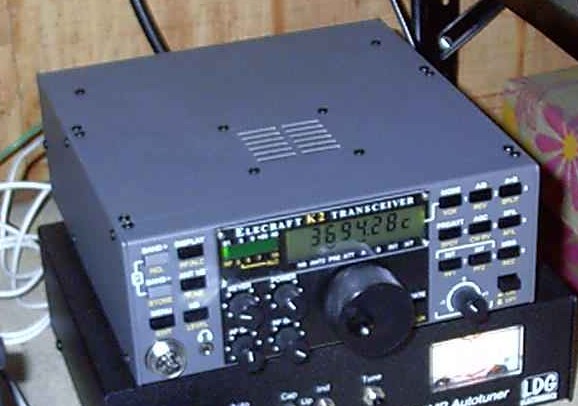
I personally built this baby and after I had built it, I had sent it to Alan Wilcox of Wilcox Engineering. He installed the KAF2 for me and perfected the settings of the filters and tweaked it for optimum output. This radio is the best!
Cosmetically, it is a 9.8 out of 10. The case is PRISTINE and the only imperfections are a few minor scuffs on the face of the main tuning knob.
If you were to purchase all the components new from Elecraft, it would cost you $1090.00, plus you’d have to build it (and there is a rumor of a price increase from Elecraft at the beginning of the new year). This radio, although used, looks and (even better) works perfectly. AND it comes from a non-smoker home. I am contemplating a price of $850.00, and I will cover the (domestic) shipping. I have the original manual and will throw in the power cord. – Note: K2 IS SOLD
In the same vein, I am also offering up my PFR3A:
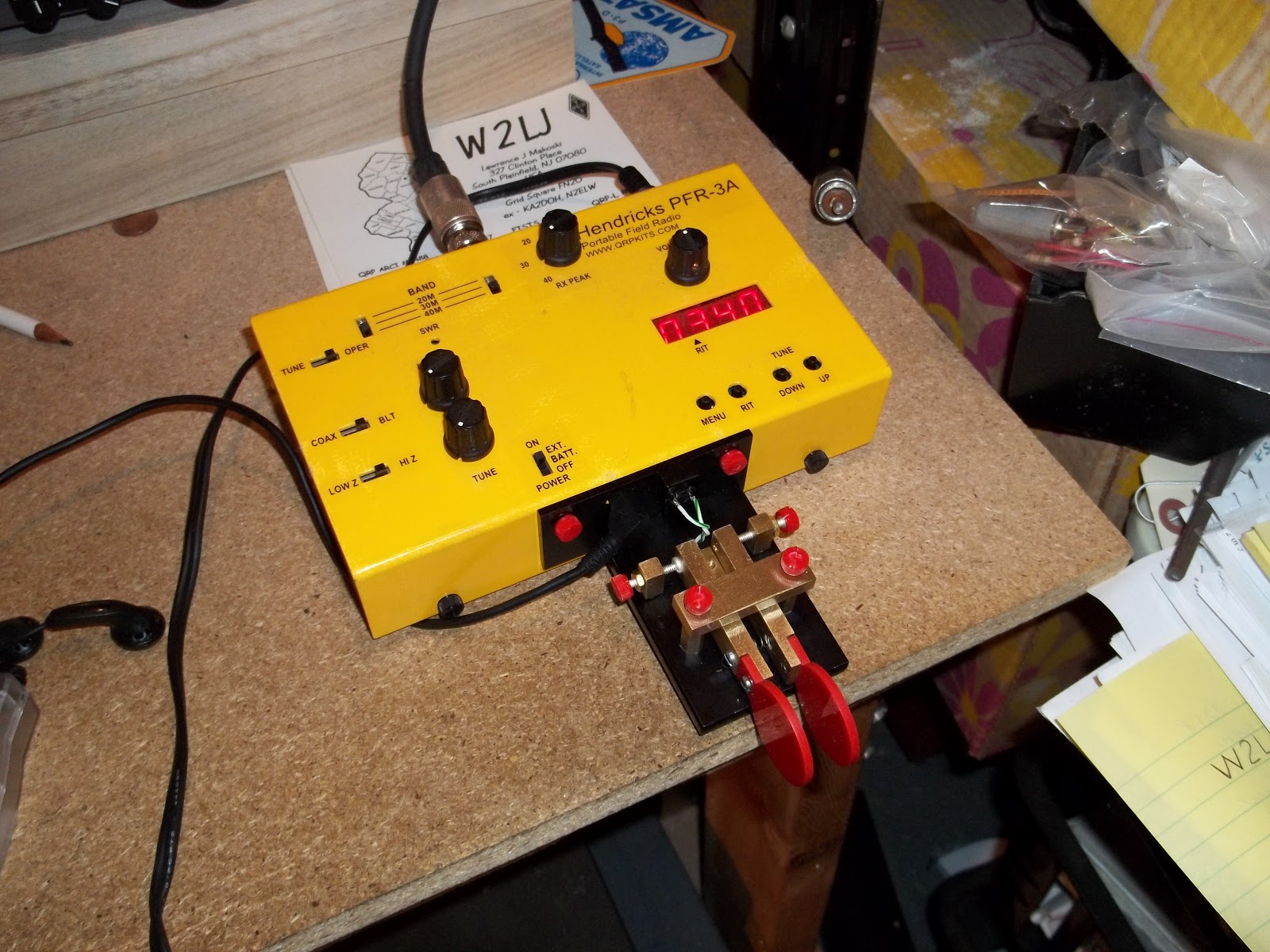
This includes the Baby Black Widow paddles. There is an issue – a cosmetic one. I clear coated the front cover of the PFR3A and it got smudged before the clear coat dried completely. I’d rate this one as an 8 out of 10. BUT ……….. I ordered a new front cover for it; but have not had the time to put the decals on it, clear coat it and install it. So this package will contain the PFR3A, new cover and decals, as well as the Baby Black Widow paddles. Brandy new from Hendricks QRPKits, the radio alone goes for – $240.00. I will let this one go with the extras described above for $200. I will also cover the (domestic) shipping costs of this one too.
I am probably going to post these to QRP-L tomorrow evening. If I get no bites there, then onto eBay probably Monday or Tuesday. I’m giving my readers first crack.
I accept PayPal or money orders – and the above prices are not carved in granite. I’m willing to consider REASONABLE offers. Please send an e-mail to [email protected] if interested. Please don’t use the comments as they have been wacky with spam and I might miss your offer as I delete spam comments.
72 de Larry W2LJ
QRP – When you care to send the very least!
Larry Makoski, W2LJ, is a regular contributor to AmateurRadio.com and writes from New Jersey, USA. Contact him at [email protected].
 Ham Radio Deluxe |
 W5SWL Electronics |
 Ham Radio Prep |
 KB3IFH QSL Cards  Hip Ham Shirts  HamRadioAuctions HamRadioAuctions Reliance Antennas Reliance Antennas Enigma Shop Enigma Shop |  morseDX  Ni4L Antennas  R&L Electronics R&L Electronics antennas.us antennas.us QRV QRV |
- Matt W1MST, Managing Editor
