 |
 5MHz and 472khz NOVs received
 22 December 2012 | by
 Over the last day or so, I’d seen people commenting on Twitter that they’d applied for 5MHz NOVs. I’ve got a current one and I wasn’t sure whether I need to apply for a new one to use the new frequencies. I decided that it was probably just easier to apply for a new NOV and then there is no doubt!
Application for the NOV couldn’t be easier! Just head over to the RSGB’s NOV page – the only thing that slowed me up was that I didn’t know my licence number, so I had to log onto the OFCOM portal (having remembered my password!) to find it out.
On the same page there is the NOV application for the new 472khz band. I decided that, although I don’t have any gear for the band at the moment, I might as well apply for an NOV, which I have done and received. And it’s already given rise to a bit of experimentation which has been quite interesting. More on that in another post…
The NOVs don’t come into force until 1st January 2013, but I am looking forward to seeing what can be done on these bands.
Tim Kirby, G4VXE, is a regular contributor to AmateurRadio.com and writes from Oxfordshire, England. Contact him at [email protected].
The First List And Comments On LoTW
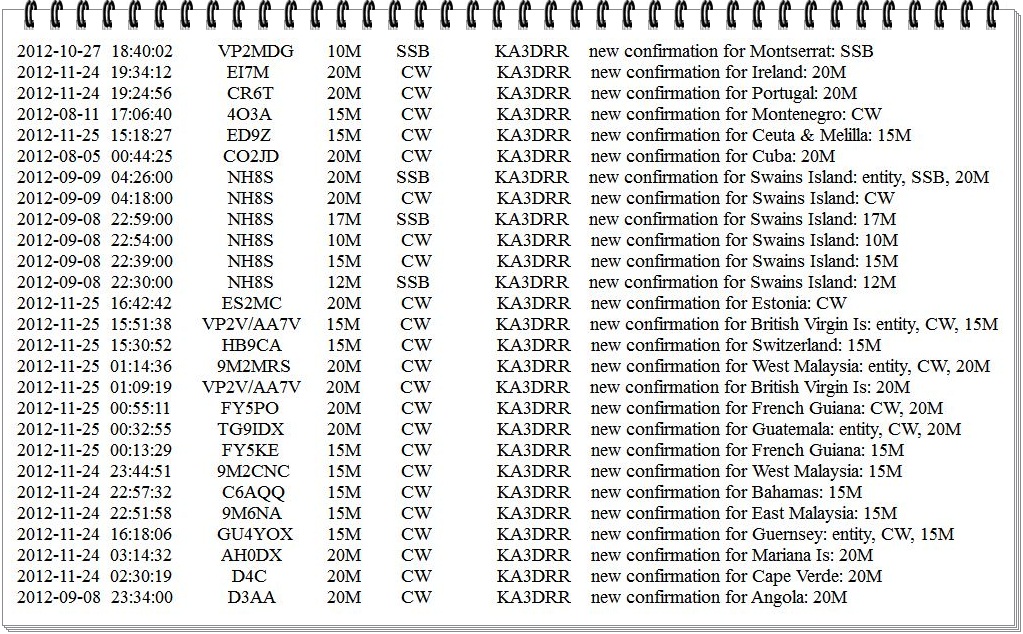 |
| First List As Of 21 December 2012 |
Good afternoon from the shackadelic #hamr zone where I’m listening to PV8AA running rate during 2012 WPX CW earlier in the year. Currently, there is a swarm of stations on Paolo, PV8DX rate frequency, and he is efficiently executing our RadioSport adrenaline rush.
In the meantime, between my vicarious thrill of listening to Paolo, PV8DX an accomplished DXer and RadioSport operator at PV8AA; a significant load of LoTW credits were downloaded into my log. The Swains Island DXpedition confirmed on respective band slots in addition to 4O3A, D4C, and D3AA.
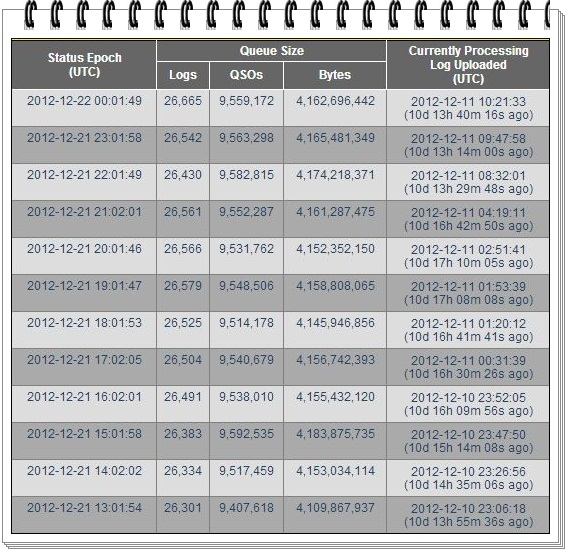 |
| LoTW Queue Status As Of 21 December 2012 |
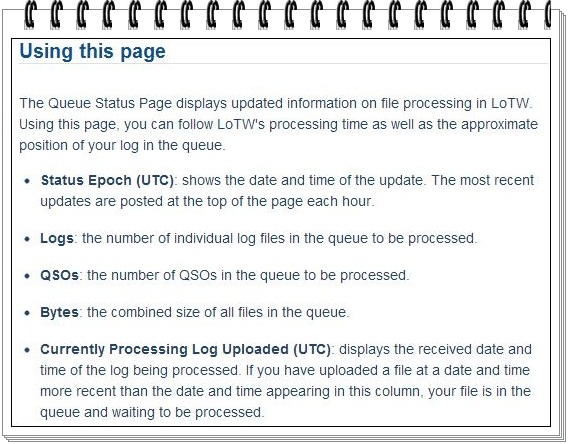
As of 21 December 2012 at 1301 UTC approximately (n = 26,301) individual logs are in the LoTW queue for processing then on 22 December 2012 at 0001 UTC approximately (n = 26,665) individual logs are awaiting processing with a 10 day, 14 hour, 40m, 16s backlog of credits yet processed.
I’m of the opinion that LoTW is one of the ARRL’s signature programs because all of our awards are based on its credit system. First, it was explained to me that current system hardware will be replaced in the very near future, explanation accepted. Then, an initiative to reinvigorate open sourcing of Trusted QSL, in order to improve functionality and efficiency.
The last communication to membership from the ARRL was 11 December 2012 and 10 business days have elapsed since the severe disruption of credit processing. Where are status updates that quantify progress? Where are we in regards to the open source project? Has any hardware arrived and from whom is membership purchasing the hardware from?
Frankly, this is unacceptable, organizations thrive on two way communication channels with almost daily updates to all those concerned especially if one of your signature programs is failing spectacularly. I’m losing confidence in the credibility of the system because of the lack of information. My question is, “What is going on?”
73 from the shackadelic near the beach.
Winter blues
I like Christmas, but with that sole exception I hate this time of year. The short days, when it’s dark at breakfast time, dark at tea time, and in between the sun struggles to reach an elevation where it can be seen over the tops of neighbouring houses.
It’s not just the daylight the sun fails to make much impact on. There’s next to no propagation on any of the higher HF bands. I believe that LF band enthusiasts have their best time at this time of year. But I have never been lucky enough to have an antenna for the LF bands. My attic multiband dipole will work on 80 metres but it is shortened so much that the usable bandwidth is barely 60kHz. It is really only usable on the QRP CW frequency and the PSK31 operating frequencies.
Yesterday I thought I would try some digital work on the 30m band. I couldn’t hear any PSK31 at first but I did hear some JT65 so I thought I would try that. I made three QSOs including one with N4ABN which I thought was quite good nfor mid-morning. The trouble with JT65 is that I find it difficult to maintain concentration. It’s 50 seconds before anything is decoded, and during that time my mind has drifted off and I have missed the moment when I should have responded.
Just as an aside, I noticed a quirk with the JT65-HF software. I don’t use CAT control of my K3 (never could get it to work) so I have to set the frequency of the radio and the software manually. But whenever I did this, after a few seconds the frequency would reset itself to 0. I happened to notice that the frequency was being displayed with a comma as the decimal separator. I had left the PC configured like that after testing the fix for the problem with KComm. On a hunch, I reset the separator to a dot (period) and lo and behold the frequency stayed as I set it. I’m surprised that no-one seems to have spotted this but at least we know now how to fix it.
After making a bit of a meal of three JT65 QSOs I decided to switch to PSK31. Although it is not such a good mode for DX, if proof were needed, there were 3 or 4 spots of me on JT65A in the USA but my PSK31 at slightly higher power never penetrated beyond Western Europe.
I do find PSK31 a more rewarding mode to operate, though, because you do usually find out something about the other operator or his station. Having said that, has anyone noticed a trend towards shorter QSOs in PSK31? Quite often now it’s name, report, qth, locator and goodbye. Whilst I can’t say I miss knowing the make and model of the operator’s computer and the colour of the interface cable, I do like to know what power they are running and what antenna they are using.
Julian Moss, G4ILO, is a regular contributor to AmateurRadio.com and writes from Cumbria, England. Contact him at [email protected].
Zombie Shuffle updates
Paul NA5N – Head Zombie and Maya King posted this today:
“I have some exciting news updates regarding the End-of-the-World Zombie Shuffle Friday (tomorrow) night.
First, I was contacted by a ham in Belize who heard about our special event and asked to participate in the Shuffle from the real Maya empire. Of course I asked him to be a Maya King!
He has agreed and thus will be our real, authentic “High Maya King” on the air, and some nice DX. (Turns out, his wife is Mayan). He was assigned Zombie number 1010, so he will be worth 1010+666 = 1676 points. So listen for a Mayan Zombie who’s calls start with “V31.” He will be operating QRP. He said he lives about 150 yards from the ocean … so we’ll be the first to know when the Mayan Empire slides into the sea!!!
Jan passed 1,000 zombie numbers last night.
# 999 was assigned to Terry K9DXA
#1000 was assigned to Steve W1SGC
#1015 was just assigned.
So there will be a few “4-digit” Zombie numbers on the air.
Our friend Ed, W1RFI (who will be in the Shuffle) asked why working Maya Kings aren’t worth “2012” points vs. 666? All I can say is: “Dang! Why didn’t I think of that?” Good going, Ed. However, I am hesitant to change the scoring rules only one day before the event. My apologies for missing such an obvious good idea.
And, the Central Connecticut QRP Club will be on the Shuffle using their famous club call of W1FB. This, of course, was the call of legendary QRP ham Doug DeMaw (SK), who authored numerous ARRL QRP related books and articles, and designer of the Tuna Tin 2 and other legacy QRP rigs. What a great tribute to Doug (who is now a Maya King).
So we’ve added two more Maya Kings to the rolls … W1FB and our V31 High King in Belize. You’ll just have to find out who the others are.
It’s almost criminal to have this much fun in the face of the entire destruction of the human race in just hours! Are we QRPers and Zombies, or what?
72, Paul NA5N
Zombie NR 04
Zombie Shuffle rules and summary sheet at:
http://www.zianet.com/qrp/ZOMBIE/zombie.htm“
Thanks, Paul! I am looking forward to this tomorrow evening! And since tomorrow is the Winter Solstice and we have the least amount of daylight, it gives us extra operating time for the Shuffle this year.
72 de Larry W2LJ – For tomorrow night at least – Maya King #858
QRP – When you care to send the very least!
Larry Makoski, W2LJ, is a regular contributor to AmateurRadio.com and writes from New Jersey, USA. Contact him at [email protected].
From The W6SL DX Desk | Dummy Load
Ham Nation 78

http://dts.podtrac.com/redirect.mp4/twit.cachefly.net/video/hn/hn0078/hn0078_h264m_1280x720_1872.mp4
http://dts.podtrac.com/redirect.mp4/twit.cachefly.net/video/hn/hn0078/hn0078_h264m_864x480_500.mp4
http://dts.podtrac.com/redirect.mp4/twit.cachefly.net/video/hn/hn0078/hn0078_h264b_640x368_256.mp4
http://www.podtrac.com/pts/redirect.mp3/twit.cachefly.net/hn0078.mp3
Hosts: Bob Heil (K9EID), Gordon West (WB6NOA), and George Thomas (W5JDX).
HRO Appreciation Day in Atlanta, christmas poems, and turning a Raspberry Pi into an FM transmitter.
Guests: Don Wilbanks (AE5DW), Cheryl Lasek (K9BIK), and Amanda Alden (K1DDN).
Download or subscribe to this show at http://twit.tv/hn.
Submit your own video to Ham Nation! See the Video Guidelines, http://www.frozen-in-time.com/guide/
We invite you to read, add to, and amend our show notes at wiki.twit.tv.
Thanks to Joe Walsh who wrote and plays the Ham Nation theme.
Thanks to Cachefly for the bandwidth for this show.
Dr. Bob Heil, K9EID, is the founder of Heil Sound and host of TWiT.tv's Ham Nation which streams live each Tuesday at 6:00pm PT (9:00pm ET) at http://live.twit.tv. Contact him at [email protected].
Proper Kerchunking
Bob Witte, KØNR, is a regular contributor to AmateurRadio.com and writes from Colorado, USA. Contact him at [email protected].
 Ham Radio Deluxe |
 W5SWL Electronics |
 Ham Radio Prep |
 KB3IFH QSL Cards  Hip Ham Shirts  HamRadioAuctions HamRadioAuctions Reliance Antennas Reliance Antennas Enigma Shop Enigma Shop |  morseDX  Ni4L Antennas  R&L Electronics R&L Electronics antennas.us antennas.us QRV QRV |
- Matt W1MST, Managing Editor
