 |
 Windows 8 Presents Opportunity
 23 December 2012 | by
 Brian Boyko, a freelance IT author, created this informational and rather entertaining video on Windows 8.
The video echos a lot of my experiences, albeit brief ones with Windows 8. A few weeks ago I attempted to use a Windows 8 Surface tablet at a mall kiosk and left in frustration. Last week while Christmas shopping I happened to venture into the computer section of a department store and played with a Windows 8 laptop. After ten minutes of trying to make sense of the Metro interface, I again left in frustration. I should mention I’m not a computer newbie. I’ve been using computers for over 30 years, and have worked with them in a professional capacity for over 20. I used Linux before it was sexy and my first GUI based OS was Windows 3.1. I’ve never owned a piece of Mac hardware (I have an iPad and an iPhone), but if you drop me in an Apple store and put me in front of a Mac, I can be web browsing, viewing pictures, and creating documents in moments. I just can’t do it with Windows 8.
User interface changes are always stressful to end users. The last major one Microsoft made was the ribbon bar in Microsoft Office replacing the venerable and admittedly long-in-the-tooth menu bar. At first I hated it and customized all my Office applications to have the buttons I needed in the quick bar which sits up in the title bar. Eventually I got used to the ribbon bar, but being a fan of minimalist interfaces I think the quick bar is much more efficient. But, OK, I admit Microsoft was right with the ribbon bar and it’s a valid step in the evolution of user interfaces.
I won’t repeat everything in Boyko’s video, but he’s absolutely right on all points. The Windows 8 Metro interface is a massive departure from the old interface. The revolutionary change would be a good one if it was actually an improvement. But similar to when Microsoft tried to put a desktop OS on a mobile device (Windows Mobile/CE), now they’re trying to shoehorn a mobile phone and tablet OS on to a PC, and it just doesn’t work.
This video goes into the desktop mode a bit more and shows the discontinuity between Metro and the desktop:
The changes in Windows 8 presents an opportunity for anyone who uses Windows, including amateur radio operators and software authors. While Windows 8 has a compatibility mode that essentially lets you run legacy apps in a legacy pre-Windows 8 style desktop, it’s problematic. If Microsoft doesn’t abandon Metro, they’re likely going to push application authors to the Metro interface, perhaps at some point even eliminating the legacy user interface. With such a revolutionary change to this tool and its steep learning curve, it may be just as easy to migrate to Linux, Mac, or a Chromebook and learn something totally new that is actually going to be productive and useful. With Windows 8, essentially Microsoft has increased the pain of upgrading to the point where it is equal or less pain to migrate to a different platform. I suspect many people will horde old or bootleg copies of Windows 7 and XP, storing them away like a rare wine or expensive cigar, for use when getting a new piece of hardware. It’s going to be interesting.

That was fun!
Surprise! The world did NOT end yesterday …….. and seriously, did you think for even the tiniest bit that it would?
But it was the shortest day of the year and Winter has officially arrived in the Northern Hemisphere (Happy Summer to you folks lucky enough to enjoy it in the Southern half!). So for once, I looked towards the dark hours, because at sunset the 2012 Zombie Shuffle commenced. I made one QSO on 20 Meters with John K4BAI before being called to dinner. After that, the family went for a drive to go view some Chrsitmas lights.
When we got home, I jumped on the radio – about 9:30 PM and stayed on for a little over two hours. Much to my surprise, I heard not a Zombie soul on 40 Meters. Even though I know that 40 Meters goes long, I expected to hear something there – but no dice.
For me, all the action was confined to 80 Meters. When all was said and done, 16 Zombies were nabbed including 4 Maya Kings. Not great; but not as terrible as I thought it was going to be with 40 Meters out of the picture.
Thanks to all the Zombies and Maya Kings that made it into my log – and special thanks to Paul NA5N for running the event.
This afternoon, I went grocery shopping and you would have thought I went to a regular shopping mall! There was traffic everywhere and a close parking spot was not to be found. What is it about the Saturday before Christmas that makes seasoned motorists drive like they’ve never been before the wheel before? Traffic and crowds were a nightmare – glad I have all my Christmas shopping done. Now …. onto wrapping!
As Advent draws to a close and Christmas draws ever closer, I leave you today with a beautiful Advent hymn – “Oh Come, Oh Come Emmanuel” which is being sung in the original Latin (it started out as a Gregorian chant) by Hayley Westenra who has an absolutely angelic voice.
72 de Larry W2LJ
QRP – When you care to send the very least!
Larry Makoski, W2LJ, is a regular contributor to AmateurRadio.com and writes from New Jersey, USA. Contact him at [email protected].
2012 CQ WPX CW Log Check Report
 |
| Summary 13.9% Score Reduction |
 |
| Not In Log |
 |
| Incorrect Call |
 |
| Incorrect Exchange Information |
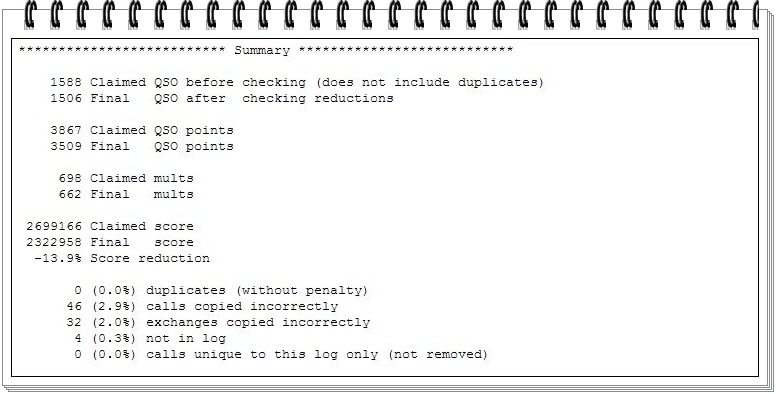
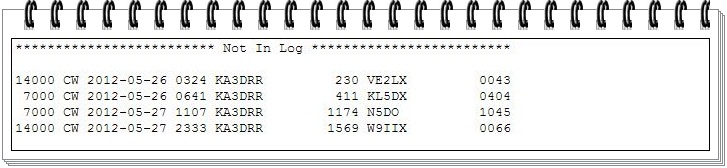
Let’s start with my score summary as I took a 13.9% (n = 376,208) score reduction as a result of not in log, incorrect call, and incorrect exchange information. I mentioned in my previous post there is cause and effect when the score is officially adjudicated.
Likewise, there is perspective, as I claimed (n = 1,588 Qs) and my final was (n = 1,506 Qs) or 2.9% of calls copied incorrectly (n = 46) and 2.0% incorrect exchange information (n = 32) with 0.3% not in the log (n = 4).
Subsequently, 376,208 points was subtracted from my claimed total of 2,699,166 points (2,699,166 – 2,322,958 = 376,208 point reduction).
The question I’m asking of my performance, “What is my root cause?”
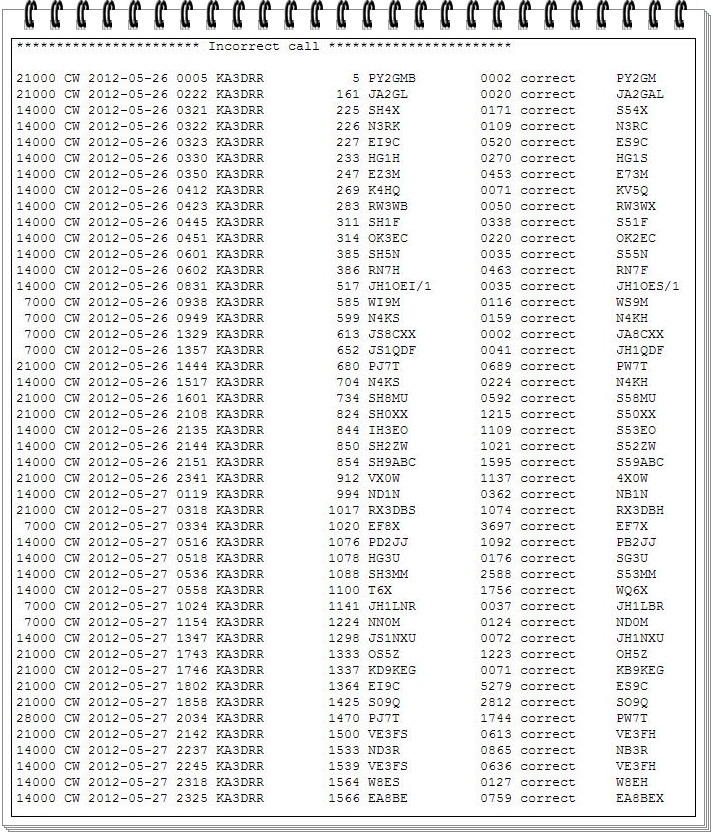
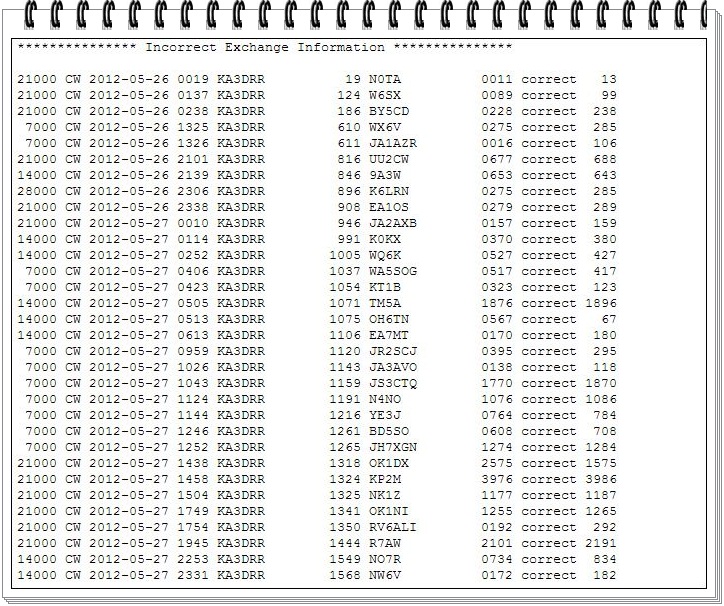
There is a definitive pattern when reviewing incorrect callsigns and incorrect exchange information. If I were to scatter plot then a picture emerges that is the preponderance of evidence suggests missed dits and missed dahs of letters-to-numbers and numbers-to-numbers.
For example, SH8MU corrected to S58MU, SH0XX corrected to S50XX, or IH3EO corrected to S53EO, SH2ZW corrected to S52ZW, and SH9ABC corrected to S59ABC.
Examples of incorrectly copied numbers such as 228 corrected to 238 or 275 corrected to 285.
Root cause analysis suggests I am not hearing crucial dits/dahs and cannot be explained away as mistakes at the keyboard. The solution is carefully listen or ask for a repeat if there is any question about either callsign or exchange information.
What patterns are you seeing in your log check report?
Contest on!
Explaining RadioSport Log Check Report
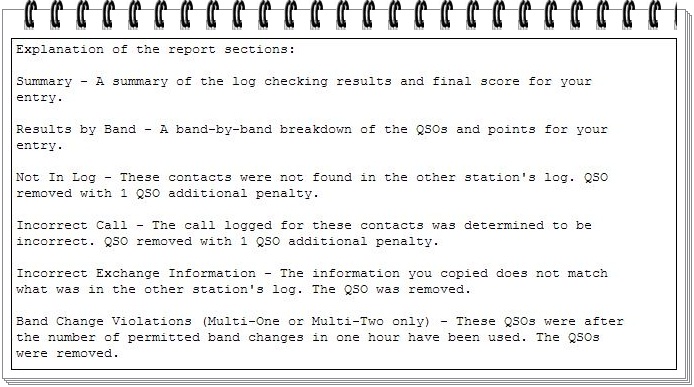
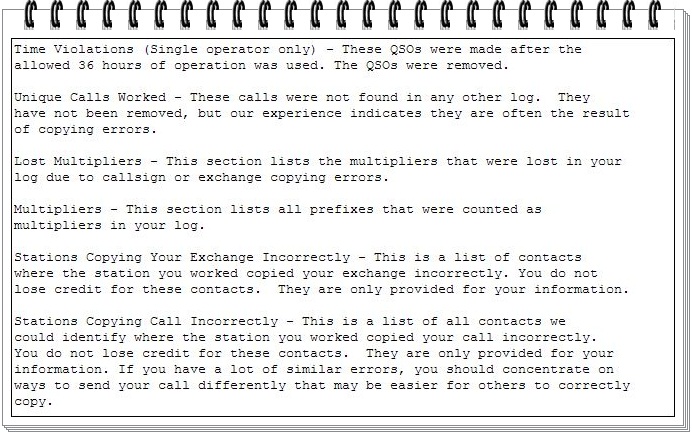
Good Saturday morning from the #hamr shackadelic zone as rain moves across the central coast of California for the remainder of the weekend. Our local surf conditions are overhead and extremely choppy. Additionally, I’m hearing signals from Texas on 15m and Canada on 20m, while Cycle 24 numbers especially sunspot count suggest satisfactory to quiet conditions.
The RadioSport log check report (LCR) is my adjudicated score that is my official score after software verifies complete and accurate exchanges including the callsign of the station. The LCR is my performance report. I recommend familiarizing to the level of knowledgeable because there is a cause and effect relationship when a station is logged.
Not in log (NIL) results in one additional QSO removed from my log.
Incorrect call results in one additional QSO penalty.
Incorrect exchange information results in QSO removed from the log.
One very important skill is listening inside the cans and ensuring the callsign inside the entry window is correct. Additionally, verify exchange information for accuracy, as operators move from zone-to-zone, section-to-section or send a different name in an event like Sprint or North American QSO Party. The pre-fill information in the entry window may not reflect what is really communicated on-the-air.
My next posting will further explain the point penalty cause and effect relationship. I really, really need to focus on the one more or one less dit and/or dah both in the callsign and exchange information.
Contest on!
First steps on 472khz – with an IC706
As you’ll have gathered from my earlier post. I hadn’t premeditated any 472khz activity, although it will certainly interest me to try and hear something on the band. Googling around quickly, I found some interesting information from DL4YHF that he had used his IC706 as an exciter on the band.
This intrigued me as I have an IC706 Mark 1 which was the same model that Wolfgang mentioned. The IC706 had been tucked away in a cupboard for a little while, so I dragged it out and hooked it up to a dummy load and a power meter. To my surprise and delight, on the lowest power setting I discovered I could get around 2W output on 472khz.
However, what didn’t quite add up was that I couldn’t hear anything on the FT1000MP that was running in the shack- either the MP is a bit deaf – OR the 706 is not doing quite what I think it is! So I will have to look a bit more carefully!
Have a look at DL4YHF’s interesting post here
Tim Kirby, G4VXE, is a regular contributor to AmateurRadio.com and writes from Oxfordshire, England. Contact him at [email protected].
5MHz and 472khz NOVs received
Over the last day or so, I’d seen people commenting on Twitter that they’d applied for 5MHz NOVs. I’ve got a current one and I wasn’t sure whether I need to apply for a new one to use the new frequencies. I decided that it was probably just easier to apply for a new NOV and then there is no doubt!
Application for the NOV couldn’t be easier! Just head over to the RSGB’s NOV page – the only thing that slowed me up was that I didn’t know my licence number, so I had to log onto the OFCOM portal (having remembered my password!) to find it out.
On the same page there is the NOV application for the new 472khz band. I decided that, although I don’t have any gear for the band at the moment, I might as well apply for an NOV, which I have done and received. And it’s already given rise to a bit of experimentation which has been quite interesting. More on that in another post…
The NOVs don’t come into force until 1st January 2013, but I am looking forward to seeing what can be done on these bands.
Tim Kirby, G4VXE, is a regular contributor to AmateurRadio.com and writes from Oxfordshire, England. Contact him at [email protected].
The First List And Comments On LoTW
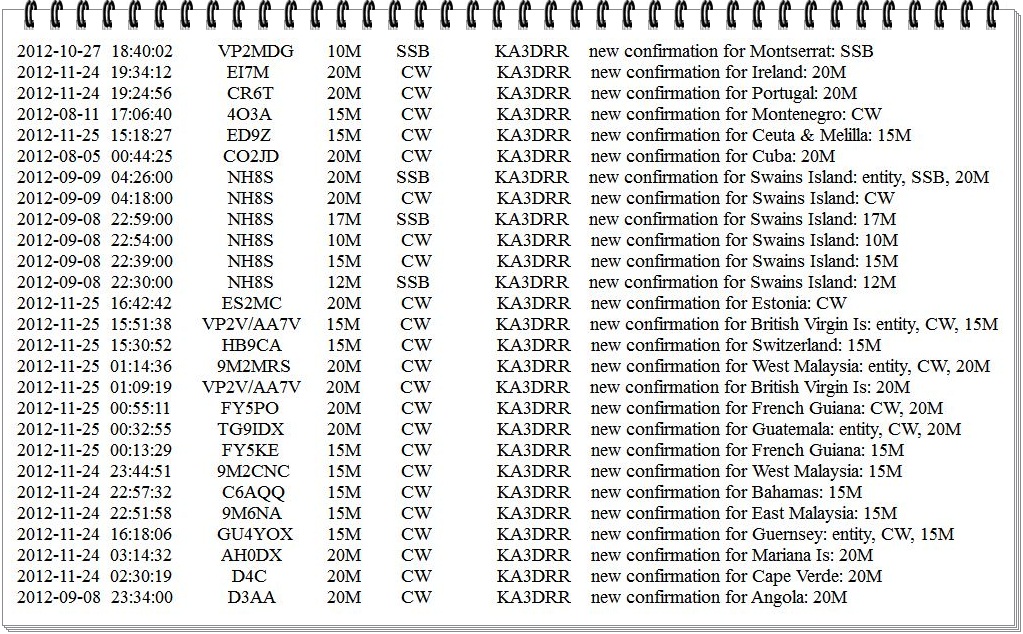 |
| First List As Of 21 December 2012 |
Good afternoon from the shackadelic #hamr zone where I’m listening to PV8AA running rate during 2012 WPX CW earlier in the year. Currently, there is a swarm of stations on Paolo, PV8DX rate frequency, and he is efficiently executing our RadioSport adrenaline rush.
In the meantime, between my vicarious thrill of listening to Paolo, PV8DX an accomplished DXer and RadioSport operator at PV8AA; a significant load of LoTW credits were downloaded into my log. The Swains Island DXpedition confirmed on respective band slots in addition to 4O3A, D4C, and D3AA.
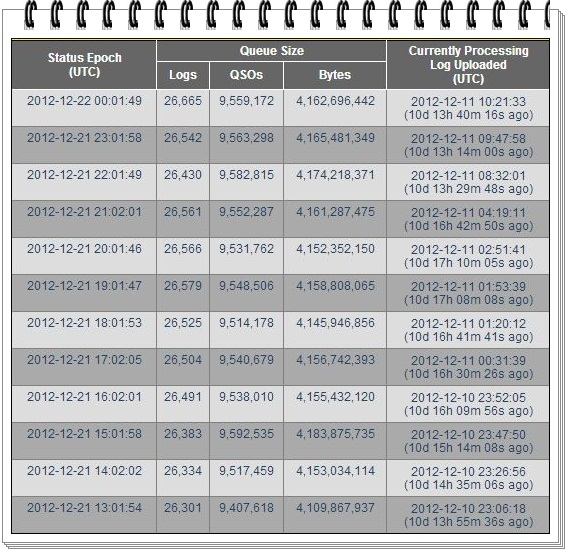 |
| LoTW Queue Status As Of 21 December 2012 |
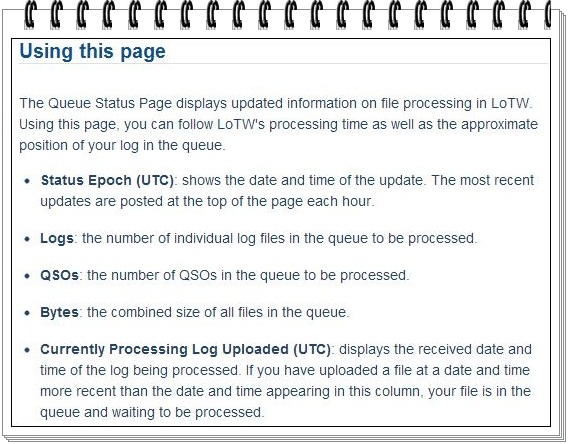
As of 21 December 2012 at 1301 UTC approximately (n = 26,301) individual logs are in the LoTW queue for processing then on 22 December 2012 at 0001 UTC approximately (n = 26,665) individual logs are awaiting processing with a 10 day, 14 hour, 40m, 16s backlog of credits yet processed.
I’m of the opinion that LoTW is one of the ARRL’s signature programs because all of our awards are based on its credit system. First, it was explained to me that current system hardware will be replaced in the very near future, explanation accepted. Then, an initiative to reinvigorate open sourcing of Trusted QSL, in order to improve functionality and efficiency.
The last communication to membership from the ARRL was 11 December 2012 and 10 business days have elapsed since the severe disruption of credit processing. Where are status updates that quantify progress? Where are we in regards to the open source project? Has any hardware arrived and from whom is membership purchasing the hardware from?
Frankly, this is unacceptable, organizations thrive on two way communication channels with almost daily updates to all those concerned especially if one of your signature programs is failing spectacularly. I’m losing confidence in the credibility of the system because of the lack of information. My question is, “What is going on?”
73 from the shackadelic near the beach.
 Ham Radio Deluxe |
 W5SWL Electronics |
 Ham Radio Prep |
 KB3IFH QSL Cards  Hip Ham Shirts  HamRadioAuctions HamRadioAuctions Reliance Antennas Reliance Antennas Enigma Shop Enigma Shop |  morseDX  Ni4L Antennas  R&L Electronics R&L Electronics antennas.us antennas.us QRV QRV |
- Matt W1MST, Managing Editor
