 |
 Interesting blog post
 27 December 2012 | by
 News from friendly sources tonight:
As pointed out to me by my friend Drew W2OU – this was posted Sunday on the “DC to White Light” blog:
http://scopefocus.blogspot.com/2012/12/theres-group-of-people-out-there-men.html
The following was posted to QRP-L by Hank N8XX today:
The Stew Perry Top Band Challenge is this coming Weekend. It starts at 1500Z December 29 and ends at 1500Z December 30. One may operate a maximum of 14 hours during the 24 hour period.
The call 160 meters “Top Band” but I figure this will need adjusting, since we will soon have an allocation around 500 KHz, or 600 meters. But, for now, let’s let sleeping lies dog (or some converse thereof).
Details of this event may be found at
http://www.kkn.net/stew/stew.rules.txt
The scoring is a bit convoluted, and the scoring team does all the scoring, so I’m not worrying about how this is done.
BUT, it DOES have a QRP category, and one gets a multiplier for operating with <5 considerably.=”considerably.” even=”even” may=”may” p=”p” platform=”platform” scoring=”scoring” the=”the” watts=”watts” which=”which”>
So, why not crank up the wavelength to about 166.666 ⅔ and give it “ye olde college try.”
72/73 de n8xx Hg
QRP >99.44% of the time
Thanks to both Drew and Hank for some interesting stuff.
72 de Larry W2LJ
QRP – When you care to send the very least!
Larry Makoski, W2LJ, is a regular contributor to AmateurRadio.com and writes from New Jersey, USA. Contact him at [email protected].
Nostalgia time: QSOs with my first HF rig – the Icom IC-740
I was up in the loft this morning looking for a couple of bits (with an eye on another project) when I came across the microphone for my Icom IC-740 – my first HF rig from when I was licenced in 1983. Being a bit of a hoarder – well who would want to buy such a vintage rig (!) – I have never disposed of the rig. For years I kept it at my parents home in Cornwall, so that I could operate from there when I visited. Now they are no longer there, the rig has been living in our loft for probably the last 6 or 7 years lying unused.
.JPG)
I decided to bring the rig and the microphone down from the loft this morning and see if I could get it to work. I gave it a dust first of all and then connected the power. I was pleased that the rig came up ok and seemed to be responding. I put it on a dummy load initially. One of the long standing faults with the rig was an intermittent on the Comp button which needs to be jiggled around a little to get RF power out. I was a little concerned that might have become a permanent problem over the years, but happily it wasn’t.
Time to try it on an antenna! I plugged the HF vertical into the rig and the receiver was working well. Tuning around was quite pleasant. The VFO was a little more ‘plasticy’ that some of the other rigs I use now, but the receiver was ok. When I bought the rig, I used the 500hz CW filter pretty much all the time. Nowadays I am happy to tune around on a wider filter, but it sounded nice enough. Sadly the S9 noise on 14MHz experienced on the other rigs was still there on the 740 (I didn’t expect it to be otherwise!).
When I was living in Canada in the mid 90s, the local radio store in Toronto, Atlantic Ham Radio were closing out some of the modules for the IC740, so I had installed the keyer module and the FM board, which I didn’t buy in 1983 – I had only just started work and I’m pretty sure that the rig was several months wages as it was!
Anyway, I plugged in the paddle, turned the power down and had a play. It sounded ok! The keyer chip was obviously a little different to the keyers I normally used as I was dropping the odd dot here and there, but quite manageable. I had a listen on another rig in the shack and the signal sounded fine, so I decided to see if I could make some QSOs.
Forty metres seemed like the best bet, so I tuned the CW end looking for a nice strong CQ to answer. PA/ON6QO was CQing from IOTA EU-146, so we successfully exchanged reports. I then found Rob M0TIX calling CQ and we had a longer ragchew on the key and I explained I was using my very first HF rig from nearly 30 years ago. Finally, I decided to try 10MHz – when I first had the rig, the 10MHz band had only just been allocated to amateurs and I had to do a modification in the rig to enable the 10, 18 and 24MHz bands! Tuning up 10MHz I heard W1MK calling CQ (not bad for the middle of the day), so I replied to him and we had a short but pleasant QSO.
Perhaps sometime I will try it on SSB. I remember that the audio reports on SSB always were a bit poor – perhaps one of the reasons that in my early years on the air, I concentrated on CW operation! As I recall the Icom microphones of the day had a preamp in them.
A happy distraction with the old rig and I am delighted that it is still working. I will have to think of a use for it! Now, back to the original reason for the visit to the loft….
Tim Kirby, G4VXE, is a regular contributor to AmateurRadio.com and writes from Oxfordshire, England. Contact him at [email protected].
Was Santa good to you?
He was to me. (Thanks to my beautiful wife Marianne and my great kids, Cara and Joey!)
I was gifted with a Kindle Fire HD which is one great lil’ tablet. I love to read and this is soooooo nice. I thought the touch screen would be more of a pain than the regular Kindle’s back and forth buttons. But the touch screen actually makes going from page to page of a book more effortless. The fact that I can also check my e-mail, surf the Web on it (read blogs) and even watch movies on it makes it all the more of a neat gift.
Marianne also bought me a few “QRP – When you care to send the very least” items from Cafe Press. The sweatshirts they sell are so nice! Thick and warm, not flimsy and thin. The design is big too, it takes up a major portion of the front of the shirt, so there’s no mistaking that QRP is the passion of the wearer. I was worried that when the design got enlarged to fill the front of a shirt that it might look fuzzy. It doesn’t! It’s sharp and prominent and other Hams will know right away what’s going on there.
She also brought me the carrying Field Bag, which will be great for carrying my Kindle Fire and my other Android tablet to and from work. My brief case was getting kind of ratty, so this is a good replacement.
Cafe Press does a great job and I’m very happy with both items that Marianne got for me.
I also got a nice pair of warm gloves and Joey gave me a “World’s Best Dad” poster and pen and Cara gave me a very cute “Dad” Christmas ornament for the tree. I did very, very well.
How did you all do in the Zombie Shuffle? Paul NA5N has posted the preliminary results here. I came in the middle of the pack, where is about where I expected to land. I know there are a few more great contesters (such as John K4BAI) who haven’t sent in summaries yet. I will be a happy camper if I remain within the top 20 when all is said and done.
Don’t forget that next Monday night is Straight Key Night. Time for me to get a little practice on the Bug again, before the big event. I sure hope that 2013 turns out to be less stress filled than 2012 was. I really would like to try the “QSO a day” thing for the entire year again. It’s hard to do that when every time you turn around, something comes up that eats up all your time and attention.
Here’s to a better 2013 for all of us!
72 de Larry W2LJ
QRP – When you care to send the very least!
Larry Makoski, W2LJ, is a regular contributor to AmateurRadio.com and writes from New Jersey, USA. Contact him at [email protected].
Christmas 2012

72 de Larry W2LJ
QRP – When you care to send the very least!
Larry Makoski, W2LJ, is a regular contributor to AmateurRadio.com and writes from New Jersey, USA. Contact him at [email protected].
Christmas Eve 2012

The angel of the Lord appeared to them and the glory of the Lord shone around them, and they were struck with great fear.
The angel said to them, “Do not be afraid; for behold, I proclaim to you good news of great joy that will be for all the people.
For today in the city of David a savior has been born for you who is Messiah and Lord.
And this will be a sign for you: you will find an infant wrapped in swaddling clothes and lying in a manger.”
And suddenly there was a multitude of the heavenly host with the angel, praising God and saying:
“Glory to God in the highest and on earth peace to those on whom his favor rests.”
Larry Makoski, W2LJ, is a regular contributor to AmateurRadio.com and writes from New Jersey, USA. Contact him at [email protected].
Planning My New QTH (Ham Radio Station) Part II Of III: Modern Contesting Tools
I’ll be writing a lot in future postings about how FlexRadio’s new 6000 series transceiver technology has influenced my new station’s design. Today’s post will focus on these rigs’ ‘Slice Receiver’ capabilities.
First, however, allow me a digression on 21st Century Radio-Sport a/k/a “Contesting.” There are hundreds of radio-sport events spread across the calendar each year from state QSO (QSO = radio contact) parties to major global events such as the CQ World Wide DX Contests (CQ WW DX, ‘DX’ = long distance radio contact) held across two weekends – one for CW (Morse code) and one for Phone (Signal Sideband = voice) – in the northern hemisphere autumn. The smaller events have a friendly ‘small town’ vibe. On the other end of the scale, the big DX contests are hard fought struggles that test technology, skill and endurance (you try averaging two international contacts via morse code per minute for 48 hours straight!).
The big contests have a multitude of classes to parse the competitors. Single operator, multiple operators with one transmitter, multiple operators with multiple transmitters, high power, low power, really low power (also known as ‘QRP’), assisted and unassisted. You compete against others in your class in your country and in your class on a regional and global scale depending on your ambition.
I mentioned ‘assisted’ and ‘unassisted’ classes in the previous paragraph. This can mean various things but the major source of assistance during a contest is the so-called ‘cluster’, Internet resources that reports what stations are active and on what frequencies. These networks started in the ’80s with hams transmitting short reports of the distant stations they were hearing, generally on the HF (short wave) bands, via the amateur VHF digital networks which were generally local, within a city or region. These were know as ‘DX Packetclusters’ back then and I used to operate a node in Tiffany, Colorado in the ’90s.
These networks later migrated to the Internet, became interconnected and are now global in scope passing literally millions of ‘spots’ (as each report of a station and its frequency is called). DX Summit, based in Finland but with visitors from around the world, has reported over 23 million such spots since it launched in 1997!
One of the challenges of big data is finding actionable useful information shooting out of the digital firehose. The cluster networks go bonkers during the big contests with several spots per second streaming by. This is not always helpful. An operator can be overwhelmed by choice; which station do I try to contact? It’s like getting a restaurant menu with a thousand choices. And with spots being reported from all corners of the planet much of the data is not actionable. A station being heard in say Mongolia might not be making it to your shack in Peoria at that time of day on that particular frequency.
I will manage this onslaught of data by disconnecting from the Internet clusters and generating my own spots distilled from radio signals actually being detected at my station in real time. The data will thus become relevant and actionable. Many stations are already doing this to supplement the Internet spots that every assisted class station sees. K3LR and W3LPL, two giants of multi-operator contesting, are doing this effectively using CW Skimmer software written by Alex Shovkoplyas, VE3NEA. CW Skimmer uses ‘sensitive CW decoding algorithm based on the methods of Bayesian statistics’; in other words your computer listens for Morse code on your radio and tells you who is transmitting and on what frequency. CW Skimmer, of course, is not much use in Phone (voice) contests.
There are several challenges to using CW Skimmer effectively. The first challenge at most stations is receiver bandwidth. Most ham radios can only listen to relatively small segments of radio spectrum at any one time limiting the size of the net CW Skimmer can cast. If a particular contest has its competitors spread out over say 70-kHz and your radio can only monitor 2.8-kHz you are going to miss a lot of the action. So called SDRs (Software Defined Receivers) overcome this limitation and can look at much larger chunks of spectrum at once. An operator using one of these radios (older generation FlexRadios for example) can actually look at a visual spectral display showing where signals are and indicate their relative strength; a CW Skimmer software working with one of these radios can decode and report on the activity of dozens of stations with this set up.
That hurdle jumped, another one looms ahead. If you are monitoring stations on one band how do you know what’s happening on other bands? Most contests are spread across several of the amateur radio bands. Some bands are good during the day, some are good during the night and propagation on all the bands is always changing. Europe might be good in the morning on a particular band , say the 21-MHz (15m) band, Africa in midday and Japan in the afternoon. The general propagation trends are predictable but there are large daily variations in propagation that are not predictable (in other words, what signals are being refracted back to earth and where). Some stations (K3LR, for example) have separate SDRs for each amateur contest band. Other stations (W3LPL for one) uses the QS1R receiver which can listen to several bands at once.
The Flex 6000 series radios listen (via direct sampling, more on that in a future posting) to 77-MHz of spectrum at the same time. That is truly spectacular! With my multiple Flex-6700s (I have two on order and plan on ordering a third unit later in 2013) i will be able to assign ‘Slice’ receivers (each Flex-6700 can have up to eight of these, created in software and 384-kHz) to each amateur band from 1.8-MHz (160m) to 144-MHz (2m) and let them run all the time, during contests and in between. I will have live, actionable intel on what CW (Morse) signals are propagating to Glade Park, Colorado at any given time on all the amateur bands. I will be feeding this data out to the Reverse Beacon Network (RBN) and using it for my own contesting and day-to-day DXing operation. (More on the RBN in a future Blog posting.)
How I plan to keep transmissions on one frequency from overloading and possibly damaging receivers listening – and running CW Skimmer software – on other frequencies on co-located (and sometimes the same) antenna will be covered in a future posting. The Flex 6000 series radios are full-duplex (in other words, they can transmit and receive at the same time) so the listening on the same band I’m transmitting on becomes a possibility but one with significant challenges.
I should point out here that many hams operate without any kind of assistance in contests whatsoever. These are some of the world’s most skilled and motivated amateur radio operators and I admire this type of contesting. However, my personal current motivation is to see where I can go with technology in contesting and amateur radio in general. Assisted, in so many words, but seeking innovation.
Bill Hein, AA7XT, is a regular contributor to AmateurRadio.com and writes from Colorado, USA. He is co-owner of Force 12 and InnovAntennas. Contact him at [email protected].
2012 CQ WPX Log Check Report – Meta Analysis
 |
| Log Check Report |
A brilliant morning looking out toward the Pacific Ocean with a sunny sky blazing away after two days of needed rain fall.
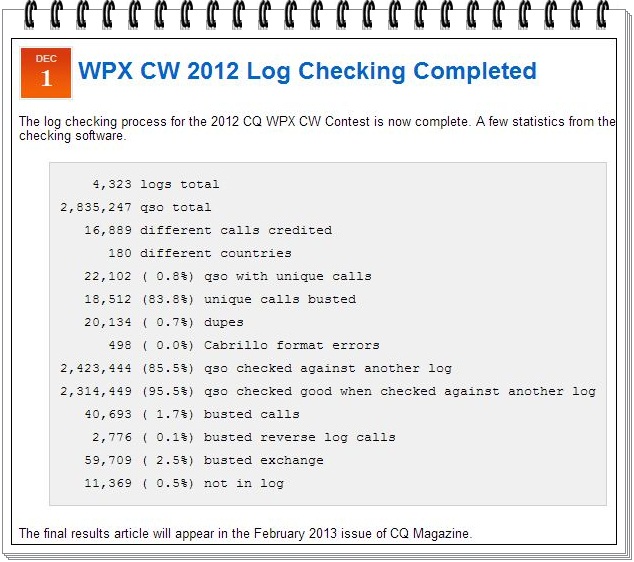
The meta-analysis of WPX CW 2012 with 4,000 plus logs submitted, 2.8 million QSO, and 180 participating countries was completed on the 1st of December. I’m working to understand the data for example what does 83.8% unique calls busted after 16,889 different calls were credited and 0.1% busted reverse log calls mean?
There is a total of 2.8 million QSOs with 2.4 million checked against another log and 2.3 million checked good when checked against another log. What is the total error percentage? Is my error percentage within range of the mean?
The North American QSO Party is scheduled for early January and I’m going to work at improving my skill at copying callsigns during the event. The path to a Golden Log is practice, practice, practice.
Contest on!
 Ham Radio Deluxe |
 W5SWL Electronics |
 Ham Radio Prep |
 KB3IFH QSL Cards  Hip Ham Shirts  HamRadioAuctions HamRadioAuctions Reliance Antennas Reliance Antennas Enigma Shop Enigma Shop |  morseDX  Ni4L Antennas  R&L Electronics R&L Electronics antennas.us antennas.us QRV QRV |
- Matt W1MST, Managing Editor
