 |
 Christmas Eve 2012
 24 December 2012 | by
The angel of the Lord appeared to them and the glory of the Lord shone around them, and they were struck with great fear.
The angel said to them, “Do not be afraid; for behold, I proclaim to you good news of great joy that will be for all the people.
For today in the city of David a savior has been born for you who is Messiah and Lord.
And this will be a sign for you: you will find an infant wrapped in swaddling clothes and lying in a manger.”
And suddenly there was a multitude of the heavenly host with the angel, praising God and saying:
“Glory to God in the highest and on earth peace to those on whom his favor rests.”
Larry Makoski, W2LJ, is a regular contributor to AmateurRadio.com and writes from New Jersey, USA. Contact him at [email protected].
Planning My New QTH (Ham Radio Station) Part II Of III: Modern Contesting Tools
I’ll be writing a lot in future postings about how FlexRadio’s new 6000 series transceiver technology has influenced my new station’s design. Today’s post will focus on these rigs’ ‘Slice Receiver’ capabilities.
First, however, allow me a digression on 21st Century Radio-Sport a/k/a “Contesting.” There are hundreds of radio-sport events spread across the calendar each year from state QSO (QSO = radio contact) parties to major global events such as the CQ World Wide DX Contests (CQ WW DX, ‘DX’ = long distance radio contact) held across two weekends – one for CW (Morse code) and one for Phone (Signal Sideband = voice) – in the northern hemisphere autumn. The smaller events have a friendly ‘small town’ vibe. On the other end of the scale, the big DX contests are hard fought struggles that test technology, skill and endurance (you try averaging two international contacts via morse code per minute for 48 hours straight!).
The big contests have a multitude of classes to parse the competitors. Single operator, multiple operators with one transmitter, multiple operators with multiple transmitters, high power, low power, really low power (also known as ‘QRP’), assisted and unassisted. You compete against others in your class in your country and in your class on a regional and global scale depending on your ambition.
I mentioned ‘assisted’ and ‘unassisted’ classes in the previous paragraph. This can mean various things but the major source of assistance during a contest is the so-called ‘cluster’, Internet resources that reports what stations are active and on what frequencies. These networks started in the ’80s with hams transmitting short reports of the distant stations they were hearing, generally on the HF (short wave) bands, via the amateur VHF digital networks which were generally local, within a city or region. These were know as ‘DX Packetclusters’ back then and I used to operate a node in Tiffany, Colorado in the ’90s.
These networks later migrated to the Internet, became interconnected and are now global in scope passing literally millions of ‘spots’ (as each report of a station and its frequency is called). DX Summit, based in Finland but with visitors from around the world, has reported over 23 million such spots since it launched in 1997!
One of the challenges of big data is finding actionable useful information shooting out of the digital firehose. The cluster networks go bonkers during the big contests with several spots per second streaming by. This is not always helpful. An operator can be overwhelmed by choice; which station do I try to contact? It’s like getting a restaurant menu with a thousand choices. And with spots being reported from all corners of the planet much of the data is not actionable. A station being heard in say Mongolia might not be making it to your shack in Peoria at that time of day on that particular frequency.
I will manage this onslaught of data by disconnecting from the Internet clusters and generating my own spots distilled from radio signals actually being detected at my station in real time. The data will thus become relevant and actionable. Many stations are already doing this to supplement the Internet spots that every assisted class station sees. K3LR and W3LPL, two giants of multi-operator contesting, are doing this effectively using CW Skimmer software written by Alex Shovkoplyas, VE3NEA. CW Skimmer uses ‘sensitive CW decoding algorithm based on the methods of Bayesian statistics’; in other words your computer listens for Morse code on your radio and tells you who is transmitting and on what frequency. CW Skimmer, of course, is not much use in Phone (voice) contests.
There are several challenges to using CW Skimmer effectively. The first challenge at most stations is receiver bandwidth. Most ham radios can only listen to relatively small segments of radio spectrum at any one time limiting the size of the net CW Skimmer can cast. If a particular contest has its competitors spread out over say 70-kHz and your radio can only monitor 2.8-kHz you are going to miss a lot of the action. So called SDRs (Software Defined Receivers) overcome this limitation and can look at much larger chunks of spectrum at once. An operator using one of these radios (older generation FlexRadios for example) can actually look at a visual spectral display showing where signals are and indicate their relative strength; a CW Skimmer software working with one of these radios can decode and report on the activity of dozens of stations with this set up.
That hurdle jumped, another one looms ahead. If you are monitoring stations on one band how do you know what’s happening on other bands? Most contests are spread across several of the amateur radio bands. Some bands are good during the day, some are good during the night and propagation on all the bands is always changing. Europe might be good in the morning on a particular band , say the 21-MHz (15m) band, Africa in midday and Japan in the afternoon. The general propagation trends are predictable but there are large daily variations in propagation that are not predictable (in other words, what signals are being refracted back to earth and where). Some stations (K3LR, for example) have separate SDRs for each amateur contest band. Other stations (W3LPL for one) uses the QS1R receiver which can listen to several bands at once.
The Flex 6000 series radios listen (via direct sampling, more on that in a future posting) to 77-MHz of spectrum at the same time. That is truly spectacular! With my multiple Flex-6700s (I have two on order and plan on ordering a third unit later in 2013) i will be able to assign ‘Slice’ receivers (each Flex-6700 can have up to eight of these, created in software and 384-kHz) to each amateur band from 1.8-MHz (160m) to 144-MHz (2m) and let them run all the time, during contests and in between. I will have live, actionable intel on what CW (Morse) signals are propagating to Glade Park, Colorado at any given time on all the amateur bands. I will be feeding this data out to the Reverse Beacon Network (RBN) and using it for my own contesting and day-to-day DXing operation. (More on the RBN in a future Blog posting.)
How I plan to keep transmissions on one frequency from overloading and possibly damaging receivers listening – and running CW Skimmer software – on other frequencies on co-located (and sometimes the same) antenna will be covered in a future posting. The Flex 6000 series radios are full-duplex (in other words, they can transmit and receive at the same time) so the listening on the same band I’m transmitting on becomes a possibility but one with significant challenges.
I should point out here that many hams operate without any kind of assistance in contests whatsoever. These are some of the world’s most skilled and motivated amateur radio operators and I admire this type of contesting. However, my personal current motivation is to see where I can go with technology in contesting and amateur radio in general. Assisted, in so many words, but seeking innovation.
Bill Hein, AA7XT, is a regular contributor to AmateurRadio.com and writes from Colorado, USA. He is co-owner of Force 12 and InnovAntennas. Contact him at [email protected].
2012 CQ WPX Log Check Report – Meta Analysis
 |
| Log Check Report |
A brilliant morning looking out toward the Pacific Ocean with a sunny sky blazing away after two days of needed rain fall.
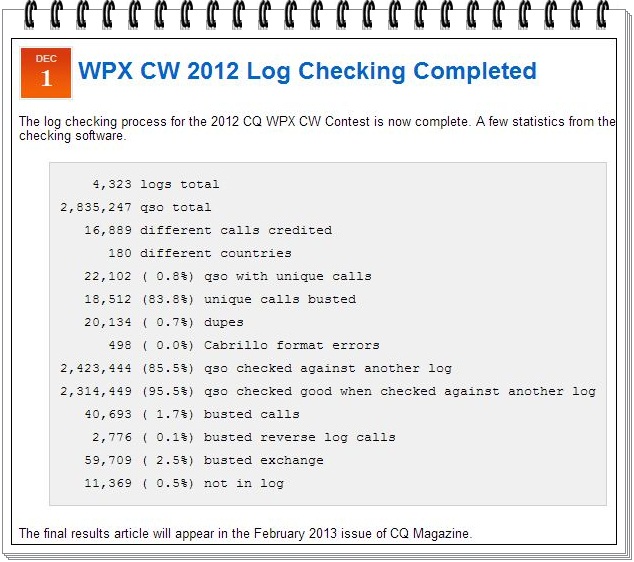
The meta-analysis of WPX CW 2012 with 4,000 plus logs submitted, 2.8 million QSO, and 180 participating countries was completed on the 1st of December. I’m working to understand the data for example what does 83.8% unique calls busted after 16,889 different calls were credited and 0.1% busted reverse log calls mean?
There is a total of 2.8 million QSOs with 2.4 million checked against another log and 2.3 million checked good when checked against another log. What is the total error percentage? Is my error percentage within range of the mean?
The North American QSO Party is scheduled for early January and I’m going to work at improving my skill at copying callsigns during the event. The path to a Golden Log is practice, practice, practice.
Contest on!
DXpedition Basics By Wayne Mills, N7NG
 |
| DXpedition Basics Written By Wayne Mills, N7NG |
Good morning from the #hamr shackadelic zone where I’m listening to our local repeater or in today’s vernacular lurking the frequency. Also, my weather report from near the beach is overcast, cool, expecting rain, and choppy surf conditions. It is the kind of day where I’m knocking to-do objectives off my list and enjoying life.
Wayne Mills, N7NG author of DXpedition Basics suggested, “But when DXpedition organizers accept contributions and support, there is an implicit, and even maybe an explicit obligation to conform to certain operating criterion. Specifically, organizations which funnel money to DXpedition groups for the benefit of the DXing community have become more particular about whom they support. Their assistance often demands minimum standards of operating proficiency, and may depend on the track record of the group. Following a few simple rules can go far in assuring the success of a DXpedition effort.” (p 2, 1994)
Mills stated, “In fact, many have said that the DXpedition operator is responsible for the conduct and outcome of an expedition, and that, indeed, the pileups in a sense mirror the DXpedition operator. The DXpedition operator must be in command, but just how is that accomplished?” (p 2, 1994)
Lastly, Mills suggested a fundamental premise for expeditions, “We will start with the premise that the overall objective of the DXpedition is for DXers around the world to simply have fun. With rare exceptions, no expeditioner ever expects to profit from his DXpeditioning activities. Rather, considerable expenses are incurred primarily in transportation costs and loss of employment income. This is a fact; chiseled in stone!” (p 3, 1994)
I’m sad to read that a highly successful year of DXpeditioning is coming to a close with a disruptive footnote attached to its banner resume for our ham radio community. It seems to me that Wayne Mills, N7NG in association with the American Radio Relay League and the International DX Association sought solutions to perplexing questions more than a decade ago.
We are fast arriving or if not have already arrived, where it is time to start this conversation anew, in lieu of significant technological and social change. Thus far, leading donor organizations remain silent in an age of unparalleled communications and intense social engagement.
I recommend downloading DXpedition Basics, print, review, then take it with you to the next gathering and renew this decade old conversation that better reflects ham radio in the 21st Century.
73 from the shackadelic near the beach.
The Blue screen of DEATH!!!!
 |
| The Blue screen of death |
Merry Christmas to all my readers!!!
Mike Weir, VE9KK, is a regular contributor to AmateurRadio.com and writes from New Brunswick, Canada. Contact him at [email protected].
Subscribe to the InnovAntennas News email List!
I am a partner in InnovAntennas, a company which designs and manufactures high performance antennas and accessories for the amateur, commercial, military, government, NGO and other markets. Stay in touch with our latest products and news by signing up to our mailing list. Select the link on right hand side of this page to go to the sign up page. Lots of new products on tap for 2013 – hear about them first here!

Bill Hein, AA7XT, is a regular contributor to AmateurRadio.com and writes from Colorado, USA. He is co-owner of Force 12 and InnovAntennas. Contact him at [email protected].
Almost there!

Christmas is almost upon us.
Preparations are winding down. Hopefully, all your trees are trimmed, houses have been decorated, gifts bought and wrapped, and all baking done and goodies carefully put away.
As Mary and Joseph travel towards the star, may your hearts find wishes granted and prayers answered.
May you and your loved ones be blessed this Christmas with the Peace that is beyond all understanding.

72 de Larry W2LJ
QRP – When you care to send the very least!
Larry Makoski, W2LJ, is a regular contributor to AmateurRadio.com and writes from New Jersey, USA. Contact him at [email protected].
 Ham Radio Deluxe |
 W5SWL Electronics |
 Ham Radio Prep |
 KB3IFH QSL Cards  Hip Ham Shirts  HamRadioAuctions HamRadioAuctions Reliance Antennas Reliance Antennas Enigma Shop Enigma Shop |  morseDX  Ni4L Antennas  R&L Electronics R&L Electronics antennas.us antennas.us QRV QRV |
- Matt W1MST, Managing Editor
