 |
 Elecraft KX3…stand, CW key and battery charger.
 20 January 2013 | by
  |
| KX3 on the new Nifty stand viewed at same angle as below pic |
Last week I ordered a stand for my KX3 radio I had seen it on the Nifty ham radio site. I was there looking at their new KX3 radio guide. I have one of their guides for each of my radios and they are great. If you want to find a "how to" with your radio instead of searching through your manual these Nifty manuals have it all set out at your finger tips. So back to the KX3 stand.....I was surprised to see they were
 |
| KX3 on it's own legs |
Also a week or so ago my KXPD3 keyer and KXBC3 NiMH battery charger came in. I have not yet had the time to install the KXBC3 charger. I have mounted the Key and it worked great right great out of the box. The key does come with other springs to change
the tension of the key. Up to this point I have not changed the key spring tension it works fine as it is.
My Begali key that I have was (I thought) giving me problems with extra dit's and dah's at times. It became very frustrating and even after adjusting the key as well as cleaning the contacts I would still have the same
 |
| New KX3 key |
Mike Weir, VE9KK, is a regular contributor to AmateurRadio.com and writes from New Brunswick, Canada. Contact him at [email protected].
First WSPR spots on 630m
A few of my blogging colleagues have written about having surprising success WSPRing with modest antennas on the 474kHz VLF band. I thought I would try to see what if anything I could spot using my attic dipole as an antenna.
 |
| Receiving WSPR-15 on the 630m band |
I downloaded the WSPR-X software which supports the new WSPR-15 mode. (The standard WSPR for HF and VHF is now called WSPR-2, the number indicating the duration in minutes of the transmit cycle.)
First problem was to find a receiver that would tune to 474kHz. My K3 would not tune below 490kHz nor the KX3. My K2 doesn’t have general coverage at all. My SDR-4 receiver would not go anywhere near the frequency. My FT-817 came to the rescue. I took it out of the drawer, blew the dust off it, found a power lead, switched it on and it tuned to 474.2kHz quite nicely.
The next problem was to find a sound card to receive the audio. I have three USB sound devices currently connected to the shack PC and I could only identify which driver was for which sound card by trial and error. After I realized that WSPR-X can be used for HF WSPR as well I tried it out first on 30m. For about an hour I had confusion as I did not seem to be receiving any WSPR signals at all. Eventually I tried WSPR-X on the sound card used by my K3. Once I verified that the program worked and was decoding spots I then tried receiving 30m WSPR on the ‘817. Once that was successful I tuned the receiver to 474.20kHz, set the mode to WSPR-15 and left it for a few hours to see what would happen.
I was doubtful whether I would receive anything on my 80 – 6m multiband dipole which is too short and totally unmatched on the 630m band, but when I came up to the shack later this evening I saw there were three spots of PA0A in JO33 at 30 minute intervals! These spots were not reported to WSPRnet as I had been so pessimistic of my chances of decoding anything that I hadn’t bothered to tick the “Upload spots” check box.
So the experiment was a success. I doubt that I will receive anyone else on this antenna so it is probably not worth leaving the radio set up for it but it was fun to see what can be received here on this new amateur band.
Julian Moss, G4ILO, is a regular contributor to AmateurRadio.com and writes from Cumbria, England. Contact him at [email protected].
Twine “Internet of Things” Monitor

My children know what kind of gifts that please their father, so they gave me a Supermechanical Twine for Christmas. It is described in this way:
Want to monitor things and environments remotely without a nerd degree? Maybe you want to get a tweet when your laundry’s done, an email when the basement floods, or a text message when you left the garage door open.
I am presently using it to monitor the temperature in the outer part of the basement, where there is a chance of freezing when the outside temperature drops below about -15 C (5 F). I can continuously read the status such as the temperature on any web browser on my computer or mobile phone. I can also set threshold values that trigger an email message.
The Twine is easy as a breeze to program, by using simple rules as shown below.

The only catch is that right now the conversion to centigrades is not fully debugged, so I had to enter the strange world, to me, of Fahrenheit degrees close to freezing temperatures to get the rules to work.
I just couldn’t let go of my curiosity as to what’s inside, so here’s a picure. Links to the datasheet for the processor and the Wifi-module can be found on the Supermechanical Community site.
The Twine comes with a temperature sensor and an orientation sensor built in. As options one can connect an external humidity sensor or a magnetic switch. Alternatively one may use a breakout board for inputs from one’s own binary sensor.
Other interesting applications are:
- Garage door monitoring and alarm when it has been open for a certain time period
- Monitoring the temperature of a turkey thawing
- Use of the magnetic switch in a pet door to track when your pet comes and goes.
- Christmas tree water level monitoring
- Temperature logging
There is a Supermechanical Community forum with discussions and lots of ideas as well as a Supermechanical Support page for users who need assistance. I think we will soon see many more similar devices – we are at the threshold of the era of the Internet of Things.
Update 29. Jan 2013: Yesterday, the Twine got software upgrade 1.2 and now it does Celcius properly, I have just tested it. So what I wrote about having to use Fahrenheit is no longer needed – and now that I was about to get familiar with Fahrenheit! In addition some new functionality was added such as vibration sensing, I’m looking forward to testing that too.
Sverre Holm, LA3ZA, is a regular contributor to AmateurRadio.com and writes from Norway. Contact him at [email protected].
Ham Radio Humor
http://www.gocomics.com/boundandgagged/
72 de Larry W2LJ
QRP – When you care to send the very least!
Larry Makoski, W2LJ, is a regular contributor to AmateurRadio.com and writes from New Jersey, USA. Contact him at [email protected].
Boy Scouts and Amateur Radio
The Boy Scouts of America (BSA) has approved an Amateur Radio Operator rating strip for Scouts and Scouters to wear on their uniforms. According to BSA Communication Services Director Jim Wilson, K5ND, the strip recognizes the Scout or Scouter’s availability as an Amateur Radio operator for communication services for events and activities, as well as emergencies. All registered youth members and adult leaders who also hold a valid FCC-issued Amateur Radio license of any class are eligible to wear the rating strip.
“Last year, the BSA Awards and Insignia Committee introduced the Morse Code Interpreter Strip upon the recommendation of the BSA’s National Radio Scouting Committee,” Wilson told the ARRL. “We are always looking for ways to promote Amateur Radio, both within Scouting and to the world. The National Radio Scouting Committee thought this new Amateur Radio rating strip was a wonderful way to do exactly that, as it readily identifies to everyone that the wearer is a licensed radio amateur, prepared to be useful and to help others.”
Wilson, who heads up the National Radio Scouting Committee, said that the Amateur Radio Operator rating strip is similar to the Amateur Radio Operator badge offered as a proficiency badge by Scouts Australia, as well as the badge recently introduced by Scouting Netherlands. It follows in the footsteps of the Scout Radioman personal interest badge for Senior Scouts and Explorer Scouts that was offered by the Boy Scouts of America in the 1940s. The strip is worn on the right sleeve.
72 de Larry W2LJ
QRP – When you care to send the very least!
Larry Makoski, W2LJ, is a regular contributor to AmateurRadio.com and writes from New Jersey, USA. Contact him at [email protected].
A good session on 15m
There was not much life on 10m this morning but 15m was really hopping. I started off using PSK31 and my first QSO was with a Ukrainian YL named Olga! Her call was US5UFF and her QSL shows that she is (X)YL of UR4UHE. I think the UFF stands for Ukrainian Flora and Fauna which seems to be a popular award scheme over in Ukraine.

I was calling CQ and worked a whole string of east European and Russian stations. Calling CQ is a good way to fill the log but not a good way to work much DX as if any DX did reply it would likely be lost under the strong local stations calling.

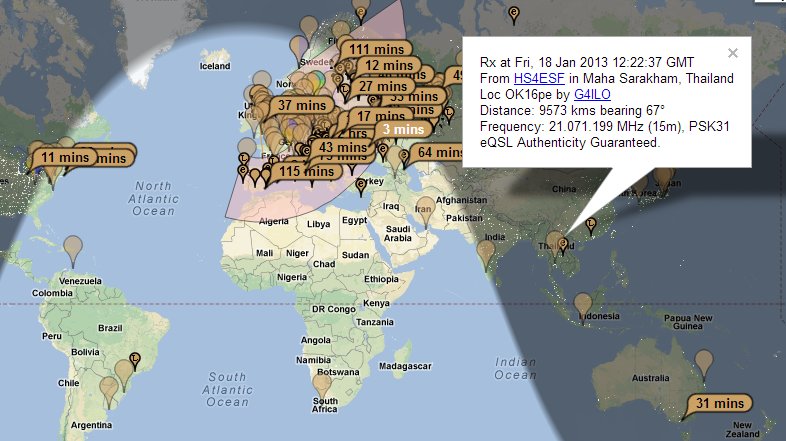
As the hour approached lunch time I did some search and pouncing and managed to nab HS4ESF from Mahasarakham University in Thailand. I don’t think it’s the first time I have worked Thailand on PSK but it was nice nonetheless, and he has a nice QSL.
I’ve often noticed from my beacon monitoring that the time around midday to lunch time is a good time to work DX on the higher HF bands. I didn’t work any other DX today but I was pleased to see on Propagation Reporter that my 40W of PSK31 to an attic dipole had been decoded near Sydney in Australia! Perhaps I’ll work VK on PSK31 one day!
 |
| PSK31 spots of G4ILO on 15m |
I tried JT65A briefly but the band segment was full of the same stations I could easily work using PSK31 so I thought I would try CW instead. I “shook hands” (as John N8ZYA puts it) with Z320K, a special call to commemorate 20 years of the Z3 prefix (Macedonia.) I then had a real QSO with Bill, WA1HMW who is an ex-Royal Navy. That QSO taxed my receiving abilities a bit so I decided to call it a day.
Julian Moss, G4ILO, is a regular contributor to AmateurRadio.com and writes from Cumbria, England. Contact him at [email protected].
Antenna switch
I played in the 80 Meter QRP Foxhunt tonight and was quite successful. I ended up bagging both pelts, but it was a close call.
Jim N0UR in MN was first in the bag and was pretty easy. He was using the “standard” 1 kHz “up” split and it was just a matter of working him.
Ray K9XE in IL was another matter. Ray was loud, but was buried under some even louder local QRN. I wasn’t getting a feel for hearing Ray, no matter how I adjusted the K3. With time running out, I decided to switch on over to the KX3. Both radios are new to me, but over the past few months I have acquainted myself with the KX3 just a bit more.
In a matter of minutes, using the Dual Watch feature, and by adjusting the passband tuning, I was able to isolate Ray’s signal. I was also able to determine his split via Dual Watch, as mentioned before, and nabbed his fur with six minutes to go.
There are various reasons that I prefer the K3 as my main station rig. One of the best features, for me, is the built in antenna switch. I can switch between the vertical and the wires in an instant, and use whichever antenna is best suited for the job.
The KX3 only has the single antenna input. To switch between all my antennas, I will have to acquire a better antenna switch than what I currently have. I am thinking of perhaps a Daiwa or a Diamond. In the past, I had been using a no name, bargain brand switch with my K2. Quite by accident, I had found out that when I removed my Butternut from the antenna switch, and connected the vertical directly, the difference was like night and day. Due to the poor quality of that particular switch, it was as if I had an attenuator in line. Needless to say, that switch got tossed. The remaining one that I am using now, is better quality but only has two positions – I need at least three.
I think a Diamond or Daiwa will do a better job and will allow me to use the KX3 more often from the shack. It’s a great rig for Fox hunting!
73 de Larry W2LJ
QRP – When you care to send the very least!
Larry Makoski, W2LJ, is a regular contributor to AmateurRadio.com and writes from New Jersey, USA. Contact him at [email protected].
 Ham Radio Deluxe |
 W5SWL Electronics |
 Ham Radio Prep |
 KB3IFH QSL Cards  Hip Ham Shirts  HamRadioAuctions HamRadioAuctions Reliance Antennas Reliance Antennas Enigma Shop Enigma Shop |  morseDX  Ni4L Antennas  R&L Electronics R&L Electronics antennas.us antennas.us QRV QRV |
- Matt W1MST, Managing Editor
