 |
 Ham Radio Humor
 19 January 2013 | by
 http://www.gocomics.com/boundandgagged/
72 de Larry W2LJ
QRP – When you care to send the very least!
Larry Makoski, W2LJ, is a regular contributor to AmateurRadio.com and writes from New Jersey, USA. Contact him at [email protected].
Boy Scouts and Amateur Radio
The Boy Scouts of America (BSA) has approved an Amateur Radio Operator rating strip for Scouts and Scouters to wear on their uniforms. According to BSA Communication Services Director Jim Wilson, K5ND, the strip recognizes the Scout or Scouter’s availability as an Amateur Radio operator for communication services for events and activities, as well as emergencies. All registered youth members and adult leaders who also hold a valid FCC-issued Amateur Radio license of any class are eligible to wear the rating strip.
“Last year, the BSA Awards and Insignia Committee introduced the Morse Code Interpreter Strip upon the recommendation of the BSA’s National Radio Scouting Committee,” Wilson told the ARRL. “We are always looking for ways to promote Amateur Radio, both within Scouting and to the world. The National Radio Scouting Committee thought this new Amateur Radio rating strip was a wonderful way to do exactly that, as it readily identifies to everyone that the wearer is a licensed radio amateur, prepared to be useful and to help others.”
Wilson, who heads up the National Radio Scouting Committee, said that the Amateur Radio Operator rating strip is similar to the Amateur Radio Operator badge offered as a proficiency badge by Scouts Australia, as well as the badge recently introduced by Scouting Netherlands. It follows in the footsteps of the Scout Radioman personal interest badge for Senior Scouts and Explorer Scouts that was offered by the Boy Scouts of America in the 1940s. The strip is worn on the right sleeve.
72 de Larry W2LJ
QRP – When you care to send the very least!
Larry Makoski, W2LJ, is a regular contributor to AmateurRadio.com and writes from New Jersey, USA. Contact him at [email protected].
A good session on 15m
There was not much life on 10m this morning but 15m was really hopping. I started off using PSK31 and my first QSO was with a Ukrainian YL named Olga! Her call was US5UFF and her QSL shows that she is (X)YL of UR4UHE. I think the UFF stands for Ukrainian Flora and Fauna which seems to be a popular award scheme over in Ukraine.

I was calling CQ and worked a whole string of east European and Russian stations. Calling CQ is a good way to fill the log but not a good way to work much DX as if any DX did reply it would likely be lost under the strong local stations calling.

As the hour approached lunch time I did some search and pouncing and managed to nab HS4ESF from Mahasarakham University in Thailand. I don’t think it’s the first time I have worked Thailand on PSK but it was nice nonetheless, and he has a nice QSL.
I’ve often noticed from my beacon monitoring that the time around midday to lunch time is a good time to work DX on the higher HF bands. I didn’t work any other DX today but I was pleased to see on Propagation Reporter that my 40W of PSK31 to an attic dipole had been decoded near Sydney in Australia! Perhaps I’ll work VK on PSK31 one day!
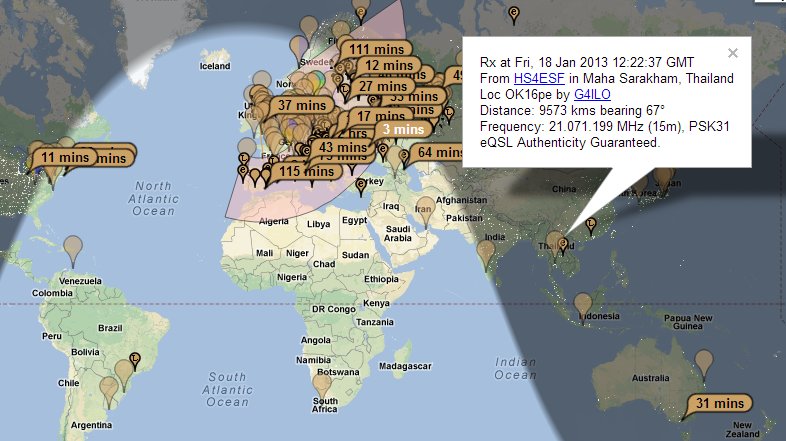 |
| PSK31 spots of G4ILO on 15m |
I tried JT65A briefly but the band segment was full of the same stations I could easily work using PSK31 so I thought I would try CW instead. I “shook hands” (as John N8ZYA puts it) with Z320K, a special call to commemorate 20 years of the Z3 prefix (Macedonia.) I then had a real QSO with Bill, WA1HMW who is an ex-Royal Navy. That QSO taxed my receiving abilities a bit so I decided to call it a day.
Julian Moss, G4ILO, is a regular contributor to AmateurRadio.com and writes from Cumbria, England. Contact him at [email protected].
Antenna switch
I played in the 80 Meter QRP Foxhunt tonight and was quite successful. I ended up bagging both pelts, but it was a close call.
Jim N0UR in MN was first in the bag and was pretty easy. He was using the “standard” 1 kHz “up” split and it was just a matter of working him.
Ray K9XE in IL was another matter. Ray was loud, but was buried under some even louder local QRN. I wasn’t getting a feel for hearing Ray, no matter how I adjusted the K3. With time running out, I decided to switch on over to the KX3. Both radios are new to me, but over the past few months I have acquainted myself with the KX3 just a bit more.
In a matter of minutes, using the Dual Watch feature, and by adjusting the passband tuning, I was able to isolate Ray’s signal. I was also able to determine his split via Dual Watch, as mentioned before, and nabbed his fur with six minutes to go.
There are various reasons that I prefer the K3 as my main station rig. One of the best features, for me, is the built in antenna switch. I can switch between the vertical and the wires in an instant, and use whichever antenna is best suited for the job.
The KX3 only has the single antenna input. To switch between all my antennas, I will have to acquire a better antenna switch than what I currently have. I am thinking of perhaps a Daiwa or a Diamond. In the past, I had been using a no name, bargain brand switch with my K2. Quite by accident, I had found out that when I removed my Butternut from the antenna switch, and connected the vertical directly, the difference was like night and day. Due to the poor quality of that particular switch, it was as if I had an attenuator in line. Needless to say, that switch got tossed. The remaining one that I am using now, is better quality but only has two positions – I need at least three.
I think a Diamond or Daiwa will do a better job and will allow me to use the KX3 more often from the shack. It’s a great rig for Fox hunting!
73 de Larry W2LJ
QRP – When you care to send the very least!
Larry Makoski, W2LJ, is a regular contributor to AmateurRadio.com and writes from New Jersey, USA. Contact him at [email protected].
Show Notes #098
Introduction:
- A Futile Exercise in Focus, or perhaps a feudal exercise. Stay tuned and find out.
Announcements:
- Listen to us live Tuesday evenings (in the USA), or subscribe and receive access to the unedited recording and other things. Visit the website for details.
- We’re in dangerous proximity to episode 100, so send in comments, suggestions, voice mail, Facebook, Google+, or carrier pigeons.
- All you podcasters out there, join the Black Sparrow Media network.
- The 2013 Dayton Hamvention will be May 17-19, 2013. Russ is hoping to have the LHS booth again, but we need your help. Please donate if you can. Every little bit helps.
- Kevin O’Brien, Publicity Director for the Ohio LinuxFest, tells us that they have set up a brief survey to gather ideas for the 2013 Ohio LinuxFest. Visit http://ohiolinux.org/ to find the survey.
- Northeast Linux Fest will be March 16th and 17th, 2013, at Harvard University in Cambridge, Massachusetts.
Topics:
- Russ’ Raspberry Pi adventures continue. His Echolink node 54711 is now up and running on a Raspbian-based Raspberry Pi with svxlink and Qtel. Russ had to insert “dwc_otg.fiq_fix_enable=0″ into the /boot/cmdline.txt file in order to fix a problem with the onboard Ethernet card locking up. Since then, all has been well.
- Amateur Radio Pi is a forum with the tagline: The interactions between amateur radio and the Raspberry Pi.
- The Society for the Preservation of Amateur Radio (SPAR) will conduct a Winter Field Day, beginning 1700Z on January 26, 2013 and ending at 1700Z January 27th.
- HamSphere is a software Amateur Radio simulator that allows licensed radio amateurs and unlicensed enthusiasts to communicate with one another using a virtual transciever over the Internet. It was designed by Kelly Lindman, a radio amateur with callsign 5B4AIT. The software runs under Windows, Mac or Linux. There’s also a Wikipedia page for more information.
- RepeaterBook is an Android application for locating amateur radio repeaters. There are lots of options, including repeater types and modes (D-Star, etc). It also supports the BlueCAT Yaesu FT-857/FT-817 interface that allows you to tap a repeater entry in RepeaterBook on the phone and it will set your radio frequency.
Feedback:
- Comment via the Web site from Leif, KC8RWR, with another attempt at explaining hard and soft links, which we were discussing in episode 95. Thanks, Leif.
- Leif also commented about difficulties hearing a mobile radio without a speaker in the head unit.
- A very strange voice mail from the Radio Gangsta, aka Rich, KD0RG, from the LowSWR podcast.
- E-mail from gasgasmike, asks if it would be possible to use short wave radio to provide wireless Internet service. Our hosts discuss the practical difficulties with such a scheme. (Note: the use of the amateur portions of the radio spectrum for commercial purposes is expressly prohibited by the FCC.)
- Jeff, KC2QZO, sends his appreciation of our discussion of Codec2 in episode 85.
- Russ mentions that there is another low-bitrate codec is being developed: The Opus Interactive Audio Codec.
Contact Info:
- Contact Richard at [email protected], Russ at [email protected], or both at the same time at [email protected].
- Listen to the live stream every other Tuesday at 8:00pm Central time. Check the LHS web site for dates.
- Leave us a voice mail at 1-909-LHS-SHOW (1-909-547-7469), or record an introduction to the podcast.
- Sign up for the LHS mailing list.
- Sign up for the MAGNetcon mailing list.
- LHS merchandise is available at the Merch link on Web site. Check out the Badgerwear or buy one of the other LHS-branded items at PrintFection.com/lhs or Cafe Press. Thanks!
- Thanks to Dave from Gamma Leonis for the theme music.
Music:
- None this episode.
Russ Woodman, K5TUX, co-hosts the Linux in the Ham Shack podcast which is available for download in both MP3 and OGG audio format. Contact him at [email protected].
Need A Logging Program for VHF Contests?
 As I prepare for the ARRL January VHF Contest, I loaded the latest version of VHF LOG, a software program by Dave W3KM. I have used this free program for many years and it just rolled over to version 4.0 to support Windows 8.
VHF LOG is easy to use while covering the basic contest logging requirements for the usual VHF contests (ARRL January/June/September, CQ Worldwide VHF, etc.). It includes a “Post Contest” mode, which is handy for entering a paper log into your computer for electronic submission.
VHF LOG runs on Windows operating systems, 98SE thru Win8. Check it out.
73, Bob K0NR
Bob Witte, KØNR, is a regular contributor to AmateurRadio.com and writes from Colorado, USA. Contact him at [email protected].
Out of practice
I had a meeting that I had to attend this evening, but it concluded quite a bit earlier than I had anticipated. I was home by 8:00 PM, so I took the opportunity to participate in the monthly NAQCC sprint tonight. Something I haven’t done in probably over a year.
I am way out of practice!!! In the past, I would sit down for this contest and I would routinely bang out anywhere from 25 – 40 contacts. Tonight, I feel fortunate to have made 17. That’s way down from my old normal.
And it just goes to show that if you want to succeed in a QRP sprint, or any other radio contest, for that matter, that it takes practice. Radio Sport, as our European friends call it, is not just something that you can sit down and “do”.
It takes practice and a plan. In the old days, I would stake out a clear frequency and run stations. Tonight, I pretty much just searched and pounced. Not the most efficient for running up a score. I never got into a rhythm and the results show.
I will have to get back into the habit of participating in the “Big Three” each month – the ARS Spartan Sprint, the Run for the Bacon, and the NAQCC Sprint. Now that’s the way to seriously fill up your logbook!
72 de Larry W2LJ
QRP – When you care to send the very least!
Larry Makoski, W2LJ, is a regular contributor to AmateurRadio.com and writes from New Jersey, USA. Contact him at [email protected].
 Ham Radio Deluxe |
 W5SWL Electronics |
 Ham Radio Prep |
 KB3IFH QSL Cards  Hip Ham Shirts  HamRadioAuctions HamRadioAuctions Reliance Antennas Reliance Antennas Enigma Shop Enigma Shop |  morseDX  Ni4L Antennas  R&L Electronics R&L Electronics antennas.us antennas.us QRV QRV |
- Matt W1MST, Managing Editor
