 |
 A PSK Core DLL mystery
 24 January 2013 | by
 The runaway success of the Elecraft KX3 has resulted in a sharp increase in the number of users of KComm. Even those who use a full-featured logging program in the shack find the simplicity of KComm and the compactness of its user interface (which was designed to fit a netbook) better suited to portable operating.
I received an email from a KComm user in Vienna, Wolfgang OE1MWW who wrote that he found the option to “Use PSK modem” (which uses AE4JY’s PSK Core DLL to operate PSK31 using the sound card) was disabled on his laptop running Windows XP SP3 though it was enabled on his desktop running Windows 7 64-bit. Wolfgang eventually found that replacing the file PSKCore.dll that was installed by KComm with one dowloaded from AE4JY’s website cured the problem.
I am surprised and a bit mystified as to why this occurred. My shack PC also runs Windows XP SP3 (I prefer to stay as far from the bleeding edge as possible) and it uses the same version of PSKCore.dll as is installed with KComm.
KComm’s version is much smaller so I’m hazarding a guess (since I can no longer remember) that it may have been compressed using UPX, an executable file compressor. I used to have a bit of a mania for compressing executable files so I could claim how small they were compared to certain other ham radio bloatware, but in these days of 100GB hard drives it’s probably rather fatuous. Possibly the compression caused an issue with some security software?
Whatever the reason, I’m grateful to Wolfgang for discovering a solution. I have added a note to KComm’s Troubleshooting page and updated the installer package to include AE4JY’s copy of the PSKCore.dll so hopefully new users will not encounter this problem.
Julian Moss, G4ILO, is a regular contributor to AmateurRadio.com and writes from Cumbria, England. Contact him at [email protected].
Time has come to drop some blogs…………..

It was time for me to go over the blog and do something that is never very easy to do.....I have had to preform this function in past and never looked forward to it. The time came to look through the blogs on my blog list and remove the ones that have been dormant for some time. As I went through the blogs I had noticed that some were without any activity for more than a year. I felt these ones for one reason or another were no longer functioning. It ended up I only had to drop about 3 blogs but it gives me more room to add active blogs. I can understand how workloads, family and sometime health problems can lead to a blog going stagnate. One thing I am guilty of is not changing my blog layout now and then to give it a new and fresh look. I think in the 3 years the blog has been up and running it has had....maybe 2 makeovers!! I should pay more attention to this as well as adding and or refreshing up the pages as well.
Mike Weir, VE9KK, is a regular contributor to AmateurRadio.com and writes from New Brunswick, Canada. Contact him at [email protected].
handiham – ham radio for people with disabilities 2013-01-23 13:50:00
Pat Tice, WA0TDA, is the manager of HANDI-HAM and a regular contributor to AmateurRadio.com. Contact him at [email protected].
Basic Android Programming
Up until I got an Android smartphone, there has not been a single programmable device that I’ve owned and not tried to write my own programs for it. However, programming for Android devices seemed to be fiendishly difficult, requiring a good knowledge of Java (which I haven’t got) so I didn’t attempt it. The other week I saw an article in a computer magazine that went through describing how to create programs using a tool called Basic4Android. It seemed similar enough to other development tools I have used such as Visual Basic, Delphi and Lazarus. So I thought I would download the trial version and have a play.
 |
| The Basic4Android development environment, |
I soon discovered that the trial version is pretty limiting. It’s enough to get a feel for the environment and the development process by creating “hello world” apps and suchlike, but in order to do anything interesting you need to use libraries and these are only accessible using the full paid-for version.
There are two full versions of Basic4Android you can buy: the Standard version which costs $49 and includes support and free upgrades for two months, and the Enterprise version which costs $99 and includes support and free upgrades for two years. As I’m not an Enterprise, only a dabbler (and a cheapskate one at that) I bought the Standard version. With hindsight that was not such a good idea, as I discovered after purchasing that only current paid-up users get access to the download links for additional libraries, even user-written ones, and access to the support forum. So after two months I’m on my own. A false economy, I think.
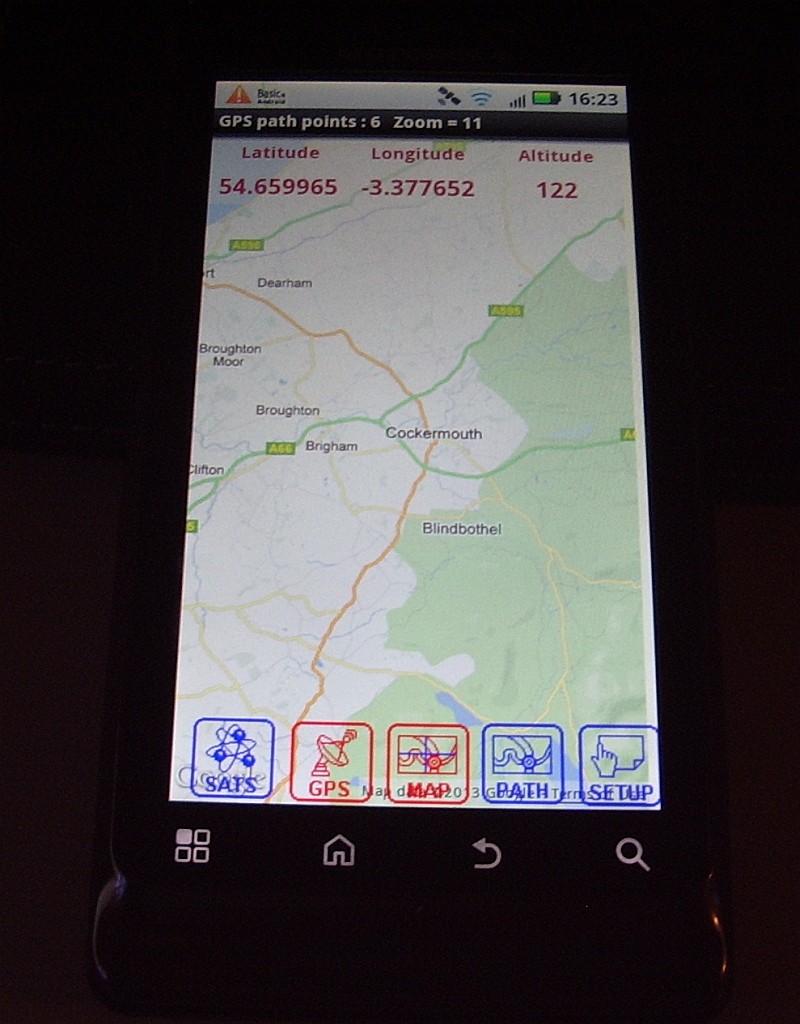 |
| Sophisticated GPS apps can be developed |
Basic4Android is a very powerful development tool and I don’t think there is much you couldn’t do with it if you’re clever enough. The language is object oriented like any modern Basic, and objects exist to let you access the internet, draw charts, access SQL databases and much more. You can access the Android device’s GPS via a fully featured GPS library. There is even code to work with Google Maps. I have no intention of developing an Android version of APRSISCE (as if I could!) but Basic4Android looks powerful enough to make that possible.
So far I haven’t learned much about Basic4Android programming that’s worth sharing with people, but here are a few things I wish I had known prior to buying.
There is no need to pay the full prices I mentioned earlier. Once Google finds out you are interested in Basic4Android, ads to buy Basic4Android with 30% off will follow you around the web. To get the deal, click on one of them.
There are two options you can use to pay for Basic4Android, PayPal and Plimus. If you are in Europe then be sure to use the PayPal purchase buttons. If you use Plimus then you’ll get stung for VAT which will bump up the price 20%.
Better still you can get Basic4Android Enterprise version with two years’ updates and support at half price by using the coupon code dnxyif. Unfortunately this is only valid if you use the Plimus payment option so there is no avoiding VAT if you are in Europe. But even with VAT it’s still the best deal I think. I hope that helps someone.
Julian Moss, G4ILO, is a regular contributor to AmateurRadio.com and writes from Cumbria, England. Contact him at [email protected].
GB4LBC cut short because of a rescue

Whilst operating the GB4LBC special event station on Sunday we had a very urgent knock on the door. The station manager burst through and announced that the crew were launching for real. We stopped the session immediately and got well out the way.
The crew managed to get the boat into the water in what seemed to be seconds and before long they were out of sight and off to help a struggling fishing boat. It made the sos radio week just that little bit more realistic and hopefully it was just as one off.
Let’s hope that next weekend is not as busy for them but just as busy for us. Our 250 or do contacts, mainly on Sunday, were very much appreciated and thanks to everyone who took the time to answer our calls.
Alex Hill, G7KSE, is a regular contributor to AmateurRadio.com and writes from Cumbria, UK. Contact him at [email protected].
Learning things
I have heard it said that everyone learns differently. That is most likely true; but I am living proof that even one single person can learn things in different ways – namely the easy way and the hard way.
The weather today in NJ has been really cold. When I woke up this morning, it was 15F (-9C) outside. As I returned home from work tonight, it was 16F (-8C). It’s a very clear night with the Moon and Jupiter shining brightly in the sky. I will not be surprised if we get down into the single digits tonight.
Why do I bring this up? Because of a lesson learned the hard way.
When I was a kid, I spent my summers at the grocery store that my Dad and my uncle owned. It was a small, family owned “Mom and Pop” kind of place. The entire width of our store probably wouldn’t amount to more than three aisles in a supermarket of today.
We sold groceries and meats. My Dad and my uncles were butchers as well as grocers. From the age of 7 and up, I worked most of my summer vacation time at our store, stocking shelves. When I got to be a teenager, I wanted to graduate from shelf stocking to butchering. My Dad was reluctant and was never thrilled with the idea; but I bugged him until he taught me. My last several summers of working at the store involved stocking shelves; but I also got to cut cold cuts, make chopped meat, bone out cuts of beef, pork and veal for kielbasa stuffing, among other things. But perhaps the toughest job of all was when chickens came in. We were a dealer for Perdue chickens – fresh chickens that were packed in ice – never frozen. When the whole chickens came in, I was given the delightful job of removing the livers and necks. They came packed in wax paper inside the chickens, exactly the same way that giblets and necks come delivered inside your Thanksgiving turkey. But imagine if you will, removing the livers and necks from many dozens of ice cold chickens, all in one sitting. After a while, I couldn’t even feel my hands as they were numbed by the ice cold chicken flesh. And of course, it had to be done this way, because you couldn’t let the chickens warm up.
My point? I had to learn the hard way, what my Dad tried to tell me. Stick your hands in cold meat for a long enough time and you’re going to develop arthritis in your hands. By the time my Dad retired, his hands were pretty disfigured. He never removed his wedding band, but even if had wanted to, his knuckles were so permanently swollen and his fingers were so crooked, that it would have been an impossibility. And now, when it get this cold, MY hands feel like two giant toothaches, even with Thinsulate gloves on. I didn’t butcher meat for anywhere near as long as he did; but those 5 – 7 summers were enough. Now I will suffer with “mildly” arthritic hands for the rest of my life – a lesson learned the hard way.
But, I’m not hopeless! I can learn things the easy way, too. And I was reminded of that when I read Jim W1PID’s post on AmateurRadio.com this afternoon – “Around The World for Morning Tea” and I was transported back to my youth. It was stories similar to this that reinforced my desire to become an Amateur Radio operator as a kid.
Travelling the world from a room (in my case, my bedroom) had an appeal that did not fade with time. A seed was planted that grew to fruition in my very early 20s, when I earned my Novice ticket back in 1978.
I am very glad for that Novice ticket, because it turned out to be learning “the easy way” (relatively speaking). My intention from “the get-go” was to get on the HF bands. The Technician class existed back then, too; but held no appeal to me. For me, Amateur Radio meant getting on the air with the possibility of communicating anywhere around the world. Whether what actually occurred was communicating down the street or around the state didn’t matter, as long as that possibility also included talking to far away places on the globe remained. The Novice ticket filled the bill, and thanks to good Elmers who taught me, I was able to procure my license with the least amount of frustration.
I am very grateful for the Novice sub bands that existed at the time. There were very small slices of 80, 40, 15 and 10 Meters where we were allowed to prowl. Of course, it was CW only but that and the frequency limitations were our only limitations! There was plenty of DX to be had and I got my share.
I worked Hams of just about every license class that visited our Novice sections in those days. But of course the majority of other stations worked were other Novices. We “grew up” together, we learned together, we made the same mistakes together, we honed our skills together. For most of us, upgrading was our reason for being. And, most importantly, when we upgraded and discovered that VHF/UHF wasn’t the end all and be all of Amateur Radio, we had our HF skills to fall back on. We were literally eased in to the operating habits and skills required by the higher class licencees.
I often wonder how the loss of that introductory Novice class has affected Amateur Radio in the United States. I suppose I could research trends and numbers that have occurred since. But in my heart, I think the impact has not beneficial. Thankfully, we have a lot of good Elmers out there who are willing to pass on what they have learned, whether by teaching classes, or producing learning materials and software, it is still possible to learn how to be a Ham “the easy way” – not stumbling around by yourself in the dark.
But I still wonder if having the Novice ticket and the Novice sub bands (or something like it) might be an effective tool to avoid the problem of new Hams who find themselves in that “VHF/UHF rut”, and get tired and disenchanted, only to never bother to further explore the varied possibilities of this wonderful hobby.
72 de Larry W2LJ
QRP – When you care to send the very least!
Larry Makoski, W2LJ, is a regular contributor to AmateurRadio.com and writes from New Jersey, USA. Contact him at [email protected].
Around the World for Morning Tea
I wrote this short article for our club newsletter in hopes it will encourage some members to upgrade from technician class.
It is a strange privilege we have… this ham radio hobby. This morning while having a quick cup of tea, I travel around the world in under 10 minutes visiting briefly with Israel, Italy, Slovenia and Aruba.
I am transported from my radio room upstairs to places far away. Outside there is fresh snow and it’s 10F. It’s definitely not snowing in Aruba. I stop for a quick visit with Carl, P49V. He’s 2100 miles to my south… at 75F the flowers are blooming. It’s a great place to begin my journey.

I have chatted with Carl before… once in 2010, and again in 2011. We don’t linger for long… just to say a quick hello and exchange signal reports.
I turn the dial and I’m in Israel! 5500 miles away between Egypt and Iraq. Who would imagine. Udi says “Hello,” and wishes me well on my journey.

This strange breakfast navigation is made possible by some modest radio equipment and a simple wire hung from the trees outside. I am using Morse on the 15 meter band. Pure magic to many, rather a common occurrence (though magic none-the-less) for those more practiced in the radio arts.
Between sips of tea I turn north and west to central Italy. It’s somewhat closer to home at 4500 miles. Vanni, I5ECW and I have visited before a few years ago. He sends, “Ciao, Ciao,” and I am on my way to Slovenia to visit with Dan.
Dan, S59N lives south of Austria in central Slovenia. He sits in his shack using mostly homemade equipment. We have chatted nearly 20 times since 2004.

I say “Good Afternoon” to Dan (he’s in a different time zone) and reach again for my tea cup. Barely ten minutes have passed since I turned on the radio set, but already I’ve traveled to the far reaches of the world. I’m ready for some oatmeal.
Jim Cluett, W1PID, is a regular contributor to AmateurRadio.com and writes from New Hampshire, USA. Contact him at [email protected].
 Ham Radio Deluxe |
 W5SWL Electronics |
 Ham Radio Prep |
 KB3IFH QSL Cards  Hip Ham Shirts  HamRadioAuctions HamRadioAuctions Reliance Antennas Reliance Antennas Enigma Shop Enigma Shop |  morseDX  Ni4L Antennas  R&L Electronics R&L Electronics antennas.us antennas.us QRV QRV |
- Matt W1MST, Managing Editor
