 |
 ARRL DX 2013 – Illustrated
 19 February 2013 | by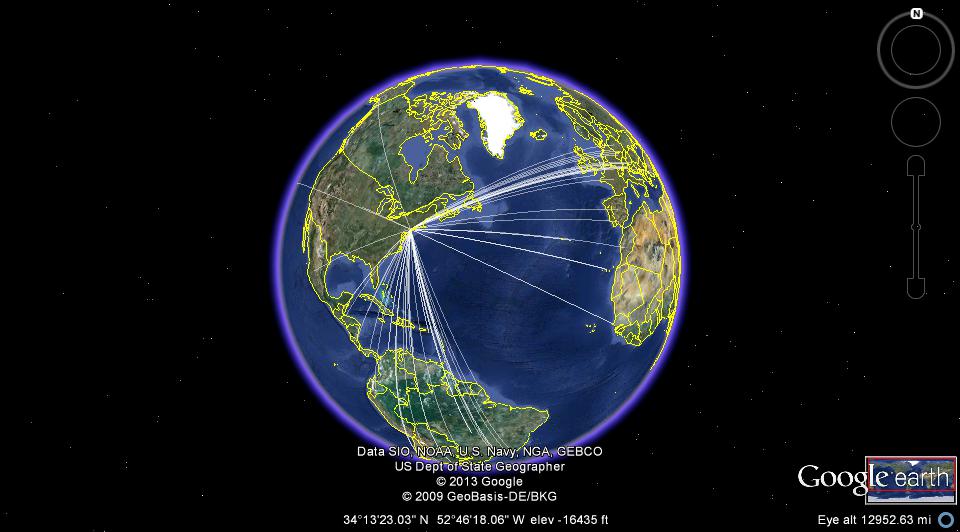
Google Earth is so cool!
72 de Larry W2LJ
QRP – When you care to send the very least!
Larry Makoski, W2LJ, is a regular contributor to AmateurRadio.com and writes from New Jersey, USA. Contact him at [email protected].
Mr. Morse

72 de Larry W2LJ
QRP – When you care to send the very least!
Larry Makoski, W2LJ, is a regular contributor to AmateurRadio.com and writes from New Jersey, USA. Contact him at [email protected].
Low-tech transmitter hunting
As I’ve mentioned before, KD2CHE and I belong to a local transmitter hunting group. We get together one or two times a month. One member will hide the  box and give us a general area, which is usually a radius from a point (i.e. 2 miles from the intersection of routes 1 and 2 in Anytown, NY). We are the only ones without doppler equipment, yet we almost always find the transmitter. Here’s some pointers for those of you that enjoy a bunny hunt every now and then, but may not think you can participate without sophisticated direction-finding equipment, or for those of you with dopplers that want to refine your techniques.
First of all, when I know the area, I print a map from the computer, and draw a circle for the hunting area. Then, using either our knowledge of the area, or a combination of Google Maps, and Bing Maps, I find a large building that I can drive all the way around, as close to the center as possible. I mark the spot on the map as our starting point. KD2CHE drives, while I navigate. When the time comes to leave for the location, I load up the equipment:
- The mobile in the car, for communicating with the other hunters, an Icom IC-207H
- An older Kenwood all-mode 2 meter mobile, with an RF-gain control, attached to an OPEK micro mag mount antenna
- A smartphone with Google Maps, or a laptop with a broadband connection
- Bright flash-lite
- 1 HT set to the third harmonic of the hunt frequency, usually my Icom IC-T90A with a good antenna
- 1 HT set to the hunt frequency with the antenna off, usually my Baofeng UV3R MkII
- 1 HT set to the hunt frequency for KD2CHE to use out of the car
Once the transmitter is activated, KD2CHE drives slowly around the building at the starting point, stopping when the transmitter stops, and starting up again when it comes back (the one we use is usually 30 seconds on / 30 seconds off). I mark the points in our loop where the signal was strongest and weakest, drawing a line with an arrow to get our initial vector. Then we navigate in that direction, using Google Maps as a guide. As the signal changes I mark the observed strength on the map. When we reach the point where the signal strength goes back down, we determine the high point, and KD2CHE drives as close to perpendicular to the original route as she can.
During this process, the RF gain control on the Kenwood comes in handy. The box puts out a full 5 Watts, so as you get close to it, an un-attenuated receiver becomes useless. For the signal readings with the RF gain all the way down, I write an ‘A’ in front of the s-meter reading on the map. As the strength goes up again, we keep an eye on the 2 HTs. When we’re within 1 or 2 blocks, one or both of them will become active. The third harmonic will usually not work until you are almost on top of the transmitter, which comes in handy. This is when we start looking for a good spot. In many cases there will be a public park, or area of some sort nearby, and the rest of the hunt is done on foot with the HTs, and the flash-lite if necessary.
Body shielding will get you a direction to walk in. Hold a radio that is getting a weak signal (the IC-T90A has a fixed-level attenuator I can activate) close in to your chest and slowly turn around, and make note again of the weak and strong points in the circle. Keep in mind though that sometimes, a good hider will put the box in a location that creates reflections and ghosts. Sometimes you just need to use logic, or in the case of our last hunt, KD2CHE found the box simply by looking, while everyone else was wandering around the woods with Yagis and other fancy equipment.
Of course it helps to know the area, and to have some insight into where people like to hide things. One of our hiders frequently hides in places he discovers while hiking. Another likes to hide in very unique, and sometimes questionable places. Once or twice we’ve had to explain to the authorities what we were doing.
I’m convinced that a doppler might enhance our abilities, but I’m afraid of relying on it too much. We actually have one, but it needs some work. We’ll see.
73! Neil W2NDG
Neil Goldstein, W2NDG, is a regular contributor to AmateurRadio.com and writes from New York, USA. Contact him at [email protected].
1 Volt/2 Volt Transceivers
Transceivers with a power supply of 1 and 2 Volts, how much can one achieve with that? Well, actually quite a lot according to DL2AVH, Helmut, who together with DL4ALJ, Gero, wrote two articles about that in the German QRP-Report in 2011. I am impressed by the output power, up to 200 mW with one battery cell (1.5 Volts) and 0.5 Watts with two cells.
I wrote about this in April last year where I also mentioned that the 1 Volt design from 2000 later had been corrected. Those corrections can be found in the article in QRP-Report 3/2011: “Niederspannungs-Schaltungtechnik – der 1-V- und der 2-V-transceiver” (Low voltage circuit technology – the 1 Volt and the 2 Volt transceivers). The improvements are concerned with better input filtering at 14 MHz with a quartz crystal in the front-end filter and better efficiency in the mixer and removal of an audio stage in the direct conversion receiver. This design only uses bipolar transistors and no ICs.
This is different in the newer 2 or 3 Volt transceiver for 7 MHz. Here an impressive figure of only 5 mA power consumption for the receiver is achieved. The transmitter consumes about 250 mA. Several MC1496P balanced modulator/demodulator ICs are used for the mixers in the transmitter and the superhet receiver, and for the product detector of the receiver. They seem to run quite comfortably on only 1.8 Volts as supplied by a low-droput regulator from the battery supply. The TDA7050 is used for the audio output stage. This is a low voltage audio amplifier for headphones which can operate with a supply voltage down to 1.6 V.
The design is said to benefit from low voltage technology of mobile phones. This is the case for circuitry like that of the output stage of the transmitter which consists of a pair of BFG21W transistors. However, both of the ICs have been around for many years.
I think this was a very inspiring read, and the final comment about power consumption from the second article is interesting. They say that with two AA-batteries, the receiver will last for 285 hours, which is the same as 70 days of listening of 4 hours per day. With transmission for 10% of the time, the set of batteries will last for 4 weeks!
- Related post: Whatever happened to the 1 Volt QRP Transceivers?
Sverre Holm, LA3ZA, is a regular contributor to AmateurRadio.com and writes from Norway. Contact him at [email protected].
Bands still relatively busy
I guess that a few folks who went places to operate for the ARRL DX Contest have stayed on a few days at their respective “vacation” spots. On the air today, I was hearing a lot of the call signs that I heard in the Caribbean from over the weekend. You would think that having completed major DX contest that these folks would be kicking back on the beach, soaking up the sun and sipping a cool libation from a coconut shell (complete with little umbrella, of course!).
I worked a couple of them; but the station that intrigued me the most was GM100RSGB, the Centennial Special Event Station for the RSGB from Scotland. At 1914 UTC, they were loud into New Jersey on 20 Meters, and I was able to work them with 5 Watts very easily. According to QRZ.com, this is what their QSL looks like:

Larry Makoski, W2LJ, is a regular contributor to AmateurRadio.com and writes from New Jersey, USA. Contact him at [email protected].
Amateur Radio Kit Roundup – Updated 2/18/2013

The Splinter – from Breadboard Radio
Kit building appears to be on the rise again. With so many people talking about it lately I attempted to research sources for kits, only to find out that there wasn’t a single-source for Ham Radio kit suppliers.
I decided to put together a good list of sources for kits that are currently available. Many of these are for QRP operation, but a few are full-featured professional transceivers (Elecraft, DZ). On the beginners side there are a few sources that stand out: Hendricks has a great assortment of kits, including some SSB QRP equipment. QRPme offers the inexpensive, easy-to-build tuna-can products, and I would like to make special mention of the Four State QRP Group NS-40 which has the coils etched right into the PC board! What a great idea! I’ve covered trasmitters, transceivers, and some receivers here. Some accessories are mentioned in the source descriptions.
Revised 7/19/2012 Changes in Hendricks QRP Kits, YouKits, Genesis Radio, Tony Parks, and removed the coming soon designation on Heathkit. I didn’t check ALL of the prices, so don’t hold me to total accuracy in that department.
Revised 10/22/2012 Changes in Hendricks, YouKits, Tony Parks, Small Wonder Labs, Wilderness Radio, and Four State QRP Group. Removed Heathkit, Added HSC.
Revised 2/18/2013 Changes in Hendricks, YouKits, Tony Parks. Added CR KITS, and BreadBoard Radio.
Revised 2/20/2013 Added K5BCQ & K5JHF Kits
Enjoy, and feel free to add any corrections, or additions in the comments. The list can always be found at RadioKitGuide.com–Neil W2NDG
-Hendricks QRP Kits http://www.qrpkits.com/
- BitX20A/17A SSB Transceiver. The BitX20A and BitX17A are complete SSB kits with board, all parts, digital display and custom powder coated and punched case that is based on the BitX20 that was designed by Ashlan Farhan. Output is about 10 Watts. $180.00 + S&H
- PFR-3a 3-Band Portable Field Radio. Bands : 40 meters, 30 meters and 20 meters. Tuning range: Full band coverage. Mode: CW only. $240.00 + S&H
- NADC30/40 CW Transceiver. Nearly All Discrete Component CW Transceiver for either 30m or 40m. Tuning range ~ 60 kHz. Power output: 3.5 watts. Full Kit: $130.00 + S&H
- Ft Tuthill 15 Meter CW Transceiver. Two 60 KHz tuning ranges, ~ 21.000 – 21.060 and 21.075 – 21.135 MHz. Power Output: 5 Watts. Complete Kit (w/ case and digital dial) $130.00 + S&H
- Ft Tuthill 160 Meter CW Transceiver. Two 30 KHz tuning ranges, ~ 1800 – 1835 and 1830 – 1865 MHz. Power Output: 5 Watts. Complete Kit (w/ case and digital dial) $130.00 + S&H
- DCxxB Board Only Trasceiver Kit. These radios are the next generation of the popular DC40 transceiver that was also designed by Steve Weber. The kit will come with 1 crystal for the band specified. 7.040 for DC40, 10.120 for DC30, 14.060 for DC20. Board-Only kit with decals: $30.00 + S&H
- Weber Tri-Bander. The Weber Tri-Bander can be built for any three of these bands: 80, 40, 30, 20, 17, or 15. 5 Watts out on all bands at 13.8 VDC. Built in Iambic keyer with 5 to 40 wpm code speed. DDS VFO for rock steady stability with 50 Hz and 200 Hz tuning rates. Many more features! $200 + S&H
- Scout Regen Receiver. A simple 2 band regenerative radio receiver that is capable of receiving signals from 3.5 to 11 MHz. A complete kit with L shaped aluminum chassis, quality doublesided Read the rest of this post
Neil Goldstein, W2NDG, is a regular contributor to AmateurRadio.com and writes from New York, USA. Contact him at [email protected].
Like an Oasis
This last weekend was a major DX contest and I managed to stay away from the HF radio for all of it. At least until the waning minutes of the contest. The waters had been mightily churned and it seemed one cacophonous mess to the casual listener.
And then, almost magically, as the clock rolled over to 0000 of the next day, the silence was suddenly deafening.
I can just imagine there were quite a few exhausted operators and it’s likely many of them had to be grinning over putting a few news ones in the log. I’ve played in these waters before and know the feeling. But somewhere along the road to becoming a grumpy old man, I got turned off by the high-speed exchanges of button pushing keyboard jockeys staring into the glow of LCD monitors while their computers and radio equipment ran the show.
Anyway, after the contest I had the rig on and was monitoring familiar territory on 40 meters. It was just getting late enough that the band was beginning to go long. I suppose that means different things depending on your location. Here in the Hoosier Heartland 40 meters is good for 250-750 miles, give or take, while the Sun shines. Things can be a bit spooky and unpredictable right around the gray line, but as the hours pass after sunset, the workable area for me on 40 meters grows dramatically.
By 0200 it’s not strange to begin working the West coast. And as the night continues we often see a path to Hawaii and the rest of the Pacific. By 0800 signals from the VK’s and ZL’s waft over Central Indiana just begging to be snagged by anyone awake at that ungodly hour.
So last night at around 0300 I was listening to the quiet while putting together a few things for an early next-morning conference call when I heard a seven calling CQ.
And what welcome relief his signal provided, like an oasis.
Good old-fashioned CW, sent by hand, the way God and Hiram meant it to be, flowing from the desert to my front door.
My new friend was in Lake Havasu City, some 1600 miles southwest of here. After the usual opening platitudes that CW enthusiasts suffer in hopes of what might come next, conversation ensued. Real conversation. He told me about a boating trip he had planned for today and we spoke of other things besides radio and the ailments of age. It was probably the longest CW conversation I’ve enjoyed in 2013 and I would have been pleased had it gone on even longer.
But through the burps in the QSK I could hear other signals floating into the bandpass. No doubt other parched patrons of the dits and dahs anxious to get their turn in the aether now that the contest was over and the band had purified itself from its former abuse.
We signed off in the customary manner of the mode with 73 and many hopes to meet again.
After the logging, I closed station for the night. Now sleep was the one calling CQ and I was slipping into the abyss. But just before passing to the other side of consciousness, I couldn’t help but think that when radio is good, it’s very good.
Jeff Davis, KE9V, is a regular contributor to AmateurRadio.com and writes from Indiana, USA.
 Ham Radio Deluxe |
 W5SWL Electronics |
 Ham Radio Prep |
 KB3IFH QSL Cards  Hip Ham Shirts  HamRadioAuctions HamRadioAuctions Reliance Antennas Reliance Antennas Enigma Shop Enigma Shop |  morseDX  Ni4L Antennas  R&L Electronics R&L Electronics antennas.us antennas.us QRV QRV |
- Matt W1MST, Managing Editor
