 |
 A 40m transceiver kit
 25 February 2013 | by
 It has been a while since my soldering iron has been warmed up and I have been feeling the urge to build something. The challenge of building something from scratch has usually proved too much, so I have decided to build a kit. I’ve read a lot of good things about the “Iler 40” and its 20m brother so I decided to get one.
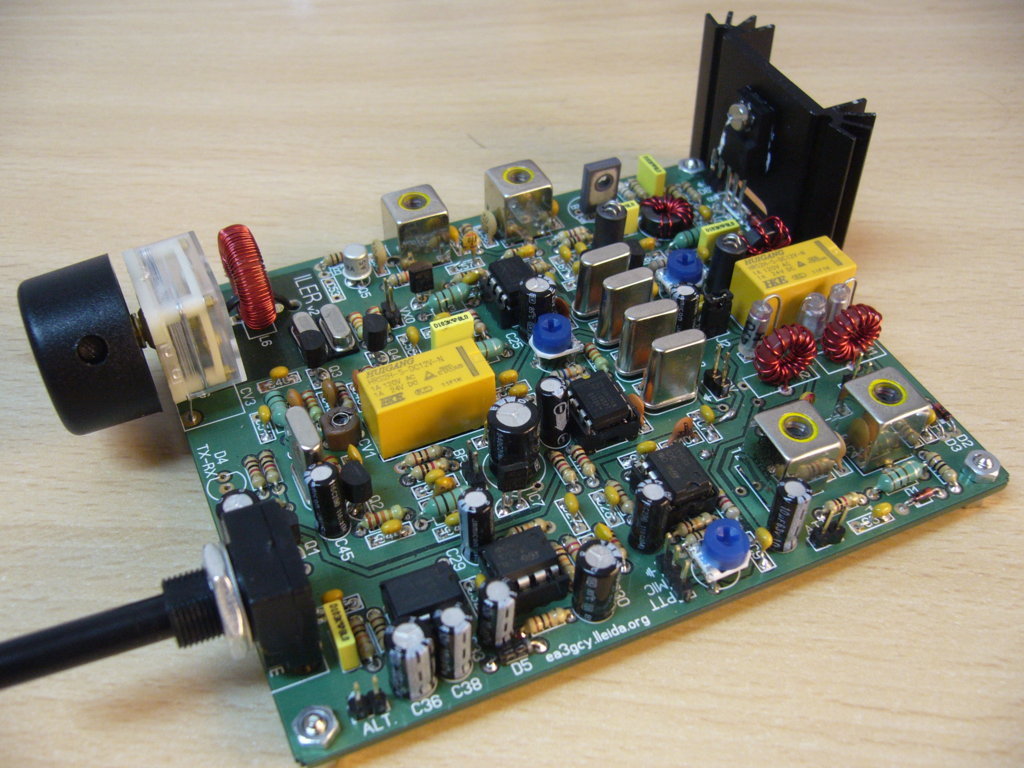 |
| Iler 40 transceiver (EA9GCY photo) |
I thought that this kit was sold on Ebay but a search for “Iler 20” came up blank. A more generic search produced some interesting hits including this 40m transceiver kit from a UK seller. This kit is quite a bit cheaper than the Iler kits but without any reviews it is a bit of an unknown quantity. I eventually found that the Iler kits can be bought from the maker’s own site. The excellent reviews plus a higher output (4w vs 1w) were the decider. I was a bit unsure of which version to go for but I eventually plumped for the 40m version. More to follow once it gets here.
Julian Moss, G4ILO, is a regular contributor to AmateurRadio.com and writes from Cumbria, England. Contact him at [email protected].
LHS Episode #100: The Centennial
 Hello, everyone. This is the 100th installment of Linux in the Ham Shack. Some may have doubted that we would ever get this far. Some may be delighted. Some may be dismayed. Whatever feelings you may have on the matter, we have arrived. Please be advised that there is little in the way of Linux and/or Ham Radio content in this episode. It’s a bit more of a gab fest. That being said, we did have a couple of listeners on with us as guests, and everyone who joined us for the live event had a great time. The recording of this episode also coincided with Richard’s birthday, so if you haven’t already, feel free to wish him a happy belated birthday. Also in this episode is THE BIG BOMBSHELL. Word may have leaked out, but to some it will still be a surprise. Please take a moment to reminisce with us about our last 100 episodes, and we can’t wait to see what the next 100 will bring.
73 de The LHS Guys
Russ Woodman, K5TUX, co-hosts the Linux in the Ham Shack podcast which is available for download in both MP3 and OGG audio format. Contact him at [email protected].
Homebrew Buddistick Project – Part 1
This is the first post about my project to build W3FF’s Homebrew Buddistick antenna. This is Budd Drummond’s design which is documented on his homepage. The plans for this antenna are on his web site.
I am a new Ham Radio Operator and am just getting my feet wet with HF. I have a Yaesu FT-857 sitting in a box waiting for a power supply and an antenna to get me on the air. I wanted to build an antenna that would be fairly easy to make as well as not very costly. After a fair amount of research, I settled on this for my first HF antenna. It looks like it’ll be easy to set up and take down as needed as I intend to use it for Field Day, and any other times I am out in the field. I really don’t intend on being tied down to a home station. I am going to build up a portable station of some sort.
My first step was to collect the parts. I spent a few weeks picking up bits and pieces. This first picture is what I bought in terms of hardware components. I did not find the 1 1/4″ bolts that Budd specified, so I bought 1″ and 1 1/2″ versions and will figure out which to use as I make that part of the antenna.

The PVC components are pictures below already cut and drilled per the instructions.

The next step that I am going to tackle is cutting the wire for the coils and wrapping them.
In the following picture, I have started wrapping the coils. A couple are done and I still have a couple more to do.

While doing this, I found that it’s important to wrap the coils close together tightly as the longer coils were pretty tight getting all all the wraps in between the holes that were drilled for the tag ends to go through. The easiest one was the 20m coil. The toughest was the 60m coil with 82 wraps. After wrapping the 60m coil, I had to work the wire wraps down again to get all the wraps to fit.
I’ll post more as I go . . .


Wayne Patton, K5UNX, is a regular contributor to AmateurRadio.com and writes from Arkansas, USA. Contact him at [email protected].
14Mhz WSPR over the weekend
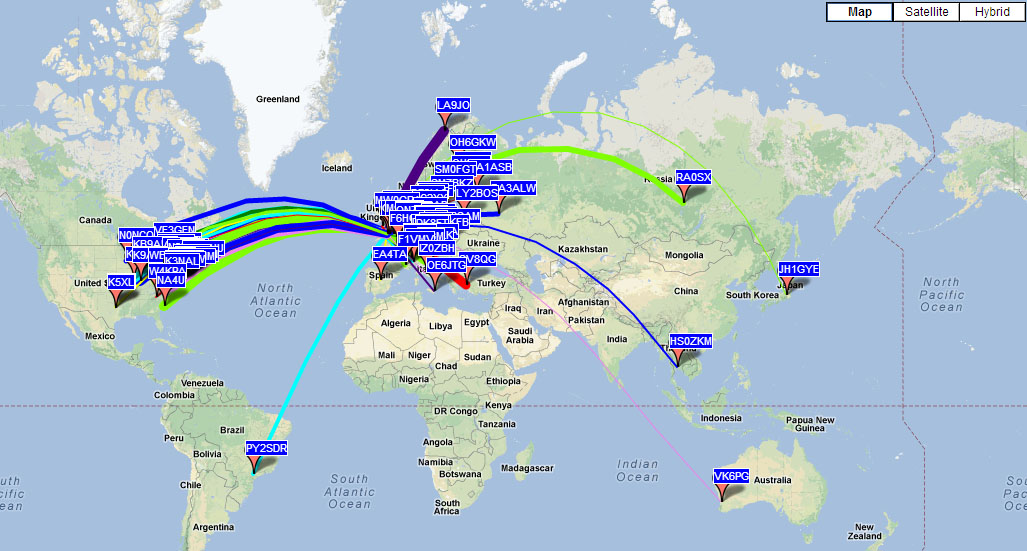
For a change, I ran 14MHz WSPR, running about 1W at the antenna over the weekend. Quite good results – nice to get a report from VK6PG
Tim Kirby, G4VXE, is a regular contributor to AmateurRadio.com and writes from Oxfordshire, England. Contact him at [email protected].
Pile up behavior
I was in the basement, cutting up some cardboard boxes for the recycling pickup tomorrow. To dispel the quiet and to have something to listen to, I turned the radio on.
I worked K6K/MM on 17 Meters. My friend Bob W3BBO worked them last night on 20 Meters and let me know that these folks are the DXpedition that is heading to Clipperton. I worked Clipperton back in 2000; but that was with 75 Watts (QRO). I will try again; but QRP this time (of course).
From there, I tuned up into the SSB portion of 20 Meters. I figured I would listen to either some guys chewing the rag, or some guys working DX. I ended up listening to guys try and work some DX. To be honest with you, I don’t even know who or where the station was. He was working simplex and the pile up was not huge; but he wasn’t calling CQ, either. He had enough stations to handle.
Why do people insist on calling a DX station when they can’t adequately hear him? I ask this, because there were guys throwing out their calls, while the DX station was still in QSO with the previous station!
It seems to me, that if you can’t hear the DX station well enough to know that he’s still talking and hasn’t finished …… what makes you think that you’ll hear him come back to you? Do these folks think that propagation is going to magically improve so that a 2X contact can be made?
I’m not getting just on the SSB guys. It’s no better on the CW side – heck, it’s no better in the QRP Fox Hunts! I can’t tell you how many times guys just keep throwing out their call signs over, and over and over until you want to tear your hair out. Call signs being spewed out when the Fox is in the middle of making a contact with someone else.
If you can’t hear THAT, why even bother to try to work them? Unless you can hear him well enough to respond to you, it seems to me that you’re just setting yourself up to be thought of as a Lid by your peers.
That old saying holds true – “You can’t work ’em if you can’t hear ’em.” But maybe we should also add, “You shouldn’t try to work ’em if you can’t hear ’em!”
Just sayin’
72 de Larry W2LJ
QRP – When you care to send the very least!
Larry Makoski, W2LJ, is a regular contributor to AmateurRadio.com and writes from New Jersey, USA. Contact him at [email protected].
DVAP tool for the Raspberry Pi
A few weeks ago, I heard that there was to be a version of the DVAP Tool software that would run on the Raspberry Pi. That was after I had discovered the image including the G4KLX software.
However, it is always great to have a choice! I found a post from Robin AA4RC from the DVAPDongle group today containing details of how to install DVAP tool onto the Raspbian Wheezy operating system.
Well worth a go!
> >
> > Follow the steps below to install/run:
> >
> > 1) make sure you are running Raspian Wheezy 2013-02-09 and are connected to
the internet with your Pi.
> >
> > 2) open an LXTerminal window and run: “sudo apt-get install qt4-dev-tools”.
Answer “Y” when prompted.
> >
> > 3) in terminal window run: “curl -O
http://opendstar.org/tools/DVAPTool-1.04-rpi.tgz”
> >
> > 4) in terminal window run “sudo tar xzPf DVAPTool-1.04-rpi.tgz”
> >
> > 5) in terminal window run DVAPTool with “./DVAPTool” from your home
directory.
> >
> > Note that this is a full GUI version. I’m working on a text only daemon.
> >
> > There are no current plans to compile DVAPTool for any distribution other
than Raspian. It may or may not work on others.
> >
> > 73,
> > Robin
> > AA4RC
> >
>
Tim Kirby, G4VXE, is a regular contributor to AmateurRadio.com and writes from Oxfordshire, England. Contact him at [email protected].
New version of ircDDB Gateway and DVAP Node installed on Raspberry Pi
After the Raspberry Pi and DVAP experiments a couple of weeks ago, I decided to dedicate a Raspberry Pi to running the gateway. I ordered a new Pi ( with different coloured case) and hard wired it to the Internet router. Connected the DVAP by USB and it all seemed to work well.
Speaking to Martin 2E1THX this morning, he mentioned that the latest release of the software included the CCS capability – which allows you to dial up another DSTAR user by entering a code on your DTMF keypad.
Upgrading the software went very smoothly, although when the machine first came up, the software locked up! I rebooted and all was well.
To accept incoming CCS requests, I needed to open up some ports on my router and forward them to the Raspberry Pi. That worked fine! I opened up UDP ports 30061 to 30065.
I’ve enjoyed having the dedicated Raspberry Pi for DSTAR gateway activity and have had some excellent QSOs as a result.
Tim Kirby, G4VXE, is a regular contributor to AmateurRadio.com and writes from Oxfordshire, England. Contact him at [email protected].
 Ham Radio Deluxe |
 W5SWL Electronics |
 Ham Radio Prep |
 KB3IFH QSL Cards  Hip Ham Shirts  HamRadioAuctions HamRadioAuctions Reliance Antennas Reliance Antennas Enigma Shop Enigma Shop |  morseDX  Ni4L Antennas  R&L Electronics R&L Electronics antennas.us antennas.us QRV QRV |
- Matt W1MST, Managing Editor
