 |
 News from the shack
 13 March 2013 | by
 The end of this month see’s the end of work based madness so I’m getting a few bits and bobs sorted out.
With the demise of the trusty (read rusty…or at least corroded in the special way that aluminium does) vertical I have order a hardware kit for a Cobwebb to go outside. it may get here by the weekend. I’ve been given a rather sorry looking mast that will polish up into a rather staely looking mast once I’ve spent some time on it and a few plastic bits and pieces from Seeedstudio for some of my bits and bobs that need tidying up.
Hopefully this Saturday it won’t be freezing cold or raining, although I’m told the time I’ll be running my part of our Red Nose Day 24 hour relay it will be chucking it down, so I can assess what needs to be done to get myself back on the air on HF and get my 50Mhz yagi up and ready for the season. Looking forward to some time on the rig Excellent!
Alex Hill, G7KSE, is a regular contributor to AmateurRadio.com and writes from Cumbria, UK. Contact him at [email protected].
A Quick RoIP Experiment
RoIP stands for Radio over the Internet Protocol and you can use this technology to connect remote radios over any distance, easily.


Above: Zello VOX settings on PC and Zello GUI on Windows XP
Now I know that Ham Radio Deluxe can be established to give full remote control over my rig, but that’s for another day. This is one solution to automatically link two radios that anyone can do.
Rob Law, MW0DNK, is a regular contributor to AmateurRadio.com and writes from Anglesey, Wales. Contact him at [email protected].
DX with a Kite Antenna
This afternoon Hanz, W1JSB and I met at the Franklin Falls Dam. Our plan was simple… lift a half wave wire with a kite and work some DX on 20 meters. We managed to work Belgium and the Ukraine… but it wasn’t all clear sailing.

We sat at a picnic table several hundred feet above the river. A stiff breeze lifted the kite about 80 feet into the air. We attached the far end of our 33 foot wire to a loop in the middle of the kite string. We connected the near end to the Par matchbox and then to the rig… an HB-1B running 4 watts. It wasn’t vertical, but it was a respectable sloper.
After a few calls, I worked ON8VP in Belgium. Peter gave me a 559 and we finished a quick exchange. His signal was strong, and I have no doubt that had the wire been vertical, I would have been stronger to him. But I was pretty happy to make a contact.
Next, I heard UY6IM in the Ukraine calling CQ. As the wind faltered and the kite lowered, Roman answered my call and gave me a 559. Then it happened.

The kite dropped below the hillside and most of the wire lay on the ground. Roman couldn’t hear me send his report. Fortunately, he didn’t hear me swear either. Darn it… (OK… Dam it.) Hanz raced down the hillside to recover the fallen kite. Right away it lifted into the sky again. By this time Roman was calling CQ again. I answered… gave him a 599 and called it quits after he acknowledged the report. Right after that, the kite dropped once again. It was frustrating.
Hanz wanted to give it a try, so I ran down and tried to get the kite airborne once again. No luck. We packed up. Of course, as soon as we did, the wind came up again. The experiment was fun, but I think I’ll stick with trees.
Jim Cluett, W1PID, is a regular contributor to AmateurRadio.com and writes from New Hampshire, USA. Contact him at [email protected].
Handiham World for 13 March 2013
Pat Tice, WA0TDA, is the manager of HANDI-HAM and a regular contributor to AmateurRadio.com. Contact him at [email protected].
Show Notes #101
Introduction:
- Russ flies solo on LHS! Well, almost. Harrison, VE2HKW, fills in as co-host.
Topics:
- What’s in a name? Russ talks about the philosophical ramifications of the phrase “Linux distribution”, and referring to Linux vs. GNU/Linux. Richard Stallman prefers using GNU/Linux to refer to the operating system, and Russ seems to agree, but feels it doesn’t go far enough. Share your thoughts via the usual communication channels.
- hamqth.com is an alternative to QRZ.com for callsign lookups, and has an application program interface (API). Russ has programmed the gnorman bot in the LHS IRC channel to access hamqth.com. While in the chat, enter “.qrz some_callsign”, and gnorman will return the info.
- Another application that uses the hamqth.com API is QtLog. It’s mostly in German, but there’s enough English to allow you to use the program. It seems to require that you have a MySQL server running on the same computer. It also supports HamLib for rig control. You can use Google Translate to translate the website.
- Harrison offers an overview of oscilloscopes, including what they are, the controls, and how you might use one in your ham shack. There are several instructional videos available on W2AEW’s YouTube channel. (You can learn more about Alan, W2AEW, on his QSL.net page. There are also software-based oscilloscopes, like xoscope. Of course, you’ll need a hardware interface to the computer’s sound card.
Feedback:
- Please make a donation to our Dayton Hamvention fund, like these fine people: Paul G. (annual membership and 2 donations), Ron E. (yearly membership), Jeremy H. (monthly membership), Scott P. (monthly membership), Bill A. (monthly membership), Bill H. (monthly membership and donation), Gary U. (monthly membership), John K. (yearly membership), and Jerome S. (donation). Thank you, all!
- Gary (KE2YK) expresses his appreciation for Richard’s screencast Introduction to JT-65.
- Brian (WB4ES) sends his best wishes to Richard.
- 100th episode audio feedback from Claudio of the Linux Basement podcast.
Contact Info:
- Contact Harrison at [email protected].
- Contact Russ at [email protected] or [email protected].
- Listen to the live stream every other Tuesday at 8:00pm Central time. Check the LHS web site for dates.
- Leave us a voice mail at 1-909-LHS-SHOW (1-909-547-7469), or record an introduction to the podcast.
- Sign up for the LHS mailing list.
- Sign up for the MAGNetcon mailing list.
- LHS merchandise is available at the Merch link on Web site. Check out the Badgerwear or buy one of the other LHS-branded items at PrintFection.com/lhs or Cafe Press. Thanks!
- Thanks to Dave from Gamma Leonis for the theme music.
Music:
- “Fraud” by Jonathan Coulton from the album Artificial Heart.
- “Down Today” by Jonathan Coulton from the album Artificial Heart.
Russ Woodman, K5TUX, co-hosts the Linux in the Ham Shack podcast which is available for download in both MP3 and OGG audio format. Contact him at [email protected].
New WSJT-X update
Hot news. I’ve just had an email from Joe Taylor K1JT informing me that a new version of WSJT-X, v0.6 r3045, has just been made available for download from the WSJT home page.

This is a must-have update which now includes spotting of JT9 signals decoded to the PSK Reporter website. (Tip: This needs to be enabled in Settings.)
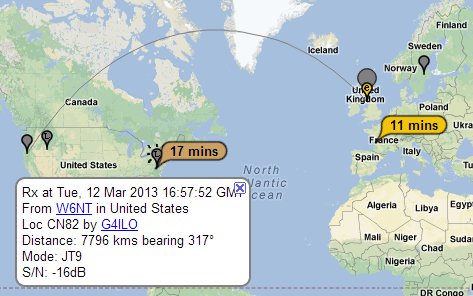
Still to come are rig control – which I will hazard a guess will use hamlib – and integration with VK3AMA’s JT-Alert. Hopefully this will encourage current users of JT65 on HF to try the new JT9-1 mode which is 2dB more sensitive than JT65A and occupies less than 10% of the bandwidth.
Thanks Joe for giving us these great programs.
Julian Moss, G4ILO, is a regular contributor to AmateurRadio.com and writes from Cumbria, England. Contact him at [email protected].
The Cost of a Summit Activation
This brings me to the costs of my recent trek to the top of East End Summit in Arizona which qualifies for the Summit on the Air (SOTA) award. I was able to fit this into a business trip so it's hard to allocate travel costs to the expedition. I did rent a car to get to the trailhead and some food to eat on the trek and water to drink, none of these costs were outrageous. However, there was a huge expenditure that is worthy of mention and that is burned calories.. Using my "Lose It" app, I burned approximately 2,500 calories on my trip up and down the mountain. Given that this activiation took place on a weekday, the QSO's were limited with 18 QSO's made. So I propose a new measure of expedition economics, and that is, calories per QSO or C/QSO. With the numbers above my C/QSO ratio for this trip was 138.9 to 1. So to help reimburse me for my costs, it might be more appropriate to send me a pastry with the QSL request rather than a green stamp.
So the next time you need to drop a few pounds, maybe you should try the SOTA activation diet, it can burn a lot of calories.
Mike Crownover, AD5A, is a regular contributor to AmateurRadio.com and writes from Texas, USA. Contact him at [email protected].
 Ham Radio Deluxe |
 W5SWL Electronics |
 Ham Radio Prep |
 KB3IFH QSL Cards  Hip Ham Shirts  HamRadioAuctions HamRadioAuctions Reliance Antennas Reliance Antennas Enigma Shop Enigma Shop |  morseDX  Ni4L Antennas  R&L Electronics R&L Electronics antennas.us antennas.us QRV QRV |
- Matt W1MST, Managing Editor
