 |
 Misconduct and Consequences
 12 March 2013 | by
 Larry, W2LJ, recently wrote about a topic that all of us can identify with, the LID in a DX station pileup who ignores protocol and has no sense of manners. They ignore DX requests for specific stations to respond and just blast the frequency, often with high power, until they get their contact. The problem has existed for decades and is nothing new. It’s one reason why I get turned off by DXing (despite dreaming of going on a high profile DXpedition someday), and it’s especially frustrating for a QRPer where timing and skill are much more important due to the power disadvantage. Conversely, RF power often makes up for a lack of skill or manners, and the DX pileup LID makes a nuisance of himself to the point where the DX station can’t ignore him, and rewards him with a QSO.
The problem has been going on too long. The reason it continues to exist is much like why we have email spam after nearly 20 years of the “mainstream” Internet. There’s no cost associated it, and the bad behavior is rewarded. The DX Code of Conduct is a great model for people to follow, but unfortunately it’s only the honest and polite people who follow it. There must be consequences for bad behavior.
First off, DX stations need to stop rewarding these LIDs with contacts. They need to call them out and let them know they’re not getting a contact during the DXpedition. Perhaps we could create a specific Q signal that says “you’re blacklisted” to keep it short and sweet and avoid long on the air explanations. Or they can work the station and not QSL the contact and let the station know through some means they got a non-QSL for their bad behavior.
Second, DX organizations and organizations like ARRL, CQ, and perhaps RSGB need to maintain a “three strikes” policy. If they receive evidence, such as recordings, of bad on the air behavior three times within a given period, the offender has awards stripped and they’re identified on a blacklist that can be accessed by high profile DXpeditions. The minutia of appeals and reinstatement and the level of public notification can be debated, but I think the basic idea is sound and something that needs to be done.
This all may sound harsh, but in order to change bad behavior there needs to be consequences. All too often in amateur radio we don’t call out bad behavior and it affects the enjoyment of the hobby for the rest of us. It’s time for the organizations who have the power to enforce consequences, to take action, rather than continue to provide rewards.

Anthony, K3NG, is a regular contributor to AmateurRadio.com.
DX Code of Conduct
This post will deal with a phenomena that is occurring more and more frequently, I believe. But it hasn’t been noticed by me alone, it was also noticed by Jim K9JV, who posted about it on QRP-L this morning. I touched upon this in my recent post about pile up behavior; however, this is a very important topic, so here we go again.
Jim was trying to work both P29NO and 9M4SLL. The pileups were big and unruly. While it is the domain of the DX to try and control the pileups, it remains the responsibility of those trying to work the DX to do so in as “professional” a manner as possible. Jim pointed out that several stations continued to throw out their calls, even though the quarry was clearly calling for a station whose call was in no way similar to those of the perpetrators.
This is maddening! K9JV was furious (and justifiably so) that when P29NO was calling “K9?V”, a KØ, a VE and a W2 kept plaguing the aether with their calls. I had a similar experience a few years ago when I was trying to work an Iraqi station. I was one of those competing in the pileup, and the Iraqi station suddenly began sending “W2L?” He meant yours truly of course, yet I was obliterated by a W4 station, and no, it wasn’t a W4Lsomething (I could have accepted that) – the station didn’t even have an “L” in their call at all! Jim was lucky as he ended up working P29NO. In my case, the Iraqi station subsequently went QRT and I never got him in the log.
What causes this kind of behavior? Are people truly that stupid and discourteous? I don’t know the answer to that, although I am tempted to offer an unfounded and uncharitable guess.
But I think part of the problem may lay in the way that I think DX is encountered today. At the risk of sounding like a curmudgeon, in the days of old, we used to find DX by twiddling the dial and listening for it. You spun the dial knob, up and down – back and forth, straining your ears to find that foreign amateur radio op. If you were lucky, you were able to hear him, you worked him and you were good to go. Or you listened for a pileup, and you located the station they were all calling, determined if you needed him, and then you joined the fray. But in essence, YOU had to locate the DX station yourself, either by dial twiddling or by locating the goal of a pileup.
Today, things have gotten immensely easier; but at the same time, we have invoked “The Law of Unintended Consequences”. Allow me to explain with this scenario:
A station twiddles the dial – he finds and hears (for example, we’ll use a DXpedition that just concluded) TX5K. He works him. Then, proud of his accomplishment, he posts TX5K to the Internet (in the days of old, the PacketCluster), wishing to share the bounty. Immediately, on the screens of Amateur Ops the world over, it appears that TX5K has appeared on 18.073 MHz (for example).
Nowadays, with the myriad of the logging programs and rig control programs available, an Amateur Op can just point and click with his mouse and “Viola!” there they are, on TX5K’s frequency.
I think the problem is, that many (but by nowhere near all) ops don’t pause to listen to hear if they can actually hear TX5K. Or may be they can, but they hear him only marginally at best. In fact, they hear him so marginally that if they were tuning across the band on their own, they wouldn’t have been able to tell that it was TX5K in the first place – but hey, their computers tell them that he’s there, right? So what do they do? They start throwing out their calls in the hopes that somehow he’ll magically get louder and that they’ll be heard in return. Heck, in many cases they can’t even tell that he’s working split! So they call right on the listening frequency, which then invokes the ensuing cacophony of “UP”s and “LID”s being sent.
It gets to be one, big frustrating mess. And this doesn’t even take into account the zoo that can occur if some quack, who literally enjoys jamming DX operations, gets involved.
So what should be done about this? Closely and completely adhere to the “DX Code of Conduct” – that’s what!
The DX Code of Conduct was formulated by Randy Johnson W6SJ. You can read about it here.
I will listen, and listen, and then listen again before calling.
I will only call if I can copy the DX station properly.
I will not trust the DX cluster and will be sure of the DX station’s call sign before calling.
I will not interfere with the DX station nor anyone calling and will never tune up on the DX frequency or in the QSX slot.
I will wait for the DX station to end a contact before I call.
I will always send my full call sign.
I will call and then listen for a reasonable interval. I will not call continuously.
I will not transmit when the DX operator calls another call sign, not mine.
I will not transmit when the DX operator queries a call sign not like mine.
I will not transmit when the DX station requests geographic areas other than mine.
When the DX operator calls me, I will not repeat my call sign unless I think he has copied it incorrectly.
I will be thankful if and when I do make a contact.
I will respect my fellow hams and conduct myself so as to earn their respect.
Having wonderful tools at your disposal does not abrogate your responsibility to operate in an unselfish manner. You must still be courteous to your fellow Hams.
I am so taken by this credo, that I am posting the DX Code of Conduct badge on the side of this blog, to be a reminder to myself and others.
Oh, and QRP Fox hunters …… your situation is a bit different, so let’s adapt these:
I will listen, and listen, and then listen again before calling.
I will only call if I can copy the Fox station properly.
I will not interfere with the Fox station nor anyone calling and will never tune up on the Fox frequency or in the QSX slot.
I will use full break-in if at all possible.
I will wait for the Fox station to end a contact before I call.
I will always send my full call sign.
I will call and then listen for a reasonable interval. I will not call continuously.
I will not transmit when the Fox station calls another call sign, not mine.
I will not transmit when the Fox station queries a call sign not like mine.
When the Fox station calls me, I will send ONLY the required exchange of RST – S/P/C – Name – Power out
I will be thankful if and when I do make a contact.
I will resort to attempting duplicate contacts only if I am very certain that I was not heard the first time.
I will respect my fellow hams and conduct myself so as to earn their respect.
If we all do these things, life on the bands can be much more pleasant.
72 de Larry W2LJ
QRP – When you care to send the very least!
Larry Makoski, W2LJ, is a regular contributor to AmateurRadio.com and writes from New Jersey, USA. Contact him at [email protected].
An unproductive afternoon
Working JT65A can sometimes be very frustrating. Today 10m was open and quite a bit of DX was coming in but the sum total of my afternoon’s endeavours was precisely two QSOs.
This mode does eat up time. I called several stations to no avail: either they didn’t hear me or replied to someone else. A couple of stations I called faded out in mid-QSO so I never received any rogers. I tried calling CQ and had a couple of replies, but they never came back after I sent their report.
It takes two minutes each time to find out if the other guy can even hear you. So you can spend a lot of time on abortive contacts.
On well, there’s always tomorrow!
Julian Moss, G4ILO, is a regular contributor to AmateurRadio.com and writes from Cumbria, England. Contact him at [email protected].
10 Meters was nice today
I got the chance to get on the air for a short time this afternoon. I took the opportunity to spin the dial around the 10 Meter band. Around the 28.200 MHz neighborhood, I heard beacons from Mexico, Brazil and British Columbia in Canada. Encouraged that the band might be open, I continued my spin.
In the CW portion of the band, I was able to work CT1IUA with 5 Watts. He was 599 and I received a 559 in return. After that, for the heck of it, I traveled all the way up to the SSB portion of the band. Here, I heard CT1EHI booming into NJ. Again, for the heck of it, I pumped up the power to 10 Watts and gave him a call. He answered me! When he found out that I was in New Jersey, Marco asked me if I knew where Flemington is. Heck, it’s about 10 – 15 miles down the highway from where I work. Marco informed me that he has some friends that live there, and in fact he’s gone to Dayton with them a few times.
I don’t do so much in the way of QRP SSB as CW has always been my first love. It’s gratifying, though, to make a SSB contact using only 10 Watts and it’s even more gratifying when that contact is overseas. Marco gave me a 5X7 signal report, too – not too shabby! You have to absolutely love 10 Meters when it’s open – pure magic!
15 Meters was also open and I had a nice “chew” with N5XE, Carl in Oklahoma who answered my CQ. I also had a quick QSO with OX3XR, David in Greenland. I’ve worked David twice before, once on 12 Meters and once on 20 Meters, so this was a new band for me for Greenland.
On 17 Meters (I was doing a bit of band hopping) I ran into and worked OJØH/MM again. Last time I worked them, they were travelling the Caribbean. I have no idea where they were located this time. They were not as strong as they were last time; but not sure whether that was due to location or just how the propagation was.
When the bands are open and propagation is good – the most fun hobby in the world becomes even more so.
72 de Larry W2LJ
QRP – When you care to send the very least!
Larry Makoski, W2LJ, is a regular contributor to AmateurRadio.com and writes from New Jersey, USA. Contact him at [email protected].
First Spring Outing
Hanz W1JSB and I hiked down to the Pemigewasset River today. It was our first radio outing of the year… and it was fantastic! We worked Germany, Romania, Slovak Republic and Wisconsin.
We walked down the steep hill into the Corps of Engineers flood control area along the road. In the winter it’s used only by snowmobiles, cross-country skiers and sometimes horseback riders. The snow is just starting to melt. We’ve had two days in the mid-40s. The brook is showing signs of life. It’s grand.

We walked in about a mile and turned toward the river into a field. We found a little bare spot of ground near some bushes and decided to set up there. I flung the water bottle with the antenna line into a tree and Hanz pulled it up.

We used the HB-1B at 4 watts on 20 meters with a 33 foot end fed wire. I took the first turn and right away heard OM1ADX calling CQ. Martin in the Slovak Republic had a beautiful signal. He gave me a 559. Hanz made a video of the QSO.
After that, Hanz took over. He worked two stations in a row toward the lower end of the band. First he called DL6LBI in Germany. Ingo answered him right away and gave Hanz a 579. The Wisconsin QSO Party was in full swing so there were plenty of WI stations for the asking. Hanz worked K9LGU. The really interesting QSO came next.
Hanz went up to 14.060 and heard a very weak station calling CQ. It was Catalin in Romania… YO8RIX and he was only running 500 mw with a K1 and a loop antenna. Amazing.

It was so much fun to get out in the warm sunshine and operate again. The winter’s been long. On the walk back Hanz and I talked about some of the places we plan to hike to with our radios this summer. There will be lots of good exercise and radio expeditions ahead.
Jim Cluett, W1PID, is a regular contributor to AmateurRadio.com and writes from New Hampshire, USA. Contact him at [email protected].
Nice openings on 10m
 |
| Signals on 10m this afternoon |
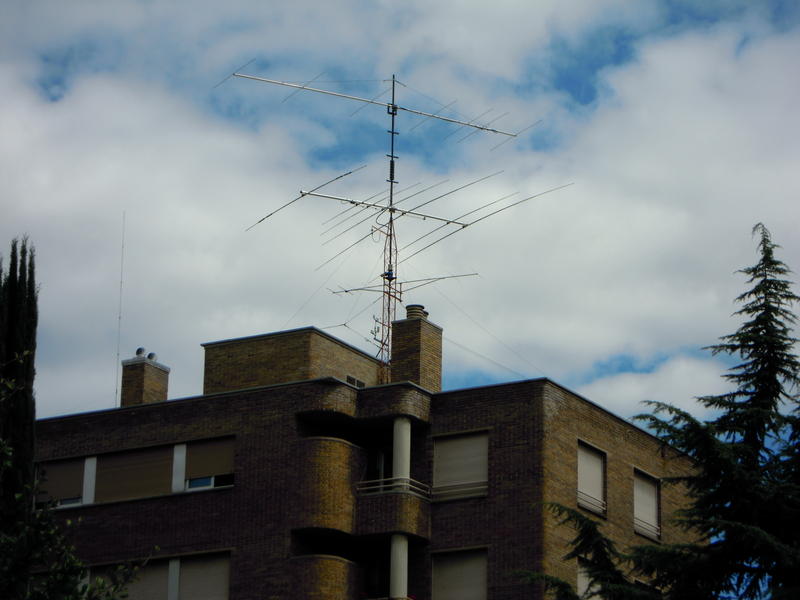 |
| EA2LU antennas |
I was now noticing some stronger signals, the first I tuned in was EA2LU from Spain. I tried Jorge with 500mW's and made the contact without any troubles. He was running a Yagi at 100 watts. This was a nice contact as we were able to exchange rig info, antenna info and
 |
| EA2LU setup |
Mike Weir, VE9KK, is a regular contributor to AmateurRadio.com and writes from New Brunswick, Canada. Contact him at [email protected].
A narrow escape!
I think I narrowly avoided a battery fire or explosion in the shack this morning. For the last 18 months or so I have been using my old HTC Touch 2 smartphone as my 2m APRS iGate (I hated it as a phone.) All that time it has been sitting in the desktop cradle talking to my Kenwood TM-D710 TNC via a Bluetooth connection and providing a 24/7 gateway that is silent (unlike my PC) and uses less power.
This morning Colin M0XSD sent me an APRS message and I took the phone out of the cradle so I could use its keyboard to reply. I noticed that it felt quite hot. After about 5 minutes conversation the battery died. Having been on permanent charge that should not have happened.
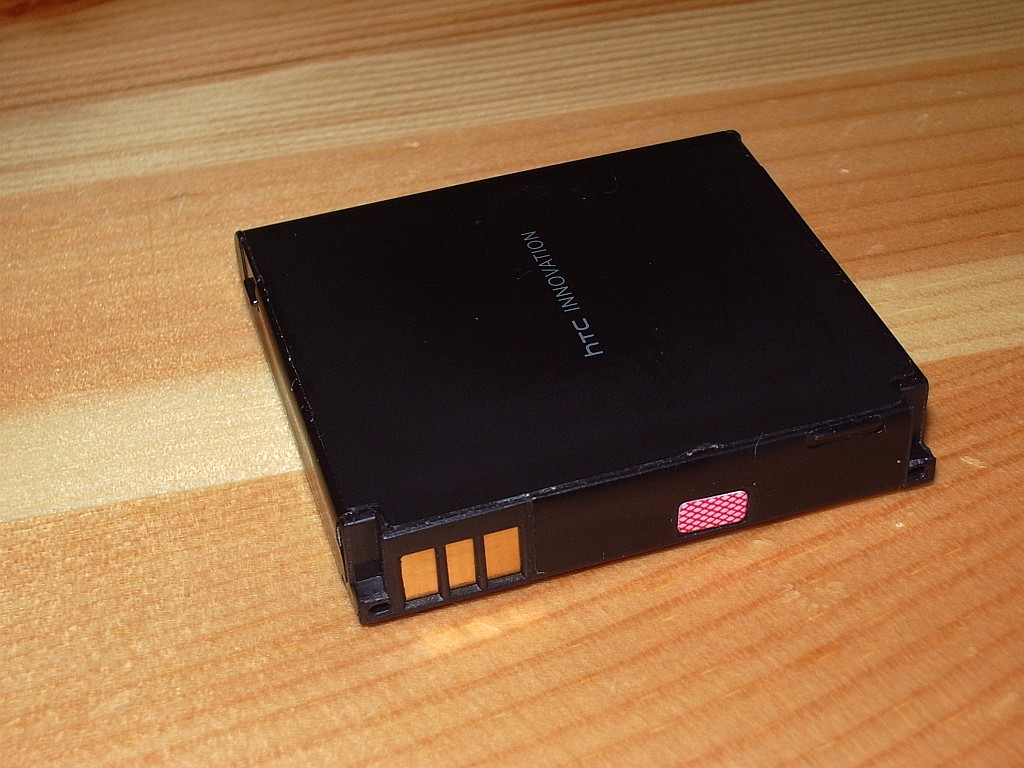 |
| My dead Touch 2 battery – can you see the bulge? |
I took the still warm Li-Ion battery out of the phone and noticed there was a distinct bulge on both sides of the casing. So I suppose that it was on the way to exploding or catching fire. Unfortunately the phone won’t work with the battery removed and powered only from the desktop cradle. So my G4ILO-2 iGate is off the air. I will think again about the wisdom using a permanently-charged smartphone as an iGate in the future!
Julian Moss, G4ILO, is a regular contributor to AmateurRadio.com and writes from Cumbria, England. Contact him at [email protected].
 Ham Radio Deluxe |
 W5SWL Electronics |
 Ham Radio Prep |
 KB3IFH QSL Cards  Hip Ham Shirts  HamRadioAuctions HamRadioAuctions Reliance Antennas Reliance Antennas Enigma Shop Enigma Shop |  morseDX  Ni4L Antennas  R&L Electronics R&L Electronics antennas.us antennas.us QRV QRV |
- Matt W1MST, Managing Editor
