 |
 Handiham World for 10 April 2013
 10 April 2013 | by
 Pat Tice, WA0TDA, is the manager of HANDI-HAM and a regular contributor to AmateurRadio.com. Contact him at [email protected].
Ghostly signals
I have been puzzled and mildly irritated by the ‘ghost’ traces that appear at plus and minus 100Hz when I receive a very strong signal with WSJT-X. Torben OZ1TMK wrote to me after we had a JT9-1 QSO to ask if his signal had been OK. He had received requests from a couple of local stations to reduce power because he was ‘causing harmonics’. I hadn’t noticed anything wrong with Torben’s signal but it hadn’t been strong enough. It looked to me as if it was the same effect I and a few other JT9-1 users had observed when very strong signals were received, so I decided to investigate.
I had a theory that the +/-100Hz spurious outputs ( +/-120Hz observed in the USA) were caused by ripple modulating the transmitted carrier. I used my general purpose signal generator, otherwise known as the FT-817ND, to transmit a low power carrier (CW key down) into an unscreened dummy load (Elecraft DL-1). I repeated this with the transceiver powered from my bench power supply and then on its internal batteries with the power cable removed. The results in the WSJT-X spectrum display window are shown below.
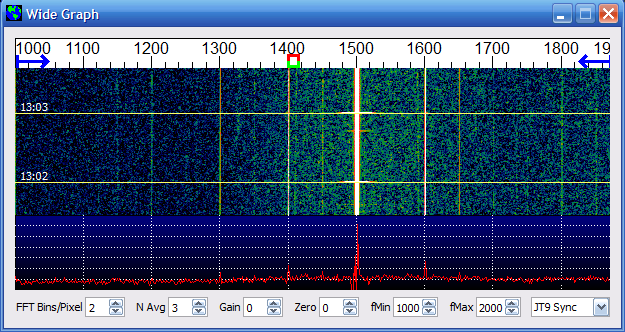 |
| K3 RX, FT-817 TX on mains supply. |
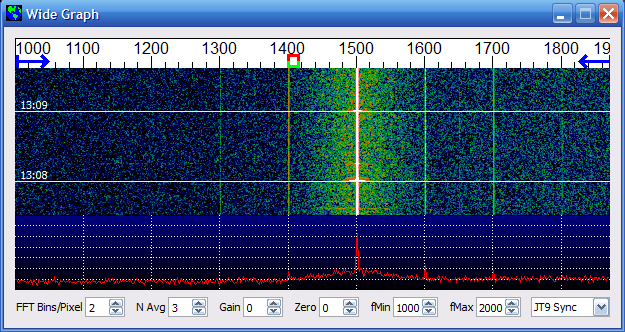 |
| K3 RX, FT-817 on battery power |
As can be seen, there are traces at +/-100Hz and at 100Hz intervals on both signals, but the ghosts seem a bit stronger on the signal when the TX is powered from the main supply.
I recalled an issue a few years ago when someone sending CW using their K3 had reports of spurious signals +/- the sidetone frequency. This turned out to be audio modulation of the synthesizer by the sound of the sidetone from the K3 speaker. Elecraft provided a fix in the form of a stiffener for the synthesizer board. My K3 is an old one and does not have this modification. You can see that the synthesizer is affected by physical vibration looking at the trace produced when I rapped on the K3 case.
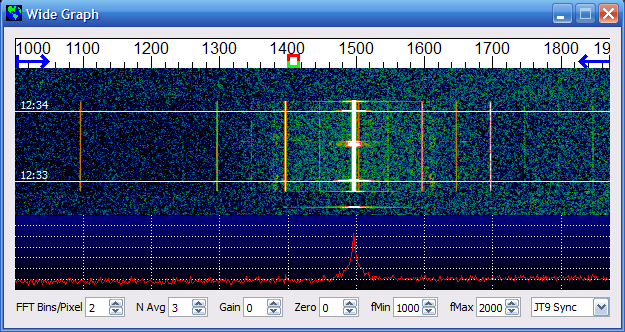 |
| K3 RX showing the effect of vibration (knock on the case) |
My K3 sits on a shelf next door to a heavy linear power supply. Could slight vibration of the mains transformer be modulating the receiver’s local oscillator so as to create weak sidebands at +/- double the mains frequency?
To answer that question I repeated the tests using my Elecraft K2 as a receiver, feeding the headphone output at low level into the cheap USB audio dongle I use for computer sound. You can see the result below.
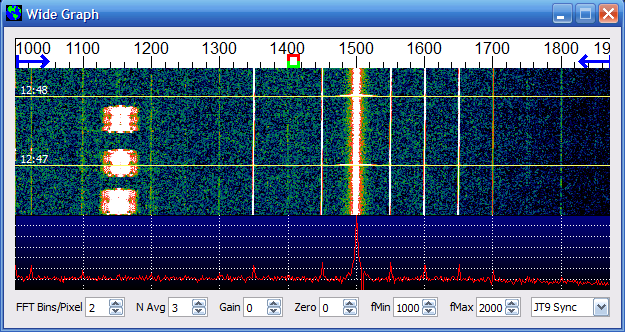 |
| K2 on RX, FT-817 on mains power. |
 |
| K2 RX, FT-817 on battery power |
You can see that the sidebands are much reduced when the signal is produced by a transmitter running on battery power. In fact, some weak +/- 50Hz sidebands are present – possibly the effect of 50Hz AC hum on the un-isolated cable used to connect the K2 headphone output to the sound card.
I’m not sure what to make of all this. It does appear that the ‘harmonics’ – which are really sidebands – that accompany a strong JT9-1 signal are caused mainly by AC ripple modulating the transmitted carrier, but that hum on the receive side can produce a decodable signal as well. The WSJT-X software is extremely sensitive and can detect these components even if they are 30dB or more below the fundamental carrier.
I would appreciate hearing of other theories or tests carried out to explain this phenomenon. It seems to be that this issue is going to be almost unavoidable when mains-powered equipment is used to generate signals that are decoded by very sensitive software.
Julian Moss, G4ILO, is a regular contributor to AmateurRadio.com and writes from Cumbria, England. Contact him at [email protected].
NAQCC Sprint
I actually had a meeting to attend this evening; but I must confess that I played hooky My attendance was not mandatory, so I decided to stay home and play in the monthly NAQCC Sprint. I am glad I did, as I had the best time I’ve had in a while.
I must be getting back into the swing of things, as I was able to make 34 contacts in the two hours. I am sure that puts me nowhere even close to the top. But it sure beats my efforts in the past couple of months, where I had only made 19 -20 QSOs per Sprint.
Conditions were decent on 20 Meters, where I made 8 QSOs; but the money band was 40 Meters. With the exception of one measly QSO on 80 Meters, the balance were made on 40 Meters. I was even able to hold a frequency and run it for a period of time, like I used to in the past. Man, that was fun!
I used the KX3 all night, but I used two different antennas. The HF9V vertical was used for 20 Meters, while the 88′ EDZ antenna was the mainstay for 40 Meters. Activity remained pretty steady throughout the Sprint, except for the last 20 minutes or so. By then, no one was answering my CQs and searching and pouncing landed me only a few calls that I had not worked before.
The main thing was the fun factor however, and that was very high! High marks go to the NAQCC for providing a good Sprint opportunity each and every month.
One thing I do have to sheepishly admit to, however. After all these years of either using paddles or a bug, my form with a straight key needs work. Two hours of using my Speed-X and my wrist is hurting! Nothing that won’t go away by tomorrow, though.
72 de Larry W2LJ
QRP – When you care to send the very least!
Larry Makoski, W2LJ, is a regular contributor to AmateurRadio.com and writes from New Jersey, USA. Contact him at [email protected].
BOGO
BOGO – Buy One, Get One free. Two for the price of one. You know what I’m getting at here, right?
Unfortunately, I am NOT announcing a cool bargain on Amateur Radio equipment. If that were the case, I’d probably be at the head of the line. But BOGO does have something to do with QRPTTF for me, this year.
QRP To The Field is just a couple of weekends away. This year, the theme for the event is “Happy Trails”. As Paul NA5N describes it on the official QRPTTF Website, “About every community has an historic trail or two …… from the biggies like Route 66 or the Santa Fe Trail, to a local old wagon trail, mining or lumber road. About all railroad lines, active or abandoned, are old trails.”
Paul proceeded to provide a link to a list of historic trails, highways and railroads, which I clicked on. And there, right at the top of the list of Historic Highways was the Lincoln Highway. Holy! That’s what we now call Route 27 which runs through Edison, just the next township over from South Plainfield. A quick trip to Wikipedia informed me that the Lincoln Highway is celebrating its 100th anniversary this year. With Wikipedia’s indulgence, I am going to paraphrase some history.

“The Lincoln Highway is one of the first transcontinental highways for automobiles across the USA. The highway turns 100 years old in 2013. It was conceived and promoted by Indiana entrepreneur Carl Fisher. The Lincoln Highway spans the United States coast-to-coast from Times Square in New York City to Lincoln Park in San Francisco. It passes through New York, New Jersey, Pennsylvania, Ohio, Indiana, Illinois, Iowa, Nebraska, Colorado, Wyoming, Utah, Nevada and California. When originally built, it measured 3,389 miles long. After some re-alignments were done over the years, the road currently measures 3,142 miles.”
Thanks to Paul NA5N, I learned more about this road than I ever knew before (isn’t Amateur Radio a wonderful thing!?!). I have seen some street signs along Route 27 that still call it “The Lincoln Highway”, but I had never bothered to investigate its history before. But where does the BOGO come in you ask? It comes in here – as Paul states: “Many old historic trails are also today’s super highways (like Route 66, the Lincoln Highway, etc); we don’t expect you to operate from an Interstate junction! Find a nice operating spot within a couple of miles if you can to ensure your safety.”
Immediately, I thought of a real neat place to operate from that is literally just a couple of blocks away from the Lincoln Highway:
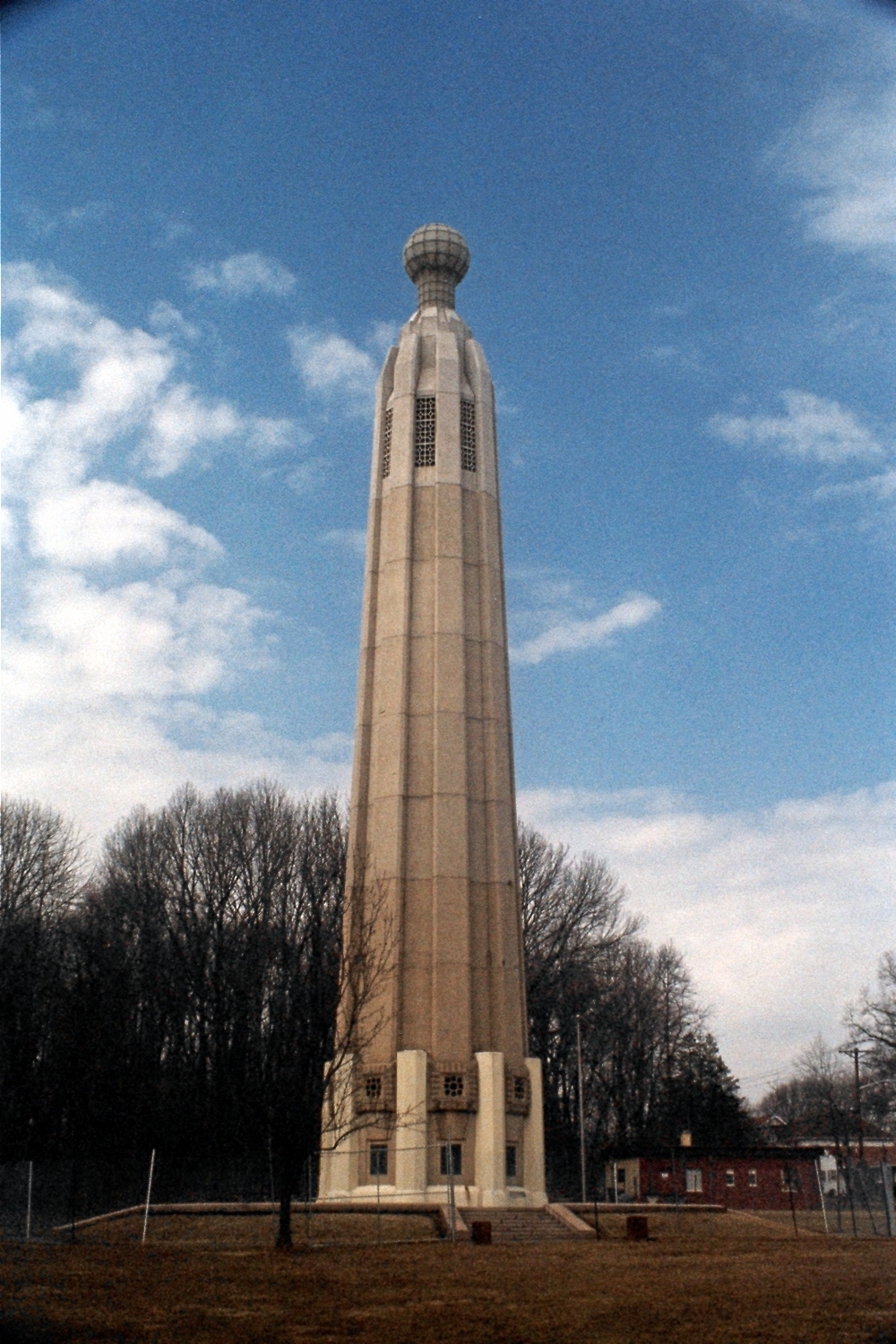
The Edison Memorial Tower, which was dedicated in 1938 and was built on the spot where Edison’s Laboratory was located. It was here that the incandescent light bulb, as well as many of Edison’s other inventions were conceived and produced. The original buildings have since been relocated to Dearborn Michigan by Henry Ford so this tower and its accompanying museum (which has a parking lot where I can operate from) were built to memorialize the spot. The tower and museum were just recently renovated and were reopened last year after being closed for a long time due to deterioration.
I am envisioning a special QSL card, designed for the day which will include photos of both the Edison Tower and something having to do with the Lincoln Highway. Two “special” QRP outdoor events for the price of one – BOGO! This is going to be fun!
72 de Larry W2LJ
QRP – When you care to send the very least!
Larry Makoski, W2LJ, is a regular contributor to AmateurRadio.com and writes from New Jersey, USA. Contact him at [email protected].
New 28MHz beacon from Gibraltar
Via Ronald ZB2B comes news of a new 28MHz beacon from Gibraltar on 28.170
This should be very useful for us here in the UK – I’m looking forward to hearing it!
Tim Kirby, G4VXE, is a regular contributor to AmateurRadio.com and writes from Oxfordshire, England. Contact him at [email protected].
Golf and Rock n Roll
So things have calmed down a little and I will get back to the radio thing as soon as I recover from last week.
Mike Crownover, AD5A, is a regular contributor to AmateurRadio.com and writes from Texas, USA. Contact him at [email protected].
Comparing activity of popular digimodes
 |
| PSK31 activity in last 2 hours |
 |
| RTTY activity in last 2 hours |
 |
| JT65 activity in last 2 hours |
 |
| JT9 activity in last 2 hours |
 |
| ROS activity in last 2 hours |
Julian Moss, G4ILO, is a regular contributor to AmateurRadio.com and writes from Cumbria, England. Contact him at [email protected].
 Ham Radio Deluxe |
 W5SWL Electronics |
 Ham Radio Prep |
 KB3IFH QSL Cards  Hip Ham Shirts  HamRadioAuctions HamRadioAuctions Reliance Antennas Reliance Antennas Enigma Shop Enigma Shop |  morseDX  Ni4L Antennas  R&L Electronics R&L Electronics antennas.us antennas.us QRV QRV |
- Matt W1MST, Managing Editor
