 |
 Comparing activity of popular digimodes
 9 April 2013 | by
  |
| PSK31 activity in last 2 hours |
 |
| RTTY activity in last 2 hours |
 |
| JT65 activity in last 2 hours |
 |
| JT9 activity in last 2 hours |
 |
| ROS activity in last 2 hours |
Julian Moss, G4ILO, is a regular contributor to AmateurRadio.com and writes from Cumbria, England. Contact him at [email protected].
MSFduino PCB’s
When you use software regularly, thing become natural. Especially when you can find errors in your work and they need correcting. Over the past few evenings I have spent several hours trying to correct inconsistencies between the schematic and board on my first PCB project, the MSFduino.
There’s nothing fancy about the MSFduino. Its what I’ve started calling my shack clock project. Its a cut down version of the popular Arduino uno and a 60khz receiver with an LCD to display the date and time.
I got so frustrated in the end I started all over again. That made life an awful lot easier. So easy in fact that I wrapped up the Gerber files in a nice zipped package and sent them off to be prototyped. Seeing as this was my first attempt I have agonised a bit about getting it right but in the end I just had to press the send button.
Here’s hoping
Alex Hill, G7KSE, is a regular contributor to AmateurRadio.com and writes from Cumbria, UK. Contact him at [email protected].
A very nice but short evenng on the radio
 |
| No time to do lots |
I then found LZ833MBB...how is that for a call!!! This call is a special event station call and is in honour of Bulgarian Saint Martyr Knyaz Boyan Bylgarski.. I was able to work this Bulgarian club with just 1 watt.
 |
Mike Weir, VE9KK, is a regular contributor to AmateurRadio.com and writes from New Brunswick, Canada. Contact him at [email protected].
March 2013 6 and 10
It seems that whilst 6m is still a bit low on the G7KSE listening list (Nothing to do with it still being freezing cold here and me thinking its still winter) but others have had a bit more success. The latest 6 and 1o report has been uploaded here and is available.
Alex Hill, G7KSE, is a regular contributor to AmateurRadio.com and writes from Cumbria, UK. Contact him at [email protected].
Norbreck 2013
On Sunday I went with Derek 2E0MIX to the NARSA radio rally at the Norbreck Castle Hotel in Blackpool. Olga came too to keep an eye on me and make sure I remembered to take my tablets on time. She also took the photos (which is why there isn’t a picture of her, oops!)
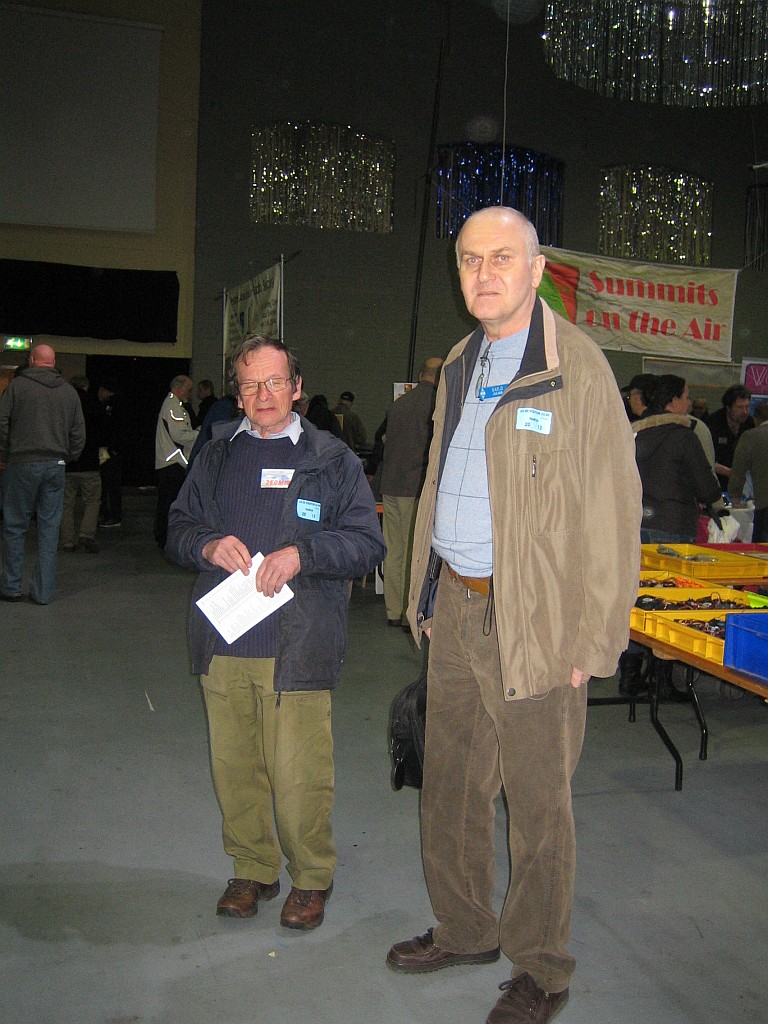 |
| G4ILO and Derek 2E0MIX |
It was good to be able to do something I would normally have done in years gone by. I met friends and also people who only know me (and Olga!) from my blog, spotted my callsign badge and came up to say hello.
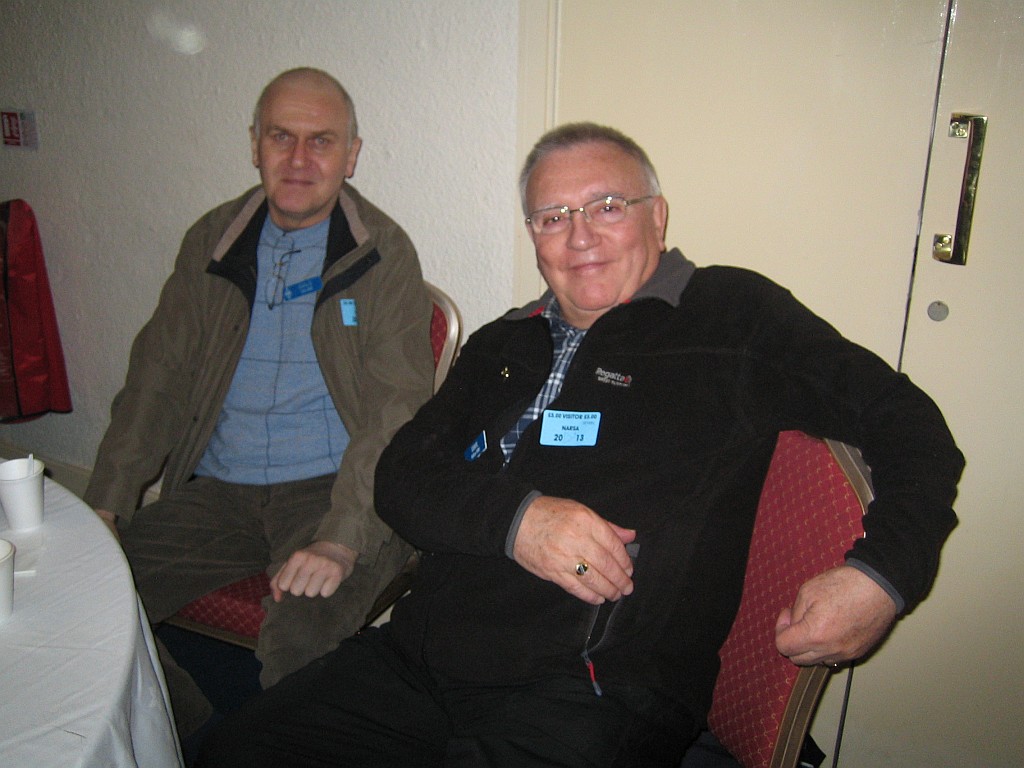 |
| G4ILO and Hylton G6AVL |
I didn’t go to the show with any specific goal, just to have a look round. The only thing that I would have liked to go home with was the magnificent Kenwood TS990S on the Waters and Stanton stand. It was in a plexiglass cage so I was unable to get “hands-on” or even get a decent photograph of it.
There seemed to be surprisingly little interest in this very expensive radio. I suppose most people looked at it, realised it was unattainable and moved on. I dropped a few hints to Olga that it would make a nice present for my 60th birthday in a few weeks time but she, ever practical, pointed out that it would be too big for my operating desk. Oh well, it was worth a try!
Waters and Stanton were also showing a number of Elecraft products, including the K3 and KX3. It was good to see these excellent radios on display at this show for the first time.
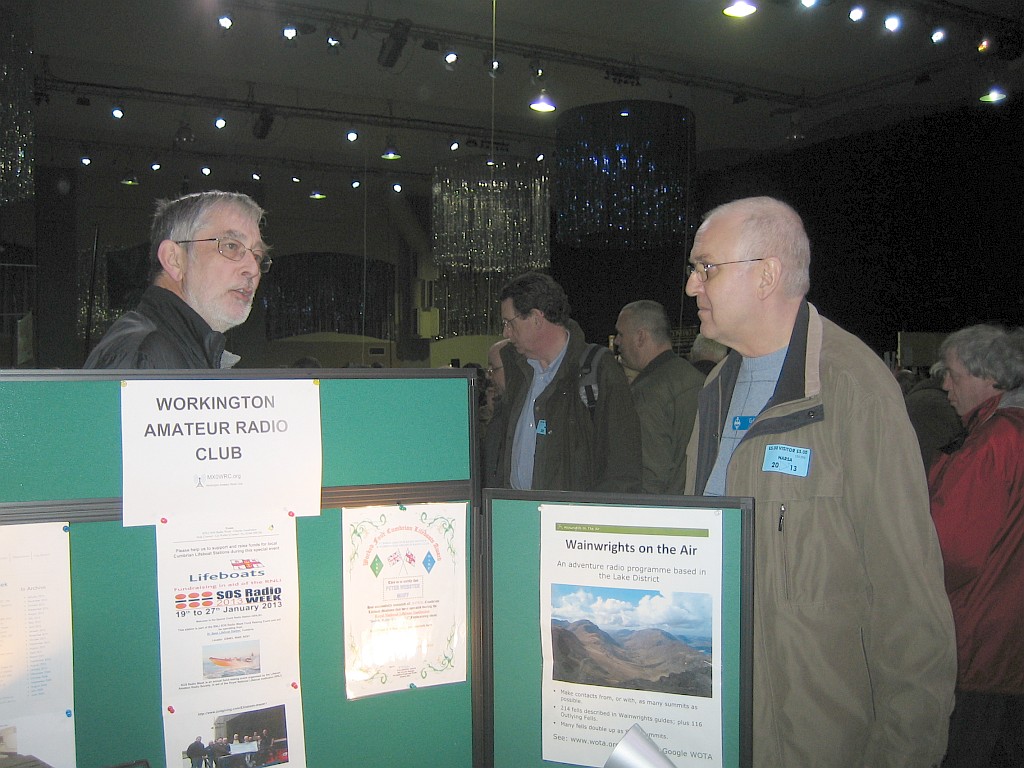 |
| G4ILO and Jim G3ZPD on the Workington Radio Club stand |
WOTA (Wainwrights on the Air) didn’t have its own stand but I was pleased to see that Workington Radio Club had a poster about WOTA on their stand.
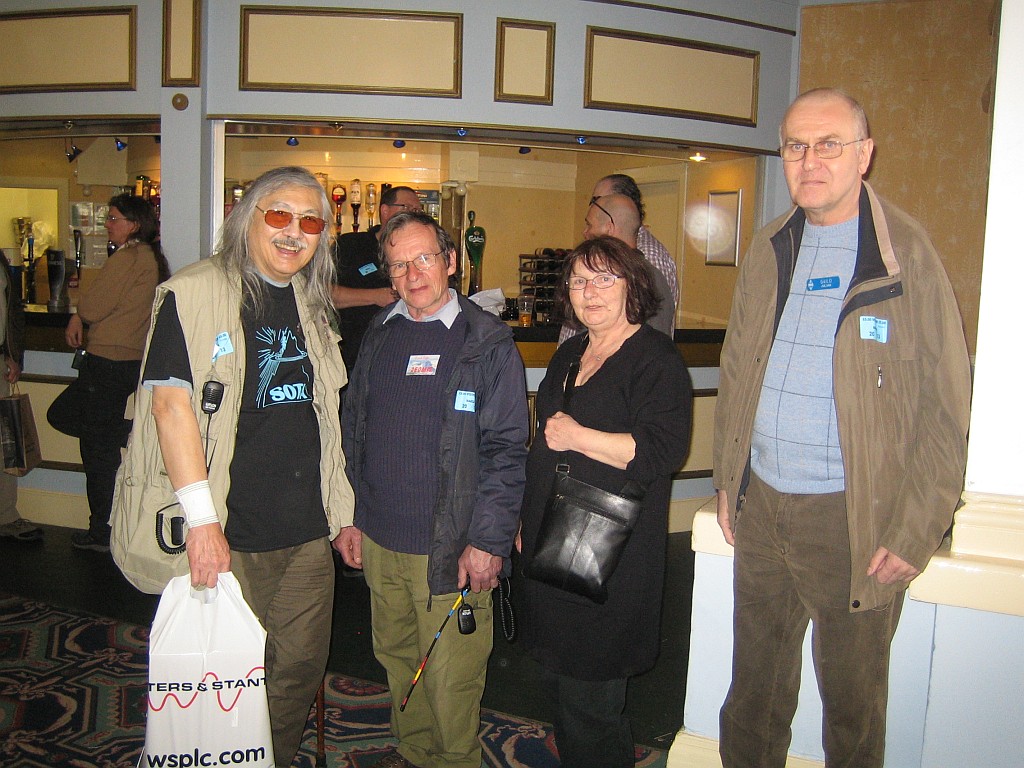 |
| Discussing WOTA |
It was good to meet some of the people I had worked on activations and put a face to the call. Several people came up to thank me for starting WOTA, saying that it had given them a new interest or got them visiting parts of the Lake District they would never have gone to before. It isn’t often that you get a chance to change people’s lives but for some activators and chasers WOTA has done just that. (I suppose some of the credit should go to SOTA (Summits On The Air) for having the original idea.)
It was a good day out. Thanks to Derek for the ride.
Julian Moss, G4ILO, is a regular contributor to AmateurRadio.com and writes from Cumbria, England. Contact him at [email protected].
PORTABLE EMCOMM STATION
PORTABLE EMCOMM STATION
In life you come across people – early on my life I think I was 16 years old I met a friend on the way into work in the mornings on our local 220mhz machine. I had gotten hurt and at the time my hand was wrapped up and I had taken some time off. I was a novice at the time so I only had privileges on 220. Mike N1RFD was one of the people that I met that convinced me take a step back from the construction work I was doing and look into computers. That changed my life I have been in the IT industry since and Mike was one of the people that I have to thank for this.
Not only did he help me then but has remained a friend, mentor and contact that I could rely on anytime it was needed.
The main reason I tell you this story is to tell you that when a friend like this gives me guidance I always listen but knowing Mike for the years I have in both business and personal I know he is very detailed and thoughtful when he works on something or builds something. Knowing he is now retired and has been working on a project that I really wanted to share with as many people as possible.
Take a look and tell me what you think of the:
What is my definition of a Communications Go-Kit?
A Communications Go-Kit (or Radio-Ready-Kit) is made up of a portable “Amateur radio” station and assorted personal gear that can quickly be assembled to respond to a “Call To Service”. There are more details on my blog and a link to his full setup.

Read more about this project on my blog: http://nicktoday.com/portable-emcomm-station/
Nick Palomba, N1IC, is a regular contributor to AmateurRadio.com and writes from Florida, USA. Contact him at [email protected].
Surprising Antenna Test
Today Hanz, W1JSB, and I hiked on Johnson Road and setup next to each other. We worked Italy, Russia, the Netherlands, and Florida. Before packing up we each called CQ and compared received signals on the Reverse Beacon Net. The results were surprising.

For these experiments we used nearly identical rigs. Hanz had the HB-1A, and I had the HB-1B. Both roughly 4 watts with similar power supplies.
The Antennas
Hanz ran the Par Electronics half-wave end fed wire straight up to a branch. It was perfectly vertical. This is the antenna that I’ve been running for almost 5 years. I thought it was probably the best portable DXer I could use. Perhaps I was wrong.
I ran a 66 foot wire configured as an inverted Vee with a 33 foot counterpoise and an Elecraft T-1 tuner. Here’s a rough diagram of the antenna that I used. It’s supported at the apex by a tree branch. The ends are a few inches above ground level.

I am sitting at the spot marked “X” on the above diagram.
The QSOs
We each worked the same stations on 20 meters. First we worked N4KXG, Pete in Florida. I received a 589 and Hanz received a 579. I expected that my antenna might be better than Hanz’s for relatively near stations. I was correct. We got a hint of something unpredicted with the next QSO.
We worked RA6CA in Russia. Pavel gave both Hanz and me a 589. I would have expected Hanz to be stronger with the vertical. Of course this is subjective. Next we worked IZ2UE in Italy. Andrea gave me a 559 and gave Hanz the same 559. Again… a surprise. The last station was PA3GEG, Gerald in the Netherlands. I received a 579 and Hanz received a 599. That would be expected.The next test shattered all my preconceptions.

Before packing up our gear, Hanz suggested that we both call CQ and check our signals on the Reverse Beacon Net. That was a stunning idea. Here are the results. I was heard by six stations. Hanz was heard by 10 stations. Four stations recorded signals from both of us.
The Results
Stations Hanz Jim
—————————————–
DL1EMY 13 db 17 db
AA4VV 18 db 27 db
W3OA 11 db 16 db
DL1GTB 6 db 10 db
In each case my signal was consistently stronger than Hanz’s. Same rig. Same location. Sent within a minute of each other.
I have to say I’m really surprised. I thought the end fed vertical could not be improved upon for a portable wire antenna. We will definitely do more testing.
Jim Cluett, W1PID, is a regular contributor to AmateurRadio.com and writes from New Hampshire, USA. Contact him at [email protected].
 Ham Radio Deluxe |
 W5SWL Electronics |
 Ham Radio Prep |
 KB3IFH QSL Cards  Hip Ham Shirts  HamRadioAuctions HamRadioAuctions Reliance Antennas Reliance Antennas Enigma Shop Enigma Shop |  morseDX  Ni4L Antennas  R&L Electronics R&L Electronics antennas.us antennas.us QRV QRV |
- Matt W1MST, Managing Editor
