 |
 Handiham World for 01 May 2013
 1 May 2013 | by
 Pat Tice, WA0TDA, is the manager of HANDI-HAM and a regular contributor to AmateurRadio.com. Contact him at [email protected].
Project: KI6J SOTA Tuner
With that in mind and a need to build something I opted for the KI6J SOTA Tuner as part of my back up antenna system. I haven't built anything in a few years and wanted to get back in the groove on melting a little solder, so I ordered the kit from Stu. Relatively speaking it is an easy kit to build. You do get the pleasure of winding a small transformer and toroid. However if that scares you as a new builder this is a great kit to learn on.
This kit is designed for use by portable QRP operations needing a lightweight, easy to deploy antenna system. Using this tuner, a portable station needs no ground radials and little or no feed line to achieve excellent results. The tuner matches the impedance of end fed, half wavelength (EFHW) wires on 40m -15m and contains a built in SWR indicator. The tuner is designed for durability and reliability of operation and handles QRP power levels, 5W CW and 10W PEP SSB.
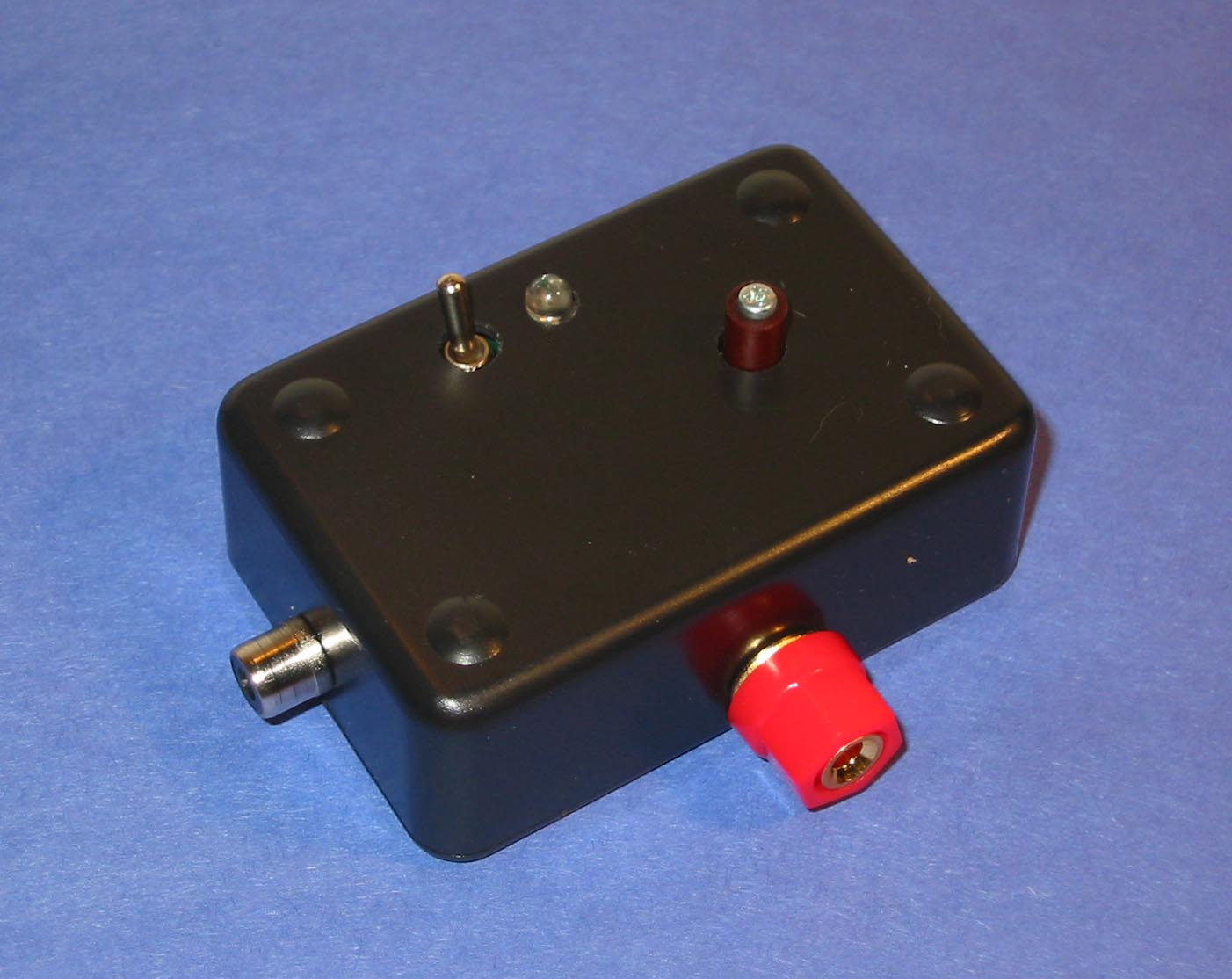
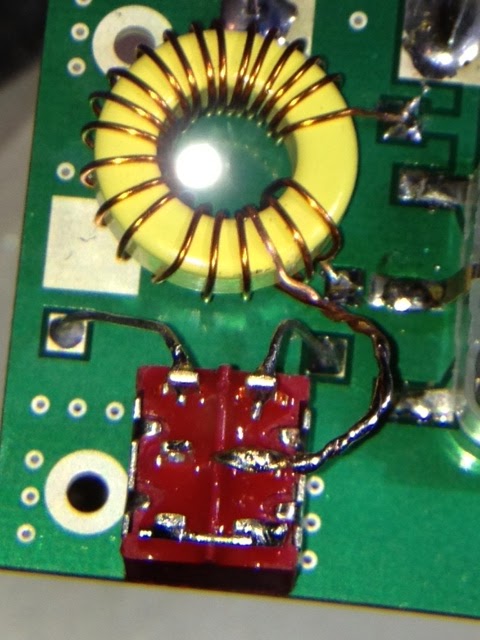
The kit is available at: http://betterqrp.com/
Mike Crownover, AD5A, is a regular contributor to AmateurRadio.com and writes from Texas, USA. Contact him at [email protected].
Spring is here!
Testing a new build of WSJTX for K1JT I hopped on to 10m and was surprised to see a strong signal. It soon revealed itself to be SM6NZV who gave me a +8dB report on my 5 watts.
This reminded me that it is May 1 today, the start of Spring and usually also the start of the Sporadic-E season. I tuned around on 6m and heard a couple of weak stations on my dipole, also a couple of stronger GMs working stations I could not hear.
I thought about installing the SDR-4+ as a panadapter for the K3 which had been one of the things I had intended to use it for. But something was amiss and I didn’t have control of the receiver’s frequency. I think the settings had got hosed, probably when I was playing around with using a USB DVB dongle as an SDR. I have no idea how to get it working again and I started getting stressed about it so I decided to abandon the idea.
SDRs are not for me, or at least not those that use a PC for a user interface. Windows is just too fragile, though if Linux is any better it’s only because there are fewer things to install on it in the first place!
Instead I will set up scanning on the K3 to scan a section of the 6m band. I always forget how to do this so I had to dig out the manual. Load the start frequency into VFO A and the end frequency in VFOB, make sure the mode and frequency are what you want and store it in a memory. I used memory 6 for 6m scanning.
To start a scan you just recall memory 6 (M>V, 6) and press and hold SCAN. I’ll probably forget that sequence of button presses as well so I looked up the CAT commands in the K3 Programmers Reference (SWT23;SWT29;SWH41;) and stored it in a KComm shortcut. I’ll probably make one for 2m as well though the chances of hearing any 2m Es up here are slim indeed. Last year I don’t think here was a single opening that extended this far north on 2m.
Julian Moss, G4ILO, is a regular contributor to AmateurRadio.com and writes from Cumbria, England. Contact him at [email protected].
Official 2013 Skeeter Hunt Announcement
The NJQRP Club is announcing the Second Annual ” Skeeter Hunt”. The objective is to get QRPers out of their shacks for the day; and into the fresh air and sunshine, to spread their wings and fill the airwaves with “Skeeters”. While commercial equipment can certainly utilized, bonus multipliers will be awarded for those who personally home brewed their own or kit built their own equipment (equipment not built by the operator would not count as either home brewed or kit built – it would be considered commercial equipment). This year, the event is to be held on Sunday August 11th. It will be a four hour sprint – from 17:00 UTC to 21:00 UTC (1:00 TO 5:00 PM EDT).

The theme for this year is “bodies of water”. We all know that Skeeters love the water. While we don’t want you going anywhere near actual Skeeter breeding grounds, we encourage operating near any local rivers, brooks, creeks, lakes, ponds, reservoirs, or even near a bay or the sea shore! Please make sure to take pictures and tell us about it in your Soapbox comments. (Bird baths, swimming pools, old tires filled with water, buckets, Dixie cups, etc. will NOT count for the contest!)
Stations who wish to be designated as “Skeeters” can get a Skeeter number by requesting one by sending an e-mail to [email protected] Please let me know if you intend to operate from a state other than your home state as listed on QRZ. Skeeter numbers will be issued from May through the day before the event. The official Website for the NJQRP Skeeter Hunt is http://www.qsl.net/w2lj/
Station Classes and Multipliers
X1 Home stations – commercial equipment
X2 Home stations – home brewed or kit built equipment
X3 Portable station – commercial equipment
X4 Portable station – home brewed or kit built equipment
Portable stations cannot use permanent antennas, i.e you can’t work from your backyard, hook up to your dipole or tower and yagi and be considered a portable station. Also, portable stations cannot be connected to the local power grid – alternative energy sources must be used – solar, battery, wind, etc.
Multi-Op Stations: – Great idea! Want to get together with some of your best buds to have a barbeque and hunt some Skeeters? FB deal, OM! When you send in your log, send the calls of everyone who participated under that call and or Skeeter number. And remember to send pictures of your group for the soapbox!
Suggested Call – Either CQ QRP or CQ BZZ
Exchange –
Skeeter Stations – RST, S/P/C, Skeeter number
Non-Skeeter Stations – RST, S/P/C, Output power
Modes – CW, SSB (new for this year!)
Power – 5W max CW, 10 Watts max SSB
Scoring –
Working a Skeeter Station – 2 points
Working a non-Skeeter Station – 1 point
Work a WAE station – 3 points – Yes! The Worked All Europe contest (CW) is the same day – working DX stations (different continent) will get you extra points!
Total score equals the number of QSO points times the number of S/P/Cs worked on all bands (stations can be worked on multiple bands for QSO points and S/P/C credit) times the multiplier for station class. For example, if you work W2LJ on 20 and 40 Meters, it counts as 2 QSOs and NJ counts for a S/P/C on each band.
Bonus points – An extra 500 points can be added to your score if you operate near a lake, stream, river, pond, beach, etc. as stated above Please send a photo of your set up, along with your log submission in order to claim points.
Suggested frequencies:
The QRP “Watering Holes”
For CW
80 Meters ~ 3.560 MHz
40 Meters ~ 7.040 and 7.030 MHz – also consider using from 7.114 to 7.122 MHz for a “slower” speed CW area. We want to have everyone involved!
20 Meters ~ 14.060 MHz
15 Meters ~ 21.060 MHz
10 Meters ~ 28.060 MHz
For SSB
80 Meters ~ 3.985 MHz
40 Meters ~ 7.285 MHz
20 Meters ~ 14.285 MHz
15 Meters ~ 21.385 MHz
10 Meters ~ 28.885 MHz
These are suggested starting points, of course. Feel free to spread out and give your “Skeeter” wings a chance to do their thing.
Categories: CW Only and SSB Only, or Mixed Operating will be considered separate categories. Please indicate with your log summary which category you are participating as.
Log summaries, photos and soapbox comments can be sent to [email protected] no later than 14 days after the event. Certificates will be issued to the top scorers of each category as well as others to be determined. Here’s an example of a summary that should be used:
Larry – W2LJ – NJ
Skeeter #4 – All CW
Skeeter QSOs – 23
Non-Skeeter QSOs – 5
DX QSOs – (if any)
S/P/Cs – 18
Station Class Multiplier X4
Claiming Bonus – No
If you send me all that information, I will figure out your score for you.
Hope to hear and work all of you during this year’s event. Special thanks to the NJQRP club for their sponsorship!
72 de Larry W2LJ
QRP – When you care to send the very least!
Larry Makoski, W2LJ, is a regular contributor to AmateurRadio.com and writes from New Jersey, USA. Contact him at [email protected].
Spring Fever
What is this strange disease that compels me to wander into the boonies on a beautiful day? I ventured out again… once more to the Pemigewasset River. I worked Russia, Sein Island, Giglio Island, Macedonia, a fellow QRPer in Spain, and Tennessee.
Today it’s 72F. The grass is absolutely turning green. Trees and plants are budding. I am in a polo shirt and shorts. It’s really spring.

I have ridden my bike about a mile and a half into the federal flood control area along the river. I stop along the trail not far from the old bridge that went over to Hill Village. I heave a line over an oak branch and set up the HB-1B on 20 meters with a half-wave wire. The band is active.

Right away I hear R5ZZ calling CQ and I answer. I must give my call twice, but the exchange is clean. Ken gives me a 569 from an area just beyond the North Sea.
In quick succession I work TM0SI an IOTA expedition to Sein Island, and IA5A, another IOTA station on Giglio Island. Both exchanges are quick 599s. Then I make a contact with Macedonia, Z320G.
I dial up toward the QRP calling frequency, 14.060. There I call Bill W4LVP in Tennessee as he finishes a QSO with another station. Bill is booming in and he gives me a 579. We have a wonderful chat. He tells me it’s 78F in TN, and he congratulates me on the QRP station. “GREAT QRP SIGNAL and FB SETUP.” As soon as we sign, I hear EA2LU calling me. Jorge is 579 from Spain. He is running a K3 at 5 watts into a yagi. He says I am peaking 589. I have worked Jorge several times over the years in QRP sprints, and it’s always a wonderful surprise.
I have only operated for a half an hour, but already I have worked a nice log full of DX. I pack up the gear and walk down to the bridge abutment.

The spring in New Hampshire is so much sweeter for having endured so many months of bone chilling cold. To be out here with the spring breeze soothing away the long winter’s freeze is remarkable… it’s no wonder we refer to the miracle of spring.
Jim Cluett, W1PID, is a regular contributor to AmateurRadio.com and writes from New Hampshire, USA. Contact him at [email protected].
Pingback
Thanks to Peter, G3OJV, for featuring this blog in his latest blog post. That’s Peter Waters of Waters and Stanton, one of the biggest ham radio dealers here in the UK. You might think that Peter would have a shack crammed with the latest equipment and a huge HF yagi out the back. But in fact Peter’s major interest is in QRP operating and antenna design. Many of his blog posts relate to those aspects of the hobby, so it’s worth a look.
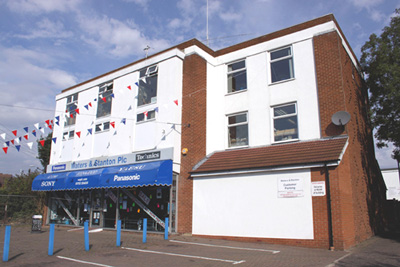 |
| Waters and Stanton’s Hockley shop |
Back in the 1970s when I was newly-licensed G8ILO and lived in Essex I was a regular visitor to Peter’s Hockley shop. In those days I used to swap rigs quite frequently as it was always necessary to sell one rig to finance the next. I can’t remember all the things I’ve had from there but it would be quite a long list.
I haven’t visited since 1994 when I moved up to Cumbria but that hasn’t stopped me from being a customer. In fact my attic antennas – the MFJ magnetic loop and the 80plus2 antenna which forms the nucleus of my multiband attic dipole, both came from there. I’m pretty sure that the 80plus2 is one of Peter’s antenna designs. It works very well as an attic antenna (with the addition of elements for 10 and 6 metres it covers all bands 80m to 6m except 30m and 17m.) I think my results on the air testify to that.
Julian Moss, G4ILO, is a regular contributor to AmateurRadio.com and writes from Cumbria, England. Contact him at [email protected].
Some QRPTTF videos
From Sean KX9X:
From Dave NK0E:
From N6NA:
I submitted my meager little log today along with SoapBox and photos. If you participated, please don’t hesitate to submit your entry. Click here to get to the QRPTTF page, where you can find summary sheets in .doc and .pdf formats. As Paul states, “Thanks to all who participated this year and hope you all had fun, regardless of band conditions (not that great) or whether you worked 5 or 50 stations.”
So I repeat, please don’t hesitate to send in your log and summary, even if you only had 1, or 5, 25, 50 or 100 contacts. Nothing warms the cockles of the organizer’s heart like seeing a bunch of logs come in! It’s not extra work. It’s affirmation that fun is being had by all; and that it’s worth it to repeat the event the next year.
And speaking of events, look for the official announcement concerning the upcoming 2013 NJQRP Skeeter Hunt here tomorrow and on all the QRP e-mail reflectors.
72 de Larry W2LJ
QRP – When you care to send the very least!
Larry Makoski, W2LJ, is a regular contributor to AmateurRadio.com and writes from New Jersey, USA. Contact him at [email protected].
 Ham Radio Deluxe |
 W5SWL Electronics |
 Ham Radio Prep |
 KB3IFH QSL Cards  Hip Ham Shirts  HamRadioAuctions HamRadioAuctions Reliance Antennas Reliance Antennas Enigma Shop Enigma Shop |  morseDX  Ni4L Antennas  R&L Electronics R&L Electronics antennas.us antennas.us QRV QRV |
- Matt W1MST, Managing Editor
