 |
 Pingback
 30 April 2013 | by
 Thanks to Peter, G3OJV, for featuring this blog in his latest blog post. That’s Peter Waters of Waters and Stanton, one of the biggest ham radio dealers here in the UK. You might think that Peter would have a shack crammed with the latest equipment and a huge HF yagi out the back. But in fact Peter’s major interest is in QRP operating and antenna design. Many of his blog posts relate to those aspects of the hobby, so it’s worth a look.
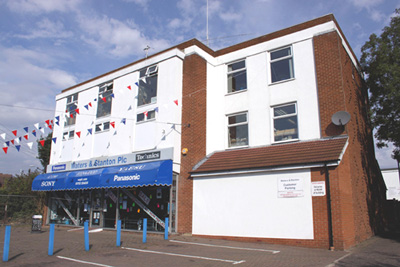 |
| Waters and Stanton’s Hockley shop |
Back in the 1970s when I was newly-licensed G8ILO and lived in Essex I was a regular visitor to Peter’s Hockley shop. In those days I used to swap rigs quite frequently as it was always necessary to sell one rig to finance the next. I can’t remember all the things I’ve had from there but it would be quite a long list.
I haven’t visited since 1994 when I moved up to Cumbria but that hasn’t stopped me from being a customer. In fact my attic antennas – the MFJ magnetic loop and the 80plus2 antenna which forms the nucleus of my multiband attic dipole, both came from there. I’m pretty sure that the 80plus2 is one of Peter’s antenna designs. It works very well as an attic antenna (with the addition of elements for 10 and 6 metres it covers all bands 80m to 6m except 30m and 17m.) I think my results on the air testify to that.
Julian Moss, G4ILO, is a regular contributor to AmateurRadio.com and writes from Cumbria, England. Contact him at [email protected].
Some QRPTTF videos
From Sean KX9X:
From Dave NK0E:
From N6NA:
I submitted my meager little log today along with SoapBox and photos. If you participated, please don’t hesitate to submit your entry. Click here to get to the QRPTTF page, where you can find summary sheets in .doc and .pdf formats. As Paul states, “Thanks to all who participated this year and hope you all had fun, regardless of band conditions (not that great) or whether you worked 5 or 50 stations.”
So I repeat, please don’t hesitate to send in your log and summary, even if you only had 1, or 5, 25, 50 or 100 contacts. Nothing warms the cockles of the organizer’s heart like seeing a bunch of logs come in! It’s not extra work. It’s affirmation that fun is being had by all; and that it’s worth it to repeat the event the next year.
And speaking of events, look for the official announcement concerning the upcoming 2013 NJQRP Skeeter Hunt here tomorrow and on all the QRP e-mail reflectors.
72 de Larry W2LJ
QRP – When you care to send the very least!
Larry Makoski, W2LJ, is a regular contributor to AmateurRadio.com and writes from New Jersey, USA. Contact him at [email protected].
A weekend with the Xiegu X1M
So, I have now had the X1M since Friday. I have to say that overall, I like it. Friday night (as previously posted) I checked in to the

Xiegu X1M
Brothers Net, and was heard clearly in Virginia, and again on Saturday night, when one of the members in Virginia relayed my check in to the operator in Maryland. Also on Saturday I logged 5 of the 7 Florida QSO Party spelling bee stations from my living room, as well as a couple of other Florida stations. Reports ranged from good for QRP, to Wow! Only 5 Watts? Keep in mind this is in a much-less-than-ideal setup.
In our apartment, KD2CHE and I are extremely limited on space, inside AND out. The X1M is attached to an L-shaped random wire in the front yard, by way of a Balun Designs 9:1 Unun, and an Emtech ZM2 tuner. Emtech recommends not using an additional balun or unun, but it seems to perform a little better with this crazy antenna.
It tunes up on most bands, and appears to tune up on 75, but signal reports were bad on 75, with a lot of RF feedback, and I can hear myself in the speakers I have attached to our TV when I transmit. 17 meters seems to be an issue with the TV speakers as well. I’d love to put up something better in the front yard, but we’ll see what the landlord and neighbors are willing to put up with. 160, by the way is a no-go, but I don’t think that’s a surprise.
I’ve gotten the hang of using the X1M pretty quickly. I haven’t used the memories yet, but I use the dual VFOs quite a bit, as well all of the different tuning speeds. Everything is fairly straight forward once you get the hang of it. Audio is what you would expect for a radio of this size (this thing is SMALL!), and fine through headphones. The receiver is very sensitive. I’ll get some actual numbers next weekend. I like that you can kill the display light to conserve batteries, which will help when portable.
I’ve tried battery power. With 8 alkaline AAs the radio seems to perform OK, however, 8 LiIon batteries are not quite enough voltage for the rig, producing some howls and distortion with the volume above about 40%. I guess I’m not too surprised at this, since 8 FULLY charged AA Eneloops only put out 9.6 volts. I will supplement that with 4 more Eneloops in series for a max of 14.4 volts. Later on, I can pick up something a little more sophisticated. I also made a coax-to-powerpole cable for mobile use, so I can always just set up next to the car when needed.
A coax power plug for making your own power cord, and a 1/8″ stereo (3 cond) plug for wiring to a key/paddle are included. The power connector is a very common size, 5.5mm OD x 2.1mm ID, or Radio Shack size M, which made powering the radio up easy, since I had a size M-to-tinned-leads cable already. I wired a straight-key up to the 1/8″ plug, and had to set the keyer mode to manual, which was also not hard to figure out. The instructions are in Chinese, but an English translated manual is available from Import Communications, or in the X1M Yahoo group.
I think the little X1M has a nice future in my collection. It’s no KX3, but for about $300, it’s a nice little radio.
To be continued………..
Neil Goldstein, W2NDG, is a regular contributor to AmateurRadio.com and writes from New York, USA. Contact him at [email protected].
Iler progress
The Iler 40 QRP SSB transceiver kit proceeds apace – a snail’s pace. I wasted a lot of time correcting stupid errors – like soldering a resistor in the wrong place and putting a diode in back to front. I mean, I know diodes have to go the right way round and the banded end is clearly enough marked on the board. Removing parts from boards with plated through holes is a nightmare. Why didn’t I check it?
 |
| Part completed Iler 40 board |
Another reason for the slow progress is that building circuits does my back in. It’s the bending forward to see the parts under the magnifying lens that does it. Eventually there is a twinge from my lower back that says: time to take a break. So I’ll put everything to one side and do something else for a bit.
Julian Moss, G4ILO, is a regular contributor to AmateurRadio.com and writes from Cumbria, England. Contact him at [email protected].
World War II German Radio Collection
http://www.stumbleupon.com/su/2QHV5Z
Mike Crownover, AD5A, is a regular contributor to AmateurRadio.com and writes from Texas, USA. Contact him at [email protected].
My Elecraft KX3 has a ping??
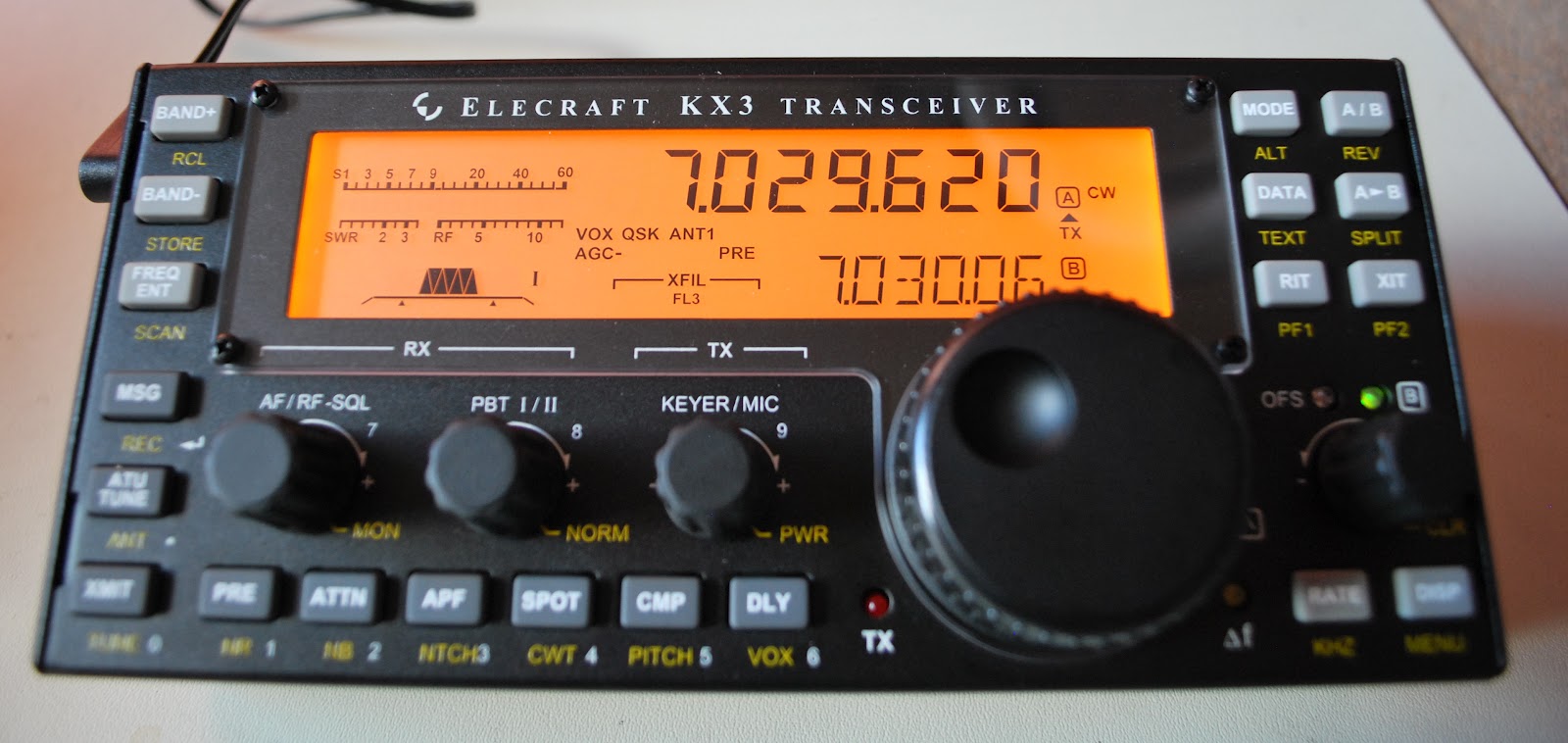
Problem has just been solved seems if I have the rig on dual RX and VFO A and B are very close to each other I am picking up "me" on VFO B. Which makes sense and when in dual mod the head phones are split with VFO A in one ear and VFO B in the other. This would explain why the ping was only heard in one ear!
Mike Weir, VE9KK, is a regular contributor to AmateurRadio.com and writes from New Brunswick, Canada. Contact him at [email protected].
How to Save Ham Radio – Modes – Part 3 (5 Part Series)
How to Save Ham Radio – Modes – Part 3 (5 Part Series)
I have been thinking and getting feedback about this series and Ham Radio overall there are several great points I have been hearing from people and I as I have said in the past… yet maybe SAVE is to strong of a word… Strengthen is a good one or expand is another… but let’s stick with SAVE for the article.
In a long list of items I think about the next one are modes of operation –
http://nicktoday.com/how-to-save-ham-radio-modes-part-3-5-part-series/
Nick Palomba, N1IC, is a regular contributor to AmateurRadio.com and writes from Florida, USA. Contact him at [email protected].
 Ham Radio Deluxe |
 W5SWL Electronics |
 Ham Radio Prep |
 KB3IFH QSL Cards  Hip Ham Shirts  HamRadioAuctions HamRadioAuctions Reliance Antennas Reliance Antennas Enigma Shop Enigma Shop |  morseDX  Ni4L Antennas  R&L Electronics R&L Electronics antennas.us antennas.us QRV QRV |
- Matt W1MST, Managing Editor
