 |
 David Cripe’s NM0S Cyclone 40 Meter Transceiver kit
 14 May 2013 | by
 Readers, check out the Cyclone 40 in this release:
A new kit from the Four State QRP Group and David Cripe (NM0S)

NM0S’s Cylcone 40M QRP transceiver. Look for it at Four Days in May!
Arising from Dave’s entry in QRP ARCI’s 72 Part Challenge Design Contest in 2010, the Cyclone 40 is an enhanced version of the original design. The transceiver designed for the design contest had 72 total parts, performed well, and won honorable mention. This improved version has less than 100 components and even better performance! The kit features all through hole parts and easy assembly. The receiver is a superhet design with very good sensitivity and selectivity, and tunes the entire 125 kHZ CW segment of the 40M Band – and does so at a comfortable tuning rate. A frequency readout is included so you know where you are at all times.
This is a complete kit, including the enclosure. A high quality board package includes the pc board, front and back panels, the sides, and top and bottom all of which make up the enclosure. The control and jack labels are silk screened in white letters and vividly contrast with the black solder mask, and the holes for the connectors and controls are pre-drilled. The ends are “dovetailed” together making a very rugged, easy to build, and attractive enclosure.
Features and Specifications
General
- Enclosure: A very nice predrilled and silkscreened enclosure is included. It’s easy to assemble and looks great.
- Ergonomics: Smooth solid tuning, a quiet receiver with QSK and well behaved AGC. Nicely laid out front and rear panels.
- VFO: The VFO is a simple PTO design, is very stable, and also quite easy to build
- Sidetone: Included!
- AGC: Audio derived, fast and smooth.
- Frequency Range: 7.000 – 7.125 typical.
- Tuning Speed: 10kHz/knob turn typical.
- Stability: 300 HZ the first 5 min after power up, less than 10 HZ/hour after that.
- QSK: Fantastic QSK! Full Break in, excellent muting, really fast!
- All Through Hole Parts There are NO SMT parts in this kit, and only three easy to wind toroids.
- Dimensions: 4.4 x 3.6 x 1.9″
- Power Connector: 2.5×5.5mm coaxial, center positive. Should be fused at 1A, fast blow at PS
- Antenna connector: BNC
Receiver
- Configuration: Superheterodyne, 11 MHZ IF, 4 Crystal IF Filter.
- Sensitivity: MDS (Minimum Discernable Signal) -125, Typical, below the normal 40M band noise level.
- Selectivity: Four crystal, 500 HZ IF filter
- IMD3: 90 dB typical, better than most commercial gear!
- IP3: +10 dBm typical – another very good number
- Frequency Readout: 3 or 4 digit CW, 1 kHz or 100 Hz resolution (user selectable), developed by Adrian Hill, KCØYOI.
- Band Edge Marker: A band edge marker is heard at 7.001 MHZ
- Headphone Jack: 1/8″ stereo, standard earbud/Walkman® headphone compatible
- DC Current consumption: 30 ma typical at 13.6 VDC.
Transmitter
- Configuration: Stable, Wide Range VFO (PTO design), Efficient Class E Final.
- Spectral Purity: All harmonics and spurs less than 50dB below the carrier.
- Output Power: approximately 4W into 50 ohms
- DC Current consumption: 500ma typical at 13.6 VDC Will operate down to 9v DC.
- Key Jack: 1/8″ stereo, grounded shell, switching the tip keys TX. Contacts accessible for an internal add-on keyer
Kits should be available at QRP ARCI’s Four Days in May conference at Dayton, and will be for sale on the Four State QRP Group’s web site approximately May 20th. The final price hasn’t been determined yet but should be less than $100 plus shipping.
Tom Witherspoon, K4SWL, is a regular contributor to AmateurRadio.com and writes from North Carolina, USA. Contact him at [email protected].
60 years of age!
Today is a day I thought I’d never see – my 60th birthday.

Even on such a special occasion you can’t keep me away from the radio and computer!
Julian Moss, G4ILO, is a regular contributor to AmateurRadio.com and writes from Cumbria, England. Contact him at [email protected].
Looking at other blogs
Two blogs that I would like to point out, just in case you haven’t visited them.
The first is the post by Tom K4SWL on the “QRPer” entitled “VA3OOG covers Bowie like no other”. After reading Tom’s account, I have seen this covered on some of the Internet news services. This is a really cool video and the fact that Commander Hadfield is a fellow Amateur Radio op is just over the top. Thanks, Tom, for picking up on that. This should put to rest the notion that we Hams are all just geeky nerds without an artistic bone in our bodies.
The second post appeared in John “K3WWP’s Diary”. Just as I got all pumped up for having successfully worked Z81X on Saturday, I read in John’s diary how he did it quite “easily” (a term he uses more than once) with QRP. For having succumbed to “the Dark Side” and for having used 85 Watts, I bow humbly before the QRP Master. I think I had better send in my QRP credentials to the QRP-ARCI, as I obviously lost the faith and did not fully give QRP the chance it deserved. 😉
72 de Larry W2LJ
QRP – When you care to send the very least!
Larry Makoski, W2LJ, is a regular contributor to AmateurRadio.com and writes from New Jersey, USA. Contact him at [email protected].
Hike to Knox Mountain in Mid-May
This afternoon I hiked to Knox Mountain. It was a beautiful spring day. I worked Croatia, Minnesota, the UK and Spain.
It’s been in the 70s for a more than a week. The trees are leafing out and the grass is high. Today the weather changed. It was 50F and windy. No matter, the trail was beautiful.

I crossed the first bridge and took a couple of snapshots of the brook.

Viburnum with its white flowers decorated the trail along the brook. The cool breeze kept the black flies away.
The second bridge has been removed. I placed a board between some rocks to facilitate a dry crossing a few weeks ago. I was glad it was still there.

The pond was full. It looks like the beaver have maintained their small dam at the near end. I tossed a line over a high branch on the cherry tree next to the cabin and pulled up a half wave wire for 15 meters. I used the ATS-4 by KD1JV with the Elecraft T-1 tuner. Here’s my log.
13 May-13 1916 21.018 9A4KW CW 599 599 Croatia
13 May-13 1922 21.013 KW7D CW 559 589 MN
13 May-13 1934 21.005 MI0VKO CW 449 579 UK
13 May-13 1951 21.011 EA8TL CW 599 599 Spain

This is the view of the pond from my operating position. After packing up, I made a quick trip back to the car. I was cold and ready for a cup of tea. Thank goodness spring is here.
Jim Cluett, W1PID, is a regular contributor to AmateurRadio.com and writes from New Hampshire, USA. Contact him at [email protected].
Alexloop vs Attic dipole
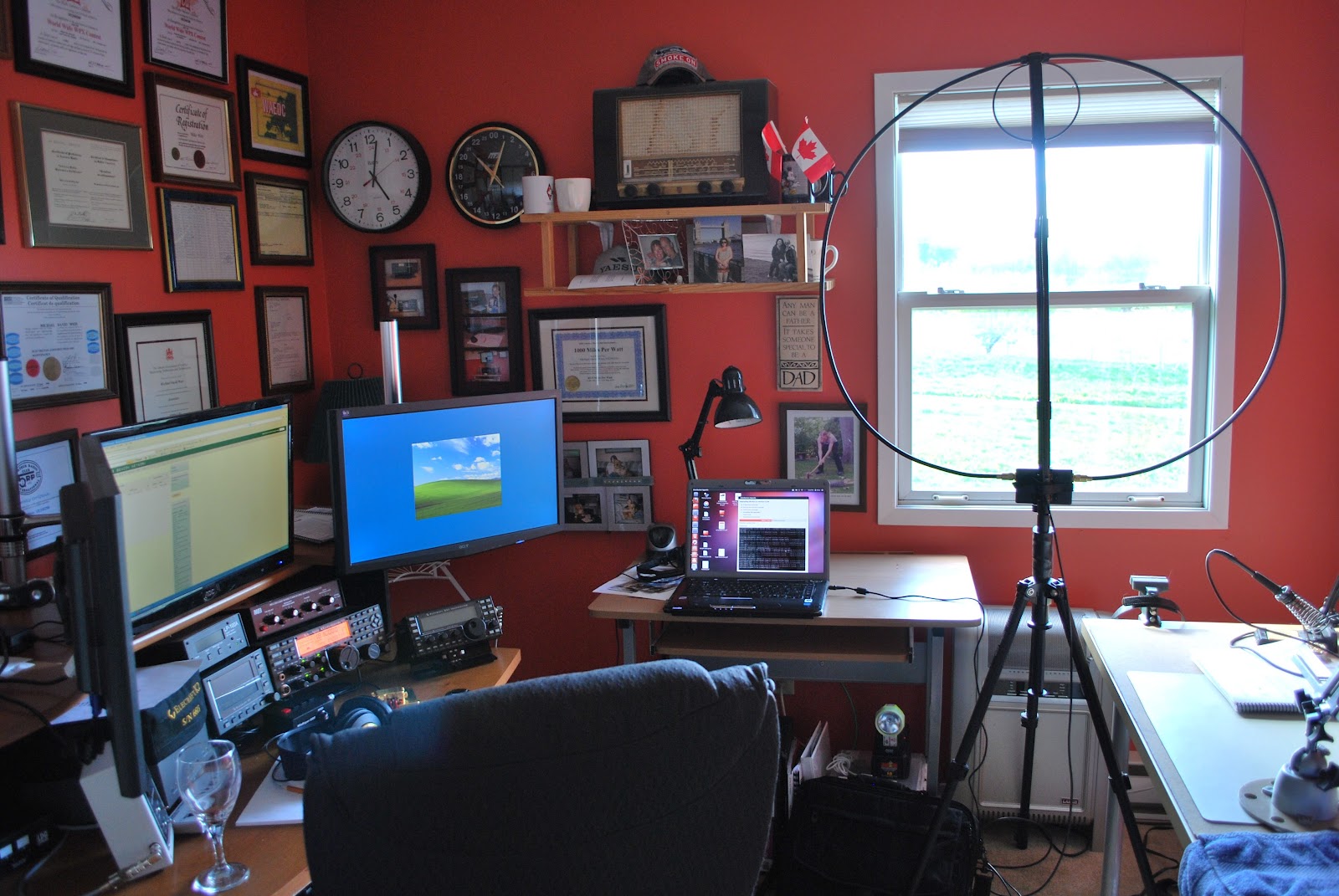 |
| Setup for test. (Laptop running Ubuntu update) |
A-5
K3
SFI 157
SN 173
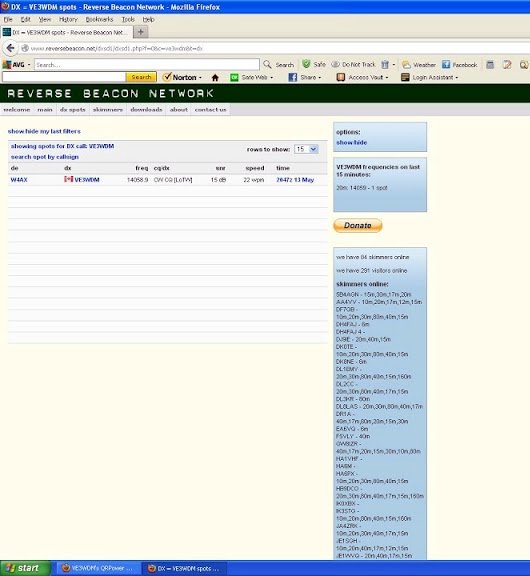
Below is the results of the test.....not so well it would seem the Alexloop netted zero and the dipole only one. So is seems for a more acurate comparison better conditions are needed.
Mike Weir, VE9KK, is a regular contributor to AmateurRadio.com and writes from New Brunswick, Canada. Contact him at [email protected].
Nice cuppa tea

112 miles. 10,000ft of climbing on roads up to 30% gradient in the wind and rain of a very ‘normal’ West Cumbria. Fred Whitton Challenge. All 6 passes in the lakes in a day. Radio is a whole load less tiring, even when its not going well. Looking forward to getting back on the air
Alex Hill, G7KSE, is a regular contributor to AmateurRadio.com and writes from Cumbria, UK. Contact him at [email protected].
What weather station?
A few days ago my Fox Delta WX1 Micro Weather Station stopped working. As it turned out, I just had to switch off the power and switch it on and it started working again . But while I was waiting for the rain to stop so I could go out and look at the device I began thinking about getting a better weather station – one that measures wind speed and direction and rainfall as well as temperature, humidity and pressure.

When you start to look at weather stations the choice is overwhelming. My first priority was that it should work with APRSISCE and generate the file wxnow.txt that it uses to update weather objects. That requirement led to the stipulation that it should be compatible with the free weather software Cumulus, which creates the required file. There is a list of weather stations that work with this software, which narrowed the choice down a little. After reading many reviews the best choice seemed to be the Davis Vantage Vue. Unfortunately this cost about four times more than I was willing to pay, so it was back to the drawing board.
The weather stations made by the Chinese firm Fine Offset and sold under the Watson brand name seemed to meet my criteria at a more reasonable price. However, browsing through the reviews on Eham.net and elsewhere there were quite a high proportion of dissatisfied users. Complaints about anemometers that stopped rotating, poor wireless reception and so on. With weather stations as with everything else, it seems, you get what you pay for.
Despite the reviews I am tempted to get one of the Watson W6861 solar weather stations. But before I did I thought I would take the opportunity to ask my readers for their experiences. Many of you must have home weather stations. So which ones are good, which are bad and which should be avoided at all costs? I await your comments with interest.
Julian Moss, G4ILO, is a regular contributor to AmateurRadio.com and writes from Cumbria, England. Contact him at [email protected].
 Ham Radio Deluxe |
 W5SWL Electronics |
 Ham Radio Prep |
 KB3IFH QSL Cards  Hip Ham Shirts  HamRadioAuctions HamRadioAuctions Reliance Antennas Reliance Antennas Enigma Shop Enigma Shop |  morseDX  Ni4L Antennas  R&L Electronics R&L Electronics antennas.us antennas.us QRV QRV |
- Matt W1MST, Managing Editor
