Cosmetic K2 Upgrade

My Elecraft K2 which is now more than 11 years old (serial #2198) has served me well, even earning me QRP DXCC (100 countries with 5 Watts) some years ago. It is still cosmetically in mint condition, except for that single item which sticks out like a sore thumb: The tuning knob.

This became very clear to me a couple of months ago when LA8OKA’s and my K2 were displayed side by side at our stand at Oslo Maker Faire. His is less than two years old, serial #7224, and they were similar except for the scratches in the faceplate of my tuning knob. If I am allowed to generalize from my knob only, it seems as if the faceplate had poor quality paint and has been replaced by a better quality version over the years.

Anyway I ordered a new one and paid the price which at present is $30.37 plus shipping. The difference is really striking and I feel like I have a new K2 now, well worth the price! The K2 now serves as my second rig, and I think it has many years of good service still to come.

Related posts:


Sverre Holm, LA3ZA, is a regular contributor to AmateurRadio.com and writes from Norway. Contact him at [email protected].

A dongle for the FT-817

If you have used a Yaesu FT-817 on SSB you’ll have probably been annoyed by the lack of a TUNE button to generate a steady carrier for antenna tuning. You usually have to press the MODE button a few times to select FM or PKT, use PTT to send a carrier, then change mode back to USB or LSB. It isn’t one of life’s greater annoyances, but it’s a nuisance all the same, especially if you use an antenna like the AlexLoop which needs retuning every time you change frequency.

A couple of weeks ago I received a letter from one of my blog readers, John G4HUK, enclosing a Quick-Tune Dongle that he makes for the Yaesu FT-817, FT-857 and FT-897 rigs. It’s a neat little gadget that plugs into the ACC port on the back of the radio. What it does is let you generate a tuning signal in SSB mode by double-clicking the microphone PTT. Simple but effective! It won’t be so useful for home users who have a CAT cable plugged into their ACC port already, but for SOTA operators and other exponents of outdoor radio (apart from CW operators who can just hold the key down) it could be a godsend.

The Quick Tune Dongle installed on the back of the FT-817

The dongle didn’t work for me at first until I set the baud rate of my FT-817’s ACC port to 9600. This is explained in the ‘manual’. The instructions also explain how you can reconfigure the dongle to change the way it works. By default it will use PKT mode to generate the tuning carrier and ignore double-clicks made in any mode other than USB and LSB, which I think will suit most people.

I think it is an ingenious little gadget which you can get from HUK Electronics for £15.95 + postage. Here’s a video of the dongle in action.


Julian Moss, G4ILO, is a regular contributor to AmateurRadio.com and writes from Cumbria, England. Contact him at [email protected].

Upgrade?

A couple of years ago I attempted to upgrade my rig to a more ‘vase’ station type. I really like my IC7000 and have thoroughly enjoyed using it but I have also enjoyed operating from larger rigs more. There’s less need to get a PC up and running and to use that to drive the menu’s. The reason why I didn’t get a new rig last time is because a more pressing need was there, we needed a new car.

Well now I get to think about it all over again. I’ve got a figure of around £1500 in my head and thought that the TS590 might do me well. Other options would be a second hand K3 but they are rarer than hens teeth and likely to be more money and an ideal would be a new Hermes SDR, but then again that would be more like £2000+.

I found this decision quite difficult before but the issue doesn’t seem to want to go away in a hurry. New or second hand I’m not really bothered. I just want the best I can for the money. HF & 6m are a must. 2m would be great and 70cm’s as well so i can do some satellite work but I’ll happily drop the VHF for a better HF rig. The TS590 does seem like the best choice so far.


Alex Hill, G7KSE, is a regular contributor to AmateurRadio.com and writes from Cumbria, UK. Contact him at [email protected].

It’s nice when a plan comes together

My contest screen
Ham radio is very diverse and has something that seems to click with each radio operator. One of my "clicks" is contesting and I also add to it the flavor of QRP (another one of my clicks). I enjoy using my PC in conjunction with ham radio and when it comes to contesting a PC is almost a must have. The program I use for contesting is N1MM logger. It 's a great program and works very well, has great support and I'm not sure of any contests that it does not support. Over time I have added some programs to my contest repertoire. I found that controlling N1MM got me used to using my mouse and that is the way to go when it comes to contesting. I then came across N4PY's rig control program. It's another way to incorporate my mouse to allow me control of my K3 during contests. This program is very well supported and the times I have emailed questions and got a reply within 1/2  hour!! This program will allow you to control most if not all functions of your radio with the click of a mouse. In a contest this is great because you are not going from mouse (N1MM logger) and back to the radio. For me it's more of a smooth type of operation using the mouse.  Hold on....my contest hangup gets weirder.....I have a keyboard tray that supports my keyboard,
Begali Contour key and why not VFO control as well!!!  Now comes the Flexcontrol VFO knob. This is a USB device that allows  you to tune your rig (and more) from where you ask.....well the keyboard tray of VSP manager to the mix. This great little program (that is free to hams) allows all the programs to live happily with each other.
FlexControl knob
coarse!  N4PY's programs allows you to interface the Flexcontrol with your rig through his program. I did say the Flexcontrol did more than just tune, it has 4 memory buttons that can be programed through N4PY's program to preform often used radio functions.  Also the VFO knob can go from fine tune to three other tuning choices by just clicking the knob! To do  this the radio, Flexcontrol knob and N1MM all have to be happy coexisting with each other. To do this  I added
You all know how it is when you have had a nice dinner and there is still room for a nice desert......well my nice dinner on my keyboard tray was the Flexcontrol knob, Begali Contour key and the mouse....there is still room for one more item! I added the K1EL USBwinkey which I assembled myself.  The N1MM contest program is able to incorporate the Winkeyer in it's program, so when I program the CW messages into the winkeyer they will be used by N1MM when I mouse click on the N1MM macro button. This is great because the Winkeyer is very easy to program and you can save various keying programs into individual files. This way I will have a file for each CW contest and just a mouse click to program N1MM for each CW contest.  If all files are stored on my PC and the Winkeyer is set up via the PC and CW is set through N1MM logger then why the heck does the Winkeyer have to be on the tray!!! Well Winkeyer has a nice variable pot control that can vary the CW on the fly. This way for op's who are sending slower or faster CW you can be varied  by a simple turn of the Winkeyer knob.
Keyboard tray setup
Finally there are those out there that subscribe to the KISS theory.....Keep it simple stupid......and this is true when you introduce other factors with ham radio. As for me trying and sometime failing is well worth it when in time all comes together and works well.


Mike Weir, VE9KK, is a regular contributor to AmateurRadio.com and writes from New Brunswick, Canada. Contact him at [email protected].

Massive Floods in Europe

My heart turns out to the people in Europe today as I read about the massive floods in Europe.    

Most of the DX stations I work with my QRP station live in these areas, and personally, I remember a lot of the towns I’m reading about on the Danube River. I found it to be one of the most beautiful and interesting places on earth. When I was there, my thoughts were always revolving around the fantastic “bicycle” routes. It was common, to see entire families on their bicycles, enjoying nature in a way that only can be experienced at this slow pace, and demanded, by human powered transportation.

We’re experiencing similar events here in the United States with heavy rain and high winds. Sadly, I feel the world is experiencing a deteriorating climate which is about to cause an inland shift of major populations. At times like this, I feel fortunate to live in this sheltered valley in West Virginia. Although I’m only 630 ft above sea level, I feel safe because of a series of locks and dams on this coal mining transportation route.

I worked a couple of stations yesterday in Poland and Denmark. I’ve worked the Polish station before. (SP9KR), and I’ve also worked Denmark previously, but this station was a new one. It was nice to see this card in my mail box before I could list him in my log book.

I still get “paper cards” in the mail without a SASE. On all the data bases on the web, I’ve made it crystal clear that I only respond with the electronic E-QSL format. I enjoy the memories of a nice QSO but find it “silly” to send a card to everyone I talk to on the air. However; “if you absolutely got’a have a paper card”, join the E-QSL group. It’s free…..and you can have a “paper card” printed and mailed to you for a fraction of the normal postage rates. (hint)


John Smithson, Jr., N8ZYA, is a regular contributor to AmateurRadio.com and writes from West Virginia, USA. Contact him at [email protected].

Trying a new template.

Not sure I like it; or will keep it, but it IS different from what I had.  Is this template easier on the eyes?  Some folks recently and privately commented to me that they didn’t like a white typeface against a dark background.  Is this any better?

I joined my CERT group to aid South Plainfield with the running of the Holy Savior Academy 5K walk/run this morning. Luckily, I only had one obnoxious driver to deal with who couldn’t understand that the main roads were closed so that people wouldn’t be run over.  “You actually expect me to park on this side street and walk a block to my house?”, I was asked.  “Yes, sir”, I replied, “It’s for your protection as well as theirs.”  He still huffed and puffed until he started getting unreasonable and a little belligerent, so at that point, I radioed for police assistance.  They arrived and suddenly the light bulb went on over his noggin – he got the idea.

The thing that gets me is that not only is this an annual event; but it’s also very well publicized.  Notice about it appears on the local cable channel. Sacred Heart Church, which loans out its parking lot for the epicenter of the event is by far the largest church in town.  The notices for the “Family 5K Run/Walk” appears in their bulletin for weeks ahead of time. The local town paper published the details about the run/walk and the road closures the week before the event, also.  The town puts it on their Website and their Facebook page. Don’t people read?  Several of our CERT members suggested to our Director of Emergency Management that perhaps next year, on the night before the event, that we do an automated “reverse 911” call and telephone all the houses anywhere near the route that the roads will be closed. Oh, and by the way, the roads are closed for all of about an hour – 90 minutes tops!

One of my Ham buddies, Marv K2VHW, who also lives in South Plainfield was at the event with me.  He told me that his rain gauge had close to 4.5 inches (11 cm) of rain in it due to yesterday’s visit from Tropical Storm Andrea.  Yesterday was definitely a soaker, and I’m willing to bet the cicadas weren’t too thrilled with it.   I know that the tropical storm season does officially start  with the end of May.  I don’t recall us ever getting a visit by a named storm so early in the season.  I hope it’s not a portent for things to come.  Irene in 2011 and Sandy in 2012 were enough for me for a long, long time.

Hmmmm ….. cicadas (locusts), floods ……. I think God’s trying to tell us something.
Last night was a relatively quiet night on the radio.  I did turn up the power to work a new DXCC entity, however.  I heard TA3XA, Met fielding callsigns on the very low end of 20 Meters.  The pile up was pretty fierce and Met must have been running barefoot as he was only about 579 here.  To make matters worse, he was running simplex, so it was a huge jumble.  This is maybe the third time in my Ham career that I’ve ever heard Turkey on the air, so I just wanted to get him in the log.  He would call “QRZ?” and the veritable dam-burst of callsigns would entail.  I waited until the deluge waned and then tapped my call out.  Eventually, my strategy paid off and a 2X 579 shorty DX QSO occurred.  Another one in the books!
Tonight, there’s a church carnival going on in town.  My CERT team will be out again, but I have to drop my kids off at a school dance and then pick them up, so I don’t think I’ll be available for parking duty.  It’s going to be a mess too, because I drove by the field where they direct cars for fair parking and it looks like a huge mud wallow after yesterday.  Maybe I can use the time between dropping my kids off and picking them up for some HF time.
72 de Larry W2LJ
QRP – When you care to send the very least!


Larry Makoski, W2LJ, is a regular contributor to AmateurRadio.com and writes from New Jersey, USA. Contact him at [email protected].

Difficult Band Conditions

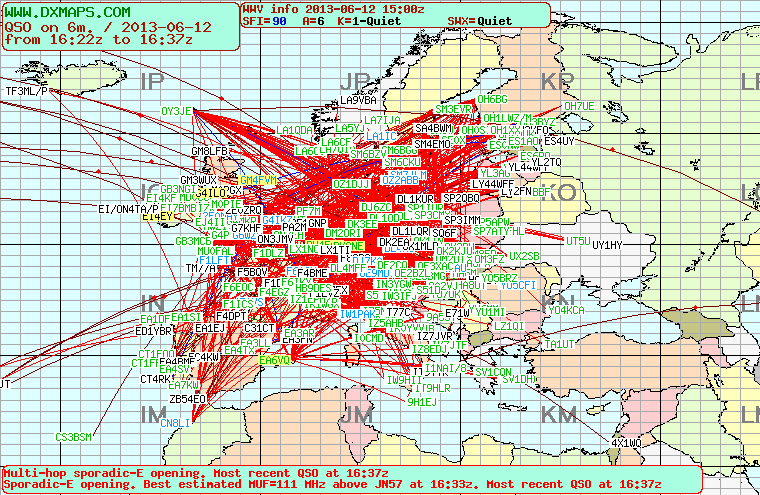
After several tries, I managed to work VP5/W5CW in the Turk and Caicos Islands last night. We’ve worked before; but last night the conditions were so poor that I worried if I would be able to continue my string of daily DX contacts.

The weather in the Caribbean, Southern Florida, and upward along the Eastern coast is horrible this week. True, the propagation is dismal, which might explain why I hear very few stations on the air, but I can’t help but think that most hams in these areas have unplugged their stations and unhooked their antennas because of the accompanying thunderstorms, high winds, and storm surges.

I worked another Oklahoma station last night (W5WIL) which was just a few miles from where that tremendously destructive tornado rumbled through last week. Within a weeks time, there’s been two tornadoes touch down in this area with 300 mph winds. (482 kph) I don’t know what word to use to describe that other than “devastating”.  Fortunately, they touched down in empty fields this time.

We were on the 40 meter QRP frequency (7040) and had the possibility of a nice QSO; but were interrupted by a careless operator who decided “his” frequency was a good place to  “tune up”. It was an inexcusable and  thoughtless action by a “four” station, who obviously “didn’t give a hoot who was on the frequency”. I continue to find this behavior a “big”  problem on this band and sadly find myself avoiding it out of frustration.

I imagine the thousands of “rock bound QRP kit builders” experience the same frustration. They don’t have the option of “moving somewhere else”.  In essence, their “kits” have become nothing more that paperweights and conversation items.

I don’t know what the answer is to this continuing problem since “common courtesy” doesn’t seem to be in their vocabulary.


John Smithson, Jr., N8ZYA, is a regular contributor to AmateurRadio.com and writes from West Virginia, USA. Contact him at [email protected].

Subscribe FREE to AmateurRadio.com's
Amateur Radio Newsletter

 
We never share your e-mail address.


Do you like to write?
Interesting project to share?
Helpful tips and ideas for other hams?

Submit an article and we will review it for publication on AmateurRadio.com!

Have a ham radio product or service?
Consider advertising on our site.

Are you a reporter covering ham radio?
Find ham radio experts for your story.

How to Set Up a Ham Radio Blog
Get started in less than 15 minutes!


  • Matt W1MST, Managing Editor