Archive for the ‘Uncategorized’ Category
 3830 Claimed Scores | NS Summer Ladder VIII | Low Power
 June 5th, 2010 |
  Author:
  Atlantic Single Operator.
- N4AF | 50 Qs | 32 Mults | 1,600 Points [PVRC].
- N1LN | 44 Qs | 34 Mults | 1,496 Points [PVRC].
- NO3M | 44 Qs | 32 Mults | 1,408 Points [NCC].
n = 7 scores submitted in this division.
East Central Single Operator.
- N4OGW | 50 Qs | 36 Mults | 1,800 Points [ACG].
- K9BGL | 51 Qs | 34 Mults | 1,734 Points [SMC].
- K8MM | 48 Qs | 34 Mults | 1,632 Points [MRRC].
n = 13 scores submitted in this division.
West Central Single Operator.
- N3BB | 54 Qs | 40 Mults | 2,160 Points [CTDXCC].
- W5JAW | 52 Qs | 39 Mults | 2,028 Points [CTDXCC].
- WD0T (@KD0S) | 54 Qs | 35 Mults | 1,890 Points.
n = 6 scores submitted in this division.
West Single Operator.
- K7SS | 57 Qs | 33 Mults | 1,881 Points [WWDXC].
- W7OM | 44 Qs | 27 Mults | 1,188 Points [WWDXC].
- W7WHY | 41 Qs | 22 Mults | 902 Points [WVDXC].
n = 3 scores submitted in this division.
NCCC in CA/NV Single Operator.
- N6RO | 45 Qs | 29 Mults | 1,305 Points.
- K6VVA | 43 Qs | 30 Mults | 1,290 Points.
- W0YK | 42 Qs | 30 Mults | 1,260 Points [Loma Prieta Contest].
n = 6 scores submitted in this division.
Our 100 foot tower whom looms large in Central Texas continues dominating the fastest 30 minutes in RadioSport. Congratulations, Jim, N3BB for turning in another fine performance and leading the Central Texas DX and Contest Club (CTDXCC) to its fourth banner position!
73 from the shack relaxation zone.

888 miles using a hand-held
This afternoon 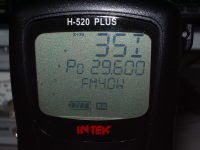 I made my first DX contact using a hand-held radio. It was a fine, warm day, so after lunch I left Olga doing things in the garden and went for a stroll with the H-520 10m FM radio. I took a footpath through fields to the north of the town that led up to the Carlisle road. It’s quite high up there, with great views down into the town and to the mountains beyond. However I was only carrying what would fit in my pockets, so the camera got left behind.
I used to take a 2m radio up there but I don’t think I ever made a contact so I lost interest. The other problem with that path is that you sometimes have to run the gauntlet of a herd of cattle. In the UK it’s illegal to put a bull into a field through which is a public right of way. However there is no such restriction on cows. They can be quite inquisitive, and there have been a few cases recently of people being knocked down and injured while walking through a field of cattle. It is quite frightening being followed across a field at less than the safe stopping distance by a couple of hundred tons of beefburgers in the making, as happened to Olga and I a couple of years ago. Shouting “horseradish sauce” at them has no effect at all!
Today, fortunately, the bovine creatures kept out of my way. I found a suitable operating spot, put the whip antenna on the Intek and started calling CQ. After a few minutes I had a call from Zdenek OK1AQW, coincidentally the same station that got away from me yesterday. Today he was strength 9 on the S meter, the same as Roger G0MWE had been from just a few miles away. We moved off the calling frequency and completed a solid 5 minute QSO, kept short only because Zdenek was receiving a lot of interference from other stations on the same frequency.
My report was initially 57, but was amended to 59 dropping to 51. At one point Zdenek informed me that I was coming over another British station that was calling on the frequency. He was running 100W to a quarter wave vertical and I think he was a bit surprised to hear I was running only 2.5W to a 140cm telescopic whip!
Incidentally it turns out OK1AQW doesn’t live near Prague at all as I wrote yesterday. His QRZ.com page is wrong. He is actually more than 100km east of Prague, about 10km from the Polish border, in locator JO80eb. I calculate that to be a distance of 888 miles or 1,430km. Not bad for a voice contact using a battery powered hand-held radio and whip antenna. Don’t you just love Sporadic E?
I didn’t manage any other contacts. I heard DO5DGH calling CQ repeatedly but he didn’t hear me. But this was a nice taste of what is possible. Some people might wonder why someone who owns nice radios like a K3 and even an FT-817 should put so much effort into trying to make contacts using a modified hand-held CB but I think to talk to someone direct using a battery powered self contained hand-held radio, without the aid of a satellite, a repeater or internet linking, is the ultimate challenge and far more exciting than anything I could achieve even if I had the full legal power, a tower and a beam!

Heard in Prague
I came a little closer to my objective of trying to make a DX contact using only a hand-held radio this afternoon. After dropping Olga off in town for a hair appointment I went up to my usual haunt Watch Hill accompanied my my 2m and 10m hand-helds. I had just stopped on the top when I heard Geoff G4WHA/P calling CQ WOTA from Kidsty Pike on the GP300 which was on my belt. He was a bit noisy as the radio only had the rubber duck on it so I foolishly decided to swap it for the 5/8 telescopic before calling him. Unfortunately in the minute or so it took to swap over the antennas I lost him and didn’t hear him call again.
 Colin 2E0XSD called me and we had a brief chat, then I made several other calls hoping to catch Geoff or anyone else who happened to be listening. After about five minutes Colin called again to say that he was hearing activity on 10m FM. I got out the Intek with the 4 foot whip and started listening around. I did hear some activity, including what sounded like a French station down in the noise on 29.600 who was not clearing the FM calling channel. I also heard what sounded like Russian on 29.620.
After numerous calls on 29.600 I heard a CQ from OK1AQW near Prague in the Czech Republic, loud and clear. I called him but he replied that I was too weak to copy. A couple of minutes later I started calling again and OK1AQW came back to me with my full callsign! I replied “OK1AQW this is G4ILO/P you are 55 in IO84 QSL?” but got no response from him. I repeated his report several times but heard nothing. I don’t know if a full 4W would have made a difference, but a couple of days ago I adjusted the full power level of the H-520 back to 2.5W to try to mitigate the problem of high current draw when the SWR is less than perfect. So that was a gotaway, unfortunately.
I didn’t hear any more DX on 10m, but I did have a QSO with Roger G0MWE from Dearham who was using a new FT-897D and pleased to hear some activity on 10m. Roger suggested I should use a better antenna which would certainly be possible to erect up there but that would defeat the object of using the hand-held. But I’m sure with perseverance I will eventually achieve my objective.

A community in mourning
Once again our quiet English backwater of West Cumbria is in the news for the wrong reasons, this time after hitherto mild mannered taxi driver Derrick Bird went on the rampage with a sniper rifle killing 12 people and injuring 11 others – many apparently for no reason other than being in the wrong place at the wrong time – before killing himself. This kind of event is traumatic at the best of times, but in a sparsely populated area there are few people who don’t know, or know someone who knows, someone who witnessed or has been affected by the atrocity.
Britain has very strict gun control rules. Gun owners have to give good reason why they need to own a weapon and confidential enquiries are made as to their soundness of mind before granting permission. Derrick Bird had apparently legally owned his weapons for 20 years. But understandably questions are now being asked as to why people who have no professional need to own weapons capable of such carnage should be allowed to keep them in their house.
The sporting guns lobby has reacted with, it seems to me, rather disrespectful haste, to stem cries for even tighter controls, using arguments such as banning guns would make it impossible for Britain to host the Olympics. I doubt if the relatives of the 12 innocent people who were killed could give a damn about the Olympics at this moment.
There are many other silly arguments being raised against tighter controls. It is argued that much gun crime is carried out with illegally owned weapons, so making it harder to legally own one wouldn’t make a difference. But if Derrick Bird and others who use guns in crimes of rage or passion had to obtain them illegally first they would probably just resort to shouting or using their fists like the rest of us.
Another daft argument is that cars can kill and no-one advocates banning the use of cars. But quite apart from the fact that cars are useful to almost everybody whilst guns aren’t, it is also true that serious road accidents are examined to see if road safety legislation could be improved in order to try to prevent such accidents in the future. So I think that examining the laws regarding gun ownership is entirely appropriate.
If people own guns solely for sporting reasons, do they need to keep these weapons at home? Perhaps they should be securely kept at a licensed gun club or a police station and signed out for a specific period of time and purpose.
If Derrick Bird had not been able to get his hands on his weapons whilst he was thinking murderous thoughts, 13 people would still be alive today and 11 more would not be in hospital. Can anyone seriously argue that their sporting freedom is more important than that?

Dead mic
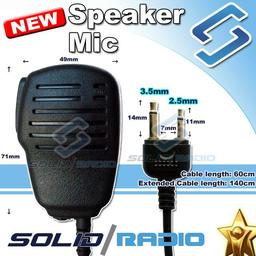 When using a hand held radio with a long whip antenna for more gain I often prefer to use a speaker mic so I can hold the radio in a steady, upright position. I have a speaker mic for the Kenwood TH-F7E (which fits the old TH-205E as well) and I have one for the Motorola GP300. But needless to say neither of them fit the Intek H-520 Plus 10m rig because the wiring and pin spacing is different. The official Intek speaker mic is rather expensive so I looked on eBay and found a speaker mic for “Alinco Icom Standard 2-pin” with the correct pin spacing for less than £7 including postage from Hong Kong.
When it arrived I decided to check what the audio sounded like by listening on the K3 while I made a call. The mic keyed the radio up but there was no audio. To make troubleshooting easier I swapped the antenna for a dummy load and audio was then heard!
I then tried a variety of different antennas and power levels and was soon pulling my hair out. I would hear audio with the dummy load connected and none as soon as I switched to an antenna. Eventually I tried the very short antenna supplied with the H-520 on the lowest power setting, 0.1W and I heard audio. It was looking very much as if the presence of radiated RF was somehow interfering with the audio. But the amount of RF required to cause the problem must be small as 0.1W on any of the larger antennas resulted in no audio from the speaker mic.
I didn’t know whether the RF was causing a problem with the microphone or the radio. I tried clamp-on ferrites at both the mic end of the cable and the plug end but neither made any difference so I was none the wiser. This particular made-in-China speaker mic is held together with screws that require a nonstandard five pointed key to undo so I couldn’t look inside to see if it used screened cable. I decided to give up on that speaker mic and do what I could have done in the first place if I hadn’t thought spending seven quid would be an easier solution.
In my junk box was the business end of another cheap Chinese speaker mic from which the cable had been ‘borrowed.’ I noticed in the past that the curly cables used for these speaker mics are often not screened. I happened to have a length of stereo audio cable with each channel separately screened. I wired this up to the spare speaker mic and attached suitable 2.5mm and 3.5mm jack plugs to the other end. When I tested it I now had transmit audio even on high power with the 4 foot telescopic whip!
At this time I don’t really know whether the mic I bought was at fault because I don’t have another radio that uses the same size plug spacing to test it with. Given that I have been less than impressed with other aspects of the H-520’s performance I wouldn’t be surprised if it wasn’t the radio that has inadequate filtering for RF picked up on the speaker mic cable.

Change of emphasis?
 I have never owned a Ten-Tec transceiver (although I once built and used one of its transverter kits) but I always thought that the thing the company’s products were most renowned for was their good support for CW operation and excellent QSK. So I was surprised to visit the Ten-Tec website a few days ago and see beneath the logo the slogan “The SSB Company.” Obviously CW isn’t seen as so important these days.
In the last couple of years Ten-Tec has dropped its kit range, its QRP Argonaut transceivers and most recently has been in the news for announcing that it will be rebranding the Chinese-made HB-1A QRP CW transceiver as a Ten-Tec product. I suppose someone somewhere has decided that this makes commercial sense but it doesn’t seem to me like the way to hold on to a reputation as an innovative indigenous American manufacturer of quality radio products for the discerning amateur.

Antique Wireless Association Journal – On-Line
 I recently featured some material available from the Antique Wireless Association and had to go a little deeper.
They have a wealth of information available on their site with some of their journal’s online articles. Great articles on vacuum tubes and such – but much, much more.
 I found a great little article called “Working With Crystal Control: A ‘Part 15′ Broadcast Band Transmitter “, the transmitter setup on the left. Really neat article (I think I must….want to build one of these)……… The image on the left is from that article – not to difficult to build and learn!!!
As I understand it, you can purchase a CD with back copies of this magazine. I just might look into that. Kinda sounds like the enjoyment I get when I receive that little journal from the G-QRP club – SPRAT. When that hits my mailbox, I know it’s getting stuffed in my backpack for enjoyment down the road.
One important thing to keep in mind with the AWA Archives is how well they not only demonstrate radio history, but how you can recreate it and learn from it. What a better way is there for a budding QRPer to learn where he’s going, but get a hands on demo from where other hams have been?
Below are only a few examples of the neat articles you’ll find on the AWA website:
Key and Telegraph by John Casale, W2NI
President Taft’s Telegraph Key
Building a 1929 Style Hartley Transmitter by Scott M. Freeberg, WA9WFA
Need a transmitter for our 1929 QSO Party? Build it in one week-end!
Breadboarding by Richard A. Parks
More Adventures With Transistors
The Vacuum Tube by Ludwell A. Sibley
Tube Bases and the Asbestos Hustle
Restoration of Shellac Finishes on Older Radios by Lane Upton
Don’t Strip That Old Finish–Save it Instead!
A nostalgia trip for the old-timer; an eye-opener for the newbie.
The Beginnings of Radio Central by Ralph Williams with Marshall Etter, Bob McGraw and Chris Bacon
Pupin and Armstrong lay an egg–An Antique Radio Gazette reprint.
A Solid-State Filter Choke or Field Coil Replacement
Go ahead and check them out at:
http://www.antiquewireless.org
http://www.antiquewireless.org/otb/archive.htm – a direct link to the journal archives













