Archive for the ‘Uncategorized’ Category
 Special event station N2H at hacker convention
 July 14th, 2010 |
  Author:
Ed Piskor's QSL card for N2H
The station has a great QSL card (above) which was drawn by Ed Piskor of Wizzywig Comics. Ed shows on his blog how he created the QSL card. I will have to try and catch N2H on the air to get one of those cards.
Great to see amateur radio involved in the hacker scene.
For above image note: Ed Piskor / CC BY-NC-ND 3.0


One day: Two different types of QSO
Last Saturday, I made two QSOs (a quiet day, then!) but what interested me was the difference between them. Both highly enjoyable, but of very different natures.
Sitting out in the sun, before breakfast I was listening to my IC-E92ED handheld, monitoring the local 2m repeater, GB3WH and the D-STAR reflector REF005A. Tyler, WX4TX from Knoxville, TN popped up on D-STAR and we had a great chat. Tyler was some distance from his local D-STAR gateway, but was running 50W and a beam antenna pointing at the gateway. The connection was solid, with a few moments of R2-D2 audio as the propagation went up and down. We had a good relaxed chat about the different styles of breakfast in our respective countries – Tyler was planning a Buttermilk and Cornbread breakfast!
A few hours later, I was briefly in the shack, doing some work on the computer – monitoring 70.200. I heard a little SSB a little LF of the calling frequency. It turned out to be a Spanish station operating from the coastal area near Alicante. He was using 10w to a small beam and I was surprised to work him with my small station. Interestingly it sounded like propagation was favouring the Oxfordshire area as he was hearing the GB3RAL beacon at Harwell, me and not much else! Shortly after our QSO he faded out and I’m sure that the propagation moved to favour another area of the country.
Two different types of contact – but both very enjoyable. Diversity is one of amateur radio’s strengths!

Inspirational
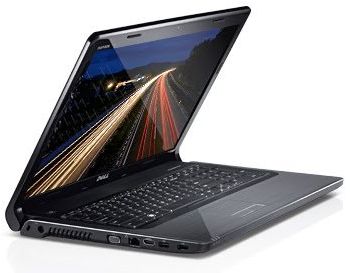 My new work laptop came this morning. It’s a Dell Inspiron 1764 with an Intel i3-350M(2.26GHz) Mobile CPU, 3GB of RAM and a 250GB SATA hard drive. It isn’t the most portable laptop, having – like the Toshiba it replaces – a full-sized keyboard and a 17.3in. widescreen display. It looks and feels absolutely gorgeous, the screen is superb, the keyboard perfect for my fat fingers, and it’s blisteringly fast. Click on the Firefox icon and the browser is there in a second or two.
What’s more, the Dell doesn’t cause any RF interference that I’ve noticed. The old Toshiba caused an increased level of hash that broke the squelch on my 2m FM receiver unless I cranked the knob round quite a way. Since I started receiving HF APRS I noticed that the Tosh caused a 3 S-point noise level on 30m as well, which all but prevented reception of any packets. So I am delighted with the new PC for that reason as well. I can now leave my radio station running all day as a VHF and HF APRS gateway while I work.
The old Toshiba had Linux installed on it early on in its life for security reasons plus the fact that Linux has some good web development tools. I was going to buy a PC with Linux preinstalled but I couldn’t find what I wanted so I resigned myself to paying the Microsoft Tax. The Dell came with 64-bit Windows 7. I thought that I should try it under Windows for a few days just in case there was a fault and I had to send it back. But to be honest I think I may stick with Windows. It looks more polished than Linux, it’s fast and I’ve already started to find replacements for the Linux tools I used. Firefox, which I spend most of the day using, looks and works exactly the same on both platforms, of course.
I certainly wouldn’t choose Windows 7 64-bit for a shack PC as there are too many compatibility problems with popular hardware and ham radio applications. But for what I need to do to keep the business running it looks like being a good choice.

2010 World Radio Team Championship
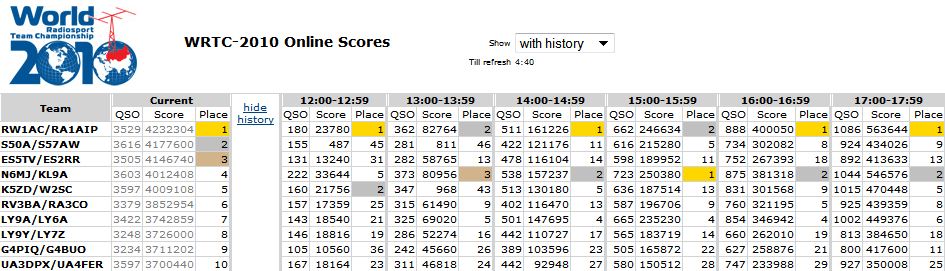 A monumental task well executed this weekend as competitors from all over the globe competed for the top slot in the game. Thank you RadioSport Russia for delivering an excellent interactive Internet product! The team of volunteers who labored behind the scenes certainly set the standard for the next global competition.
Admittedly, are there any plans to merchandise WRTC ball caps and t-shirts in the future? Each rate shackadelic right on in my logbook!
Please check out WRTC photo gallery because the spirit of ham radio and the intensity of competition is found within; note Tim, K3LR and Andy, N2NT.
From my perspective, ham radio operating inside tents beneath the ionospheric dome, really captured the essence of RadioSport. The photographs of tents illuminated by the glow of transceivers and liquid crystal displays against the canvass of sunset sparked a kilowatt worth of inspiration.
Contest on!

My 10,000 Hour RadioSport Challenge | 9,779 – 20 = 9,759 To Go
I’m scanning 20m spectrum space this morning while the event of the summer season is underway. The IARU HF World Championship in addition to the World Radio Team Championship (WRTC) guarantees a lot ham radio fun. I’m waiting for conditions to improve through the morning with a cup of coffee in one hand and my ears inside the cans listening to the music of Morse code.
My thought turns to the competitors in and around Moscow. Conditions are nowhere near epic however reflector chatter suggests heightened sporadic-e activity and not to ignore 15 or 10m this weekend. Likewise, competing with 100 watts against what one might call flat conditions, will certainly push the skill sets of all WRTC competitors.
Signals are beginning to rise above the receiver noise floor and my cup of coffee is nearly drained — first contact is logged!
An Idea.
My field day experience was a great teacher. Our operation, under the umbrella of emergency communications, provided insight into planning an expedition. It is not an easy task assembling equipment, antenna systems, power systems, and operators then operate in the field. The challenge was rewarding and field day opened a new path of ideas.
6m.
The charm of 50 MHz presents new opportunities and possibilities to consider over the summer season. Its portfolio of modes, fascinating conditions, and wide open frequency vistas is a relief from the doldrums of the current cycle and spectrum space gridlock. Likewise, 6m does not require a lot of aluminum or power, to enjoy ham radio at its finest.
I prefer the challenge of this frequency allocation because of propagation specifically sporadic-e, back scatter, and meteor scatter. Basically, one sends signal report and grid square, as measure against a fading signal. Potentially, every grid square is a rare grid square, and I enjoy logging each one as well.
Try 6m this summer season and consider CQ WW VHF next weekend because the magic band is waiting.
Meanwhile, teams are competing for the top slot in RadioSport this weekend in conjunction with the IARU HF World Championship, and I’m ready for another cup of coffee.
73 from the shack relaxation zone.

The Mechanical Universe and Beyond – Annenberg project
 First off…. sorry for the delay in posting (never took three weeks off before). As the Amateur Radio Emergency Service District Emergency Coordinator, we had a TON of public service events and I had a couple of public speaking engagements (radio related), soooo…………. But I plan on posting several posts to make up for the shortfall – there is just too much interesting stuff for amateur radio ops on the web!
Which brings me to the Annenberg Project and their series “The Mechanical Universe and Beyond”. Really great series and I’m thinking about purchasing on DVD for some of my classes – there’s a ton of information here that will indeed pertain to hams.
The course description reads:
This series helps teachers demystify physics by showing students what it looks like. Field trips to hot-air balloon events, symphony concerts, bicycle shops, and other locales make complex concepts more accessible. Inventive computer graphics illustrate abstract concepts such as time, force, and capacitance, while historical reenactments of the studies of Newton, Leibniz, Maxwell, and others trace the evolution of theories.
But, in the middle of the course are some good videos for new hams (and those that want to reinforce some of the theory in radio physics):
14. Potential Energy
Potential energy provides a powerful model for understanding why the world has worked the same way since the beginning of time.15. Conservation of Momentum
What keeps the universe ticking away until the end of time?16. Harmonic Motion
The music and mathematics of periodic motion.17. Resonance
Why a swaying bridge collapses with a high wind, and why a wine glass shatters with a higher octave.18. Waves
With an analysis of simple harmonic motion and a stroke of genius, Newton extended mechanics to the propagation of sound.28. Static Electricity
Eighteenth-century electricians knew how to spark the interest of an audience with the principles of static electricity.29. The Electric Field
Faraday’s vision of lines of constant force in space laid the foundation for the modern force field theory.30. Potential and Capacitance
Franklin proposes a successful theory of the Leyden jar and invents the parallel plate capacitor.31. Voltage, Energy, and Force
When is electricity dangerous or benign, spectacular or useful?32. The Electric Battery
Volta invents the electric battery using the internal properties of different metals.33. Electric Circuits
The work of Wheatstone, Ohm, and Kirchhoff leads to the design and analysis of how current flows.34. Magnetism
Gilbert discovered that the earth behaves like a giant magnet. Modern scientists have learned even more.35. The Magnetic Field
The law of Biot and Sarvart, the force between electric currents, and Ampère’s law.
There’s more, but this will give you an idea of the valuable resource. The video clips are viewable online (though rather small). I haven’t inquired yet as to the cost of the course on DVD.
Available at:
http://www.learner.org/resources/series42.html?pop=yes&pid=587#
Post update:
I have found the link for the cost of the series – $450. YIKES!
ARRL Derangement Syndrome
Several of the lines in this animation are paraphrased from actual web forum postings. Any resemblances to radio amateurs alive or deceased is strictly intentional.














