Archive for the ‘Uncategorized’ Category
 One thing leads to another
 October 4th, 2010 |
  Author:
 Yesterday I began assembling the Foxtrak-M APRS tracker kit. After installing all the resistors I began adding the capacitors and found that I only been given 4 0.1uF capacitors instead of the 5 needed. I noticed that this was actually a mistake in the packing list, which stated 4 of these parts, so I turned to the computer to send an email to Dinesh so he could correct the mistake in future kits.
Whilst I was logged in to my Google account I checked the blogs I am following and read an interesting entry from PE4BAS about trying PSKMail. I noticed he had a gadget in the right hand column that said he was on the air around 18.100MHz (that’s cool, I must try to set up something like that in KComm.) From the frequency I guessed Bas was on PSK31 so I switched on the K3 to see if I could spot him. I couldn’t, but I did see some DX including a Japanese station.
This was on my 80/40/20/15/10/6m dipole, which my K3 ATU managed to tune to a 1.0:1 match. I decided to see how well I could hear the DX on the magnetic loop so I shut down the K2 which was running HF APRS and groped around the back to disconnect the loop, plug it into the K3 and tune it up on 17m. What a difference resonance makes! The DX signals were noticeably stronger on the magnetic loop than the dipole, stronger enough to surely make a difference given that signal strengths were marginal in any case.
Using 40W to the attic mounted magnetic loop I worked FG5LA (Guadeloupe) and then, after several tries and witnessing some of the kind of bad mannered operating that makes me think it might be best to stay off the radio at weekends, JI1FGX/DU9. KComm said this was not a valid call, so after the contact I fired up the Lazarus development system and had another attempt at rewriting KComm’s callsign validation routine. KComm still thinks the contact is with Japan not the Philippines so that is something I still have to look at.
I could of course have tried to work these DX stations using the K2 and 5W but I doubt if I would have been successful. This made me think that it would be handy if there was an easier way to switch the magnetic loop between the K2 and the K3 than groping round the back of the rigs and unscrewing the plugs. In my junk box I had one of those die-cast coaxial switches that are intended to switch one radio between two antennas. In theory I could use it to switch one antenna between two radios, but would there be sufficient isolation on the disconnected port that I wouldn’t blow up the K2’s front end while running 100W from the K3?
To find out I connected the antenna switch between the K3 and the magnetic loop controller and connected my QRP wattmeter to the other input. While transmitting a 40W carrier I observed no movement at all on the QRP wattmeter on its 1W FSD scale so I think the isolation between the two ports is good enough. I got the drill and fixed the switch to the wall so I can now change the magnetic loop between the K2 and the K3 at the turn of a switch.
And that was Sunday’s ham radio activity in the G4ILO shack!

History of Communications – Electronics in the US Navy
 I’ve posted a lot of articles here about the history of radio – most of them weren’t even from the US. Here is the complete web listing for “History of Communications – Electronics in the US Navy”. Originally prepared in 1963, it covers a large base of history from the civil war and good focus between the two world wars.
Though this is a military publication, you will find some of the roots of radio and electronics with Faraday, Hertz, etc. This publication is rather readable, even if you aren’t a ham or a “tech junkie”. I have an interest in military history and gave segments for a friend to read, he had no issues with the technical content and found it interesting (as he served in the Navy as well).
It is a rather long read, but I didn’t find a pdf of it anywhere. If you know of a PDF version of this book, please comment below. I’d much rather read this out and about than sitting in front of the computer.
Note: 10.20.2010
I don’t know what happened to the link, but here is a working one:
LCWO on iPad and iPhone
Great news for owners of Apple portable devices who want to access Fabian Kurz DJ1YFK’s brilliant lcwo.net site on the move. LCWO stands for “Learning CW Online”. If you don’t know the site and you want to learn morse code or improve your code skills, this is one of the best destinations available – and it’s totally free.

Since May Fabian has been working on alternative ways to deliver the material, using HTML5 as an alternative to Flash.
As of Tuesday this week, Fabian has enabled the HTML5 player option to work with Apple Safari so it can handle mp3 files. And now at last iPhone and iPad owners can use the site as it was intended. Now I have no excuse for not getting my CW into shape.
Another cause for celebration is that today the lcwo.net site welcomed its 20,000th visitor. As Fabian says on the site “The reports of CW’s death are greatly exaggerated.”
Advice to amateur programmers
If you know a bit about programming and have been thinking of writing a ham radio application, here’s a word of advice. Don’t. If you do, it will take over your hobby, your spare time will never be the same again and you’ll be lucky to receive much thanks for it.
First, you’ll have to spend countless hours answering emails that ask the same basic questions. You’ll have to do this no matter how much time you put into writing documentation or creating an FAQ or a wiki, because no-one will read it. And believe me, starting the day with an inbox full of the same old questions gets tiresome very quickly.
Second, you’ll be expected to know why your program won’t run on a user’s computer, without being given any idea what kind of computer it is or what version of operating system it uses. If the user has done anything that might affect your program’s ability to run, you won’t be told that either. And beware if you should choose not to spend too much time looking into someone’s obscure problem. One user of VOAProp who had a problem several years ago that I was unwilling to solve threatened to write to the RSGB accusing me of lacking in ham spirit. That bruising encounter is one reason I gave up developing programs for the hobby completely and now make it as clear as I possibly can that the programs I wrote continue to be available on the sole condition that I provide absolutely no support for them whatsoever.
Third, you’ll receive a lot of requests from armchair programmers for changes and improvements. Some of these might be good ideas, though you still may not want to implement them. But many will be things that only that person thinks is a good idea, quite possibly because they haven’t read the instructions or understood how the program is supposed to be used. These requests will contain no acknowledgement of the amount of time you will have to spend making these suggestions happen. You’ll have the job of justifying why you shouldn’t spend several hours or days coding some function that you personally have no interest in using. And some people find it hard to take “no” for an answer. If you wanted to write programs to someone else’s spec you’d get a job as a programmer, wouldn’t you? Then at least you’d be paid for it.
Last, but by no means least, you’ll get complaints about bugs. Yes, complaints, even if your program is free. Often, these emails will be the first contact you ever have with that particular user. But don’t expect them to start with any pleasantries. If you are particularly unlucky, as I was with one email I received from someone who couldn’t get KComm to run, you’ll be blamed for wasting their time. Sometimes the “bugs” will be due to user error or failing to read the instructions, but it’s rare that you’ll receive an apology after pointing that out. And believe me, those who complain most bitterly won’t get the joke if you offer to refund what they paid for the software.
Fortunately there are users who will make you feel that your effort is worthwhile. You might even be lucky and build a team of online friends who test your program and give you useful feedback about it. But it doesn’t take many of the other sort of comments to make you wonder why you bother. If you develop your program solely for your own use you will save yourself a lot of trouble.
It’s a good job no-one takes my advice because if ham programmers didn’t release their programs for free and put up with all the brickbats I’ve described the hobby would be a lot poorer for it. But if you’ve ever seen a program mentioned in some old forum posting and been unable to find a copy of it, now you know why.
So next time you use a bit of free ham radio software ask yourself: Did I remember to say thank you for it? Before bothering the developer with a question, take the time to read the documentation and search any relevant forum for the answer. And if you think you found a bug or have a suggestion for an improvement, try not to make it sound like a criticism or a demand. A little tact goes a long way.

RSGB conducts a survey of radio amateurs in the UK
The Radio Society of Great Britain are conducting a survey of radio amateurs based in the UK. On their website, RSGB say, “The objective of the survey is to gather as much information as possible on 21st century amateur radio operation in the UK. The survey, which is internet based, will run for three months and the data collected will be used to determine the direction that amateur radio takes over the next 10 to 20 years”.
With my cynical hat on, I’m afraid I’ll have to take issue with the last point. Amateur Radio will take its own direction, regardless of any survey results! In my opinion, perhaps a better way of putting it would be that the survey would help shape the RSGB’s attitude to taking amateur radio into the future.
I’ve just completed the survey myself and I encourage you to do so if you are based in the UK. I was surprised at some things that it dwelt upon and surprised at some of the things that it didn’t cover, or only lightly touched. There is more I might say about this, perhaps when the survey is over, but I wouldn’t want to be accused of leading the witness!
Either way – take a few moments to respond – it can only help for as many people as possible to take part in the survey.
It will be interesting to see what use is made of the results.
The RSGB’s Amateur Radio Survey can be found here

Too many distractions
 |
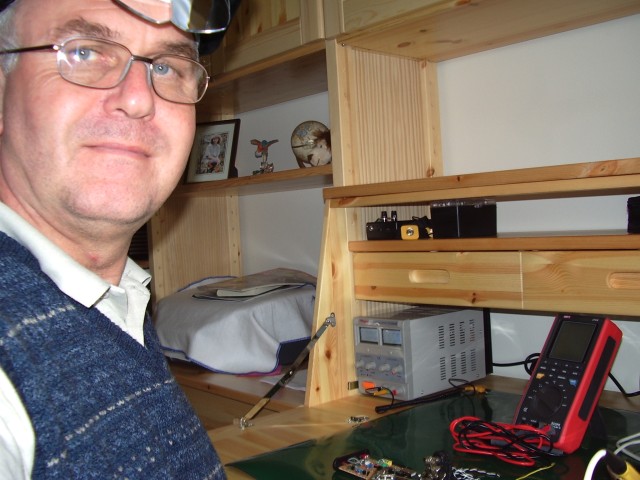
| My bureau-workshop |
I have sometimes seen comments to this blog that are disparaging towards the idea of stealth operation. I don’t for a moment accept that stealth antennas are worse than the modest wire antennas many hams in the UK who don’t have deep pockets, large gardens and amazingly tolerant neighbours use. RF doesn’t care whether an antenna is visible or not, it’s what you do to make the antenna invisible that might compromise performance and with the small gardens without trees that so many of us in the UK have, most of us have to live with compromise.
But the real test of a ham radio station is whether it allows you to pursue enough activities to maintain interest in the hobby. And based on that criterion I think G4ILO does very well. One of the best additions to the shack was to make a dedicated work area for construction in a bureau unit whose door drops down to make a work surface and which can be closed when I have done enough without having to put everything away. I have a greater interest in building stuff now that I have somewhere to do it.
In fact there are more things I would like to do, radio-wise, than I have time to do. Last weekend, for example, I would like to have tried making some contacts in the worldwide RTTY contest but of all the radio things I did that weekend, giving away some contest points was something I didn’t get around to.
Today I was trying to finish up my homebrew SignaLink USB clone, but I made the mistake of turning the K3 on and leaving JT65-HF running and I kept on being distracted by seeing CQ calls from DX stations. In between work on the interface I made contacts with YV6BFE, N8ABY, AA1CZ and KD0AGX plus a couple of Europeans, all using 25W to the attic dipole. My signals were spotted in Japan and far eastern Russia, though I didn’t hear anyone that far east. DU1GM, whom I worked a few days ago, was calling for most of the afternoon with no takers.
The SignaLink USB clone is just about finished and does work. After I made up an interface cable between it and the FT-817ND I made one solid PSK31 contact with F5TTI on 30m with it on the test bench. So now it just has to be put into its case and it will be completed.

Ham kits business models
Recent posts on this blog mentioning the Chinese DIY scene and the explosion of offerings have prompted a very interesting exchange of views and reflections on how best to nurture this business and make it accessible to the global ham market.
Most recently Sivan Toledo has posted thoughtful comments drawing possible inspiration for the emergent Chinese DIY industry from successful amateur kit operations like Tony Parks’ Softrock. And the secret appears to be finding the right balance between the great product and crowdsourcing the support and handholding that is as much part of the product and building experience as the device itself.
Elecraft clearly enjoy the best in solid detailed step-by-step documentation (reminiscent of Heathkit) and they have the added advantage of an amazing online community dedicated to solving any problems, assisted by the designers and principals of the company. Part of the success of their online presence is a well moderated space and volunteer heroes like Don Wilhelm W3FPR who don’t appear to need sleep!
Doug Hendricks’ QRP Kits shows you can fill a niche and still keep your day job. While many of Doug’s star attractions are designed by Steve Weber KD1JV, Steve has his own website which I visit frequently to see whether a new batch of ATS-4 Miniature 5 band CW / digital mode HF transceivers are available or not, knowing they’ll probably sell out in a matter of hours. Users of this and its predecessors rave about them. Steve WG0AT took an ATS3 on his latest adventure with Rooster and Peanut.
Dave Benson, K1SWL’s Small Wonder Labs also offers quality kits at really good prices and a very efficient service. (My SW-40+ arrived in Sydney in record time.) Hunt around his site for a minute and you’ll discover how how the SWLabs fit into his lifestyle on 4+ acres near Newport “(we get a lot of winter here)” NH.
K1SWL’s approach to support includes email – “If you run into trouble during alignment and test, I’ll guide you through the troubleshoot process as far as we can get by e-mail. If that doesn’t do the trick, my repair person offers prompt and reasonably-priced service- he’ll troubleshoot and repair the unit and let you know what he found.” And you have a fair sense of what Dave means by ‘reasonable’.
It’s not unlike the successful formula for a restaurant or café – to offer the number of dishes it can do consistently well rather than attempt to cater to everyone’s tastes.
Tony Parks KB9YIG seems to have achieved production numbers of SoftRock kits that would appeal to any business backer, even if they are only made available in batches of 20 or so depending on availability of components and time. The very reasonable prices charged – including international shipping – play a part in this success by attracting a broad base of committed supporters keen to share experiences and grow the platform and everyone’s skills.
And today I noticed Julian G4ILO wrote about a range of kits from Fox Delta Amateur Radio Projects and Kits in India. They have the advantage over Chinese offerings of the English language and they accept PayPal. The range of kits on offer is impressive. Julian had ordered a APRS Tracker Module.
And of course Australia has its own GenesisRadio with its amazing line of SDR Kits such as the G59.
What an amazingly exciting time to be involved in ham radio!
Speaking of global reach, a prominent link currently on eHam.net has helped boost traffic to this site as well! (Welcome to all new visitors to the blog! I hope you find something interesting here.)