Archive for the ‘Uncategorized’ Category
 New dual-band mobile from Wouxun?
 October 7th, 2010 |
  Author:
 Ham radio forums have been alive with buzz in recent days about the pending release of the KG-UV920R, a new dual-band 2m/440 mobile radio from Wouxun. Ed Griffin from Wouxun.US is in China until October 25th and was not available for comment, but a photo of the radio appears on his website. An anonymous but reliable source said that the radio is not yet in production, but that it could be available by early 2011 pending FCC certification.
How much will it cost? The same reliable source did not have a firm answer but expected the price to be less than $300. They also said that they expected a 2m/220 version in addition to the 2m/440 version. When you start looking through the feature set (remote front panel, cross-band repeat), that’s quite a bit less than a comparable radio from other manufacturers. Obviously, a lot can change between now and the final production release. The specs and price could very well change significantly. Hopefully Ed will stop by soon and provide us with some more information.
What do you think of Wouxun’s apparent entry into the mobile radio market? Will you buy one?
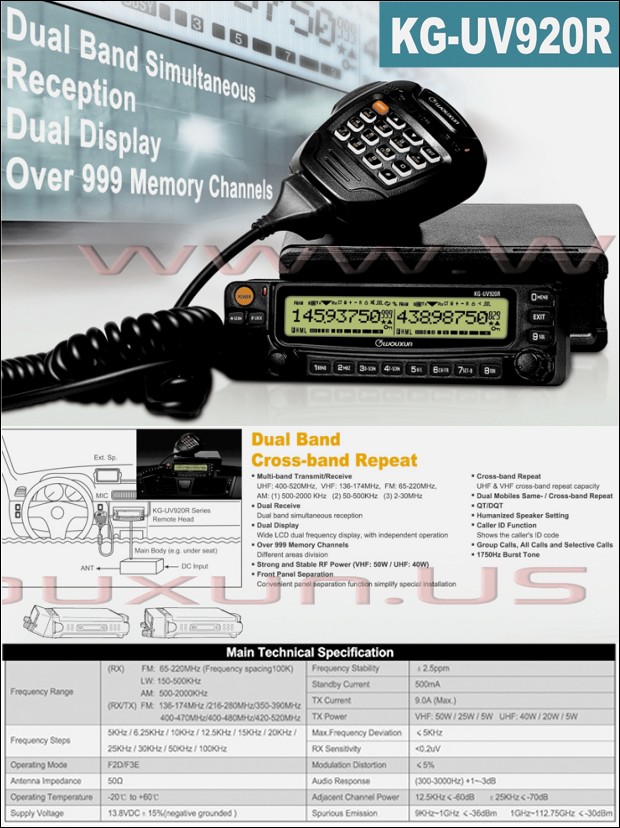 (Images above from Wouxun.US and re-formatted for viewing)
No more sunspots after 2016?
I have just updated the smoothed sunspot number data file for VOAProp with the latest predicted values up to the year 2020. It’s one of those jobs I still do even though I long ago lost interest in the program, having come to the conclusion that the most interesting thing about HF radio propagation is its unpredictability.
Although NOAA updates its sunspot number predictions every month, I only update the data file every few months as the changes are too insignificant to make any difference to the VOAProp output. Since the last time I updated the file NOAA scientists seem to think that the maximum of the next cycle will occur a little later and be a tad higher than previously predicted, with a maximum SSN of 84.6 in the middle of 2013. They also don’t expect the next minimum at the end of 2019 to be as low as the last one.
This view is not shared by solar astronomers Matthew Penn and William Livingston of the National Solar Observatory in Arizona. They have been studying the magnetic strength of sunspots since 1990 and have observed that in that time it has fallen by nearly a third. If the trend continues, the astronomers believe, then by 2016 it will have fallen to the level below which the formation of sunspots is believed to be impossible. Though this prediction seems far fetched, it becomes a little more believable when writing about it on a day when there are once again no sunspots.
A period with almost no sunspots has occurred before, and not so long ago either, between 1645 and 1715, known as the Maunder Minimum. This period was also known as the Little Ice Age due to the fact that lower than average temperatures occurred in Europe. Time to sell our radios and invest in heating appliances, perhaps?
If nothing else, this example should show us that healthy scepticism, not credulity, is the sensible response to any scientific prediction. If you don’t care for what one bunch of boffins say, don’t worry, another bunch will be along in a few months claiming to prove just the opposite. It’s about time the global warming alarmists woke up to this.

Remembering Robin Greenwood, G3LBA
Yesterday, through my friends in the Harwell Amateur Radio Society, I was very saddened to learn of the death of Robin Greenwood, G3LBA.
When Julie and I moved to Longworth around 8 years ago, we decided to attend one of the barn dances to get to know people. Julie went to pick up the tickets from a house in the village and came back saying, ‘there’s a chap who’s got a lot of stuff like yours’! At the barn dance, I met this chap, who turned out to be Robin, G3LBA (Gee Three Light Brown Ale as he put it). That was our first enjoyable meeting.
Over the years we met at many village events and always had fun! Robin was an avuncular character, always interesting to talk to. He had an interesting professional background and had worked for the European Space Agency. Stories about the International Space Station were often heard in the Village Hall!
On the air, I think we had about two contacts in 8 years! Being around 500 yards apart we were quite loud with each other, on both HF and VHF. I suspect we were active at different times. Robin had done a lot of work with the local repeater groups and several local repeaters have bits of Robin’s work in their configuration.
I last saw Robin about three weeks ago at the village fete. He’d been suffering from thyroid cancer and was very clearly not well. He had hopes of seeing his next grandchild born early next year, but very sadly that was not to be.
Robin joked that I would soon have the airwaves in the village to myself. Frankly, I like a bit of company. Farewell friend.
See the Harwell tribute to Robin here

Home-brew USB digimodes interface
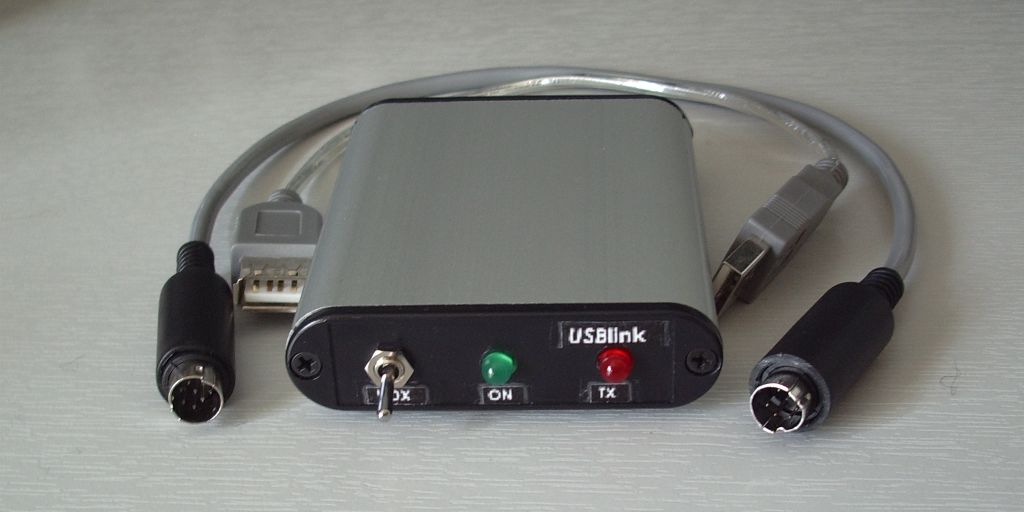
My home made USB digital modes interface “SignaLink clone” has been completed. It has been in use for several days and is currently in use with my K2 for 30m APRS.
 |
| USBlink interface with cables for FT-817 |
I have written up the project on the G4ILO’s Shack website. See home-brew USB digital modes interface.

Ham Radio’s Lost Future
There was a time when developments in the realm of amateur radio were relevant in relation to the rest of the world. In those days, a young man might become interested in the technology of radio and his first steps in that venture may have been as a radio amateur. Through building and experimentation this neophyte might eventually make a living as a radio and TV repairman, or find work as an electronics technician. He might even follow a path to becoming an electronics engineer developing new methods and hardware for commercial or military communication.
There was a thread of commonality between his hobby and his vocation. Radio amateurs were on the leading edge of discovery and experimentation and these developments were closely mirrored in the non-amateur world. In fact, what this fellow was doing on the workbench in his ham shack was often a step or two ahead of what he did for his employer.
But at some point in the flow of space and time, amateur radio reached a critical crossroad. It could proceed one direction into the future or choose the other direction – a long, and circuitous route back to the past.
For good or for bad, we chose to jettison the future and return to the past.
Consider carefully the position of amateur radio just prior to this crossroad. We had pioneered FM radio at VHF and UHF and had blanketed the countryside with repeaters such that an operator with a handheld radio could make contact with others far outside his line of site. We had already worked out the protocols and network topology necessary for passing data through the ether at rates comparable to landline methods of the age. And we had our own fleet of satellites that pioneered new methods in space communication as well as low-cost spacecraft construction and launch.
Future developments in the non-amateur world of radio from that point included cellular technology and the transmission of higher speed data over the air. Commercial applications for broadcast radio and television have changed radically and now include the imposition of digital methods. Military applications for secure battlefield communication use satellite and terrestrial means like mesh networking for voice and data transmission. Our homes, restaurants and coffee shops are bathed in RF transmitted data that keep our mobile devices connected to the Internet.
None of these “new” technologies would have been even the least bit foreign to the radio amateur had we taken the path to the future. Youngsters would have been encouraged to become involved in our hobby as it could very well lead to a rewarding career in one of many growing and lucrative technical fields – just like in the earlier days.
The most important point I want to make is this: technology didn’t pass amateur radio by because we weren’t intelligent enough to have adapted to the rapid changes it produced, we could have lead that revolution, ham radio enthusiasts were the proto-geeks on this planet.
No, technology didn’t abandon us, rather, we voluntarily chose a path that led back to the past and in so doing, watched the future march ahead without us.
My guess is that we chose this path because the future involved changes that seriously challenged the old dogmas. The old guy who could pound brass would be dimininshed in the new world while the young kid with the computer connected to his radio would be raised up and this was deemed unacceptable.
Of course there remain some facets of our hobby where higher tech methods are required. For instance, it would be difficult to argue that bouncing a radio signal off the moon and then receiving the echo from it isn’t one of the more challenging things that hams do. But consider how many amateurs are active in that pursuit and you must conclude that it’s a small fraction of even one percent of all licensees. Why? Probably because of the degree of technical difficulty required for success. It’s much easier, trivial in fact, to toss a wire over a tree limb and make a 40 meter CW contact; so more choose to do that instead.
Low-power enthusiasts, (QRP) have spent decades trying to make the point that HF communication is possible with practically nothing at all. That you or I could whip up a two-transistor transceiver in a single evening and make radio contacts with it is widely seen as the magic of radio among those in this camp, however, it really only serves to make the point that they have embraced the simplest, lowest elements of RF technology and have no intention of moving beyond it.
In selecting the path to the past, we also decided that the entertainment value of amateur radio was more important than the rapidly expanding field of communication technology.
Consider the many ways that we have made two-way radio a game. We chase DX until all of the countries of the world have been worked and then we invent new ones. Weekends are dedicated to non-stop operation with the goal being to earn the most points. We make radio contact with others and then trade post cards to prove that we actually did it. Certificates (wallpaper) of all kinds are offered for contact with specific stations or during specific events, etc.
The lingua franca of amateur radio is the Morse code and those who are proficient in CW are more valued than those who are not. Like Latin, it’s a dead language that is non-essential yet it serves as a powerful totem for an entire belief system internal to amateur radio and nothing else under the sun.
In selecting the path to the past, the hobby has determined that nostalgia is more important than innovation and therefore we must now depend upon nostalgia to drive future growth; this is a critical point.
The United States has a population with a soon coming glut (baby boomers) of new retirees. Folks like me who enjoy looking at the past as much or more than looking ahead. This is a ready-built market for nostalgic growth and we should anticipate that those who enjoy reading about the radio distress call from the Titanic, restoring old radios or building new equipment with vacuum tubes, etc. will swell our numbers for a season. It’s completely unsustainable over the longer-term, but it is here and now and it will contribute to some additional growth for the hobby.
Though ham radio is a delightful and enjoyable hobby, we are forced to own up to the consequences of the decision that was made not so long ago. Ham radio has become like an old trading post on a lonely stretch of Route 66 somewhere in the desert. You stop to admire the wooden Indian, the old time gas pumps and the soda machines. You snap a few pictures, buy a few trinkets for your niece and nephew and spend a moment warmly remembering what the Old West was like long ago.
And then you get into your car and return to the real world.
None of this will diminish the enjoyment that enthusiasts can derive from this unique hobby. There are people in the world who enjoy building old steam engines, restoring antique cars, and making butter by hand. Technology doesn’t always improve the quality of life and it has many unintended consequences. But reality demands that we acknowledge our proper place in the grand scheme of things, and when it comes to amateur radio, we are no longer of the same ilk as those who innovate and invent. It’s been decades since we last put a dent in the universe and it probably best we live out our days quietly playing with our radios.
On To Something New


On To Something New
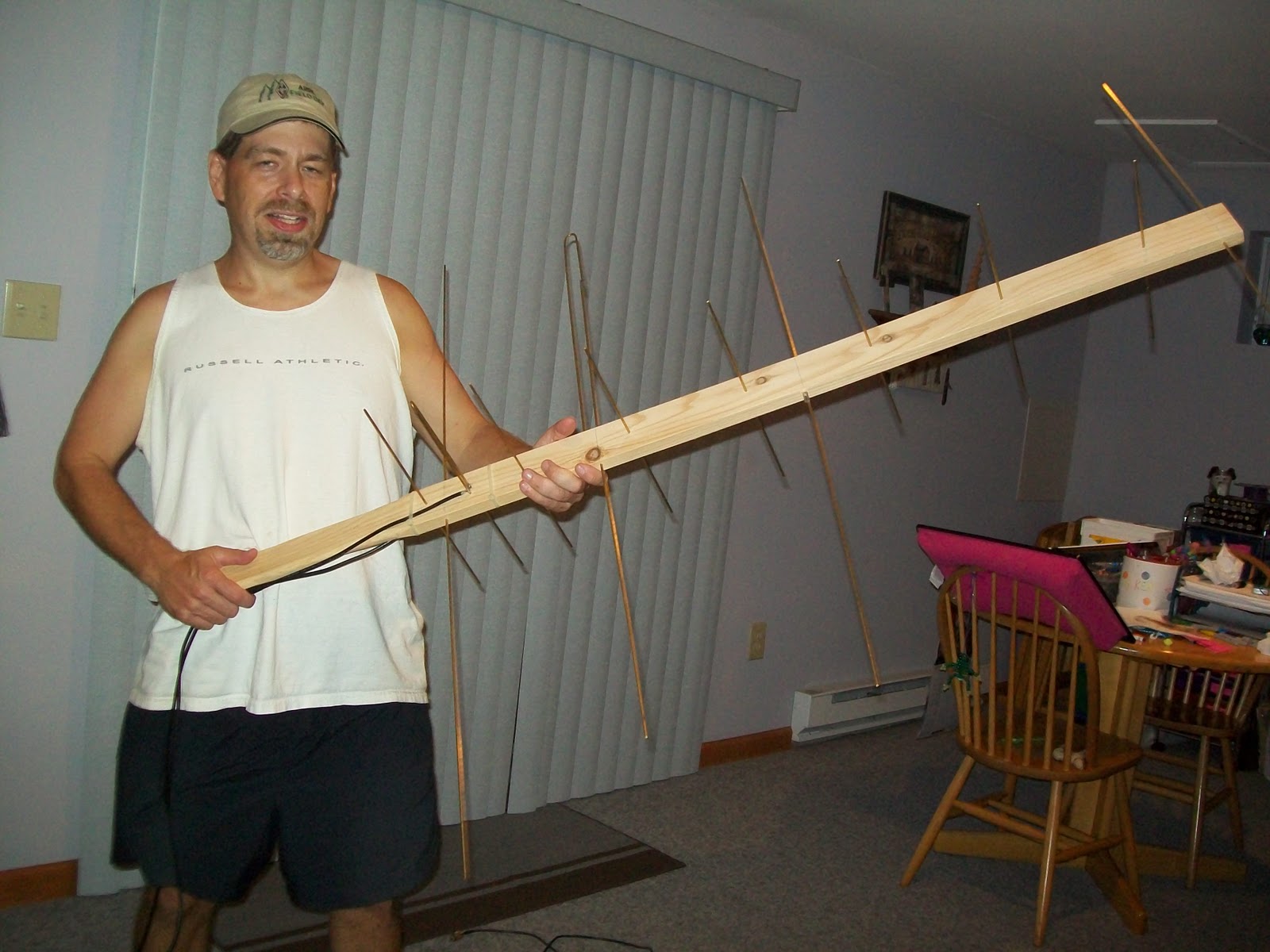
Inspired by Diana Eng, a few weeks ago I built a WA5VJB cheap dual-band yagi for 2m and 70cm. I thought I’d give satellite operation a try as nothing else is floating my boat right now in amateur radio.