Archive for the ‘Uncategorized’ Category
 Grab me a callsign
 October 13th, 2010 |
  Author:
 While I wait for a correctly programmed chip for my QRSS keyer kit I thought I would investigate the receive side of QRSS beaconing. It’s no good transmitting if nobody receives, and unlike WSPR every transmitter isn’t automatically a receiver during its off periods. This is a mode where you need to give as well as take, to receive in order to be heard, otherwise you can’t complain if no-one tells you that they heard you.
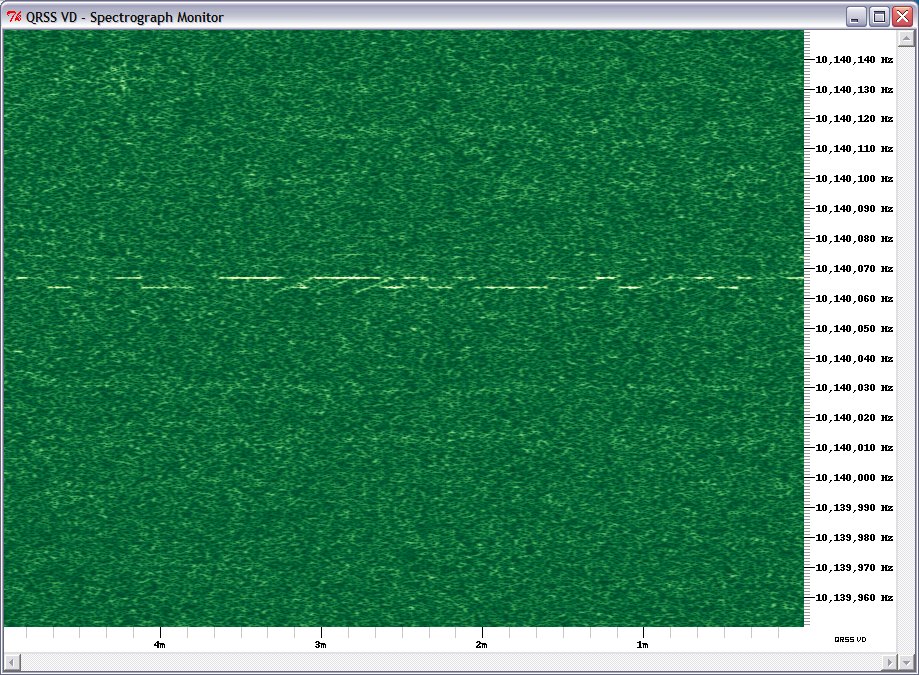
QRSS signals are decoded visually using a spectrograph, a waterfall display similar to that found in digital mode software. However, you can’t use a digimode software waterfall for two reasons: it moves too quickly – to capture a full callsign in QRSS you need to be able to see at least a couple of minutes worth of transmission – and it scrolls down vertically so trying to read calls would give you a crick in your neck!
Fortunately there are programs that have been specially written for just this application – and they are free so there is nothing to stop you trying them. The most popular program for Windows appears to be Argo. However there is alternative called QRSS VD by Scott Harden (the odd choice of name becomes clear when you realized that Scott’s call is AJ4VD.) QRSS VD has one problem: it is a CPU hog. On my fairly modern shack PC it runs at about 50% CPU utilization. For that reason, you might have no alternative but to use Argo. But if you can run QRSS VD it has some nice features that add to the enjoyment of this aspect of the hobby.
QRSS VD includes three programs: a Spectrograph, a Viewer and a Grabber. The QRSS VD Grabber automatically captures the live waterfall and creates images suitable for uploading to a website so others can see whether you are receiving their signals. It doesn’t have any way of automatically uploading the images to the web server, though. It’s really for people who want to run an online grabber, which is only worth doing if you are going to run it regularly. I don’t have enough radios and antennas to do that so I probably won’t investigate this feature further.
QRSS VD Spectrograph is the program that displays in real-time what you are receiving. It has no obvious user interface – you have to right-click the window and then you will get a menu of options. One option lets you select the sound card that is connected to your radio. Another is for setting the frequency. The main settings option determines the size of the window and the maximum and minimum frequencies that are displayed.
There is also an option to save these settings. If you don’t, you will have to set them all over again the next time you start the program. Finally there is the Resume option which you must click to start the spectrum display working.
Most QRSS activity takes place on the 30m band, in the first 100Hz above 10.140 MHz. This is just below the 200Hz used by WSPR, which is itself just below the region where PSK31 operation takes place.
To start receiving QRSS, set your receiver to USB mode and tune it to 10.139.000. If your rig has a DATA mode that is USB you can use that. Don’t be tempted to use the CW mode – most rigs add an offset to the displayed frequency so it shows the frequency in the centre of the CW filter passband, and some rigs use LSB for CW, so finding the right spot gets confusing.
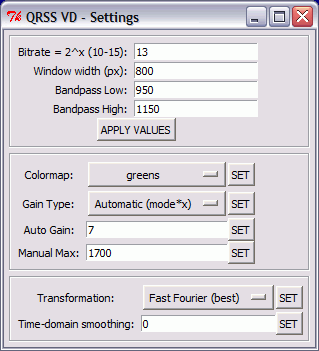
Select the sound card in QRSS VD, then set up the settings dialog. The window width in pixels can be whatever suits your screen size. The bandpass low and high settings define the height of the window, the minimum and maximum audio frequencies displayed on the spectrograph. With the radio on 10.139.000 USB, signals in the QRSS sub-band will be heard at audio frequencies of 1000 to 1100Hz. I set the low and high values to 950 and 1150Hz respectively to give a 50Hz margin on either side. (Note: if you aren’t sure of your receiver’s accurate calibration you might want to choose a wider margin initially because you could miss the QRSS band entirely of it is more than 100Hz out.) The other values on this dialog are all defaults.
[If you are interested in receiving WSPR as well, you could tune the radio to 10.138.700 and enter low and high values of 1250 and 1450Hz. Then you could run WSPR and QRSS VD on 30m simultaneously.]
Right-click the spectrograph window, click Resume and the screen should start scrolling to the left and filling with received signals. Conditions are pretty poor at the moment so there isn’t much to see on the screenshot I made, but when I first tried this program I immediately received a trace of a signal from Steve, G0XAR who coincidentally is the producer, together with Hans G0UPL, of the QRSS beacon kit I just bought. I don’t know if he was using one of these kits but it was producing a heck of a signal. (Ignore the frequency shown, this was received using my K2 whose calibration is considerably out.)

What’s nice about the QRSS VD software is that you don’t have to watch the output in real time to capture signals and it is simple to produce nicely formatted records of signals received like the one above. Every few minutes the spectrograph dumps a bitmap file in the program’s Output folder. When you want to see what you caught you start up the QRSS VD Viewer, select a group of bitmaps to view and it will stitch them into a seamless time continuum. You can then scroll through from start to finish looking for the traces of QRSS signals.
When you find one, you can capture a region of the spectrograph by clicking to specify the top left and bottom right of the desired area. You can even specify a custom caption. The selected area is then copied to the Windows clipboard and pasted into your default bitmap viewer ready for you to save in a format of your choosing (for example, as a JPG file.)
Why would you want to do this? As I mentioned at the beginning, there is no way of finding out how far your signals got (apart from a handful of online grabbers) unless someone sends you a signal report, so if you receive someone’s beacon you should send them a report too. The only way to do this is to look up their email address at qrz.com and send them an email. A picture is worth a thousand words, so it’s nice to be able to send a screen grab of their actual signal as an attachment to the email.

If my initial experience is anything to go by, this personalized way of sending signal reports makes for a very friendly aspect to the hobby. I sent this capture (above) of a beacon from IQ2DP with an emailed report. This morning I received a nice reply from Teo I2RIT thanking me for the report and telling me all about the beacon, which is made from junk box parts and runs well under 100mW into a ground plane made of scrap aluminium tubing. He also sent a link to an article about it. The article is in Italian but here is a translation. If you’ve read this far then you will probably find it interesting. Yet another facet to our amazingly varied radio hobby.

Getting old
After breakfast this morning I went up to the shack as usual. I switched on the computer, switched on the main power supply and switched on the Kenwood TM-D710. When Windows came up I started my VHF instance of APRSIS32 for my local APRS gateway. Then I switched on my K2 to start the HF gateway. The LCD showed the usual “Elecraft” but then the segments went crazy and the radio emitted a noise that can best be described as an endless fart.
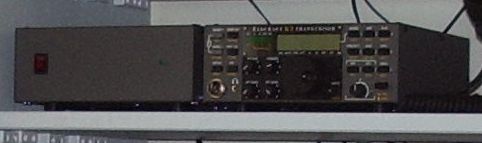
I switched off. Then I realized that I had forgotten to switch on the K2’s power supply. I switched it on, then I switched the radio on again and this time it started up normally. Phew! Then my fuddled brain worked out that this must mean the K2’s internal SLA battery has finally given up the ghost.
I built my K2 in 1999. Originally only the basic radio was available as a CW-only kit. Other options were soon added including the KSB2 module for SSB, the internal ATU and an internal battery pack. I added these options as soon as they were available, which must have been around the end of 1999 or early 2000, so the battery must be around ten years old.
As it happened I have rarely used my K2 portable so I have made little use of the battery pack. I used the radio in the field once earlier this year. The previous occasion on which I ran the K2 from the battery was during the floods a year ago when the power went off for several hours and I was able to experience what the bands were like without all the local QRN. Ten years is a very good life for an SLA battery and I wondered when it would fail, but I hated to throw it out while it was still doing its job. It seems that time had finally come.
I removed the top cover from the K2, disconnected the cables and lifted it off. Then I undid the screws securing the aluminium bracket that holds the battery in place. I noticed a small patch of corrosion in the area adjacent to one of the terminals, and when I removed the battery I noticed a drop of liquid in the same place. The battery had started to leak. I had got to it just in time. If my fuzzy-headedness hadn’t caused me to turn on the K2 without the power supply I might never have noticed the problem until it was too late and some of this electrolyte had dripped into the radio itself!
I’m not sure whether to replace the battery pack or not. In the meantime I thought I would put the battery bracket back and tape the battery cables to it, then put the top back on the K2 and get my HF gateway back on the air.
But it isn’t just the K2 that is getting old. I am, too, and I hate it. I’ve never had particularly good co-ordination but it seems to be getting worse. I can’t use a Morse paddle now and I can’t send faster than 12wpm with a straight key. Sometimes I have days where I’m even more clumsy than usual and my hands shake too much to do any constructional work. In that state it’s impossible to hold nuts and washers in hard to access positions while you turn a screw from the other side. I’m having one of those days today and I found that I couldn’t put the battery cover back. So I’ve put the K2 in a drawer until a day when I’m feeling sharper. Hopefully I’ll be able to give it a realignment at the same time, something else it probably needs after ten years. Until that time I will be off the air on HF APRS.

VHF Tropo still going well
Most of yesterday evening was spent very enjoyably, getting to know our new cats – they are real stars! However, just before bed, I did pop into the shack to see what was happening.
OP7V from Belgium was very loud on 432.200 and I enjoyed a QSO with him. By the time I listened, 432MHz was quieter, so I switched over to 144MHz was was pleased to find DK3EE (JO41) coming through at great strength – so had a nice quick QSO with him and also DF0WD (JO42) who I also worked quickly.
Swapped e-mails with Allan, GM4ZUK and he’d been out portable last night and worked over 300 stations on 144/432/1296 over a few hours last night. Allan’s best DX on 1296MHz was OY and SP!
(Edited this in thanks to Ralf, DK4KW for letting me know about it)
This morning conditions were still good and ON0WV was coming through at S9 on 145.650 on my drive to the station. There was a very strong repeater on 145.6375 too, with French stations QRV. I didn’t hear it ID, so it may have been the Jersey repeater, GB3GJ.

QRSS Keyer
I have operated most of the reverse beacon and weak signal modes but one that I have never tried is QRSS. “QRS” is the Morse Q code for “send slowly” so QRSS means send very slowly indeed. QRSS beacons send your call using very, very slow Morse, which listeners receive using a “grabber”, which is a slow moving waterfall display. If you’re lucky, they will email you a reception report, but you can also look for your signal yourself on one of the various online grabbers.
One day I planned to build my own QRSS beacon. When I found out that Hans Summers G0UPL had produced a QRSS beacon kit I was disappointed to learn that all the kits had been sold at the US Dayton hamfest. However I recently discovered that he had made a new batch of kits and not wanting to wait and find out they were all sold at the G-QRP Convention I ordered one at the weekend. The order process was extremely professional (amateur components suppliers who expect you to email your order and credit card details please note) and the kit arrived this morning.
I opened the envelope and was very impressed to find that the package included a printed copy of the instructions as I had expected to have to print them myself from the website. The PCB is of very high quality. But as I tipped the parts on to the workbench my heart immediately sank.
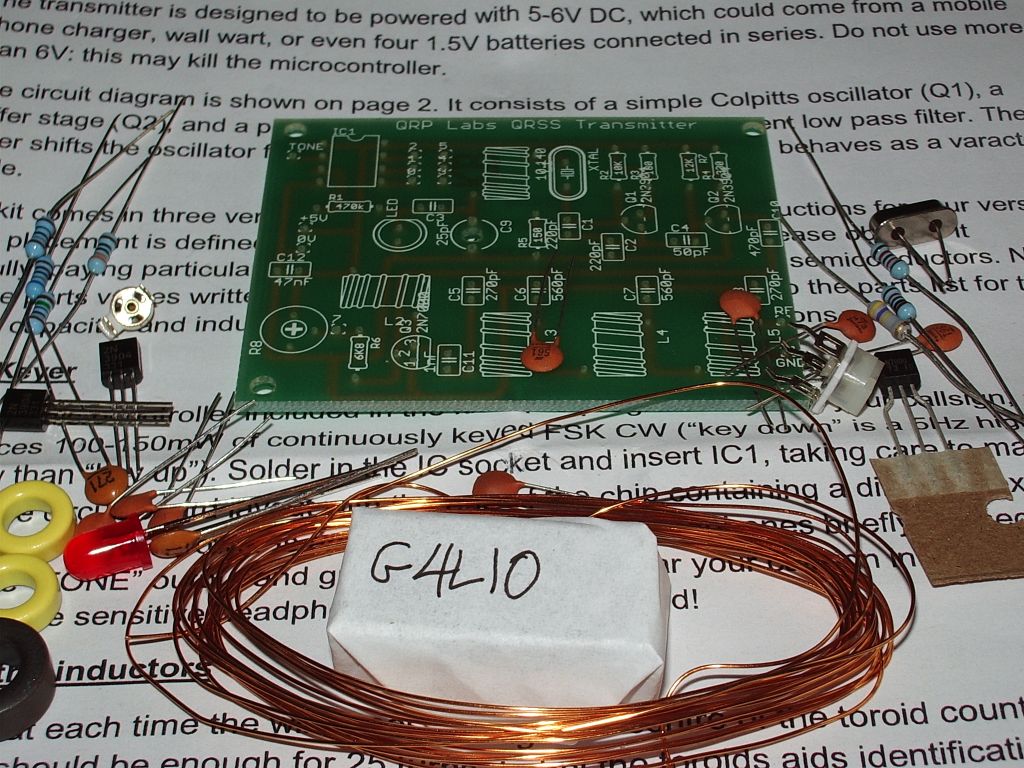
Because the microcontroller chip which keys the transmitter and has been preprogrammed with my callsign was wrapped in a slip of paper on which was written G4LIO, a transposition of my call that often afflicts people on the air as well – I don’t know why. The incorrect call was also written on the jiffy bag the kit came in. I checked the emailed copy of the order and the mistake was not mine.
After an exchange of emails with Hans I installed the chip in its socket, applied power and connected an earpiece to pin 2 which produces an audio tone to verify whether the chip had been programmed incorrectly. It sent G4LIO. 🙁 Why is it always me that gets the kits with the missing or faulty parts?

And they’re racing!
Interesting thread on the softrock40 email list about how easy it is these days to get a good sense of how well your station and the ionosphere are performing in an almost ‘hands-free’ way.
Increasingly modes like WSPR and tools like SDR have enabled us to let the radio do its thing and in a short amount of time access detailed logs of our successes – where we were heard. The softrock40ers were using this approach to compare their SDR rigs performance to other sets.
Rob KL7NA joined in the conversation. He pointed to his recent paper on what he calls ‘Robotic radio‘ that he presented to the DCC meeting in Vancouver WA recently.
Your radio is doing what the operator used to do automatically, and as you have been finding out, it is really fun to horse race different software demodulators, receivers and antennas, and radio locations this way. I am trying to promote it as a way for our youth to get into amateur radio. They seem to be very enamored by robotics.
Rob’s paper is full of interesting ideas and he lists the building blocks of Robotic radio… hardware, software and networks. He introduces his open source project CW Robot which is still in alpha and explains the thinking behind it.
This looks like a very rewarding place to play and discover – and there’s already a road map.
You know it’s autumn when the tropo starts
We’ve had a busy weekend which didn’t contain too much radio. Last week was a bit of a sad one for us; we scattered my Dad’s ashes on Monday and then on Thursday we had to say goodbye to our much-loved cat, Buttons who was 16. A cat-less house was not good for us and we were ‘directed’ to visit the animal rescue centre, run by the Blue Cross at Burford. There we met and fell in love with two new cat friends, Pippi and Max, who I am pleased to say have kindly consented to come and live with us. They moved in yesterday and needless to say, much fun and time is being spent, looking after them and trying to settle them in.
When I popped out to the garden centre yesterday, I noticed some reasonable 145MHz tropo to the east, with the GB3PO repeater in Ipswich coming in better than normal on the mobile. Just before I went to bed, I saw a tweet from G0PKT on the east coast saying that he’d been working some good DX on VHF/UHF. I stopped off in the shack on the way to bed and had a quick QSO with Juergen, DL5EBS (JO31) on 432MHz. Signals were great – also, DJ6JJ was on 432.200 working Polish stations. Interestingly, I was able to detect fragments of the signals from the Polish stations.
This morning, on the drive to work, conditions were still good. On 145.650, I heard ON0WV identify very clearly a couple of times. And during our commuter ‘net’ on GB3TD (433.075) we were surprised and delighted to be joined by John, G6HKQ from Norfolk.

2010 California QSO Party
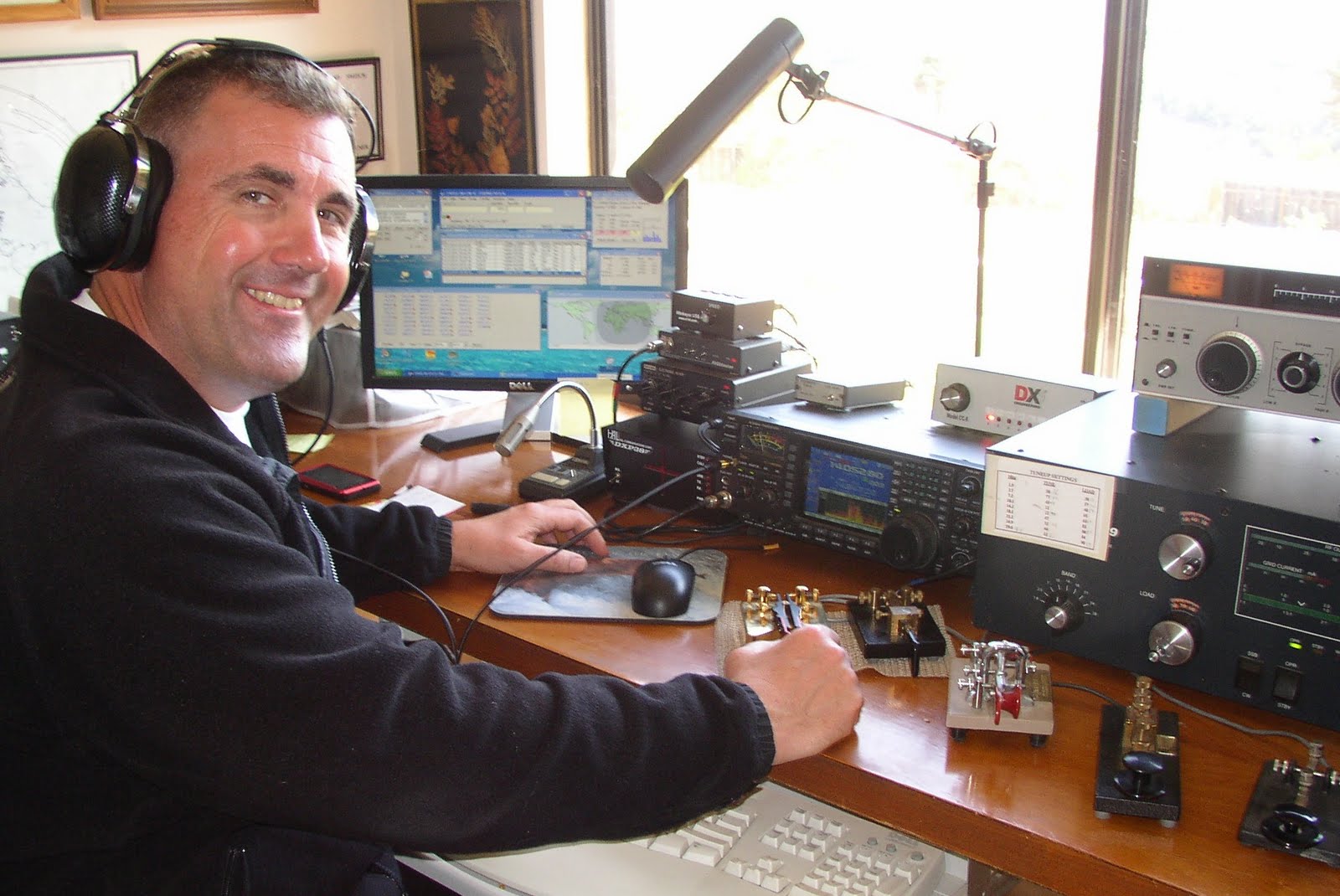 Photograph 1 taken Sunday afternoon as rate drops in half and I’m logging California counties on 20m with the yagi pointed due east.
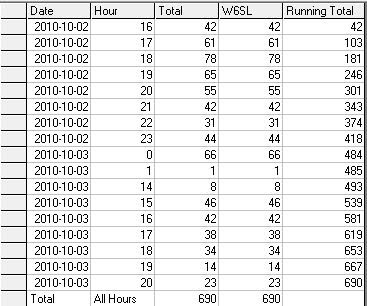 Photograph 2 illustrates my rate per hour through 17 hours of operation. What a blast operating CW through CQP weekend as 3 point Qs drove my score into six digits.
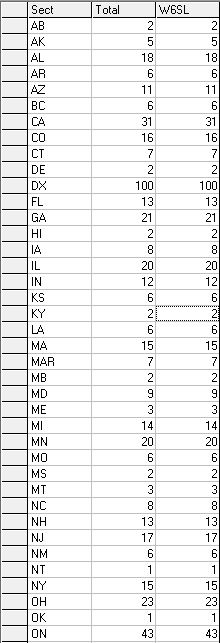 Photograph 3 is a list of sections worked and one notes band conditions were long especially on 15 and 20m however 10m never ionized over the weekend. I miss 10m activity and hope the band will finally play next year?
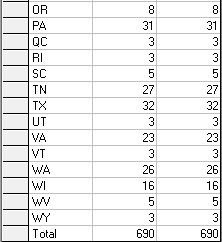 Photograph 4 is a continuation of sections worked and I did not log Nebraska, North Dakota, South Dakota, Nevada, or Utah in addition two Canadian sections as well.
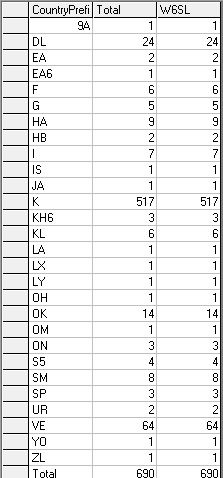 Photograph 5 breaks down my country total and each European counted as new one against my DXCC pursuit. What a joy finally hearing stations across the Atlantic on the wireless set!
California QSO Party.
Rest is important going into any RadioSport event and fatigue does not help one’s morale when butt-in-the-chair time is a priority. I was wiped out when Saturday evening rolled across the ionosphere and called it at 0100 UTC when CW signals blurred my brain. I slept 12 hours then returned to the keyer catching long skip into Europe on Sunday morning.
I recognized many stations who filled the log at the shackadelic in Shell Beach and, what a hoot, logging Dave, K2DSL and Victor, KD2HE both of whom journal their wireless activities on the Internet.
Likewise, logging Bill, N6ZFO who was booming through the ICOM wireless on Sunday morning from Lake County. A great signal from his location. I want to thank the North California Contest Club for sponsoring a stellar event. The California QSO Party is world class!
KA3DRR/6 CQP Score.
40m = 92Qs and 1 Section.
20m = 376 Qs and 25 Sections.
15m = 222 Qs and 26 Sections.
Total Qs = 690
Total Sections = 52
Total Points = 107, 640
Spirit of Ham Radio.
Likewise John, W6SL is a stellar example when speaking about the spirit of ham radio and the friendship that follows our hobby. He opened his operating chair and put me in the pilot seat of his accomplished station. John is a 5 band DXCC operator with 300 plus entities to his credit. He is one who patiently waits for a new country recently logging Andorra not an easy feat from the west coast given the mountainous terrain surrounding this country.
The spirit of ham radio moves through the ether in mysterious ways. I was speaking with Dick Norton, N6AA about moving to the next level in RadioSport during an annual swap fest in Santa Maria, California. He mentioned guest operating just as W6SL walked within range of our conversation. John asked about my guest operating interest and invited me over without hesitation.
I enjoyed operating a wireless set using an amplifier and competitive grade antenna systems through last weekend because of John, W6SL.
Conclusion.
Rest is important going into an event. RadioSport is fun and reasonably defined goals make a difference in the operating chair. I logged new countries, grid squares, and counties through last weekend while learning about propagation using competitive grade antennas.
The spirit of ham radio endures through men like John, W6SL, Bill, N6ZFO, and organizations like the Northern California Contest Club.
73 from the shackadelic.














