Archive for the ‘Uncategorized’ Category
 Let’s Not Go There
 October 18th, 2010 |
  Author:
 The weekend before last while operating the Pennsylvania QSO Party, I noticed spots on the DX cluster for the “South Dakota Tea Party“. At first I thought it was a joke, but Googling I found this contest announcement on the ‘zed. The contest organizer claims that this contest has “an emphasis limited government and there are no rules.” Extra points are offered for things like having a valid concealed weapons permit, a hunting license, or fishing license. I’m not sure how this relates to limited government as all of these are issued by government agencies, as are amateur radio licenses. (Several of the posts in this announcement thread have disappeared; I’m not sure why.)
For those in amateur radio blogademia outside of K/W/N land, the tea party in the United States is a political movement that has sprung up since the current president took office. The tea party started out as a supposedly independent grassroots movement, but has clearly emerged as a right wing conservative Republican organization funded by commercial interests. You can see footage of them here and here protesting taxes and healthcare reform. Google “tea party signs” and make your own judgement.
While it appears this QSO party is the creation of a handful of amateurs and is somewhat an informal thrown-together event, and albeit on that armpit of an amateur radio forum known as QRZ, this is the first time I’m aware of an operating event with a political theme. As if it wasn’t enough to have non-stop right wing politics in 80 meter roundtables and on amateur radio forums, now we’re luring people into working stations in a somewhat rare state under the semblance of a political movement and agenda. It’s distasteful and not in the spirit of amateur radio.
Having politically-oriented operating events could open the door to a whole new realm of contests and special event stations, both conservative and liberal oriented that would offend just about everyone. Can you imagine having operating events such as the Obama Re-election Party or the Sarah Palin QRO Sprint? How about the National Rifle Association Worked All Free States Award or the QRP Pro-Choice Contest? And while we’re bringing politics into amateur radio, why not religion? How about a Mosques On The Air weekend, or a Westboro Baptist Church Koran Burning special events station? I could go on and on, but I think you get the idea. We don’t want to start an arms race of political and religious on-the-air events in amateur radio.
This may come as a surprise, but I did participate in the South Dakota tea party event. I made no contacts, but since there are no rules I awarded myself 10 billion points and I made a clean sweep of all counties in South Dakota. Such is life without rules. Perhaps next year I’ll actually get on the air, but make up my own callsign in the spirit of limited government and regulation, and political inanity….


All roads leading to Software Defined Radio (SDR)
Before I tell you about the weekend and SDR – I want to do a shameless plug. My lovely wife, Julie is very talented in many dimensions. She’s just set up an online shop on ETSY where you can see some of the beautiful craft items that she makes and perhaps buy them too! Do have a look there – with Christmas coming up, you might find a nice gift for someone special.
Anyway. Back to Software Defined Radio. It’s funny how sometimes you can’t escape a particular topic! On Saturday, the latest Practical Wireless dropped through the door. Naturally I checked the VHF column had come out ok (it had, thanks Rob and the team!) and then started to look through the other examples. I was particularly interested in the review of the FlexRadio 1500 QRP SDR transceiver by Phil, G3XBZ.
What a fascinating looking little box that you plug an aerial and a morse key into, connect the USB to your computer and control the rig and all the filtering from within the computer. Phil had obviously had a good time with the rig and had made some nice CW and SSB QSOs with it. Ideal too, I should think for data modes. Very tempting. I don’t need another rig or anything like that. But if I did….
The next ‘nudge’ towards SDR came from an interesting posting via the Southgate club’s blog about the AMSAT-UK FuncubeDongle. This is a dongle, which takes antenna input via an SMA adapter and plugs into your USB port. It forms a VHF/UHF/SHF receiver, obviously aimed at the satellite market which operates between around 64 to 1700MHz. You can use it with any of the current raft of SDR control programs and thus decode all sorts of modes.
Interestingly, there will be two versions of the dongle – a basic one aimed at the educational/schools market – to allow them to listen / decode transmissions from the Funcube satellite and a ‘Pro’ one with a little more flexibility. The feature set of the basic and Pro models isn’t entirely clear at the moment. This looks a brilliant project. Pricing for the ‘Pro’ model looks to be around £100. A 64-1700MHz receiver for £100. That sounds worth keeping an eye on, doesn’t it!
See the FuncubeDongle site here. But before you do, go and see Julie’s ETSY shop and tell her I sent you 🙂

On the air!
My QRSS beacon is now on the air, running 50mW into my MFJ magnetic loop in the attic. It is showing up very well right now on the grabber of PA0TAB.

I also saw it less strongly on the grabber of I2NDT, but I forgot to grab the image before it faded into QSB.

Reception reports will be most welcome to:

Benoît Mandelbrot 1924-2010

Benoît Mandelbrot (courtesy of Rama via Wikimedia Commons)
It was sad to read late last night that Benoît Mandelbrot had just died. He was an outstanding mathematician and the individual that coined the term ‘fractal’. Obituaries can be found at the New York Times and the BBC.

A closer look into a Mandelbrot set. (Courtesy of Dr. Wolfgang Beyer and reproduced from Wikimedia Commons).
Beside the fractal he is perhaps most famous for the Mandlebrot Set (see an image above), which of course has fractal geometry. As a grad student, in the late ’80s and early ’90s, myself and a few others would run our computers in our spare time to generate Mandlebrot sets and we would zoom in and explore different regions. This was outside our main research work but these images were so beautiful it was fun to explore the set by mathematically zooming in to different regions. Professionally I still work in nonlinear science and I was sad to hear of the passing of Mandlebrot. His legacy to our understanding of the natural world and nonlinear science is considerable. Here is a clip of a BBC documentary that explains some of what he helped us understand.
Here is the man himself talking earlier this year at a TED talk.

If you are wondering if there is a connection to amateur radio. Well besides a better understanding of our natural world, Mandelbrot’s work gave us fractal antennas.

Fractal antenna (from a patent via Wikimedia Commons)


QRSS reception report

QRSS reception by ON5SL in Belgium
I received a reception report today via the KnightsQRSS e-mail list. Pierre, ON5SL, received my QRSS signal last night in Belgium along with the signals from WB3ANQ and W4HBK, as shown above. My signal is running QRSS3, that is a 3 second dit, and is the bottom trace.
My set-up was the homebrew transmitter putting out 160mW into the homebrew Z-match and an 88′ doublet (again homebrew). Helping match the short coax feed to the outside of the house to the doublet’s ladderline is an Elecraft BL2 balun.
Thanks goes to Pierre for the reception report. This is not the first time he has sent reception report, he sent me one in April and also one in March 2009. I am sure I speak for all who run such beacons that we all welcome and appreciate reception reports of our signals.


Bricked chip
Last night I received an email from Steve G0XAR to let me know that a replacement chip for the QRSS beacon had been programmed but not posted yet as he had been ill with a bad cold. However my impatience had got the better of me and I started wondering whether I could reprogram the chip myself. Perhaps this was the opportunity I needed to start playing with microcontrollers? The source code was on Hans G0UPL’s website, the development tools were all free. All I would need is a programmer, and I was sure I had seen circuits for microcontroller programmers knocked up from junk box parts on the web.
A bit of searching revealed that simple programmers for the AVR ATtiny13 chip can easily be made, such as this one built by Alan, VK2ZAY, but they require a parallel port, an antique piece of hardware that went out of use around the time Bill Gates made his first billion and is now as obsolete as the USB port will one day surely be.
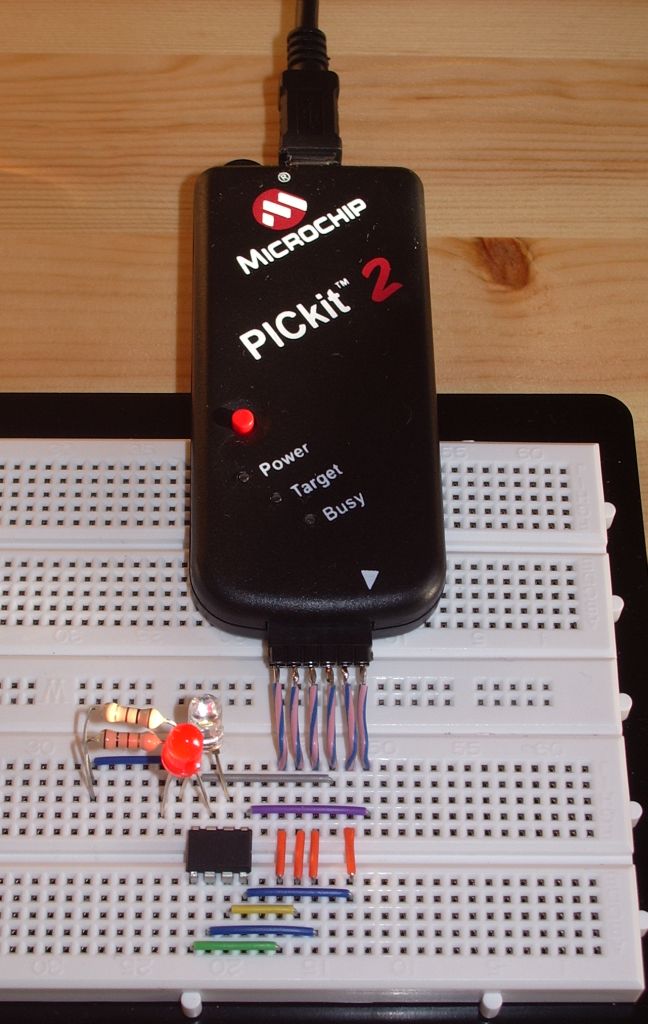
However I also came across an article that described how to program AVR microcontrollers using a Microchip PICkit2 programmer. A couple of years ago I obtained a PICkit2 because it was being offered in an electronics magazine for just the cost of the postage. Apart from running a couple of demo programs I had never done anything with it. What more of an excuse did I need?
In less than an hour I had downloaded and installed the AVR Studio software, WinAVR which was also needed, PK2AVRISP (the program which makes the PICkit2 look like an AVRISP or STK500 programmer), soldered six short leads to a 6-way header to attach to the PICkit2 and wired up the connections to the chip on my solderless breadboard. I already had a pair of virtual serial ports set up on the shack PC to use with the TrueTTY packet TNC so I was good to go.
PK2AVRISP detected my PICkit2 and I assigned it to one of the pair of virtual serial ports. The QRSS keyer program compiled in a couple of seconds and I was ready to program the chip. I selected the AVRISP programmer on the other end of the virtual serial port pair. The programmer read the signature from the chip and reported it was correct – an encouraging sign. Then I wrote the hex code into the flash memory. The write appeared to work but the verification failed with “WARNING: FLASH byte address 0×0006 is 0xFF (should be 0xCF).”
I searched forums for solutions to this error and tried various suggestions such as reducing the SPI clock speed or trying the STK500 option but I could not get past this error. One person claimed that he had somehow managed to program the chip despite the error so I put it back in the QRSS keyer, but now I just got a steady carrier with no keying at all. Oh dear!
I tried programming the code again this time using the avrdude command line programming software which is included with WinAVR but can’t be run directly from AVR Studio. This appeared to work, no error was displayed when the code was verified, but the chip still did not work when put back in the keyer.
To avoid moving the chip back and forth to test it after each programming attempt I tried programming a simple LED flasher into it so I could test it on the breadboard (hence the LEDs in the photo.) This works fine if I simply ignore the flash verification error. So the chip isn’t bricked. But why the keyer program doesn’t work is a mystery. I assume it should flash the LED on pin 3 in time with the keying, but it doesn’t.
Obviously a new chip will get the QRSS keyer working again but having spent all this time on trying to do it myself I would like to know why I couldn’t. Usually when something doesn’t work it is because I have made a stupid error, but I can’t see what I have done wrong. It’s so frustrating.

QRSS shows 30m propagation conditions

W4HBK Grabber 15th Oct 2010
After reading about Julian’s QRSS activities I decided to put my 30m QRSS beacon back on the air which has had a break for a few months. This morning I checked W4HBK’s grabber and was pleased to see my signal getting into Pensacola, FL (see 10140020Hz in the image above). I then checked his 4 hour scan and saw something interesting, but not too surprising.

4hrs grabber scan by W4HBK 15th Oct. 2010
The scan clearly shows my 160mW signal stopped reaching Pensacola, from Ontario, at around 00:40am local time (0540 UTC) and then was received again at just before 5am (1000UTC). The closing down of the band in the early hours of the morning is to be expected, but it is nice to see the time and duration of the closing so clearly illustrated.
A few hours later I checked again and the 4 hour scan revealed other QRSS signals joining mine about 2 hours after mine had appeared on W4HBK’s grabber.

4hr W4HBK grabber scan a few hours later (15th Oct. 2010)
The 10 minute grabber screenshot below shows the number of signals being received by W4HBK and how popular QRSS has become, after the release of kits by Hans Summers, G0UPL, and Genesis Radio.

W4HBK grabber at 1629 UTC 15th Oct 2010
Comparing that to reception in Nova Scotia recorded by Vernon’s, VE1VDM, grabber it can be seen that not all the signals were visible. My trace was clear, but my QRSS station is perhaps the closest to Vernon’s station.

VE1VDM grabber at 1617UTC. 15th OCt 2010
This nicely shows how milliwatt QRSS signals reveal propagation conditions. I was also pleased to see how stable my homebrew QRSS transmitter still is (remember the frequency shift in the keying of my signal is about 6Hz). To help reduce/eliminate thermal drift I have the oscillator surrounded by pieces of polystyrene packing.















