Archive for the ‘Uncategorized’ Category
 Curse Yaesu
 November 11th, 2010 |
  Author:
 … for making the power connector for the FT-817 a nonstandard and apparently unique size. I sacrificed the power cable of a multi-voltage wall-wart which had a set of interchangeable tips to make a cable I could use to run the ‘817 from my lab bench supply for an experiment. One of the tips looked to my eyes exactly the same as the one on the Yaesu charger, even down to having a yellow plastic insulator at the tip. But stupid me I didn’t think to check it would actually go in before severing the cable from the wall-wart and now I find that it doesn’t. So not only did the wall-wart lose its cable in vain but I now can’t do my experiement, since it would have taken longer than the ‘817’s woefully inadequate batteries would permit. Grrr!!
I can’t even find an FT-817 power cable on eBay.

QSO with G8DDY, Marconi Memorial CW and AO-51
Not had a chance to write things up since the weekend. But I had quite a varied and interesting time on the air at the weekend. Didn’t spend too much time, as is often the case, but it was proof that a few quick visits to the radio can be interesting.
First interesting contact was from the mobile, as I was driving to get some catfood on Saturday morning. I had the FT8900 scanning and as it went through GB3RD, it stopped and I heard ‘Golf Eight Delta Delta’ in a very distinctive voice and then the rig resumed scanning. I recognised the voice and went back to GB3RD. As I’d thought it was Peter, G8DDY from the Isle of Wight, who was mobile on one of the highspots of the island. I remembered Peter as being my first QSO from the Isle of Wight on both 144 and 432MHz way back in the early 1980s.
By the time I’d got the rig back on GB3RD, Peter was already in QSO, but I listened and waited for the QSO to end. It did and I called in. It was fun to speak to Peter and compare notes of operating from the island. He knew the apartments where we have stayed and how good a radio spot it is! A lovely QSO and nice to catch up again after all this time.
The first weekend of November is always the Marconi Memorial CW contest on 144MHz. Though I don’t treat it as a contest, I always tune around as it’s interesting to see what can be heard. This year was no exception and there were some nice contacts to be made. Conditions weren’t brilliant, but I was pleased to make some reasonable contacts – mostly from Continental Europe. The best DX was F8DGY in JN18. The two gotaways, at greater distance were DK0BN (JN39) heard for a reasonable period on Saturday afternoon, just above the noise and TM0W (JN36) again, heard for a good period on Saturday evening, but not QUITE strong enough to work! I did hear TM0W again briefly on Sunday, but conditions were poorer and tropo was very weak by this time (there were some good MS bursts though!).
The other experiment was to listen for the AO-51 satellite (repeater in the sky). I was inspired to do this, after seeing a tweet from Paul, 2E0BHA. I’d hoped to try and work him. However, the experiment was only partially successful in that I heard signals on the IC-E92 handheld. But despite the overhead pass, signals were weak. After the event, I discovered that the satellite had not been operating at full strength, so I shall have to try again on a more auspicious occasion.

What Kinda Radio Set You Workin’ On In That Basement?
By his description of who he talks to it must be an 80 meter phone rig. :-) If only neighbors took this much interest in radio today…

Ottawa Mini Maker Faire 2010

For readers local to my home area you may be interested in this exciting and free event in Ottawa this weekend. Full details can be found on the Artengine website. The essential details are:
Dates and times: Nov. 6th and Nov 7th, 12pm to 6pm.
Location: Arts Court 2 Daly Ave. Ottawa, ON K1N 6E2
If you are not sure what makers do or what goes on at a Maker Faire take a look at this video of the 2010 Kansas City Mini Maker Faire



Spot on
Having an interest in weak signal narrow band modes, not to mention APRS which requires you to park your receiver on a specific frequency, I have always wished that the frequency readout on my radios could be relied upon. The QRSS band, for example, is only 100Hz wide. If your dial reading is out by that much, you’ll miss it completely.
Many people try to calibrate their transceivers using WWV but that is not often a very good signal over here, and what with all the other carriers around 10MHz – many of them locally generated – you can never be sure that you have tuned to the right signal. I have wanted an accurate frequency reference for some time so a couple of weeks ago, following a comment by QRSS enthusiast Steve G0XAR, I ordered an Efratom LPRO-101 rubidium frequency standard on eBay. It arrived in about a week.
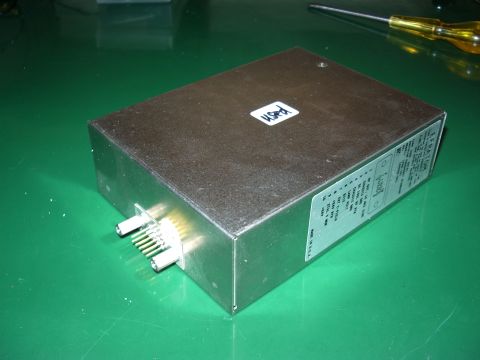
The unit I bought cost about £50 and came with a plug for the 10-pin connector and a 24V switched-mode power supply. These second hand units are widely available. New, they cost over $1,000 even in quantity. They are used in cellular base stations and are manufactured to have a maintenance-free life of ten years. To ensure reliable service the cellphone network providers take the equipment out of service before the ten years is up after which it is presumably shipped to China for reclamation. The used units should have several years of life in them, especially in occasional amateur use.
Rubidium frequency standards work by locking a crystal oscillator to the very precise frequency at which the amount of light from a rubidium lamp dips due to a phenomenon known as the hyperfine transition. A synthesizer locked to a reference oscillator is swept through this frequency until the dip is detected. The LPRO-101 includes an oven for the reference crystal, circuits to detect the dip and lock the oscillator, an output that tells you when the unit is locked, and the frequency reference output at 10MHz. The connector also provides signals that can tell you the state of health of the rubidium lamp. Once that fails you may as well scrap the unit because it can only be replaced by the manufacturer at a cost far in excess of what you paid for it.
To use the LPRO-101 you could simply attach a 24V supply and connect a cable to the 10MHz output. However, it’s useful to have a circuit that shows you when the unit is locked on frequency. I used one shown in an article by KA7OEI built up on a piece of Veroboard, which uses a dual-colour LED to light red when the reference oscillator is unlocked and green when it is locked. You can see the circuit board inside the partially assembled case.
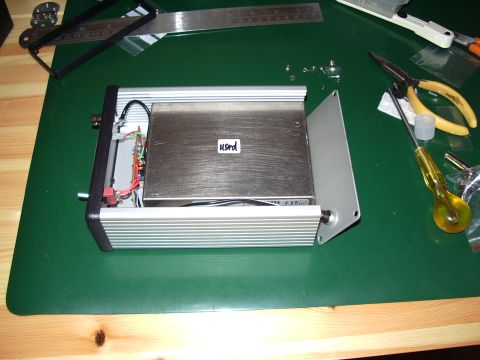
The voltage regulator and crystal oven inside the LPRO-101 generate a lot of heat so the unit is intended to be mounted on a heat sink. I purchased a Hammond extruded aluminium case to use for the project, which should provide reasonable heat sinking for the module.
One thing I learned from researching on the internet is that the LPRO-101 will run cooler when operated from its minimum recommended supply of 19V. This just so happens to be the output voltage of the power supply for an old Toshiba laptop whose screen failed so I decided to use that instead of the 24V supply that was sent by the seller.
The other thing I learned is that the rubidium lamps wear out with time. When they are made, the manufacturer ensures that they contain sufficient rubidium to achieve the stated maintenance free life of ten years, so the expected life in continuous use would be ten years less the use it has already had.
If I ran the unit all the time my rig is on – for example as an external frequency reference for a transceiver – then it is going to fail sooner or later. If I only use it for frequency calibration purposes, switching it on only when needed, then it will probably outlast me. The TCXO in my K3 is pretty stable so I should be able to obtain adequate accuracy for my purposes by manually calibrating the master oscillator using the rubidium standard and repeating this as often as necessary. How often that turns out to be, we’ll see.
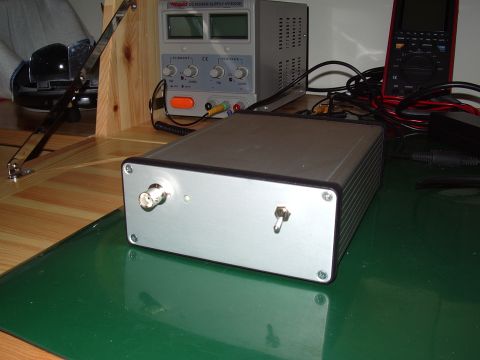
Here is the finished unit. Annoyingly, I messed up the front panel of the rather expensive Hammond case. Originally I had intended to use an SMA socket for the output but I didn’t get the holes for its two mounting screws in the right place and after filing to fit it looked unsightly. So I fitted a BNC socket instead which is what I should have done in the first place. Unfortunately you can see the two holes for the SMA mounting screws either side of the BNC socket. So my frequency standard doesn’t look quite as professional as this one built by DL2MDQ. Oh well, it’s only a piece of test equipment!

What I hear on VHF/UHF from the car
Over the last few days, I’ve been using the scan feature on the FT8900 a bit more from the car. I’m scanning particular channels, rather than the whole of the band, but it’s interesting to see what coverage I’m getting. I’ll probably add more channels to scan when I identify likely targets of semi-distant stations to listen for.
I thought it might be fun to try and put together a Google Map of what I heard this morning – I’ve colour coded the different bands.
View Heard by G4VXE this morning in a larger map
As you can see, GB3CF up in Leicestershire is probably the most distant station heard this morning. It fights it out on 145.600 with GB3WR. But I didn’t hear WR this morning and GB3CF was clearly audible just around Abingdon for a few hundred yards.

VHF Tropo forecasting using William Hepburn’s tropo pages
About a week or so, I got an e-mail from Matty, MD0MAN drawing my attention to some propagation forecasting websites. One that I hadn’t come across before, though somewhere at the back of my mind, I think I’ve heard it mentioned, is William Hepburn’s Tropospheric Ducting Forecast site.
The site allows you to select the area of the globe that you’re in – so in my case, I selected the North West Europe page but if you’re in North America, this is your map
But how well does it work? After Matty’s e-mail, I looked at the maps for the UK and NW Europe last weekend and could see that there would be a chance of some tropo to the South West towards the end of this week, from Thursday onwards.
Driving to the station this morning, with one VFO going on 145.650, there was another repeater just breaking the squelch – something not normally audible. Purely a guess, but I’ll bet it was the GB3TR repeater, to the South West of me, in Torbay.
An interesting site – I’m looking forward to keeping an eye on it. Thanks to William for some fascinating data and to Matty, MD0MAN for the tip-off.














