Archive for the ‘Uncategorized’ Category
 What do I want to achieve in amateur radio this year?
 January 3rd, 2011 |
  Author:
 At the beginning of each year I always think it’s fun to try and set some goals for the year. Sometimes I find my focus changes and I end up not doing them, but it’s always interesting to look back on
Here’s what I’m thinking of at the moment:
1 – Activity. Try to maintain my rule of calling CQ each day on one band or another and to let no CQ call go unsanswered – even if it’s just a quick hello.
2 – 70MHz. I seem to have spent more time on 70MHz than ever before in the last year. I’m currently enjoying 70MHz FM, but I hope to focus on CW/SSB during the Sporadic E season. Although the FT847 gives me some CW/SSB capability at low power and a poor receiver. I want to improve on that. It may involve a transverter driven from the FT817, or perhaps modifying the FT847. Keen to do *SOMETHING* to improve what I can hear on 70MHz.
3 – 50/144/432MHz. I’m keen to install a collinear antenna for these three bands. The intention is to erect a small mast on the house which will also support a TV antenna for the boys’ TV. On top of the mast can go a collinear for 50/144/432 MHz. I’m hoping that I can use this antenna for Sporadic E on 50MHz as well as regular FM operation on 144 and 432MHz. Currently I have no vertically polarised antenna for 144 and 432MHz and it would be useful to be able to scan the FM channels to monitor propagation more closely, as the repeater channels very often show hints of openings before there is adequate activity on SSB.
4 – 1296MHz. I’m getting more intrigued by 1296MHz and would like to get some sort of capability on the band in the year. Not sure whether this may just be simple 1296MHz FM from a handheld or something else. We’ll see. I can do so simple 1297MHz receive using a scanner, so it will be interesting to see if that yields any results.

We’ve just joined Facebook!
AmateurRadio.com is now on Facebook. Why? Who knows! The important thing is that all the cool kids are doing it….
So, if you’re on Facebook, please take a moment to “Like” our page below.
I’m curious. Are you a Facebook user? Why or why not?
Lost memory
I am a strong believer that “if it ain’t broke, don’t fix it.” I also find that, particularly if it is anything to do with computers, the law “if something can go wrong, it will” operates with near 100% certainty. As a consequence, I an extremely reluctant to upgrade or update anything unless it fixes a problem I’ve experienced or am likely to experience, or provides new functionality that I actually need. I get anxious whenever the “Windows has new updates” balloon pops up, worrying about whether my computer is going to get screwed fixing some obscure vulnerability I don’t understand in some bit of Windows I may not even use.
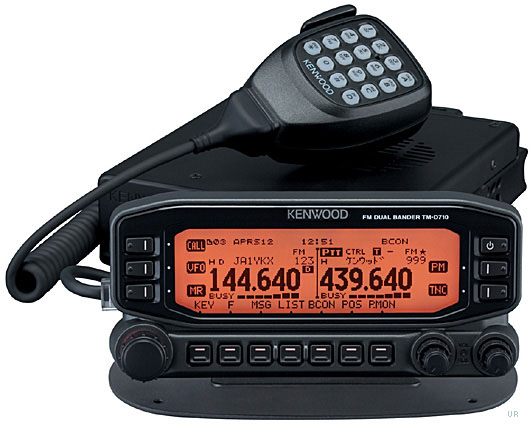
One of the problems of getting old is that you tend to forget things and sometimes I do something having forgotten that the day before I had decided there was no point in doing it. And so, this morning, I decided to update the firmware in my Kenwood TH-D710 in order that it could identify from APRS packets newer radios like the VX-8G and TH-D72, regardless of the fact that I hardly ever use the radio’s own APRS display and the update would not affect the ability of APRSIS32 to identify these radios on my PC.
I downloaded the update software, browsed the help file that came with it and then ran the program and followed the instructions it displayed. The update went without a hitch. I was a bit concerned when the concluding instruction was to perform a full reset, which I thought would erase all my settings, but I had not seen any dire warnings about this so I went ahead. Sure enough, on completion the Kenwood was now in factory default mode, with all my settings and laboriously entered memory channels lost forever! Arrghh! If only there was a System Restore for real life!
Kenwood does provide a free memory management program for the TM-D710, MCP-2A, which can be used to edit, back up and restore memories and settings. However it needs a second serial cable attached to a different port to the one used for the built-in TNC. I had never got around to making up another cable as I don’t need computer control of the radio and storing channels in memory manually isn’t that hard so I don’t usually bother with programming software. Besides, all four serial ports on the shack PC were already used. So I had never tried it.
In the hope that it would save me time re-entering the settings and memories, which I could then back up, I installed MCP-2A and moved my serial cable from the radio’s control head (the TNC port) to the PC port at the back. But no matter what I tried, the program could not communicate with the radio.
Now I’m completely stumped. I’m using the same PC serial port and cable as I used to perform the upgrade and access the TNC, so the port and serial cable work. I tried the “Auto” baud rate setting and several manual selections and it made no difference. As this is the first time I have used it, I’m wondering if the rear PC port is actually broken. Have I overlooked something stupid? Is there anything else I could try to test if it works?

UPS: Useless Pathetic Shower
What a useless courier company UPS is. I ordered something from Martin Lynch on Tuesday afternoon and was informed that it had been shipped an hour later by UPS. At 7.45 on Wednesday morning the UPS tracking site showed the package had arrived in the depot at Carlisle and was marked as in transit for delivery that day. I waited in all day and nothing arrived. Later that evening I checked the site again and found the message at 6.45pm: THE PACKAGE WAS MISSED AT THE UPS FACILITY, UPS WILL DELIVER ON THE NEXT BUSINESS DAY / DELIVERY RESCHEDULE. The delivery date was changed to today (Thursday.)
So I waited in all day today and still no UPS man. Again I checked the UPS tracking site this evening and the same message had been added, this time at 7.48pm. The delivery date is now rescheduled for tomorrow (Friday.)
We have had poor weather conditions and the roads have been icy but FedEx called as usual around lunch time to the neighbour across the road who has a regular delivery. And Interlink Direct called to pick up two packages of items I’d sold on eBay the shipment of which I’d arranged online yesterday. (Tip: use the code XMAS10 to get £5 off a delivery before Christmas.) So I don’t think that’s a valid excuse, really.
I wonder what the chances are that I will actually receive my new toy tomorrow? I just hope that when it does arrive I don’t find they have lived up to the other meaning of their acronym: United Package Smashers.

More real radio and Cyrillic morse
When I called Radcom VHF editor, David, G4ASR last weekend in the 144MHz AFS contest, it was fun when he replied “Good to see you doing real radio, Tim, don’t bother with the other stuff!”. Thanks for reading the blog, Dave!
There couldn’t be anything much more ‘real radio’ than 3.5MHz CW, could there? Last night Julie was out at a WI meeting (oooh – I haven’t mentioned her Etsy shop for a while – there are some lovely gifts for someone in your life – look out particularly for things she’s made featuring our home-grown lavender) and I switched on the HF radio for some ‘company’ as some people would the TV…
Looking around the low-end of 80m, I tuned from station to station to get a sense of what the band was doing and stopped on a CW ragchew to see who it was. My CW’s not quite as sharp as it used to be, but it’s not bad and I don’t miss much. But this QSO was getting me worried – I really couldn’t understand much at all. Fortunately all became clear when the callsigns were sent – it was a UA4 talking to a UA1. Of course, they were using Cyrillic Morse – hence it seemed like some of the characters might be familiar, yet weren’t! I always love to hear those Russian QSOs and on a winter’s evening, it’s surprising just how deep into the Asian continent you can hear if the band’s quiet.
And so it was until an expedition landed in the vicinity (ZL8X?) and all hell broke loose. Then, it was time to go and make a coffee…

Death of 20m incorrectly reported
It’s a good job I looked at the beacon reports this morning or I wouldn’t have noticed that there were no reception reports for the 20m band. The problem was that I had visited 20m yesterday and put the K3 into data mode. An annoying feature of the K3 is that when you change bands it restores the mode you last used on that band. It does that even if the band change is being made under software control, even if the mode it is restoring is inappropriate for the frequency you are changing to under the band plan. This is totally bonkers logic because no computer program worth its salt should make assumptions about the state of the radio so when changing the frequency it should also set the mode. Unfortunately if it sets the mode too quickly, or before the frequency change is sent, the K3 “feature” overrides the mode set by the software. Consequently the option in Faros to “force CW mode” doesn’t work on the K3 and you are left in the mode you last used on that band.
Faros is not alone in experiencing this problem. Complaints have been frequent on the Elecraft reflector that when clicking on DX cluster spots in various programs the radio changes to the right frequency but is in the wrong mode. One of the reasons I wrote KComm specifically for the Elecraft radios was that I could make it work the way the radios work instead of being stuck with some generic logic. But there is nothing I can do about programs I didn’t write. I wish that more ham radio applications were open source so you could fix problems like this yourself instead of having to ask a developer to make the necessary changes (and very often getting nowhere.)

My first QSO with V4 mode

This was on 80m, running 25W to the bent 80plus2 dipole in the attic. I also copied snatches from WD4KPD and KC2DMC. I have never worked across the Atlantic on 80m on any mode, so this new mode seems quite promising.














