Archive for the ‘Uncategorized’ Category
 Another Fall Hike on Shute Hill
 October 24th, 2012 |
  Author:
 I hiked again on Shute Hill today. It was a glorious, warm day with a brilliant blue sky. Once again I worked GM0HCQ/MM, the Royal Research Vessel, James Clark Ross. The vessel is on its way to the Falkland Islands and today was a bit north of the Equator… at about the same latitude as Equatorial Guinea in Africa. I also worked California, NC and TN.

It was nearly 70F on the ground where I sat beneath an oak tree. I set up on 15 meters with a 22 foot wire and the ATS-4. I tuned the wire with an Elecraft T-1. First I heard Andy, KN6ZA calling CQ and answered. My report was only 449 but he copied most of the exchange. “Enjoy UR hike X UR 4W is working,” he sent. Going up the band a bit I heard Mike, GM0HCQ/MM finishing up a QSO, and I called him. I had worked him the other day, and I was excited to hear him once again.

-Mike, GM0HCQ in the radio room of the James Clark Ross-
Mike gave me a 449 and gave his QTH at 5N/20W. He was about a 579. It’s always thrilling for me to work a ship at sea. Here’s a photo of the vessel.

-The James Clark Ross entering the harbor at Uruguay-
After contacting the ship, I moved to 20 meters and worked two stations in the CW Ops sprint. The first was N4AF in NC; the second was N4ZZ in TN. These were quick exchanges with name and number.
Shute Hill is a beautiful area to hike and operate. It’s absolutely quiet and the afternoon sun is a welcome as the days get cooler.
Amateur Radio Kit Roundup – Updated
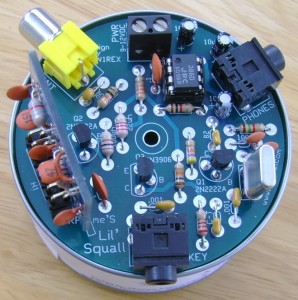
QRPme.com Lil’ Squall Transceiver
- BitX20A/17A SSB Transceiver. The BitX20A and BitX17A are complete SSB kits with board, all parts, digital display and custom powder coated and punched case that is based on the BitX20 that was designed by Ashlan Farhan. Output is about 10 Watts. $180.00 + S&H
- PFR-3a 3-Band Portable Field Radio. Bands : 40 meters, 30 meters and 20 meters. Tuning range: Full band coverage. Mode: CW only. $240.00 + S&H
- NADC30/40 CW Transceiver. Nearly All Discrete Component CW Transceiver for either 30m or 40m. Tuning range ~ 60 kHz. Power output: 3.5 watts. Full Kit: $130.00 + S&H
- Ft Tuthill 15 Meter CW Transceiver. Two 60 KHz tuning ranges, ~ 21.000 – 21.060 and 21.075 – 21.135 MHz. Power Output: 5 Watts. Complete Kit (w/ case and digital dial) $130.00 + S&H
- Ft Tuthill 160 Meter CW Transceiver. Two 30 KHz tuning ranges, ~ 1800 – 1835 and 1830 – 1865 MHz. Power Output: 5 Watts. Complete Kit (w/ case and digital dial) $130.00 + S&H
- –DISCONTINUED–Red Hot 40 Meter Transceiver. A high performance QRP CW transceiver kit for the 40m band. It has been designed to operate well in the presence of large out-of-band (shortwave broadcast) and in-band (contest station just down the road) unwanted signals. Frequency range is a (nominal) 70KHz segment of the CW end of 40m. Output power 0 to 5 Watts nominal (7 Watts typical). Full Kit: $250.00 + S&H
- –DISCONTINUED–MMR-40 CW/SSB Transceiver. The MMR-40 features both CW and SSB operation, the first rig kit in this price class to do so. Transmitter power out: 6 watts CW/pep typical at 13.8V supply. Typical tuning range: SSB: 7.280 to 7.150 MHz CW: 7.100 to 6.700 MHz. Full Kit: $225.00 + S&H
- –DISCONTINUED–TwoFer Plus CW Transmitter. The TwoFer Plus is a simple transmitter that will be offered on 40, 30, and 20 meters. The kits come with crystals in the qrp region of the band. It will put out approximately 1 Watt using a 2N3053 transistor for the final. It has a crystal based VXO that will give about 1.5kHz on 40, and 3kHz on 20. It also has a built in T-R switch on the board that mutes the receiver during transmit. We have upgraded the kit with a custom prepunched case that was designed by Ken LoCasale, WA4MNT. The kit comes complete, with all parts, connectors, case, knobs, wire, and our usual commercial quality double sided, plated through, silkscreened solder masked board. $35.00 + S&H
- DCxxB Board Only Trasceiver Kit. These radios are the next generation of the popular DC40 transceiver that was also designed by Steve Weber. The kit will come with 1 crystal for the band specified. 7.040 for DC40, 10.120 for DC30, 14.060 for DC20. Board-Only kit with decals: $30.00 + S&H
- Weber Tri-Bander. The Weber Tri-Bander can be built for any three of these bands: 80, 40, 30, 20, 17, or 15. 5 Watts out on all bands at 13.8 VDC. Built in Iambic keyer with 5 to 40 wpm code speed. DDS VFO for rock steady stability with 50 Hz and 200 Hz tuning rates. Many more features! $200 + S&H
- Scout Regen Receiver. A simple 2 band regenerative radio receiver that is capable of receiving signals from 3.5 to 11 MHz. A complete kit with L shaped aluminum chassis, quality doublesided silkscreened soldermasked board, all parts, hookup wire, board mounted battery holder. This kit is ideal for the first time builder. $50.00 + S&H
- –NEW– SMK-2 40m Surface Mount CW Transceiver. The SMK-2 is a fully functional surface mount component 40 meter transceiver. It has an independently tuned transmitter and direct conversion receiver. Full break-in TX with sidetone, and a modest 350mW output. The crystal VXO on receiver allow about 3 kHz+ tuning range on the crystal frequency. It was originally conceived as the SMK-1, a platform to teach SMT construction techniques. Transceiver Kit: $40.00 + S&H, Optional switched crystal board: $10.00 + S&H
- –DISCONTINUED– TJ2A 2 Band SSB / CW Handheld Transceiver. Can be set to operate on 2 bands from 160m – 10m. Output power 3.5 – 4 Watts. Rechargeable. Many band combinations available. $169.00 + S&H
- TJ4A 4 Band Backpack HF Trasceiver. Available in 2 TX models: 80,40,20,15, or 40,20,15,10. New general coverage receiver capability. 20 Watts output (adjustable), SSB, CW, AM. Full Kit: $399.00 + S&H
- –NEW– TT1A 2 Band CW Tube Transmitter Kit. This is a 2-tube 4-watt transmitter kit. Comes with crystals for 40 and 20 meters, but can operate from 60 to 20 meters with different crystals. Power supply kit coming soon, as well as custom case. $129 + S&H
- MFJ-8100K World Band SWL Receiver Kit. Regenerative general coverage receiver covering 3.51 – 4.31 MHz, 5.95 – 7.40 MHz, 9.56 – 12.05 MHz, 13.21 – 16.4 MHz, and 17.6-22 MHz. $79.95 + S&H
- MFJ-93xxK QRP Cub Transceiver Kits. QRP Transceiver available in 80, 40, 30, 20, 17, or 15. Output 2 Watts (except 1 Watt on 17 and 15).
- Too many kits to list here. They sell several different Transmitter, Receiver, and Transceiver kits, as well as shortwave converters for the car. A couple of the items seem to be kit versions of MFJ products.
- Similar assortment to Vectronics above, with several transmitter, transceiver and receiver projects.
- G11 5 band SDR Transceiver Kit. Power output 10 W. SMT components factory pre-assembled, buyer to assemble only large through hole components. Price in AUS$: $299.00 + S&H
- –LIMITED AVAILABILITY–G59 All Mode 160-6M SDR transceiver kit. The G59 is an all-mode 160-6m SDR transceiver with 10mW of output power. The output is boosted to 10W with the GPA10 linear amplifier. Genesis kits are produced in batches of 50 units at a time. Current demand for the G59 is much greater than our production capability. The best way to get a hold of a Genesis kit is to subscribe to our GenesisRadio Yahoo group and watch for announcements. G59: $349.00 + S&H, GPA10: $129.00 + S&H
- SoftRock RX Ensemble II Receiver Kit. The SoftRock RX Ensemble II Receiver Kit includes the components for building the kit for LF, 180kHz through 3.0 MHz, operation or for HF, 1.8 MHz through 30 MHz. $67.00
- SoftRock Lite II Combined Receiver Kit. The SoftRock Lite II kit now includes the components to build it for one of the following bands: 160m, 80m, 40m, 30m or 20m. This replaces prior Lite II kits that were set to a specific band when ordered. The SoftRock Lite II provides a simple to build SDR receiver with a fixed center frequency to be used with a sound card that can sample at 96 kHz, providing band coverage from 48 KHz below the center frequency to 48 KHz above the center frequency. $21.00
- SoftRock RXTX Ensemble Transceiver Kit. The SoftRock RXTX Ensemble Transceiver Kit provides a 1 watt SDR transceiver that can be built for one of the following four band groups: 160m, 80m/40m, 30m/20m/17m or 15m/12m/10m. $89.00
- SoftRock 6m/4m/2m RX Ensemble Receiver Kit. The SoftRock 6m/4m/2m RX Ensemble Receiver Kit may be built from the parts included in the kit for one of the three VHF frequency ranges. $68.00
- QRP Transceiver Kits (20,30,40, or 80 meters). 3 watts power output. covers a 50 kHz segment determined by you at the time of construction. With pre-labeled and painted case. $124.00 + S&H
- 9 Band Regenerative Receiver. 1.760 – 1.990 MHz, 3.3 – 4.150 MHz, 5.5 – 6.9 MHz, 6.9 – 8.5 MHz, 8.5 – 11 MHz, 10.1 – 13.2 MHz, 12.5 – 16 MHz, 14.7 – 18.5 MHz, 18.5 – 21.5 MHz Integrated audio amp IC for clean robust audio from internal speaker or headphones. includes parts, circuit board, assembly manual, battery holder, speaker, complete enclosure, and knobs. $93.00 + S&H
- 4 Band Regenerative Receiver. 5.9 – 6.4 Mhz, 6.9 – 7.4 Mhz, 8.5 – 10.2 Mhz, 11.5 – 16.5 Mhz. Comes with finished front panel. No knobs or case. $41.95 + S&H
- Digital Readout Superhet Receiver. 100 Khz to 20 Mhz coverage. This is the radio that Jay, KC2YSK built and wrote about in the Log previously. Several option available to improve performance from 3rd parties. $205.00 + S&H
- Any Band Direct Conversion Receiver Kit. Includes all of the parts and instructions to let you build the receiver (or change it to) ANY band of your choice (160, 80, 75, 40, 30, 20, 17, 15, 12 or 10 meters). $39.00 + S&H
- K3 Modular Kit. The K3 is Elecraft’s top of the line. Available in 10 and 100 watt versions and with a multitude of options. The modular kit comes with mostly pre-assembled boards that need to be plugged in. The K3 kit starts at $1549.95 and increases depending on what options you choose.
- KX3 Modular Kit. The KX3 is Elecraft’s newest transceiver. Similar to the K3 in features, but in a compact portable package. This is a modular kit like the K3 that requires you to assemble the pre-soldered boards. Many options available. Starts at $899.95
- K2 Kit. The K2 is available only as a full kit. This is not a modular kit like the two above, but a full kit for the advanced kit builder. The K2 is a full-featured transceiver available in 10 and 100 watt versions, and with many options. Basic kit starts at $739.95
- K1 Kit. The K1 is a small portable CW transceiver available as either a 2 or 4 band rig. You choose which bands you want at the end of the kit build. Adjustable output from 0 to 5 watts. The 2 band model starts at $299.95
- KX1 Kit. The KX1 is an ultra-portable CW transceiver. Available with 2 bands in the basic model, and upgradeable to 4. ! to 4 watt output. Starting at $299.95
- Hamtronics offers a variety of VHF and UHF receiver and exciter kits as well as many other interesting items.
- Emtech is currently out of stock on their NW-series radios. Check back. In the meantime, they have the excellent ZM-2 QRP tuner kit.\
- Series one kits. Three kits available. All DDS controlled, covering 80, and 40 meters. RX1 Receiver, 74.80€, TX1 Transmitter, 80.33€, and TRX1 Transceiver, 169.00€.\
- Series two kits. Two kits available. Both are high dynamic range, 10W output, SSB and CW transceiver kits, using quadrature sampling techniques for demodulation and modulation with low noise phasing. VFO is DDS controlled for a good frequency stability. TRX2 2-band model (80 and 40) 395.00€, and TRX2A 80 thru 10 model with general coverage receiver, 499.00€
- R1 Code Practice Receiver. High quality fixed frequency CW receivers designed for simple operation. Standard models are available for W1AW frequencies in the 80, 40 and 20 meter bands. $29.95 + S&H
- Rock Mite CW Transceiver. The Rock-Mite is a crystal-controlled direct-conversion transceiver available for 80M, 40M, 30M or 20M. $29 + S&H some accessories available.
- –Discontinued– The Retro 75. This is a nostalgic kit. A crystal controlled AM Transceiver with 2 watts carrier, 8 watts peak. $69 + S&H
- –OUT OF STOCK– Simple Superhet Receiver (SST). The SST is an optimized, superhet rig with an extremely low parts count . This may be the easiest to build superhet ever, and it comes with a miniature custom enclosure. 2 Watts output. $90 + S&H
- Nor Cal 40a. The revision B NorCal 40A is a third-generation 40-meter QRP transceiver kit, designed by Wayne Burdick, N6KR. The rig covers any 40KHz portion of the CW band, with a very stable VFO operating in the 2MHz range. The receiver is a superhet with crystal filter, AGC, and RIT. 3 Watts output. $145 + S&H
- –OUT OF STOCK– Sierra. The Sierra is the only compact, low-current, multiband transceiver kit available. Designed by N6KR and extensively field-tested by the NorCal QRP Club, the Sierra has been completely upgraded for Wilderness Radio–including a painted and silk-screened enclosure and improved performance on both transmit and receive. Uses plug-in band modules for 80, 40, 30, 20, 17 and 15 meters. 1.5 to 3 watts depending on band. LCD display. Starts at $245 + S&H with 1 band module.
- Ham Can Transceiver. A crystal-controlled CW transceiver, delivering 1/2 to 1 watts. Easy thru-hole kit. Crystal for 7122 included. $30 includes shipping.
- NS-40 Transmitter. Ideal first kit. There are only 14 electronic components, and NO TOROIDS or COILS of any kind to wind – NONE! All inductors are incorporated directly on the PC board as etched spirals. 5 watts at 13.6 volts. $30 includes shipping.
- SS-40 High Performance 40M Receiver. The SS-40 high performance receiver is the latest design effort from Jim Kortge, K8IQY. SS stands for “Stable and Sensitive”. It exhibits the signature IQY extremely quiet amplifier chain. Disconnect the antenna and the receiver’s noise floor is almost undetectable. A matched crystal IF filter provides a steep sided 500 cycle bandpass and outstanding opposite sideband rejection. Covering the 40M QRP “watering holes”, a Super VXO provides 25-30 kHZ of smooth stable tuning, and no perceptible drift even from a cold start.. While easy to build, this is not a trivial kit. There are 150 parts, and when completed the resulting high quality receiver is a pleasure to use. $60 + S&H
- Several inexpensive kits for the radio hobbyist, mostly supplied as a “bag of parts” with a schematic.
- A nice collection of kits including keys, keyers, and clocks.
- Little Joe Transmitter Kit. A small kit with board and parts from the book QRP Classics. Available for 80, 40, 20, and 10/15. Does not include crystals. $19.95 + S&H
- Cubic Incher Transmitter Kit. A small kit available for 40 or 80 meters. Crystals not included. Currently on closeout for $6.50 + S&H
- Sienna Transceiver Kit. This is a high end, full-featured transceiver with many options. The Sienna can be a full-control stand-alone rig, or a computer-controlled-only rig. Available in 10 and 100 watt version. Kits start at $2098 + S&H for the computer-only 10 watt model.
- HT-7 7Meter AM Walkie Talkie. The HT-7 is a simple AM handie-talkie that operates on the 40M AM calling frequency. $149.99 + S&H
- OHR 100A single band CW transceiver kit. Offered in 80, 40, 30, 20, and 15 Meter versions. Each can be aligned to cover 70-80Khz. 5 Watt output. $149.95 + S&H
- Micro 80D. Small tunable 80 meter CW transceiver kit. $35 + S&H
- Lil Squall Transceiver. A version of the Pixie Transceiver. A tinkerers delight. It fits in a small tuna can. Includes a socket for the FINAL transistor for easy experimenting with output power. Likewise, the feedback caps in the oscillator circuit also have sockets making it easy to experiment with new bands. The crystal also has a socket for easily moving the operating frequency about a band. Comes will ALL the parts necessary to complete the transceiver and a 7122 crystal for operating the Lil’ Squall ][ in an area where other minimalist rigs hang out, AND the ‘officially unofficial’ TUNA NET frequency for tuna can gatherings. $35 + S&H
- Super Tuna II+. A version of the Sudden Transmitter from the GQRP Club. Transmitter section is comprised of an oscillator, buffer and final driver transistor. Produces 2 watts at 12.6 volts. Frequency dependent components are mounted on an easily changed band module. The basic kit comes with a band module for 40 meter operation. $40 + S&H
- Tuna Tin 2 30th Anniversary Isuue. A re-issue of the original TT2 transmitter. Parts are laid out on the board in the exact same way the schematic is drawn. Simple, and easy to build. Comes with crystal for 7.030. $25 + S&H
- EZ Build Two-Tinned-Tuna Transmitter. EZ build version with no toroids to wind. Several socketed parts for experimenting and comes with 2 crystals for 40 meters. $30 + S&H
- Sudden Storm Receiver Kit. Great companion to any of the tuna can transmitters. Comes with components for 40 meters but can be operated on 80, 30, and 20 using the upgrade kit. $35 + S&H
- Reggie II Transceiver Kit. A lesson in minimalist design. The Reggie uses the Limerick construction technique. Output is about 100mW. $40 + S&H
- MKARS80 SSB Transceiver. This kit is based on the same design that is used in the BITX20 from Hendricks, but modified for 80 meter use. Main changes from Ashhar’s original design are the inclusion of a frequency counter and a Huff and Puff frequency stabilizer. Covers from 3.5 to 3.8 Mhz with about 5 Watts output. This kit is a bargain! Ranging from a basic no-case kit for £55.00 shipped to the USA, to full kit with connectors, knobs, and an undrilled case for £68.50
- Hunter SDR Receiver / Panadapter. This looks like an interesting and economical SDR kit, that can also be controlled by an existing rig for use as a panadapter. £87.00 shipped to the USA
- Soft66Lite. Small monoband SDR that can be built for different ranges depending on the bandpass components installed. Easily switchable by plugging in homemade bp modules setup on IC sockets. $18 shipped to USA
- BITX Kits. I won’t list the kits individually because the website is a bit confusing. They seem to have several different options from a basic kit with just the board and specialty components only for $18 to a deluxe complete kit with digital readout for $85
- AVALA SDR board only. There are a few sites supporting this SDR. Not sure if I’m ready to tackle something like this, but it does look interesting. Board only: $10
- Pixie II Kit. This includes the components for 80 and 40 meter versions of the famous Pixie II kit. It does not come with crystals, but HSC has them available individually or in a 6-pack. $9.95 + S&H
–Hans Summers dot com. http://www.hanssummers.com/qrsskitmm.html. Hans sells the Ultimate QRSS kit. The website lists many other projects and experiments.
- Ultimate QRSS kit. The ultimate QRSS Transmitter Kit is produced by Steve G0XAR and Hans G0UPL in 30, 40 and 80m versions. Supports many different modes: QRSS, FSK/CW, DFCW, WSPR, Hellshreiber, CW, and more. The kit contains the PCB, LCD, programmed microcontroller and all board-mounted components. 15.39 GBP + S&H
Worked All Germany from Shute Hill
Today was almost Indian summer. I hiked on Shute Hill and sat in the sun under a canopy of gold. I worked a dozen German stations in the Worked All Germany Contest.

I hiked up the Rufus Colby road and turned right into the woods. Not far ahead lay two small fields. It was grand to be in shirt sleeves at the edge of the field. I brought the ATS-4 and set up a half wave wire for 15 meters in an oak tree. Bright orange, yellow and gold accentuated the deep blue sky.

In barely six minutes, I worked six German stations with my 3 watts and 22 foot wire. I tuned the wire with an Elecraft T-1. Then I extended the wire to 33 feet and set the ATS-4 for 20 meters.

In the next ten minutes I worked 3 more German stations and a Dutch special event station celebrating 75 years of Boy Scouting. All the QSOs
were quick contest exchanges. Here’s my log:
20 Oct-12 1843 21.018 DL5NDX CW 599 599
20 Oct-12 1844 21.019 DJ9DZ CW 599 599
20 Oct-12 1846 21.024 DK4WF CW 599 599
20 Oct-12 1847 21.028 DK5DQ CW 599 599
20 Oct-12 1848 21.030 DL0UM CW 599 599
20 Oct-12 1849 21.032 DL5JS CW 599 599
20 Oct-12 1900 14.016 DL3GA CW 599 599
20 Oct-12 1903 14.019 DJ9DZ CW 599 599
20 Oct-12 1904 14.020 PH75S/J CW 599 599
20 Oct-12 1905 14.022 DL8QS CW 599 599
20 Oct-12 1910 14.042 DL0UM CW 599 599

I packed up and headed back through the 20 acre field at the top of Shute Hill. The field is surrounded by a wall of color. The air is so fragrant and warm, I wonder why Mother Nature didn’t make Fall last at least another month or so.
“Armchair Copy”
DX from the Old Range Road
Today I hiked on the old east-west range road in Sanbornton. The fall colors were fantastic and so was the DX. I worked Dominica, Germany, Czech Rep., and a research ship off the coast of Africa.

The day was glorious… a tad over 60F with clear blue skies. The hike was less than a mile, but the views and the fall colors were grand. I stopped in a field on the Swain Farm, a little north of Hunkins Pond. I tossed my line into a huge maple tree. In the spring, it’s tapped for maple syrup. Today, it provided glorious color and a great antenna support.

Even though my throw went nearly 50 feet high… I only needed 22 feet. I set up on 15 meters with the ATS-4 and used a half wave wire. I powered the setup with 8AA batteries that I solar charged this morning.
The band was remarkable. Very quiet with a handful of very strong signals. My first contact was with Volker, J79WE in Dominica. He gave me a 549 and we finished a quick exchange easily. Next I answered a CQ from CM8CAD in Cuba. Carl gave me a 559. I sat right in the grass under the tree and enjoyed a view of the Belknap range to the south.

My third QSO was with Hardy, DL1VDL in Dresden. He gave me a 579. Hardy reminded me that we had worked before. Checking my log, I noted that I had worked him in 2008 from the cabin at Knox Mountain! “UR FB 4W is great,” he sent. “Have fun hiking.” With that we signed and I packed up to continue the hike. I went east over the side of the hill, and set up once again. This time on 20 meters.

I sat down in a second field after throwing a 33 foot wire over another maple branch. This time I looked across the high field into a glade below. Mt. Rowe is in the background. I called CQ on 14.060 and received a quick reply from Jan, OK2BUT in the Czech Rep. Jan gave me a 569 and sent “FB sig from UR 4W.” He was running 100 watts with a 3 element yagi. I dropped down to 14.017 and was just in time to hear the end of a QSO. I called GM0HCQ/MM and Mike returned my call. He gave his QTH as 28N – 20W. Mike was on the Royal Research Ship James Clark Ross near Gomera Island off the north east coast of Africa. Here’s a picture of the ship at anchor in the Antarctic:

You can find out more about the ship and Mike’s station at: http://gm0hcq.com
After this QSO I packed up and walked out of the field onto the old range road. The sun was falling rapidly and illuminated the trees as I headed west.

These glorious fall days are numbered, with November just around the corner. The forecast for tomorrow is rain.
Falling Leaves at Knox Mountain
It’s a perfect fall day… sunny and nearly 60F. I head to Knox Mountain to enjoy the fall air and make a few QSOs. I work France and Georgia.

The trail is a carpet of color. The air is glorious. Most of the leaves are on the ground. Afternoon sunlight still dances between the bright yellow beech leaves.

The brook tells the story without a word. Gold leaves mingle with golden sun and green moss. The season is changing as rapidly as the running water. There is a certain nostalgia that comes with the season.

The trail follows the brook, and as I approach the cabin, I must jump across the rocks to the other side. The old bridge has rotted, and the caretaker has removed the ancient timbers.

The pond is full, not only with water… but of stories and images that lay mysteriously upon the fragile surface.
I sit in my favorite place in the sun on the east side of the cabin… beneath a cherry tree. Everything is still except the tapping of a woodpecker. Even the crickets are quiet now. But I see them hopping in the grass around me. The clouds are but wisps… the day a poignant reminder of the changing season.
I heave a line about 40 feet over a cherry branch and pull up a half wave wire for 20 meters. The band is muted… I think many of the stalwarts are on 15 and 10 meters today. I should have brought the ATS-4 so I could operate on 15. I am using the HB-1B with 4 watts. Signals are down here and I get poor reports from the stations I work. First I call F8BPF in the northwest of France. It takes Sylvain a few tries to get my call correctly. He gives me a 419, but copies my name and QTH the first time. He is running 100 watts to a 3 element yagi. I can hear him easily.
Next I work a county hunter operating mobile in Georgia. Greg, NM2L/M only gives me a 339, but again he copies the exchange first time.
I pull down the wire and prepare to leave. Today radios take second place. The air, the sky, the water, the leaves and the quiet rule the atmosphere.
That downward “ham radio” trend line
There’s an interesting discussion ongoing on some of the amateur radio blogs (including this one) about how an analysis of the number of searches in Google using the term “ham radio” is trending. No doubt about it, if you simply look at the graph, it shows the hobby I love so much–and that I fully credit for getting me into a career in media–is trending more and more southward:
This could mean a number of things:
— People are getting their info about ham radio in other ways besides searching for that specific term on Google.
— They are searching for info on the hobby using other keywords, such as “amateur radio.”
— Nowadays, people search initially for information on a subject and then, if they find what they seek, they bookmark it/make it a favorite and don’t search anymore on Google.
— As we have gotten more sophisticated in how we use the search engines–often merely using the address bar in our browsers to type in odd terms that more closely match what we are seeking–the big, all-inclusive search terms are not used so often.
— Interest really is declining.
You know what my heart tells me. Licensing backs me up in that belief. We have more licensed amateurs in the country now than ever before in the 100-year history of the hobby. My sense is that the hobby is vibrant and growing, and, before you slap on me me that “rose-colored glasses” brand, be aware that I am pretty good at looking at things such as reliable research data realistically.
On the other hand, I still believe it behooves those of us active in the hobby, those who want to see it continue to grow, expand, and become even more exciting and diverse, to be evangelistic about it. We have to do what we can to recruit potential hams into our little “cult of the airwaves.”
That was one reason I wrote the book RIDING THE SHORTWAVES: EXPLORING THE MAGIC OF AMATEUR RADIO. I want people to understand that the hobby can be much more than sitting in a basement sending Morse code or trying futilely to hit repeaters with a handheld and a rubber-ducky antenna. As with most technology, our avocation has dramatically changed, and for the better. It offers so much to younger people who have grown up with cable, satellites, computers, and smart phones. True, those folks might think amateur radio is still what their weird uncle used to do in his back room with all that spittin’ and sparkin’ radio junk. We need to make them more aware of what the hobby is these days. And make sure they know that it absolutely can lead to a career in a technical field, including computers, communications, engineering, meteorology, media and more.
We won’t panic about that trend line. We will continue to do what we should be able to do best: COMMUNICATE!
Don Keith N4KC
www.n4kc.com
www.donkeith.com













