Archive for the ‘Uncategorized’ Category
 A weekend with the Xiegu X1M
 April 29th, 2013 |
  Author:
 So, I have now had the X1M since Friday. I have to say that overall, I like it. Friday night (as previously posted) I checked in to the

Xiegu X1M
Brothers Net, and was heard clearly in Virginia, and again on Saturday night, when one of the members in Virginia relayed my check in to the operator in Maryland. Also on Saturday I logged 5 of the 7 Florida QSO Party spelling bee stations from my living room, as well as a couple of other Florida stations. Reports ranged from good for QRP, to Wow! Only 5 Watts? Keep in mind this is in a much-less-than-ideal setup.
In our apartment, KD2CHE and I are extremely limited on space, inside AND out. The X1M is attached to an L-shaped random wire in the front yard, by way of a Balun Designs 9:1 Unun, and an Emtech ZM2 tuner. Emtech recommends not using an additional balun or unun, but it seems to perform a little better with this crazy antenna.
It tunes up on most bands, and appears to tune up on 75, but signal reports were bad on 75, with a lot of RF feedback, and I can hear myself in the speakers I have attached to our TV when I transmit. 17 meters seems to be an issue with the TV speakers as well. I’d love to put up something better in the front yard, but we’ll see what the landlord and neighbors are willing to put up with. 160, by the way is a no-go, but I don’t think that’s a surprise.
I’ve gotten the hang of using the X1M pretty quickly. I haven’t used the memories yet, but I use the dual VFOs quite a bit, as well all of the different tuning speeds. Everything is fairly straight forward once you get the hang of it. Audio is what you would expect for a radio of this size (this thing is SMALL!), and fine through headphones. The receiver is very sensitive. I’ll get some actual numbers next weekend. I like that you can kill the display light to conserve batteries, which will help when portable.
I’ve tried battery power. With 8 alkaline AAs the radio seems to perform OK, however, 8 LiIon batteries are not quite enough voltage for the rig, producing some howls and distortion with the volume above about 40%. I guess I’m not too surprised at this, since 8 FULLY charged AA Eneloops only put out 9.6 volts. I will supplement that with 4 more Eneloops in series for a max of 14.4 volts. Later on, I can pick up something a little more sophisticated. I also made a coax-to-powerpole cable for mobile use, so I can always just set up next to the car when needed.
A coax power plug for making your own power cord, and a 1/8″ stereo (3 cond) plug for wiring to a key/paddle are included. The power connector is a very common size, 5.5mm OD x 2.1mm ID, or Radio Shack size M, which made powering the radio up easy, since I had a size M-to-tinned-leads cable already. I wired a straight-key up to the 1/8″ plug, and had to set the keyer mode to manual, which was also not hard to figure out. The instructions are in Chinese, but an English translated manual is available from Import Communications, or in the X1M Yahoo group.
I think the little X1M has a nice future in my collection. It’s no KX3, but for about $300, it’s a nice little radio.
To be continued………..
QRP to the Field at Profile Falls
This afternoon Dick N1LT and I headed to Profile Falls in Bristol for the annual QRP to the Field event. What a perfect day we had… lots of contacts… dazzling scenery, even a little break for tea and cake!

We set up right at the edge of the Pemigewasset River not far from where the Smith River enters the Pemi from Profile Falls. This year’s theme for the QRP to the Field event is historic trails. This spot fit in perfectly. There are TWO historic trails here. We were only several hundred yards from the old Northern Railroad route between Franklin and Bristol and just a little farther from the old road that ran between the two New Hampshire towns. Both have been out of service since the 1940’s when the Corps of Engineers took over the area for flood control.
We ran two separate stations. Dick set up about 70 feet from me. He operated in my VW camper with an FT-817 and a Par End Fed 40, 20, 10. I don’t have his log, but he worked a dozen or so stations on 20 meters in about an hour and a half of operating.

As shown in the first picture, I set up on a picnic table in front of the river. I ran a K2 to a 21 foot piece of wire (half wave on 15M) tuned with an Elecraft T-1 tuner. I operated almost exclusively on 15 meters. The band was sparse, but now and then a strong station appeared and I was able to work him. Here’s my log for the event.
Date UTC Freq Call Mode MY His QTH Name
————————————————————-
27 Apr-13 1753 21.023 RA2FF CW 599 599 Russia
27 Apr-13 1758 21.061 AA5CK CW 559 599 OK Ted
27 Apr-13 1802 21.062 N7KE(?) CW 439 559 WA
27 Apr-13 1808 7.034 W2M CW 599 599 NY Morse event
27 Apr-13 1820 21.037 AA4PP CW 599 599 FL
27 Apr-13 1825 21.060 WT5RZ CW 229 559 NM Ron
27 Apr-13 1828 21.009 HB9BMY CW 599 599 SOTA
27 Apr-13 1830 21.029 WD4AHZ CW 599 599 FL
27 Apr-13 1833 21.033 F6FEA CW 569 599 France Didier
27 Apr-13 1920 21.034 K4LQ CW 599 599 FL
27 Apr-13 1925 21.017 I2TAO CW 559 599 Italy
27 Apr-13 1930 21.057 DF2GN/P CW 559 559 SOTA Germany Klaus
27 Apr-13 1937 18.073 WT0S CW 579 599 ND Don
27 Apr-13 1944 18.077 TM0SI CW 599 599 Sein Isl
It’s a mix of DX, SOTA, FL QSO Party and a couple of QRPTTFers. My QSO with Didier F6FEA in France lasted more than 20 minutes and I received a very cordial email from Didier. He was most patient with my weak signal!
About three quarters of the way through the afternoon we stopped for a quick cup of tea and some lovely orange cake that my wife sent along with us. I had brought along a gas stove, a pot, and some cups and plates. What a wonderful treat.
Before packing up, we went across the road to Profile Falls. It’s a popular swimming hole in the summer. A bit cold right now!

Dick and I have operated this event together at least 4 years out of the last five. It’s something we look forward to each year with good reason. Thanks to Paul NA5N for putting the event together.
The X1M Arrives!
I finally received my assembled Xiegu X1M today. I unpacked it and started tuning around before going out to dinner with the XYL, but after I got home I picked
Xiegu X1M
up the mic and tried it out. Attached to an Emtech ZM2 tuner, and about 50-odd feet of random wire in the trees here, I checked in to the Brothers Net on 7192kHz. Not bad for 5 watts, and a less-than-ideal antenna. We’re off to a good start. More to follow.
Multi-Band 4 Foot Magnetic Loop with Gamma Match

4 Foot Diameter Magnetic Loop In Operation
As my mag loop projects progress, I’m learning a lot about building them and using them. This antenna works on 17, 20, and 30 meters, with the best bandwidth on 20 meters. The bandwidth on 17 and 30 is quite small but usable. There is a 20 KHz bandwidth on 20 meters. I used a vacuum capacitor to build this particular loop for 100 watt operation. The air capacitors are good for QRP but will arc over using much power over QRP levels.

4 Foot Magnetic Loop Antenna with Gamma Match
This photo was taken before I trimmed the Gamma Match.
I didn’t know how long the Gamma Match should be, so I made it long enough to allow for trimming after the match to 50 Ohms was made.
This is the first mag loop that I made with a Gamma match. I like this match better than the usual Faraday feed loop that is featured in my previous mag loop antennas. Matching is easy and building the Gamma match is not difficult. I’m planning to build other smaller loops that will also feature the Gamma match. The smaller loops will target 10, 12, and 15 meters. Loop size determines which band its best suited too. Although it is possible to get more bands on one loop, the bandwidth is small and the tuning ‘dip’ is very sharp. I found it better to limit the number of bands in favor of wider bandwidth and antenna efficiency.
Please look up my previous posts for more details on parts and plans.

Here is a good close up of the clamp.
(Before Trimming)
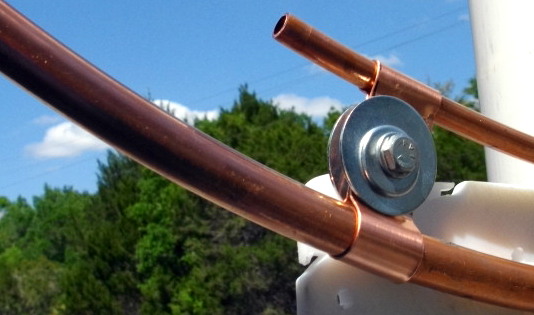
Gamma Match After Trimming. This enables a 50 Ohm Match for all three bands.

Gamma Match on the left, PL 259 in the center and, Tuning Aid Stick (PVC) pipe , on the right.
The vacuum capacitor is ‘tuned’ by twisting the PVC pipe that is attacked to it with a cotter pin.
Tuning the cap to the ‘loudest noise’ on the air will put you in the ball park for operating.
You can also use an antenna analyzer if you want to know the exact SWR, and RR of the antenna.
Tuning with a radio attached is fast and easy.

Making the clamp for the Gamma Match

Soldering The Back Plate and PL 259

Removing The Oxidation Before Soldering
The main loop is 5/8 inch, soft copper tubing.

Close Up of PL 259 to Gamma Match Joint
The center of the PL 259 had a #10 solid copper wire inserted and soldered in place.
The Gamma match is 3/8 inch soft copper tubing.
This part of the job was done with a soldering iron, the rest was done with a plumbers torch.

Handy ‘third hand’. A clamp to hold the Gamma match in place while I soldered it.
My town was going to hire a ‘Mad Scientist’ but it couldn’t afford one, so they settled for a ham radio operator instead. Me!
73 de AA1IK
Ernest Gregoire
On 40m at last… (Part I)
Using a Buddipole antenna (BP) for my SOTA activations leaves me high and dry when it comes to the 40 m band. I was never able to build an efficient BP for these frequencies and received many ‘complaints’ that I never activate on 40m, thereby leaving out the ‘local’ chasers. This is going to change now…
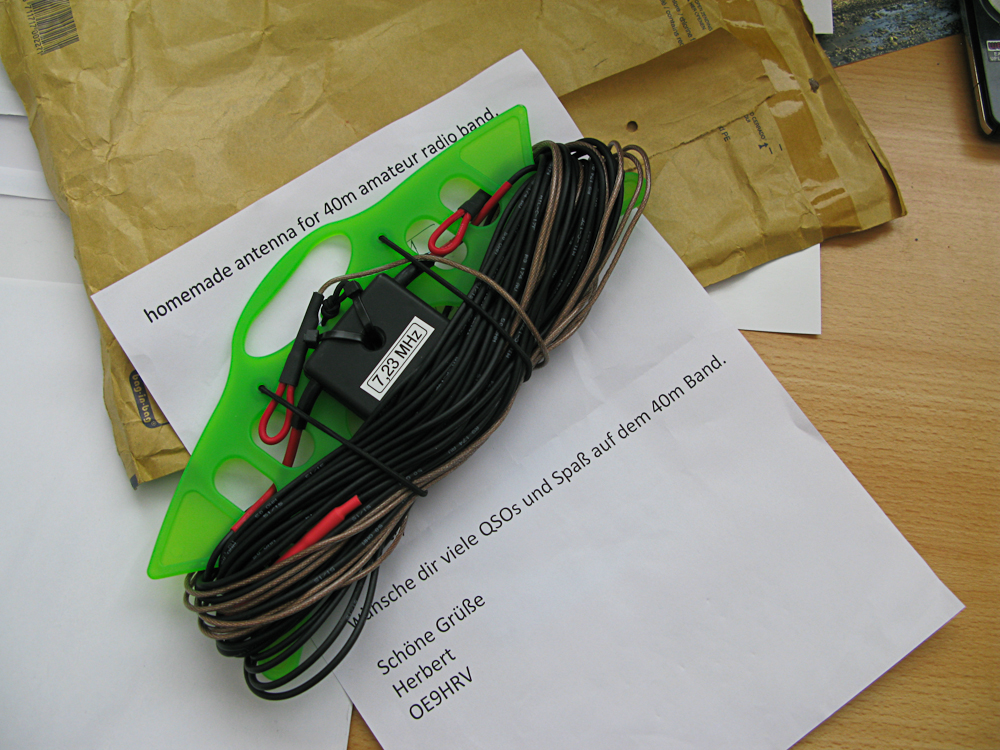
Yesterday I received a package from my buddy and SOTA Mountain Goat Herbert/OE9HRV, containing a home brew double Bazooka for 7 MHz based on RG174 coax. Herbert is my go-to guy when it comes to antennas. On our joint SOTA activations in OE he always carries an impressive assortment of home brew antennas to the summits, and due to this weight I would NOT want to carry his backpack – seriously. To see some examples of his creations, check out his FLICKR stream and/or QRZ page.
I had not known about double Bazookas before being educated by Herbert. It’s an efficient and quiet single band antenna based on 50 ohm coax cable, with the shield split at the center and feed line attache to it. It can be used in a flat top or inverted vee configuration – the latter more suitable for SOTA. To save on weight, Herbert made it out of RG174 with a BNC connector, and used a wire-winder to create a small and easy to manage package. The final antenna is around 310 g (~ 11 ounces) and about 25 cm x 8 cm (~ 9.5″ x 3″ ). With any luck you might hear me on 40m over the week-end.
For more pictures head over to my blog.
73, Matt/KØMOS
Prayers for Boston
As of now, news agencies are reporting two people killed and dozens injured at the Boston Marathon after two large explosions. Please say a prayer for those affected by this and for the first responders working so hard.
As I ponder the CME aftermath…
Guess my ears are too old and mummified from all those years as a broadcast personality (our favored term for “disk jockey”), but all that hiss and sizzle from the CME and local thunderstorms this weekend sent me in a different direction. I did give some guys Alabama for their QSO parties, and I always enjoy doing that. But the band noise, generally yucky conditions, and my continued depression over not working VK9CZ had me doing other stuff I’ve been putting off. And with all that rain, that stuff did not include antenna maintenance or yard work. I’ve successfully postponed that for a few more days.
What it did involve was my next adventure with self-publishing. I make my living writing books and finally got around to doing one on my favorite hobby for the past 52 years…ham radio! RIDING THE SHORTWAVES: EXPLORING THE MAGIC OF AMATEUR RADIO (http://www.donkeith.com/index.php?p=24). No big-time publishing house was interested in doing the book. Neither was the ARRL. They say non-technical books don”t sell well for them, and I understand. They’ve been kind enough to sell the book in their online bookstore, so bless them!
Anyway, I went a different route and published the book myself. It has been available for a while in paperback as well as for the Kindle e-book reader. But this weekend…while the bands hissed at me like an audience does a villain…I busied myself getting it formatted and uploaded for every other conceivable e-book reader out there. That includes the Apple iPad, Barnes & Nobles’s Nook, and the free-to-download Adobe Digital Editions reader. Success! After a couple of false starts, of course. Man, the technology around book publishing is changing quickly, just as it is in all media and our wonderful hobby. (By the way, I blog on such stuff at http://n4kc.blogspot.com and sometimes here on AmateurRadio.com.) I also finally got around to designing and setting up a store where I can make available shirts, sweatshirts, coffee mugs and other items to help people promote our hobby with the message: “I ride the shortwaves. Ask me about amateur radio.”. It’s at http://www.cafepress.com/shortwaves.
Another bit of good news helped through the CME aftermath, too. I got word from the ARRL that not only will the League be selling my book at Dayton, but they asked me to do some signing events. I look forward to it! Please drop by and say hello if you make the pilgrimage…no purchase necessary!
I’m already going to be hanging around the QRP ARCI “Four Days in May” event on Thursday, May 16. It’s at the Holiday Inn in Fairborn, not far from Wright-Patterson AFB. I’m there with Rich Arland K7SZ, author of the ARRL’s QRP book. Rich has been shoving and pushing me to get deeper into QRP, and I think I may finally be catching the bug. Or maybe it is just the ragweed. I do occasionally turn down the power to 5 watts and see what I can do. The challenge is something of a thrill.
Just not when the A-index is 45!
Don N4KC
www.n4kc.com













