Archive for the ‘radio’ Category
 March 9th, 2011 |
  Author:
 More “Cheap Yagi” construction notes: push nuts
As I have mentioned in previous posts, I am a fan of the WA5VJB “Cheap Yagis” as described by W0FMS. One of the construction techniques W0FMS describes is the use of a “push nut” to secure elements to the boom. I bought some push nuts from McMaster last week. Since Mom and Dad were in town over the weekend, I took the opportunity brainstorm with Dad about methods and mechanisms for installing the push nuts. McMaster would have happily sold me a tool for $60, but as usual, I was feeling thrifty.
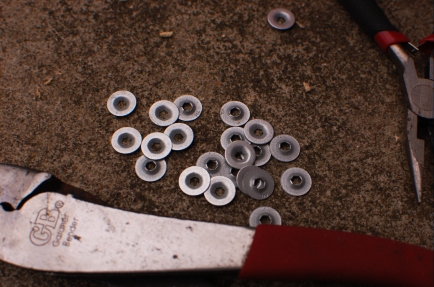
And, this is what a push nut is. They come in various sizes. These are for 1/8-inch shafts (McMaster part number 94807A024).
Here is a jig with an oversized (3/16-inch hole) for installing push nuts:
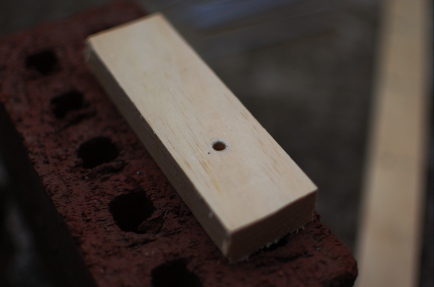
With a push nut fitted:
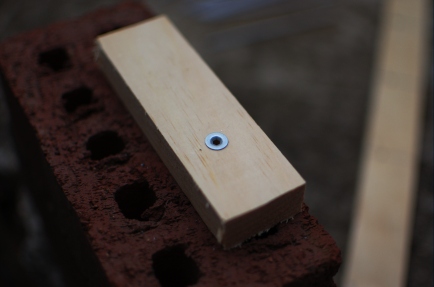
Dad demonstrates operation of the jig (why yes, those are tower sections in the background):
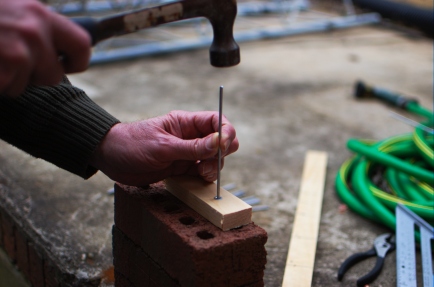
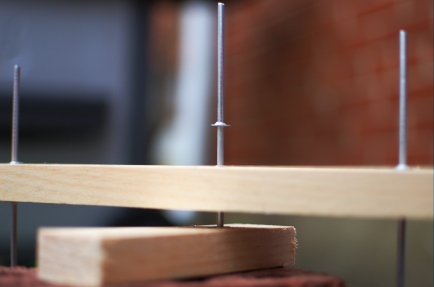
Demonstrating how to do the other side, notice that the installed (top) push nut works as a positive stop:
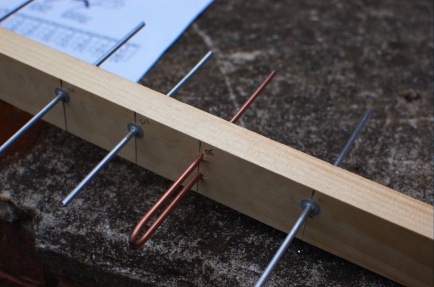
And, a (nearly) finished 10-element Yagi for 903 MHz:
Triple Play / LoTW status
Happily, Sarah returned from Texas last night. You don’t always know how much you miss your spouse until they’re not around. But, she (and the baby—we’re expecting in July—very excited) is (are) home again!
She also brought the Trusted QSL-containing MacBook home safely and I uploaded my RTTY log to LoTW. Got a whole bunch of matches! So, the Triple Play award from the Maryland QTH is indeed coming along nicely: CW 50/50 – PH 34/50 – DG 29/50. Lots of easy ones still needed. Also have 31/50 states on 160 (lacking easy confs like VA, for instance?!). It’s also amusing to have more states on 2 meters than 15 meters. I guess I should spend some time on the high bands. 
RYRYRY O RLY?
A few readers of this blog may have been surprised to contact me on a new mode last night…RTTY. I’ve tried radioteletype once before in the past (also in the NAQP contest) but rather unsuccessfully the first time. The second outing was a bit better. I suppose with practice it becomes fun, but the primary motivation here is ARRL’s Triple Play award for contacting all 50 states each three times, using CW, SSB, and digital. CW was, of course, easy. And, I’m making good progress on the SSB totals. So, I figured I would stop putting RTTY off and give it a shot.
As you are probably well familiar, I normally contest with two TS-930s. Their prior owners (who were CW contest/DX types like myself) made various “improvements” to them, most of which I appreciate, but I have no idea how they affect FSK. One radio simply does not work on FSK (need to look into this) and the other has the passband shifted about 50-100 Hz off-center of the normal RTTY frequencies. So, when I was running AFC in MMTTY, it would “walk” to the point that having a lock on the other station would put me at the edge of their passband. I had a terrible time making QSOs for the first hour until K0TI told me I was off-frequency (thanks, Dan!!!) and then I started paying attention to all of the numbers in MMTTY and turned off the AFC, which had some deleterious effects that I overcame thanks to the occasional repeat. Typical analog op becomes digital lid op.
I sent the MacBook (our “home” computer) with Sarah to a conference yesterday. Since that’s the only place I have LoTW’s Trusted QSL installed and I failed to export a .p12 file, I’ll have to hold tight for a couple of days until they return. (This is not entirely true, I have an old .p12 file, but I haven’t backed it up again since I renewed the certificate a few weeks ago. Bad backup practices…although I just got a new external drive so the old drive can be used to do a Time Machine back up…finally. Another day, another project.)
This post mostly mirrors my 3830 post, but here are the numbers for the curious. My grepping missed one QSO on 80 meters when I did the totals (N1MM rounded the frequency up to 3600 kHz) for 3830. So, these numbers are right, aside from log-checking discounts:
Call: K8GU
Operator(s): K8GU
Station: K8GU

Class: Single Op LP
QTH: MD
Operating Time (hrs): ~3

Summary:
 Band  QSOs  Mults
-------------------
   80:   37    21
   40:   58    27
   20:   35    18
   15:
   10:
-------------------
Total:  130    66  Total Score = 8,580

Club: Potomac Valley Radio Club

Team: PVRC #1
NA Sprints, ARRL DX, and other notes
February, like November, is a busy month for contesting: the CW edition of the NA Sprint leads off the month (along with the Minnesota QSO Party), followed by the phone edition of the NA Sprint the second weekend, and of course, the ARRL DX CW contest on the third weekend.
In short…
NA Sprint CW SO-LP: claimed 162 x 38 = 6156, preliminary 158 x 38 = 6004. Four busted QSOs is actually better than I felt at the end. So, that is good. Still not happy with the numbers, though.
NA Sprint Phone SO-LP: claimed 28 x 16 = 448 in 1 hour operating time. As KE3X told me, his NS score was higher that week! The phone Sprint is more fun from a bigger station, but really suffers from lack of participation.
ARRL DX SOAB-LP: claimed 544 x 243 = 396,576 in 14 hours. This should have been a bit better, but I got sucked into trying to make myself heard in EU on 160 before their sunrise. Killed almost 60 minutes on 15 QSOs there. Also only operated about 1-2 hours during prime EU time on each of Sat/Sun morning. Efforts at getting a run started were a complete failure. Need. More. Firepower. I was very pleased to work ZM1A on 10 meters, though.
Other notes…
After 17ish years of amateur radio, I finally installed my first 30-meter antenna—a dipole at 35ish feet. First QSO was ST2AR, so I guess it’s working alright.
A box full of goodies arrived from Down East Microwave this week and I started working on buttoning up the 1296-MHz W1GHZ transverter. Massive thanks to Ben, N3UM, who lives nearby for sharing his construction notes with me. Not too far along other than punching and tapping a few holes in a diecast box. The DEMI box also included a couple of LNA boards that I hope to tune up for 432.
High winds (90 km/h gusts, according the forecast) from Friday night through Saturday night did not manage to topple my FO12 and A50-3S from their perch on the chimney. I haven’t checked the rotator to see if they still turn, though. This antenna situation needs to change eventually.
Finally, I also managed to score about 250 feet of RG-213 and 10 feet of LMR-600 from a dumpster-diving excursion. The LMR will make nice jumpers from the 903 and 1296 transverters to their respective antennas and I can use the RG-213 to replace the RG-8X on some of my HF antennas.
CQ 160 CW
We got a dose of Mid-Atlantic winter weather last week—that once or twice a year event that is too much for the utilities and drivers to handle. Snow, sleet, freezing rain, and rain arrived on Wednesday. Power was out from 2030 LT to 0200 LT on Wednesday night/Thursday morning and then again from 1600 LT on Thursday to around 1100 LT on Friday. So, I didn’t get to operate NS this week on account of no power! I did think of going out to the car, but I was too wiped out and cold from the furnace blower being off. I just wanted to crawl under a big pile of blankets and sleep until the electricity came back on. As I have mentioned before, I grew up in an area with many Amish. A coworker many years ago was teasing me about finding an Amish girlfriend. I responded by asking him how an electrical engineer would fare in a society dedicated to not using electricity. He had to agree, although the Amish have rather ingenious mechanisms for harnessing electricity to do their work. But, as usual, I digress—we’re slightly dependent on electricity in ways we probably should not be!
I like contesting on 160 meters (1.8 MHz). When you call CQ, you are usually rewarded with blistering rate from loud stateside stations. When you’re tuning up and down the band, weak DX stations pop out from between said loud stateside stations. Now that I have something resembling a 160-meter antenna, I gave the CQ 160 CW contest a shot after some friends left on Saturday night. Another nice thing was that the station is working well enough (with the exception of the K9AY relays and possibly directivity) that I could just walk into the shack and operate.
So, that’s what I did… Only worked a handful of Europeans, but that’s not too surprising. They were loud here, even with 10 dB of attenuation in line to reduce IMD from really loud local stations. There were numerous other European stations that I could hear (on the TX antenna) but was unable to raise. But, in about four hours (three in the CQ 160 and one in the NAQP) of operating on Topband, I have only the hard states left for WAS from this QTH: ID, SD, ND, WY, AK, HI. I’m waiting for the LoTW confirmations to start showing up!
                    CQ 160-Meter Contest, CW

Call: K8GU
Operator(s): K8GU
Station: K8GU

Class: Single Op LP
QTH: MD
Operating Time (hrs): 3

Summary:
Total:  QSOs = 182  State/Prov = 48  Countries = 8  Total Score = 25,984

Club: Potomac Valley Radio Club













