Archive for the ‘qrp’ Category
 Ten-Tec 539: a new QRP transceiver
 September 29th, 2011 |
  Author:
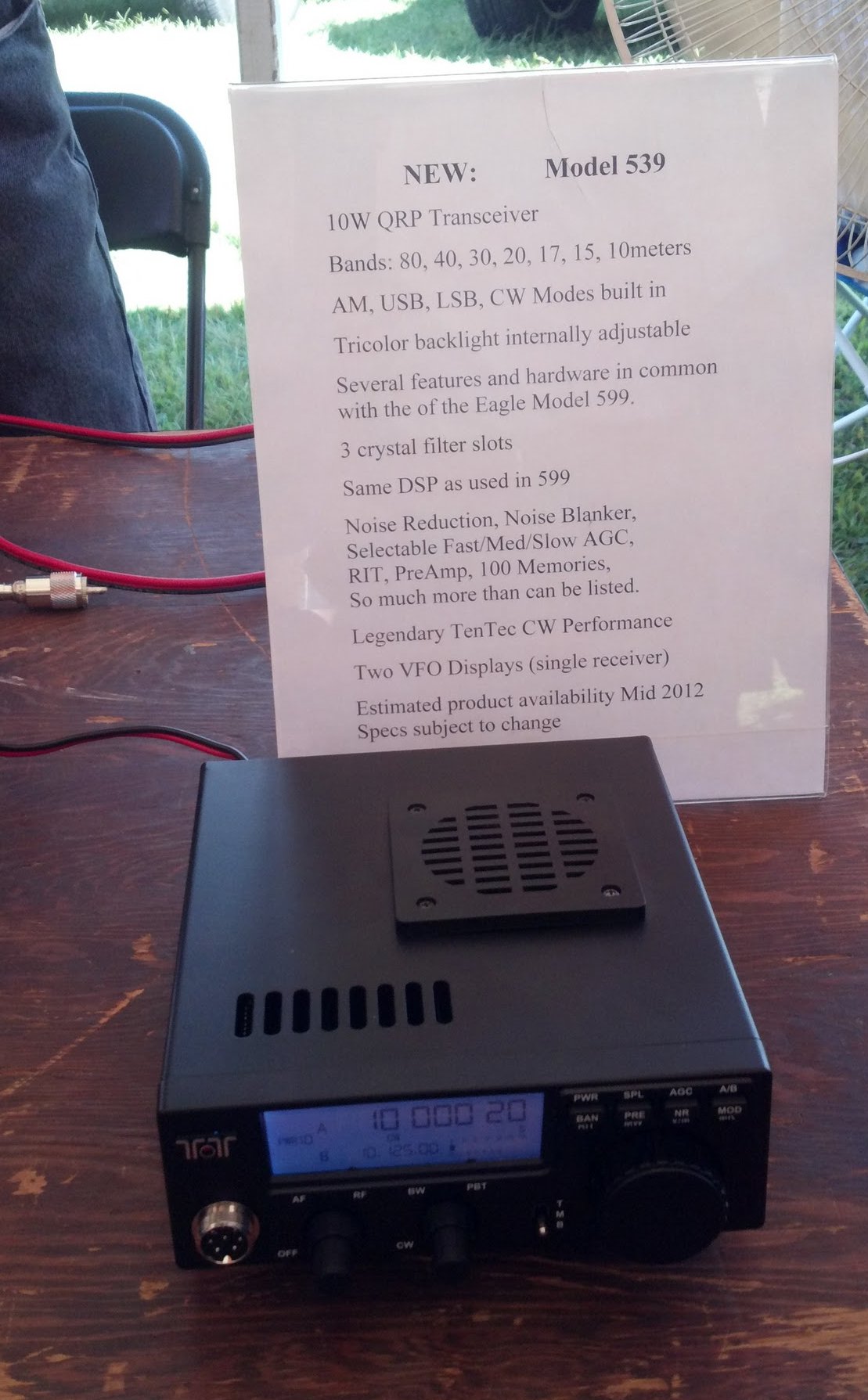
 Through the QRP-L mailing list I have read about a new QRP HF transceiver to be made by Ten-Tec. It has the model number 539 and seems to be a 10W output rig with 80m, 40m, 30m, 20m, 17m, 15m and 10m band coverage, three filter slots, DSP and dual VFOs. Photographs and details are available at the QRPer blog. The rig looks about the size of a K2 and seems to be designed for portable operations. The front panel looks very minimalist with a few knobs and buttons, and I could not help thinking it resembled the old Lowe HF 150 in appearance. From the QRPer blog it is reported that the receiver board is the same as that used in the Eagle.
Besides the transceiver there appears to be a planned 100W amplifier to match with the 539. This is a clever combination as having both will allow a user to have a full 100W station at home with the ability to take away the 10W transceiver ‘front-end’ for portable use. No information yet on the Ten-Tec site as of the time of writing this, but there is a Yahoo group already available.
You have time to save your money, it is indicated on a display board in one photograph that it is expected to be available in mid 2012.


ATS-4 b due late September / early October
UPDATE: As of mid October the new availability date for the ATS-4B is November 2011. Also Steven Weber is developing a daughter board to enable the ATS-4B to decode PSK and CW – which has a January 2012 delivery date. This board can’t be added to the earlier ATS-4A.
Since late June, Steven Weber’s site at http://kd1jv.qrpradio.com has displayed a short announcement that the next batch of ATS-4a kits will be available in the “fall of 2011″.

- Steven Weber KD1JV’s ATS-4 5 band trail friendly transceiver
On the AT_Sprint Yahoo group Steven has just confirmed that he anticipates having the kits available from late September or early October. He’s expecting the boards to be delivered “soon”.
This will be a revision ‘b’ as there are some minor circuit and layout changes. These include
- a simple AGC circuit to add to the audio output to limit the volume of very strong signals. The AGC should limit the audio output to about 200 mV p-p.
- a change of LCD display, reverting back to the graphics type used in the first run ATS-4 rigs.
- using the 28 pin version of the now scarce 20 pin SOIC MSP430 chip in the new board layout.
These kits enjoy a passionate following – especially the ATS-3b – and they sell out very quickly. Monitoring the AT_Sprint group closely over the next few weeks is the best way to avoid disappointment. An automated alert (such as changedetection.com) when the kd1jv.qrpradio.com page changes might help.
Duh-tective sends his confession and apologies!
Made one of those last minute decisions to go out and operate in the last minute announced QRP-ARCI Welcome to QRP Event. Packed my trusty Sierra and End Fed Half Wave with Stuner (ala Stu KI6J) and went down to the lake park to take over the shelter. Hurricane Irene’s leftover wind gusts of up to 30 mph made the launching of antenna supports a bit more challenging than normal, but I used a bit heavier sinker than normal and only need one do-over shot to get my two lines in the air.

K4UPG setup for QRP ARCI Welcome to QRP Event 2011
Ran my EFHW in a L configuration with the vertical side up to about 33 feet and the horizontal side going to a nearby tree that was well placed for hanging my antenna. I started on 40 m and shortly after light off worked QRP contest regular W4BAI and felt good about the day. But either the band or the connection quickly began to let me down with signals diminishing quickly into the noise floor. Reluctantly shortened the antenna to switch to 20m and for some reason signals there were even lower in strength… and the antenna was not loading. Hmmmm! Could not get the LED to even dim–what could cause that? Changed my coax from rig to tuner, double checked the banana plugs and all seemed well there, but no match and the signals I heard were WAY down in the mud. I tried to check freq with a QRL? on several spots and called CQ until I was tired of pounding brass with no response heard. No fun…
Then the DUH-tective showed up and solved the problem.
Seems I had not switched the band module in the Sierra and it was still on 40m but the antenna was a 20m EFHW. DUH… my sincere apologies to anyone that got qrm’ed by my QRL’s and CQ’s into a mis-matched antenna. This is one time that I was glad to be running QRP at only 2.4 watts out. A quick band switch and I worked another contest regular K0ZK and then in the next QSO worked NE5DL for both QRP ARCI and SKCC number exchanges in two different QSO’s. Had a bit of distraction in the middle of our first QSO as the rain started and was pounding into my back as the 30 mph winds sent the rain horizontally! A bit more with Dave and I called it a day before the rig got wet. Good thing the DUH-tective showed up.

My sole visitor was a Black Racer about 4 ft away from me!
Hey, I was outdoors, saw a nice looking 3+ft long Black Racer snake about 4 feet from my operating position and made a couple QSO’s despite the goof ups. Who could ask for more?
I am thinking Flight of the Bumblebees in STYLE this year !

K4UPG demonstrates how to get to FOBB in STYLE!
While everyone is thinking about antennas, staying cool and planning for the upcoming FOBB, I been checkin out a new ride! What do you think? Buzz- Buzz! Does this shout FOBB or what?
Now I can settle down and get ready for FOBB action with my untested top secret antenna. It will be all out for me again this year! Lookin’ for my friends out there on the ether and praying we don’t get lightning again like we did in 2009.
The last few years 20 meters has been the go to band, but it sure has not sounded very good here in Central Florida during the contest hours, so it will require being ready to shift bands to take advantage of the conditions.
BumbleBee #010 is gonna be listening for you all and lookin’ for the promised post of last year’s results too. CUL and 72– K4UPG
Give a Hoot? How NOT to Avoid Mosquito Bites!!
The Hoot Owl Sprint sponsored by the QRP-ARCI requires one to operate from 2000-2359 local time. The objective (?) is to test our ability to operate QRP Portable in the night hours, portable if possible. I chose a secret location with TALL pine trees next to an alligator occupied lake in the SE suburbs of Orlando for my site. Knowing the place is prone to giant mosquitos, I planned to use my screen house enclosure. Weather was HOT and WINDY with gusts of over 25mph so that killed option to hide from the critters inside my screen house. SHUCKS. But, the good news was the wind also blew the mosquitos out of the air so I settled in for operating from my portable table in the middle of the tall trees.
Wind did blow Ole’ Murphy in and added a couple hours to getting my 88 ft doublet up into the pines as my 1 oz sinkers hung in mid-air. The tension on the line with all that wind equaled the weight of the sinker and once it got up over the 60 ft limb it merely hung in space and didn’t descend no matter how many things I tried. Very frustrating! Eventually my Scottish and Irish nature won out over nature and I settled for a 45 ft high perch for my antenna in a slight horizontal vee config favoring NNW direction. From FL this is not a bad direction to point as it covers the better part of the USA! So with my jeans and a light jacket to break the wind, I began my contest effort, missing the first hour due to delay in getting the antenna up, so it was really dark by the time I made my first contact which was my good friend and fellow Polar Bear QRP group member the Hill Billy Bear, AF4O in Tennessee.
What a mess, I had just turned the rig on and had not even setup my BLT+ tuner but heard a quick CQ from AF4O and wanted to make the contact. I didn’t notice until afterwards that I was still in SWR position and not in operate, so the contact I made with him was thru the LED SWR Bridge which must have reduced my 2+ watt output to the lowish milliwatt range. How’s that for QRPp? Amazing that we even connected and my keying was so poor as the wind was blowing so hard the tuner was getting airborne during our brief exchange! Finally settled down and taped it to the table for the rest of the evening. Thanks for hanging in there with me Chuck! Operating in a strange place, in the middle of nowhere in the dark was a bit unsettling I was to learn.
The night effort was fun and I got to work several Polar Bear friends, Larry W2LJ, Hank WQ8RP using his club call, and Martin VA3SIE/VE2/P (what fun to send that call each time, eh?) Sure worth the effort to get out and experience the wierd band conditions. 20m was open until midnite but was pipelining to various parts of the country with STRONG sigs until it shifted to another region without much warning. It was either good or bad like that all evening but much more reliable than 40m here in the FL area.

Achilles HEAD shot
The lesson of the night was an itchy one. I was well covered from potential mosquitos and the wind was in my favor. BUT, they found my Achilles heel (or should I say Achilles HEAD?) They managed to bite my head without my noticing in the upside down U-shaped area where the cap adjuster is in the back. I am sporting about a dozen (almost the same as my 3 hr QSO total of 13) bites that itch like crazy in that small area that was not well covered by clothing or insect repellent. So next time I go out contesting in the night, I’ll be prepared… Look out, I’m ready for ya skeeters. Grrrrrrrr!
Elecraft KX3 Preview
KX3 STANDARD FEATURES
- 160-6 meter ham bands; general coverage from 1.6-30 MHz (optional broadcast-band filter module covers 0.5-1.6 KHz)
- All modes: SSB, CW, Data (four sub-modes), AM FM
- Ultra-compact size: 3.4″H x 7.4″W x 1.7″D; 18 oz. (less options)
- Rear tilt feet fold up for transport
- Custom high-contrast LCD with alphanumeric text display
- Current drain as low as 150 mA in receive mode
- High-performance 32-bit floating-point DSP
- Built-in PSK/TTY decode/encode allows data mode operation without a PC; transmit in data modes using CW keyer paddle
- Low-noise synthesizer with 1-Hz tuning resolution
- Firmware updateable via provided application software
- Quadrature down-sampling mixer compatible with PC-based SDR (software-defined-radio) applications
- Receiver I/Q outputs for use with PC soundcard
- Narrow roofing filter option with four bandwidths (500Hz, 1500Hz, 2700Hz, 3800Hz) for excellent dynamic range
- Switchable preamp (2 levels) and attenuator (2 levels)
- 8-band receive audio equalizer
- Dual watch over ±10kHz range; uses applicable roofing filter
- Easy-to-use PassBand Tuning (PBT) for shift/width/hi-cut/lo-cut; roofing filters automatically track DSP filter settings
- Automatic and manual notch filtering; adjustable noise reduction and noise blanking; binaural audio effects for enhanced receive
- Center-tuning indicator for CW and data modes
- Built-in speaker; stereo jack for headphones/external speakers
TRANSMITTER
- Adjustable output, 0.1 to 10W+ (100W+ with KXPA100 amp)
- Rugged, SWR and temperature-protected final amplifier stage
- Optional MH3 microphone with PT and UP/DOWN functions
- Optional attached keyer paddle with spacing adjustment
- Switchable PA output impedance for efficient 5-W or 10-W use
- Fast, silent, PIN-diode T-R switching – no relays
- DSP speech processing for excellent “punch”
- 8 band equalizer tailors passband to your voice and microphone
OTHER FEATURES
- Built in digital voice recorder (DVR) with two message buffers
- Internal CW keyer with 8-50 WPM range
- Six CW/DATA message memories
- 100 general-purpose memories store VFO A/B, modes, etc.
- Accessory/RS-232 port for computer control using supplied cable
- Full remote-control command set works with most amateur radio software applications (emulates Elecraft K3)
- One-click firmware upgrades via the web (with free PC software)
- Optional mobile bracket compatible with RAM-mounts
- Tutorial-style manual ideal for new hams
OPTIONS and ACCESSORIES
- KXFLE Roofing Filter Module (500/1500/2700/3800 Hz)
- KXAT3 Internal, Wide-Range 20-W Automatic Antenna Tuner
- KXAM3 Broadcast Band Filter Module (0.5-1.6 MHz)
- KXBT3 Internal 8-AA Cell Battery Pack with NiMH Charger (Batteries not supplied; nonrechanrgeable batteries can also be used)
- KXPD3 Precision Keyer Paddle
- KXMM3 Mobile Mount Bracket
- MH3 Hand Microphone with UP/DN Controls
- KUSB RS232 to USB Adapter
- KXPA100 High-Performance 160-6 meter, 100-W Amplifier; usable with most 5 to 10 W transceivers KXAT100 Wide-Range 100-W ATU with Dual Anenna Jacks (attaches to KXPA100 module)
Ultraportable Elecraft KX3
UPDATE: Steve G4GXL’s 10 minute YouTube video of Wayne N6KR’s quick overview of the new KX3 is available from http://qrparci.org. Also there are early photos on Twitpic here - courtesy of Jeff Davis KE9V including this one:

One of the earliest - and clearest - photos of the new KX3 taken at the Elecraft stand in Dayton by Jeff Davis KE9V
Under the tantalising subject line “Something *really* new at Dayton from Elecraft” and while en route to Dayton – Elecraft’s Wayne Burdick N6KR announced to the Elecraft email lists a very interesting new offering to be launched there – the KX3 and a companion 100W amp, the KXPA100.
According to Wayne, the KX3 handles all modes, SSB/CW/AM/FM/DATA (the latter including built-in PSK31 and RTTY encode/decode/display).
He promised to post full details and photos later this weekend. But that was too intriguing for the list. This is an edited and probably repetitive summary of what they managed to find out about the new set.
KX3: Ultra-compact K3/KX1 hybrid, 160-6 m, 10/100 W, all-mode, 32-bit DSP/SDR, 1.5 lbs.
Ultraportable:
- 1.5 lbs (680g)
- 1.7″ x 3.5″ x 7.4″ (4.3cm x 8.9cm x 18.8cm)
- extended KX1 form-factor (KX1 - 1.2 x 3 x 5.3″ (3 x 7.5 x 13 cm) KX1 base weight 9oz / 255g)
- internal battery pack & charger
- internal wide-range ATU
- new adjustable, attached keyer paddle
…and a K3-like front panel, including the same LCD.
RX-mode current drain ~150 mA. Very efficient on TX, with dual-output-impedance 5W/10W PA.
The optional 100W amp is in an external chassis. The internal amplifier is 10W with switchable impedance matching so it can also operate with maximum efficiency at 5W.
PA output impedance switch allows efficient 5-W use from internal batteries, or 10 W from external supply.
KXPA100 - 100 W+ with new high-performance external amp/ATU that works with most 5W to 10W rigs.
>Same flat layout as the KX-1 – just bigger box I would assume????
Yes, but with new fold-up rear tilt-feet.
>…and a K3-like front panel, including the same LCD.
>
> And it makes use of EVERY display on that LCD?? Carumba!Not quite. I think there are a couple annunciators that are not used. But it’s amazing that the design team managed to fit almost all the features of a 10W K3 into a box that is a small fraction of the size and weight. And with space left over for an internal battery pack!
By the time we’re done, we’ll be using every icon.
Totally different architecture than the K3, of course. (Wayne N6KR)
RX-mode current drain ~150 mA. Very efficient on TX, with dual-output-impedance 5W/10W PA.
> More $$$ or less $$$ that the regular K3?
Much less.
> Dual output impedance 5w/10w pa? I don’t understand.
The MOSFET 10-W amp stage includes an output transformer with both 1:4 and 1:1 windings. When using low power, or when running from internal batteries, the 1:1 winding is used, which optimizes efficiency at about 5 W, greatly reducing transmit current drain. The 1:4 winding is used when running higher power (using an external supply).
> One email said 10w/100w models. Is that correct?
The 1.5-pound radio itself puts out 10 watts+. We’ll also be describing a new, high-performance 100-watt+ companion amplifier/ATU for fixed-station/mobile use. It will work very well with other 5 to 10-W radios besides the KX3.
From follow-up discussion etc it appears as if the base price of the KX3 will be US$799. Availability towards end of 2011. See video for a pretty comprehensive outline of features. Options for the KX3 include roofing filters, internal battery pack and ATU similar to one of K3. Truly an exciting trail friendly radio!
I’ve created a page where I’ll pull together all the available information there is about this ultimate trail friendly radio.