Archive for the ‘hf’ Category
 Ukrainians lose 30m and part of 20m
 April 13th, 2011 |
  Author:
 The Ukrainian government has confirmed new rules for its radio amateurs. Since 11th March 2011 Ukrainian amateurs may no longer use the following frequencies: 10100-10150kHz, 14250-14350kHz, 1240-1300MHz, 2300-2450MHz, 5670-5850MHz, 10-10,1 GHz, 10,15-10,5GHZ, 24,05-24,25GHz,76-77,5 GHz , 78-81GHz, 122.25-123.0 GHz, 134-136 GHz, 136-141GHz, 241-248GHz, 248-250GHz. Note the first two – that is all of 30m and half of the phone portion of 20m the Ukrainians can no longer use!
This is very sad for a country whose amateurs are among the most active on the HF bands. What is the point of denying the use of frequencies that will still be used throughout the world including by Ukraine’s neighbours? If it is intended to give these frequencies to other services (in defiance of ITU frequency allocations) then these services will find them unusable because of activity from elsewhere.
It is crazy. As my Ukrainian-born wife Olga would agree, surely the Ukrainian government has more important things it could be doing than meddling with amateur frequency allocations?
I’m hoping that this is just an April Fool that has got out of hand. I cannot find any information confirming this other than a few forum posts. Certainly someone in Ukraine kept enough of a sense of humour to make this little video about it in English. Hopefully some comments to this post will provide more details.

APRS aggro
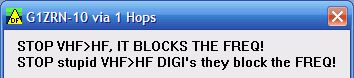
I like to think APRS is a haven from the aggravation often found on the rest of the bands, but unfortunately we have our problems too. This afternoon an APRS message appeared on my screen from G1ZRN-10 that clearly had been addressed to ALL.
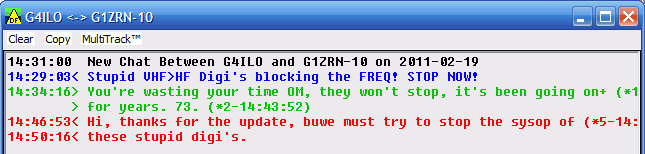
It obviously wasn’t intended for me personally. I don’t gate from one band to another. In fact at the weekend I leave my HF IGate receive-only because I don’t want to add to the mayhem. But there is a lot of traffic gated from VHF to HF by stations in the south of France. It serves no useful purpose for me in the UK to receive information about French repeaters or French radio club meetings nor is there any point in gating position beacons from French VHF stations on to 30m. But what can you do?
I don’t think getting your blood pressure up and acting like a band policeman will solve the problem. Unfortunately the language barrier doesn’t help here. Because of that there are no common forums where European APRS users meet, where an approach could be worked out. A direct approach to the offenders would need to be made by a native speaker who could gauge the individual’s attitude, find out why they are doing this, and tactfully dissuade them from it. Blunt emails in capitals and in English could easily have the opposite of the desired effect.
I think it is one of those things we just have to live with. Actually I’m not sure the effect is really that bad. I’m running just 10W to a magnetic loop in the attic and my beacons are reliably gated throughout most of the day by stations in Germany. When European HF mobiles are about I often gate them, so the network still works. But it would be nice to have a blacklist function in my IGate software so that I can refuse to pass traffic for the offending stations. If everyone did that, it might get them to mend their ways or get off the air.
Some folks have set up an alternative APRS network on 20 metres called Net14. I don’t think that’s the answer. Sure, you get away from the idiotic VHF to HF gateways, but you get away from all the other activity too. I tried it a couple of times and it was even more boring than VHF is here most of the time.
If anyone has any serious suggestions as to how to solve the problem of cross-band gating on 30m I’d be glad to hear them. Or even non-serious ones. Right, I’m off to bid for a GPS-guided missile on eBay!

Taking part
On Saturday I blew the dust (literally!) off my K3’s microphone. After I had finished sneezing, I started making some contacts in the CQ WorldWide SSB DX Contest.
This was not intended to be a serious competitive effort. My intention was to spend all of the time I could spare that weekend making contest contacts and see how many stations I could work. I spent about an hour on Saturday morning before going with Olga to the garden centre, and a couple of hours in the afternoon. On Sunday I was up earlier than normal because the clocks went back overnight, so I operated for about three hours in the morning before lunch. I had intended to do some operating in the afternoon as well but the three hours in the morning had left me feeling a bit tired and stiff so I went for a walk after lunch and then fell asleep on my return home. Getting old is my excuse!
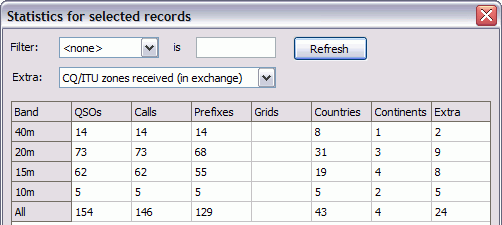
I made a total of 154 contacts in 43 different countries and 4 continents during my six hours or so of operating. The detailed breakdown, for those interested, is shown in the screen grab of the contest statistics dialog from KComm (the Extra field shows the number of CQ zones.) This would give me a claimed score of 17,487 points if my calculations are correct, which by comparison with last year’s results would place me well down the second half of the All Band Single Operator Low Power Unassisted results table.
This was the first time I had made such an effort for an SSB contest. Until now I hated turning on the radio during big SSB contests because the bands sounded like bedlam. But I had never tried with the K3 before. Instead of a mush of intermod, splatter and AGC pumping I could hear everything clearly. Sometimes I could hear two or three stations on the same frequency simultaneously, one in the foreground and a couple in the background. And the superb DSP filtering made it easy to shut out close-by stations so I could copy a weaker one. I often had the passband down to 1.8kHz and copy was still crystal clear.
Initially I started off just working the loud ones because I didn’t want to waste the serious contesters’ time by making them struggle to hear my call. But I found there was no hard and fast rule relating how strong a station was with whether they heard me. One Finnish station, 10dB over 9 with me, just kept on calling as if I wasn’t there. But many weaker ones came right back to my first call.
Frustratingly, a significant number of stations came back to me as “Golf 4 Lima India Oscar” – exactly the same error that was made when I ordered my QRSS beacon kit a couple of weeks ago. What is it about my call? This doesn’t happen on CW (though I used to get replied to as G3ILO very often as the holder of that call is a well known QRP CW operator.)
Conditions didn’t appear to be very good this weekend. I’d hoped to hear some interesting DX on 10m but I heard hardly anyone at all on the band. As always, 20m was the liveliest band, but I made almost as many contacts on 15m, probably because the QRM was less making it easier to make contacts.
I didn’t work any DX and I only worked one all time new DXCC entity – Svalbard, JW5E. I did hear a VK on 15m on Sunday morning but he had a big pileup going and after trying for about five minutes I decided not to waste any more time and move on.
Despite my unspectacular results I thoroughly enjoyed my few hours in the CQ WW DX SSB contest. No doubt QRZ.com and other online forums will be full of grumbles about contests taking over the band for the entire weekend, the only time working people can get on the air etc etc. But if you can’t beat them, why not join them?
My feeling is that contesting is one of the many different activities you can pursue and to get the most from the hobby you should try as many of those different activities as you can. As this post has hopefully shown, having indoor antennas is no obstacle to working a decent number of stations and earning a respectable score for the time spent. It’s not the winning, it’s the taking part that counts. I certainly felt like a real participant in this radiosport event and I look forward to seeing my call in the results table next year.

Fraternity?
Over the last few days a North American ham has been operating a beacon at the top end of the 30m band on the frequency that has been used for many years for HF APRS. At times this has made HF APRS operation impossible. After some difficulty, due to the fact that the beacon operator’s contact information was incorrect, someone managed to get in touch with him to point out the problems he was causing and ask politely if he would move the beacon. This is part of the reply that was received, copied verbatim from an APRS mailing list:
“Last week I moved the beacon when some other hams we’re bitching at me about ‘their’ all important!!! ham activity…… PSK, RTTY what ever!!! .
I move AGAIN then another cry baby bunch CRIES about ‘THEIR’ ALL IMPORTANT activities like weak signal CW QRRS CW whatever!
We have to SHARE the frequencies I will think about the QSY ….. if I get Bitching from so other ham ‘group’ like the DX cluster folks who are ‘DXing’ fish in a BARREL for some ALL IMPORTANT ‘certificate’ What am I to do??? I am an experimenter /builder when do I get to use a frequency????????
WHY is ‘APRS’ more important than MY activity? I look in the regs and I see NOTHING about one ham activity has priority over another!”
I have left out the individual’s details as I don’t want to start a personal attack that could be counterproductive by leading him to entrench his position. But whatever happened to good manners, politeness and consideration for one’s fellow amateur? When, as a young teenager, I first began listening on the amateur bands, I used to be impressed by the politeness and courtesy of the conversations I heard. No longer is amateur radio a gentleman’s hobby.
This OM is quite correct that we have to share the frequencies. It is a common courtesy that if a frequency is in use then you don’t use it, even if you have a net that has been meeting on that frequency every day since Marconi invented the spark transmitter.
But in the digital parts of the bands which can be used for more than conversations between two or more people, checking whether a frequency is in use may involve more than just sending “QRL?” or listening for a couple of minutes. Activities like APRS, packet radio, Winlink and so on are effectively nets that operate 24/7. If you don’t hear anything for a while that may just be because propagation isn’t sending anything your way at the moment.
This is how Chris, G4HYG prepared to select the frequency to use for APRS over PSK. He recently wrote: “Before I released the HF version of APRS Messenger I spent some time checking various frequencies on the 30m band. I found that the section from the 300 bd APRS frequency to the band edge appeared to be clear. I then started a period of monitoring the band from 10.1494 to 10.150 on a receiver with a digital mode program running with a very slow waterfall to catch anything I heard. This ran for a month from mid January to mid February.” It’s a pity the developer of the ROS digital mode that has caused so much disruption to other established activities could not have been as thorough and considerate in selecting operational frequencies.
To those who will trot out the response that activities like APRS have no more right to use a particular frequency than anything else I would say first of all that some types of activity need a specific frequency where other users can find it. It isn’t a matter of one activity being more important than another. If you had to hunt to find what frequency everyone is using today, some types of worldwide net operation would not be possible. In any case, a frequency that was clear in, say, North America might well be occupied in Europe. Allowing legitimate activities sole use of an established frequency by gentleman’s agreement is the only option. There is still plenty of room for other activities including ad-hoc beacons.
In activities like APRS, many dozens of stations all use the same frequency, making this a very efficient use of bandwidth. If users are driven off these frequencies or prevented from using these modes the result would be even less space left for other activities.
What people who object to this argument really mean is “I don’t have any interest in that mode and I don’t give a fig about those who do.” Is ham radio a fraternity? Yes, we are like a family of brothers who are forever breaking each other’s toys and beating the shit out of one another.

40m bandplan confusion
Peter, G4NKX, uncovered a can of worms the other day after encountering some unpleasantness by CW users in what has traditionally been the PSK segment of 40m starting at 7.035MHz. It appears that the 40m band plan in IARU Region 1 (Europe) has been changed, but nobody has been told, including the IARU.org website which still has copies of the old band plan coming up top in Google searches for “IARU Region 1 Bandplan“.
Under the current European band plan for 40m, CW now has free reign up to 7.040MHz, with narrow band digimodes from 7.040 to 7.050. So the start of PSK31 operation is now presumably 7.040MHz. However the bright sparks who sit in their ivory towers and decide this sort of thing clearly forgot about the real world in which people don’t find out about something unless it is shoved under their noses. People will operate where they hear other people operating, which creates a very powerful inertia against any form of change. These band plan changes came into effect on 29th March 2009, yet people are still in ignorance of them 18 months later. Where was the letter from the national society to each licensed amateur, informing them of the changes?
But more to the point, why change? It’s just a recipe for chaos and an opportunity for the band police to cause unpleasantness, just for the sake of an extra 5KHz for CW operators. It also now means that digital mode users in Europe must use a different part of the spectrum to those in the USA, making transatlantic digital DX impossible without incurring the wrath of the policemen. Frankly, I don’t blame PSK31 users for staying where they were and refusing to be shunted around by bandplan changes that don’t give them any benefits.
I’m somewhat confused about what the 40m USA bandplan is. The document on the IARU website for Region 2 shows narrow band digital modes starting at 7.035MHz. But I thought people in the USA operated PSK31 starting at 7.070MHz and other narrow band modes like JT65A at 7.075MHz? No wonder I have never heard any Stateside DX on digital.
Radio waves don’t stop at IARU regional boundaries so what is the point in having bandplans that put digital modes in different parts of the band in different regions? It just goes to prove that the powers that be who make these decisions think the only modes that matter are SSB and CW.


Interference on 30m
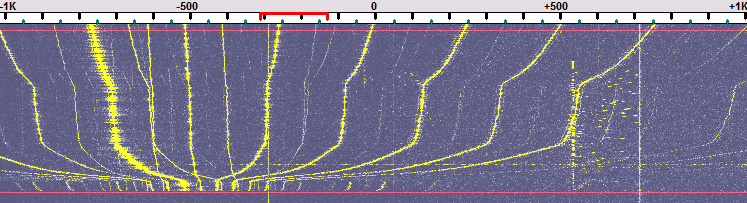
I was in the shack making a few adjustments to the Echolink software configuration. The K3 was on 30m APRS with the speaker volume turned down to almost inaudible. Suddenly, at about 1410 UTC, I heard a buzzing type of interference. I looked at the TrueTTY waterfall and saw there were interference bars every 50Hz right across the screen, strong enough to prevent anything from being decoded.

50Hz is the mains frequency here in the UK. With a sinking feeling my immediate thought was that one of the neighbours had discovered a new way to make the HF bands unusable. Then I remembered that Lynn, KJ4ERJ had posted a screenshot of similar interference only the day before in an APRS forum. I checked back, and sure enough the interference Lynn had seen in Florida was exactly the same.
I don’t know what it is, but I don’t think even my neighbours are capable of generating interference that could be heard across the Atlantic. It’s still going strong 30 minutes later. I haven’t seen an HF band wiped out like this since the Woodpecker fell silent back in the ’80s. Well, at least I’ve got Echolink!














