Archive for the ‘ham radio’ Category
 Handiham World for 07 July 2010
 July 7th, 2010 |
  Author:
 Welcome to Handiham World!
A volunteer summer
Will Tice, KC0LJL, does some soldering.

Handiham volunteer Will Tice, KC0LJL, helped out at Camp Courage by soldering some PL-259’s to random wire receiving antennas. Will learned to solder when he took an electronics class in high school. Now that he is heading into his senior year at university, he helps us with other jobs as well, including computer-related stuff.
“Look at these nice, shiny solder joints”, he says.
And speaking of volunteers, Bob Garwood, W0BV, has a first draft of the Summer Handiham World print edition ready. Bob is an experienced newsletter editor, and knows how to cut my sometimes too-long articles down to size. Look for the print edition (with a giving envelope) to show up later this summer.
Handiham volunteers Lyle Koehler, K0LR, and Eliot Ricciardelli, KE0N, will be working with me on the W0ZSW Remote Base HF station. We expected to work on the project soon after radio camp, and several important pieces of the project are now in place. We have completed our office move and have configured the office and ham shack space at Camp Courage. We have drilled holes through the concrete walls for feedlines, and our antenna team of Dave Glas, W0OXB, and John Harvard, KC0UHY, have installed an excellent 300 foot center-fed dipole fed with 450 Ohm open wire line and a current balun. The parts were donated by the Stillwater Amateur Radio Association, and a tuner was donated by Eliot, KE0N.
We are so grateful for the time and talent that all of our volunteers share with us. Thank you!
For Handiham World, I’m…
Patrick Tice
[email protected]

Handiham World for 07 July 2010
Welcome to Handiham World!
A volunteer summer
Will Tice, KC0LJL, does some soldering.
Handiham volunteer Will Tice, KC0LJL, helped out at Camp Courage by soldering some PL-259’s to random wire receiving antennas. Will learned to solder when he took an electronics class in high school. Now that he is heading into his senior year at university, he helps us with other jobs as well, including computer-related stuff.
“Look at these nice, shiny solder joints”, he says.
And speaking of volunteers, Bob Garwood, W0BV, has a first draft of the Summer Handiham World print edition ready. Bob is an experienced newsletter editor, and knows how to cut my sometimes too-long articles down to size. Look for the print edition (with a giving envelope) to show up later this summer.
Handiham volunteers Lyle Koehler, K0LR, and Eliot Ricciardelli, KE0N, will be working with me on the W0ZSW Remote Base HF station. We expected to work on the project soon after radio camp, and several important pieces of the project are now in place. We have completed our office move and have configured the office and ham shack space at Camp Courage. We have drilled holes through the concrete walls for feedlines, and our antenna team of Dave Glas, W0OXB, and John Harvard, KC0UHY, have installed an excellent 300 foot center-fed dipole fed with 450 Ohm open wire line and a current balun. The parts were donated by the Stillwater Amateur Radio Association, and a tuner was donated by Eliot, KE0N.
We are so grateful for the time and talent that all of our volunteers share with us. Thank you!
For Handiham World, I’m…
Patrick Tice
[email protected]
NEScaf Filter Saves the Day
As one of the many antenna restricted condo owners of America, I cannot operate as often as I’d like. The hassle of putting up and taking down temporary antennas wastes time, isn’t always practical and generally spoils the fun for us.
Great that we have some holidays and time off as it allows a bit more opportunity to get on the air. The MI QRP group hosted a 4th of July Sprint and although the hour was late (7-11PM EDT) since I did not have to go to work Monday, I took advantage of the chance to work a few of my fellow QRP ops.
Rain and lightning welcomed my efforts to set up an antenna. So I forsook my normal setup and settled for a twinlead 44 foot doublet hung from my 20 foot Jackite pole which was bungee cord strapped to a ladder in the back yard of our condo. The antenna ran north south so much less than ideal, but at least I could get on the air.

Freshly Built NEScaf saved my bacon!
The day was saved by my freshly built NEScaf filter. As one of the lucky ones, I recently received the latest edition of this great kit provided by the NE QRP bunch. It enabled me to listen to cw despite the high QRN and background hash from neighbor’s TV’s, computers and air conditioners. What a joy it is to actually hear stations through the noise. This is a must have accessory for the condo based QRP op! I am still learning to use it well, but am mega-impressed with the capabilities it offers. With this audio filter, I could null out the QRN and peak the CW signals making for much more relaxed and enjoyable copy. The extra audio boost helps my little Sierra audio too. Keep watching for the next round of kits!
Handiham World for 30 June 2010
Welcome to Handiham World!
Raining on a parade

Now that Field Day is over, we can look forward to a relatively quiet time on the HF bands. Summer thunderstorms are making a lot of racket, and even the 6 m band may have already peaked for the summer season. June is typically a good month for 6 m, and some activity was still being heard early yesterday morning. Sometimes sporadic-E skip can help make the VHF bands exciting during the high summer months, but you have to be on the lookout. Ducting can occur and enhance long distance communications, even on 2 m repeaters. One way to check conditions is to set your radio to scan, especially in the early morning hours. You never know what you might hear!
So let’s get to the topic at hand. I’m sure you have heard the expression “raining on a parade”. What it means is that someone has mostly negative or uncomplimentary things to say about someone else’s idea or event. After all, no one enjoys going to a parade and then having a rainstorm come up so that everyone gets soaked and the parade is ruined, right? When someone disrupts an activity for someone else, whether by simply proselytizing against it and saying negative things or by actually getting in the way of that activity, that is “raining on the parade.”
I was tuning the HF bands, listening for potential contacts, as were many other people during last weekend’s Field Day event. While my interest lies mainly in the social aspects of the contest rather than the point score, I do still enjoy listening around the bands to find out who is making contacts and what the HF propagation conditions are like. I ran across an unfortunate QSO — if you can even call it that — around 14.270 MHz. There seemed to be some kind of argument or perhaps even a monologue going on about one guy suing another guy, and then there was a CQ for a “no contest contest”, during which the caller went on and on without much listening time and sparse identification. It didn’t take long to figure out that he hated Field Day and was not shy about letting everyone else know his opinion.
Of course anyone is entitled to an opinion and the regulations say that you only need to identify your station at the end of the series of transmissions and once every 10 minutes. While making domestic contacts, there is actually no requirement to identify your station right away. The thing I find disturbing is that it seems so confrontational to behave in this ungentlemanly manner. Field Day is a popular operating activity, and this really amounts to “raining on the parade”. Why not just let people enjoy the contest during this one weekend out of the year and let it go at that? Or, if one really wanted to operate without competition from contesters, one could just as easily get on one of the bands that is not used in the contest.
Most of the amateur radio operators one meets either in person or on the air are really friendly, but a single loudmouth can give our service a bad name.
My advice?
Ignore the loudmouths and lead by giving good example yourself. Avoid the temptation to make a contact with anyone who seems primed for a verbal confrontation. Avoid giving them the satisfaction of knowing that they got your attention. This is pretty much the same thing we have been told by seasoned operators about how to deal with people who cause interference on repeaters or during scheduled nets. While it is seemingly passive to let someone blather on and simply ignore them, it is probably the most effective course of action because it does not lead to an escalation of the situation on the air. Of course willful violations of rules and regulations should be documented and reported to the governing authority, the FCC in our case, if the situation is ongoing and serious.
Wise old Elmer says:
| Always identify your transmissions. | |
| Be polite while sharing the bands. | |
| Welcome those who are new to operating, and be patient with them when they make mistakes. | |
| Be thoughtful and kind to others. | |
| Respect the fact that other operators may have different operating goals, and give them their time and space on the bands to pursue them. |
For Handiham World, I’m…
Patrick Tice
[email protected]

Handiham World for 23 June 2010
Welcome to Handiham World!
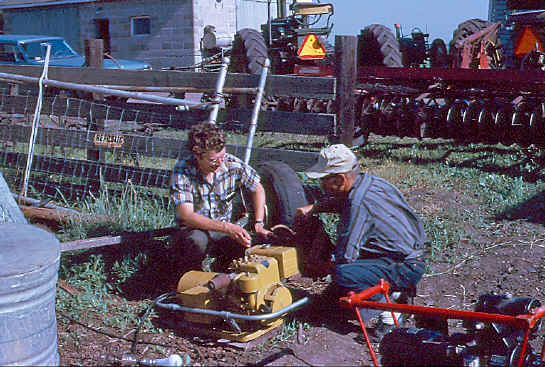
Photo: Pat, WA0TDA, left, and friend Newt, a farmer who let us use his barn for a Field Day ham shack, set up a generator. This was a Field Day with a real field – the end-fed Marconi antenna was hundreds of feet long, extending from a high point on the barn out to a solitary tree in a soybean field. Look at that head of curly hair I had back then, which I think was sometime in the early 1970’s! The old gas generator made considerable racket, so it was located as far as we could manage from the operating position. This rustic setting for the generator was in the farmyard next to Newt’s machine shed. Field Day has changed quite a bit for some of us…
Field Day is this coming weekend, June 26 and 27, 2010. We are looking forward to joining the SARA group, a Handiham-affiliate as well as an ARRL Special Service Club, for this annual operating event. Look for W0JH, our club callsign, and give us a shout. We will be operating on the HF bands as well as on 2 m, and you may even find us on Echolink.
Yes, I know that Echolink contacts do not count for Field Day points, but we will be in this contest for fun, fellowship, the promotion of amateur radio to the general public, and to use and have fun with new technologies. Earning Field Day points is far down on our list of priorities, and that brings me to what I have mentioned before in my columns and podcasts: Different clubs and individual amateur radio operators have different priorities for operation on ARRL Field Day. Some will be in aggressive contesting mode and will work hard to earn as many points as possible, often with multiple CW stations earning double points for Morse code contacts. Considerable effort will be put into impressive antenna systems and station staffing will include the best and most experienced operators. The logging system will be state-of-the-art and the entire operation will be carried off with military precision. Other clubs, like ours, will not consider high point scores as our first goal. The success of our operation will be whether or not we had fun getting on the air. I’ve had decades of ham radio experience, and that has given me a chance to approach Field Day from different angles. This leads to the observation that Field Day rules, while designed to be broad enough to include a variety of interests and goals, also set up a certain tension between contesting and the other goals, such as showcasing amateur radio to the general public, training new operators by getting them on the air, exposing seasoned operators to new technology, preparing for and operating in a simulated emergency situation, and drawing in family members to observe and participate.
Tension? What do you mean by that?
Well, here’s the deal. If a club is really in it for the points, the top priority will be finding a location for the event that enhances operating, setting up stations with elaborate antenna systems, spending a significant amount of time operating CW for the double point score, designing and deploying bulletproof supporting systems that include multiple power sources independent of the grid and a shared logging system. Serious clubs will prepare all year long for this event and operator training will be a significant part of the preparation. All of this is well and good, and all of it is rewarded handsomely in the point scoring system. And who can argue with extensive preparation and training? Both are important aspects of emergency preparedness.
The problem is that the very nature of this kind of operation is that it can suffer enormously if it is compromised by allowing inexperienced operators to run the stations. True, those inexperienced operators may hold General or Extra licenses, but they may have little or no Morse code experience. If they do operate CW, they may do so at a much slower speed than the experienced operators in the club. Relegated to the phone stations, these relative newcomers to HF operation may still work stations at a far slower rate than experienced phone operators. The best Field Day location for antenna systems that are really competitive may not be the easiest site to get to. Club members who have family, work, or school obligations will find it difficult to participate in multiple planning and training sessions in the months prior to the contest. Do you see what I’m getting at? It might be said that “winning” in contest mode requires quite a different mindset and singular dedication toward scoring points than the other goals typically associated with a more inclusive Field Day experience. Let’s take a look at the object of Field Day, as stated in the official rules:
“To work as many stations as possible on any and all amateur bands (excluding the 60, 30, 17, and 12-meter bands) and in doing so to learn to operate in abnormal situations in less than optimal conditions. A premium is placed on developing skills to meet the challenges of emergency preparedness as well as to acquaint the general public with the capabilities of Amateur Radio.”
Okay, working as many stations as possible probably means a no holds barred contest station. However, developing skills to meet the challenges of emergency preparedness is quite a different matter unless you are willing to compromise your point score to spend a significant amount of time during the event training relative newcomers to HF. Furthermore, if your site is optimally placed for contesting but inaccessible to people who can’t hike up a rocky slope, I would have to argue that you would not only be shutting out club members with disabilities but also discouraging observation by the general public.
Some considerable effort over the years has been made to meld these otherwise incompatible goals. The “GOTA”, or “Get on the Air” station concept was designed to fulfill the goal of getting newbies on the air while still allowing the more experienced operators to run up the point score on the other stations. The GOTA station could then also served as a point of demonstration to members of the press or general public who happened to show up. Still, there remains a sort of stigma about the GOTA operation in some clubs, where it is looked upon as a necessary but inconvenient compromise to the primary goal, which is to earn lots of points. Still, the rules do allow bonus points for locating in a publicly accessible place and having an information table. The question for any serious contest group will be how to compromise between optimal contest operation and putting on a show for the general public and training new operators. Some points are awarded for copying or passing messages. Again, this remains somewhat of a sideline activity to simply working as many stations as possible, preferably in a mode that allows for a higher point score.
Can you imagine a real-life emergency situation in which amateur radio repeaters, if they were available, would not be used? When the Interstate 35W bridge collapsed here in the Twin Cities several years ago, you can bet that the repeaters were buzzing with activity. Nonetheless, making Field Day contacts on repeater systems for points is prohibited by the rules. Some clubs will use their repeater systems for so-called “talk-in” information to guide participants to the Field Day site or to give out information of interest to the greater amateur radio community. Of course Echolink and IRLP contacts are not valid for points, either. If your club wishes to use these new technologies, you may not list the contacts for point scoring purposes, though they may be of great interest to the general public.
Extra consideration is given for CW operation, which earns two points for every contact as opposed to a phone contact, which earns only one point. Similarly, digital mode operation counts for two points per contact. From what I have observed over the years, CW is a highly efficient mode of operation that lends itself to really racking up the points, at least at the hands of experienced operators. I’m not sure exactly why it needs the extra boost of a point subsidy, but I suppose this could encourage the old timers to let a couple of newer, less experienced CW operators take over for a shift or two. The two point subsidy for digital contacts might be somewhat more justified as a means to promote more digital operation. Still, if special point considerations are given for digital operation and satellite contacts (bonus points), I do have to confess that I am somewhat at a loss as to why Echolink, IRLP, or WIRES capability isn’t at least recognized in some kind of bonus point scheme if not outright point scores per contact. After all, these technologies will define amateur radio operation for a significant part of the ham radio population in the years to come — as they do right now in this rather disappointing lingering sunspot minimum when HF operation has been lackluster at best.
Yes, I have heard all the arguments before about how repeaters cannot be tied up with any sort of contesting activity and how Echolink isn’t real ham radio. I understand the reluctance of clubs to step too far outside the bounds of tradition. There are good and compelling reasons why unleashing contest activity onto repeater systems might be a really bad idea. Visions of repeaters tied up for hours on end come to mind. A repeater tied up with contest activity would be unavailable in an emergency. Contacts through an Echolink repeater would be said to make use of non-ham radio technology, doing an end run around the purpose and scope of amateur radio. These are all valid concerns, but I would counter that one can drive across the country these days scanning for repeater activity and finding city after city where the repeaters sit virtually dormant if not outright comatose. What would be wrong with actually using these resources? I’m going to stick my neck out and say that the horror stories of repeaters being tied up and in constant use will not come to pass. If using a repeater as a talk-in station or just to make random contacts to demonstrate the repeater and ham radio to the general public suits you, go for it. Believe me, with most repeaters going hours and sometimes days on end with no activity, you probably won’t stand much chance of causing a problem.
And what if you make an Echolink contact or two? Don’t count it in the Field Day log, but at least use the opportunity to enjoy the latest communications technology.
For Handiham World, I’m…
Patrick Tice
[email protected]
Oh, and if you want to join the Field Day fun with us, check out the Oakdale Discovery Center, starting at 10:00 a.m. on Saturday, June 26, when we will be starting the station setup. The SARA Field Day will include a cooperative project with University of Minnesota students to launch a helium balloon, which will be tethered to fly above the Field Day site and transmit ATV – Amateur Television – pictures to the ground from aloft. Points? No. Fun? Yes.
Oakdale Discovery Center
4444 Hadley Ave N
St Paul, MN 55128-2651
W0JH Repeater Talk-In
The SARA 2m repeater is on 147.060 MHz, with a positive offset (transmit on 147.660 MHz). It is an open repeater. You need a tone of 114.8 Hz on your transmit signal.

Polar Bear Summer Picnic Event Jun 2010
My favorite QRP group is the Polar Bear QRP gang! We have a good time and enjoy outdoors activities and trying to connect with one another at least once a month with some kind of activity. To escape some of the heat, I got an early start on the day. I wanted to try out a new mini-bac antenna configuration and knew it would take some time to get it up into the trees. BOY WAS THAT AN UNDERSTATEMENT! It was 110 ft doublet with a 40 ft feedline that was setup as a ladder line. Not an easy one to get up single-handed. Thanks to some tall trees, was able to get it up about 40-45 feet in the pine trees. It loaded great on 40m, but was disappointing on 20m so I ended up setting up my W3EDP in an L from my 20 ft Jackite pole to a nearby cedar tree at about 35 feet. The sun chased me into the treeline where I settled in to chase bears.

Abandoned mini-back doublet feedline hangs in foreground
My xyl Connie took a picture that shows the mini-back feedline hanging in the breeze after I shifted positions and setup the W3EDP in the shade. Grrrrr!

Osprey perched right above my head…cell phone picture
Was able to work a couple of the Polar Bears, Mike W3MC in MD and Guy N7UN up in the mountains on a trail(?) in NJ. I heard VA2SG but he was at ESP level briefly then faded away. I did hear a few others working him though. WA8REI was working Guy but I could not hear him at all and ended up tail ending their QSO to connect with N7UN.
Got to work a few others through the QSB and poor signal strength on 20m including Pastor Les, K4NK in SC, KE5SBZ, Ed in TX, N1FJ in MA, and Phil W3HZZ in Atlanta so it was a nice way to spend a few hours outdoors in the heat.
Connie brought me a picnic lunch and we enjoyed the osprey and bald eagle show as they fished Lake Fredrica.

Had to drink extra coffee to copy speedy W3MC's signal

This is the life… outdoors and ham radio…making QSO's…PTL!
Handiham World for 16 June 2010
Welcome to Handiham World!
What coax should I use?

Question:
The repeaters I want to use are all just a bit too far away for me to work with an indoor antenna or a handheld radio. I want to install an outdoor antenna so that I can use several different VHF and UHF repeaters. I already have a dual-band 2m/70cm vertical antenna, but what kind of coax should I use? I am thinking about RG-58 or RG-8X, because they are cheaper and easy to work with than the thicker RG-8 or RG-213. My cable run will be about 100 feet.
Answer:
Since the repeaters you plan to work are probably located in different compass directions, your choice of a vertical antenna is a good one, as long as the repeaters are not so far away that you would need a directional antenna with more gain. The directional antenna usually means an extra investment in a rotator system, a considerable expense and an additional accessory to maintain over the ensuing years.
One thing you will not want to skimp on is your feedline, especially if it is to be used for VHF and UHF work, and when the feedline is going to be run for a considerable distance. A short run of RG-8X, under 25 feet, is probably acceptable for VHF work. The problem with these thin, cheaper feedlines is that they lose quite a significant amount of signal – both on receive and on transmit – and the savings in initial cost for the coax are quickly offset by the poor performance they introduce to your otherwise well-designed system. RG-58 is such thin, fragile coax that it is a poor choice for anything but temporary use or short connecting cables used in test situations. It is very lossy and should not be used over long runs, even for HF operation. Its fragility means that it can easily break.
Let’s take a look at the loss for a typical VHF frequency, 146.52 MHz for three common types of coax, all assuming a 100 foot run.
RG-58: Power in = 100 Watts. Power out = 34 Watts. Total loss is 4.7 dB. Ouch!
RG-8X: Power in = 100 Watts. Power out = 39 Watts. Total loss is 4.1 dB. Ouch!
RG-213: Power in = 100 Watts. Power out = 55 Watts. Total loss is 2.6 dB.
As you can see, the unfortunate truth is that all of these cables have significant loss, but the cheaper cables will end up turning most of your signal into heat. Only the RG-213 comes close to being acceptable for VHF use with a 100 foot run.
Now for something really scary, let’s try a 70cm frequency, 446.0 MHz, with the same cable run.
RG-58: Power in = 100 Watts. Power out = 13 Watts. Total loss is 8.9 dB. Double Ouch!
RG-8X: Power in = 100 Watts. Power out = 15 Watts. Total loss is 8.2 dB. Double Ouch!
RG-213: Power in = 100 Watts. Power out = 32 Watts. Total loss is 5 dB. Ouch!
Discussion:
Even with the best of these three coax types, you are still getting less than one third of your signal to the antenna. Remember that it works the same way on receive. And why would you even bother with RG-58 or RG-8X for UHF work, when 100 Watts turns into only 15 Watts or less? Long runs of cheap, lossy cable might as well just be dummy loads!
As you can see from the results we have listed, the loss per distance unit of feedline goes up when the frequency goes up. Therefore, a cheaper grade of feedline might be acceptable for use on 3.9 MHz, but far too lossy for use at VHF or UHF. Another consideration is that if one intends to use even higher transmit power levels, cheaper coax must not be used because it may arc over and fail. It is generally acceptable only for lower power levels.
The results we listed are for SWR readings that are virtually perfect, 1:1. Since no antenna installation is perfect and minor mismatches occur in even a carefully-designed system, the actual loss will be even higher than what we listed. This makes using good feedline even more important.
To summarize, you will have several important choices to make when you plan your VHF/UHF antenna system. You will want to decide which repeaters you want to work, their compass directions from your station, and whether you will need to choose a directional antenna or a vertical antenna. The supporting structure will add height, which is generally a good thing for effective VHF/UHF work, but also add to the length of a feedline, and longer feedline runs mean more loss. If you want to try weak-signal work on VHF and UHF, you will need a rotator and a horizontally-polarized directional antenna. Unlike repeater operation, weak signal work on SSB and CW absolutely demands good quality feedline for the lowest loss possible. FM repeater operation is less demanding, and will require vertical polarization. You may be able make your horizontally-polarized system work for repeaters, but your vertically-polarized antenna will not be effective for weak signal work on SSB and CW.
Our recommendation is to use good quality feedline for every installation, avoiding higher loss coax except for short connectors and temporary use in sort runs.
Resources:
Are you wondering how we calculated the loss for examples we used in this article? It was easy with the online calculator we found at the KC7HXC website!
For Handiham World, I’m…
Patrick Tice
[email protected]














