Archive for the ‘ham radio’ Category
 Cannot Get Enough QRP Portable
 August 20th, 2010 |
  Author:
 Now into the third week of my sabbatical, I am surprised how much I want to get out and operate my QRP portable gear. Guess I have deprived myself over the years of being a confirmed workaholic and avoiding time off, vacations, and time for my favorite hobby.

Grrrrr! The Polar Bears Are On The Loose!
This should be a good weekend for QRP portable. The Polar Bear QRP Group will be out for another Polar Bear Summer Picnic Event and Polar Bears from Spain to the West Coast of the US will be out looking for BSO’s. Grrrrr! I am PB #173 and we’re over 200 members now. With the new Twitter and APRS connections to QRPSPOTS.COM which also point to the excellent spotting site of K3UK with a section for FISTS/QRP Ops to spot and sked one another, there are plenty of ways to use technology to help find each other. Add in a few other contests and state QSO parties, and there should be some buzzing going on this weekend. Makes me wonder when the FOBB results will be announced! Buzzzz Buzzzzz
I’ll be out and if all goes well I will be field testing a new C Pole antenna based on the suggestion I received from Neil W0LVZ. I added some switchable capacitance to my BLT+ and have rewound the main toroid to see if I can push the range a bit more with it so will have a delta loop and probably my W3EDP in the air too. I love playing with antennas and am still amazed when the ones I build actually make contacts!
Give a listen for me on the QRP watering holes on 40m, 30m and 20m Saturday morning. I’ll be self spotting on QRPSPOTS and the K3UK sites to make it easier for you to find me. Let me know how my newest antenna is workin’.
72,
Kelly K4UPG
PB #173
Handiham World for 18 August 2010
Welcome to Handiham World!
Second remote base station goes into beta testing phase
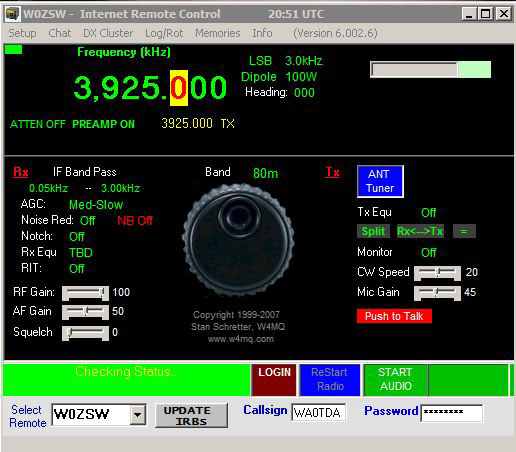
With the addition of the W0ZSW remote base at Handiham headquarters, members now have a choice of two remote base stations. Users who have signed up for access to the “Handiham Remote Base” (W0EQO) will be added automatically to the list for W0ZSW, with the same password. The remote base concept has been gaining in popularity as more of us want to be able to use an HF radio without the need to drag along a lot of extra gear while traveling. Some users live in condos or antenna-restricted areas and simply want to expand their operating horizons beyond VHF and UHF repeaters. The remote base stations allow users to operate real HF radios connected to real antennas, and make friends far and wide on the HF bands.
The W0EQO station at Courage North, a Kenwood TS-480SAT equipped with the VG-S1 voice module, is preferred by our members who are blind. We have a Kenwood TS-570S set up at this time in the W0ZSW station at Camp Courage. The two stations are quite a distance apart, hundreds of miles, so they can be used at the same time with no chance of interference between the two. W0EQO is in the tall pines of northern Minnesota, near the headwaters of the Mississippi river. The location is a very quiet one, with little interference. We have reports of users making very successful DX contacts. The station operates on 80 through 10 meters. This is due to the capabilities of the current antenna, a G5RV, which will not tune on 160 or 6 meters. The W0ZSW remote base station has a 300 foot “W0OXB Special” antenna, up an average of 45 feet. This antenna covers 160 through 6 meters, including the WARC bands. The W0EQO station will hopefully get an upgraded antenna system later this year, bringing it more in line with the W0ZSW station for band coverage and performance. Camp Courage is about 40 miles west of Minneapolis.
The DSL internet service has given us a great deal of trouble at Camp Courage, so the W0ZSW station has been off line as much or more than it has been on line. We hope to remedy this situation soon, but I have been tied up in meetings and office work and have been running behind with this project. One other issue with the W0ZSW remote is that we do not have the frequency speech readout working. The TS-570 does have the VS-3 voice module, but apparently the software does not support the voice readout. It may be necessary to replace the radio with another model for which the speech output will work if we cannot find a solution for the TS-570.
Lyle, K0LR, and Eliot, KE0N, have been working with me on this project and we are anxious to get it out of beta testing and on the air for our users. Please keep watching the Handiham website and this newsletter for the latest updates.
73,
Patrick Tice, WA0TDA
Handiham Manager
[email protected]

Antenna Ideas: Please Keep ‘em Coming!
After last week’s plea for antenna ideas for my antenna restricted condo, I received a good number of comments both on and off blog. Thanks for those… great food for thought. That is why I enjoy our QRP community. We don’t hesitate to share ideas with one another.
This morning as I took my daily walk around the lake, I met our condo association president. He graciously is allowing me to sink a pipe that will serve as a base to set up my Jackite poles in the backyard. I will be able to pop a cap on the top and keep the dirt and water out and just slide my fiberglass poles into the mount and be on the air in no time. YAHOO… that is a pretty good solution for now.

C Pole Antenna by W0VLZ
But being the antenna tweak that I am, I continue to look for the best alternatives I can find. I’ve started to put together the parts for the C Pole antenna that Niel W0VLZ pointed out to me. He has a fine site with lots of good QRP info too.
So, do you have another idea that can top that one? Or maybe you have a thought for what kind of vertical setup I might use with the new mount?
I’m standing by for my next project assignment.
72,
Kelly K4UPG
What Would You Do? Antenna ideas anyone?
We purchased our condo before I got back into ham radio. Like most in Orlando, we have antenna restrictions. I can put up portable or temporary antennas but cannot mount anything to the building permanently. I’d love to be able to get on the air without all the hassles of dragging gear to the porch, setting up an antenna and then tearing it all down again. It takes so much time to setup and tear down that it turns a few minutes of operating into a long process.
Here’s the layout I have to work with at the QTH…

The front yard view… I am next door down from the blue car

Preferred antenna site is the backyard
The buildings run north and south and these photos are shot facing due north. My condo is ground floor, second from the south end of the building. Yes, that is a big electrical transformer box and a major underground feeder line runs to it from the north.
I’ve used my Buddistick with some success but it doesn’t like being so close to the buildings and the swr is higher than when it is out in the open. I also have run a doublet inverted vee fed with twinlead but the north south orientation is not very favorable from my Florida QTH and sends most of my rf into the two buildings. My W3EDP works fairly well as an inverted L with my 20′ Jackite pole and I’ve used end fed halfwaves as slopers and inverted vees but again the directivity is not favorably oriented. I have a 3 foot magnetic loop propped against the wall but it is not working as well as I’d like yet. (i.e. the outdoor antennas work LOTS better so far)
Thought I’d ask ya’ll for some input.
Any outrageous ideas or thoughts for me? Send me a comment and let me know.
Thanks in advance for your thoughts.
Handiham World for 11 August 2010
Welcome to Handiham World!
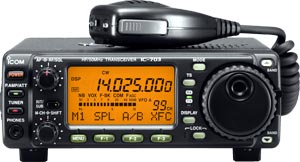
From time to time we will feature a special operating skills essay, a short discussion of a topic related to building better operating habits on the air. There has always been a need to learn operating skills in amateur radio, but a great deal has changed over the history of radio, so the skills necessary must also follow this changing technology.
Some operating skills are very basic and one might think that they have changed little over the years. But remember, all of you old timers out there, newcomers to amateur radio now enter the hobby in a much different way than you did — or I did, for that matter. When I got interested in radio as a teenager, the thing to do was listen to short-wave radio. Many hours were spent listening on the air and learning about how to operate by simply hearing stations use their call signs, make contacts with other stations local and distant, or using those new things called “repeaters” on the VHF band. A licensing exam for a “Novice” license included a five word per minute Morse code exam. You were expected to get on the air and operate, learning as you went, for a specified time, after which you had to take the General Class exam or else find yourself another hobby. The system promoted the learning of basic operating skills from the beginning.
That is not the case today.
Newcomers to amateur radio today generally don’t even own short-wave receivers. Some may have listened to repeater traffic on VHF/UHF scanning radios, but their listening experience doesn’t come close to being the same kind of experience many of us had on the short-wave bands decades ago. The Novice Class examination is long gone from the requirements, as is any kind of Morse code exam. Now, don’t get me wrong; I am not complaining about these changes at all. Change is a normal part of life and we all realize that technology, including amateur radio, must change and evolve over the years. Unfortunately, even though our licensing process and structure has changed and technology has evolved radically, we have really not managed to figure out a way to teach basic operating skills before our newly-licensed hams press the push to talk button for the first time. Furthermore, the experience most Technician Class operators will have on repeater systems will not adequately train them in operating skills suitable for the HF bands. This has resulted in a situation where General and even Extra Class operators can be very weak in what we once considered basic operating techniques.
Fortunately, today we have more resources than ever to teach operating skills. The personal computer and the Internet offer vast resources and great potential. We can produce audio and video lectures to train people in basic operating. Radio clubs can have websites with “how-to” links. Amateur radio websites around the world offer help if only you can figure out how to find it. Helpers and teachers (Elmers) can connect with a person needing help using many different Internet tools, including e-mail reflectors, social networking sites, and Echolink-enabled repeater systems. VoIP systems like Skype can connect a newcomer needing some personal help in operating skills with an experienced operator on a one on one basis. The problem is that the application of this technology is scattered and inconsistent. Some radio clubs might be quite aggressive in helping their new members learn how to operate, while others do not. Some newcomers to amateur radio are able to figure things out for themselves, while others start out with bad habits and never seem to change.
What can you or I do about this?
Training excellent amateur radio operators begins at home. I have a mirror, and I look at myself in it every day. Sometimes I don’t like what I see and I know that I have to make changes. The same is true with my own amateur radio operating skills. From time to time, I need to just think about how I am doing things and about how I might do them better. Listening on the air to operators who really know how to conduct a net or snag a DX contact can really show me how other operators with better skills in these areas than mine succeed where I might not be doing so well. Listen, listen, listen. Think to yourself about how you can change your operating technique to more closely match that of the best operator you hear on the air.
Clubs and organizations can help, too. Offer club programs or even small study groups that promote operating skills. Do tabletop exercises, simulating on the air operation. Recognize good operating with awards. Use the Internet to promote good operating by including operating articles and tips on the club website. Develop on the air opportunities like practice nets where club members can develop their skills. The key to helping other people learn is to be helpful but non-judgmental. Learning takes place best in a non-stressful situation, so beginning with tabletop exercises where the mistakes people might make will not go out over the repeater system is a good idea.
I would like to hear some ideas from our readers and listeners about what has worked for you and for your local radio club as you bring newcomers into the fold. From time to time, I will be writing one of these short essays about some kind of operating skill. We will do our best to make a good operator out of each and every Handiham member. Some of you may have an idea for a unique and creative way to run a small operating skills class. Please share those ideas with us so that we can help make amateur radio better.
73,
Patrick Tice, WA0TDA
Handiham Manager
[email protected]

Toe Dipping & Antenna Modeling

I still think the tin foil does the magic!
After years of neglect, this analog era ham is willing to admit I only understand a bit about digital electronics. (Yep! Pun intended.) Well into the second week of my sabbatical leave, I have begun to plot out a course of study to get up to speed on the state of the art that I have so long neglected. Should be fun. There seems to be a good bit of open source help online these days and I have my trusty ARRL Handbook, Extra Class study guide, Antenna Handbook and assortment of other aids.
Any suggestions from the veteran techies out there will be greatly appreciated.
I am a learn by doing/hands-on sort of guy and find deep theory puts me into a semi-catatonic state after a few minutes. For me, it’s a whole lot more fun to take a stab at things and find out if they smoke, and it also makes a lot more sense when I can dink and tweak and see what that actually does. But since that is a bit expensive, perhaps I should learn how to use software like spice to do simulations? Any recommendations for how to learn this software?
Another area of toe dipping will be learning to do antenna modeling. For years I’ve looked at those charts and made little sense out of them. HA… I like to throw wire out and see what happens, but in the summer heat, maybe it is wiser to do a bit of modeling from my air conditioned den?

Thanks WX7S– Your site looks AWESOME for learning this stuff!
I’ll try to share some of the learning curve, but would love to hear from some of you that have gone before. Shortcuts are nice. WX7S your site looks like a great place for me to start! Thanks for the effort it takes to do that.
This weekend (Sat 14 Aug 2010) the Central Florida QRP Group will gather for breakfast at 0730 (Denny’s in Sanford, FL) and off to Sylvan Lake Park in Sanford, FL at 0900 EDT to operate. If you like cw and qrp or are just plain curious… come join us!
Handiham World for 04 August 2010
Welcome to Handiham World!
Daisy book version of Handiham World Summer 2010 is released

DAISY books provide spoken word audio that is connected to text. The Summer Handiham World will soon arrive in regular print, but that isn’t much good to our blind members, except for the giving envelope that will be enclosed. We are hoping that our members will help us out with a little extra this summer so that we can keep our services coming.
Now we are offering a Daisy version of the newsletter, and we think you will enjoy it. The print edition of the newsletter doesn’t have the complete set of articles that this Daisy version has. The reason is that a print newsletter is limited to only 4 pages. We can make our Daisy version as long as we want.
Why should you use a Daisy book? Well, that is a good question. You may have been satisfied with cassette tape books for the past 30 years or more, and the tapes played nicely in your Library of Congress audio book player. Indeed, that technology has served our Handiham members very well over the decades, but it has its shortcomings. Tapes would sometimes not be recorded properly. Occasionally parts of the audio would be cut off when the tape wasn’t quite long enough. Once in awhile a tape would break and wind itself around the capstan or rubber drive wheel in the player and really make a mess. The cassettes themselves did not hold much program material, even in the 4-track format used in LOC players. The audio quality was poor, and even worse in 4-track mode where the tape speed was half the normal speed. If you wanted to find a particular article or chapter, you either had to guess which tape it might be on (a typical book had multiple cassettes) and which side and track it might be on. This was seldom a big deal if one was listening to a novel, but if you were reading some kind of a textbook or reference book and wanted to find a particular topic, well, let’s just say you had your work cut out for you.
DAISY is an acronym that stands for “Digital Accessible Information System”. It is properly spelled in all capital letters, but generally when I write articles I capitalize only the D so that Daisy production software will say “Daisy” instead of spelling out each letter. In this article, I have mixed both spellings. Maybe some of our readers who use Jaws or Window-Eyes will let me know if those screen readers differentiate between the two spellings. I do know for sure that the Daisy production software behaves as I said, spelling out Daisy if all the letters are in caps.
That little trick is just one of many that I have learned in producing accessible materials for our Handiham members. Even so, every time I work on another production I learn something new. I could say plenty more about that, but I still haven’t told you about the advantages of reading a Daisy book instead of a cassette tape book. A Daisy book can be played, which means to say listened to, on the new Library of Congress players that are currently being issued. You can also listen to a Daisy book on your computer. Often times the Daisy book can be simply downloaded via the Internet, which allows the user to bypass the time-consuming process of using regular postal mail. Your Library of Congress player can play the Daisy book that you download to your computer if you wish. If you don’t like the Library of Congress player or you think it’s too large to carry around when you are going places, you can buy a commercial Daisy player that will double as an MP3 player.
Since Daisy formatting includes the text of the book, you can use your player to search for a term within the text and skip directly to that part of the book. Or you can browse the book’s contents and go to the section of the book, say a particular article, that you want to read. There is no more fumbling around with a box full of cassette tapes that get mixed up, since a Daisy book can fit on a single USB cartridge or in a single folder on a personal computer.
The audio quality of a Daisy book is very good to start with, and it stays that way no matter how many times you play it. A Daisy book doesn’t wear out, break, and get tangled up like a cassette tape.
Are you ready to learn more?
How to get started:
You will need a DAISY book reader. You can easily read DAISY on your computer, but you need a software program to do so. AMIS is a free of charge, open source DAISY book playback software. Version 3.1 is the latest stable release of AMIS. You can view the release notes, learn the latest news, or download AMIS by visiting Daisy.org.
Next, you will need to download the Daisy book, in this case the Handiham World Summer 2010 newsletter itself. It is a zip file, and you will find it on the Handiham website.
Unzip the file with an unzipping utility (built into later versions of Windows or freely available), and place all the files in a single folder. Then use AMIS to open the book. The file you want AMIS to open is speechgen.opf. All the files from the folder must be in the same folder for AMIS to read the book.
I don’t expect all of our readers and listeners to figure this out without running into a few problems. As with anything that must be learned, being patient is definitely a virtue. If something doesn’t work the first time, go back through the instructions and make sure you didn’t skip some vital step. The DAISY website has a frequently asked questions page just for AMIS.
Hopefully you will find that reading Daisy books is both easy and fun. If you haven’t tried Daisy yet, this is your chance! If there are any volunteers out there who want to help us make books into Daisy format, please let me know. It does not require a huge investment, and you may even have all of the computing equipment you need. I am considering making some tutorials and also teaching Daisy book use at our next Radio Camp session in August, 2011.
Links to the resources mentioned here are available on the Handiham.org website. We don’t include links in the text of these stories because they mess up the podcast production process.
73,
Patrick Tice, WA0TDA
Handiham Manager
[email protected]














