Archive for the ‘crossband’ Category
 630m Crossband Summary
 November 3rd, 2014 |
 Author:
Friday evening's 630m crossband activity was 'interesting' in many respects. Propagation, which had been improving slowly, chose to follow Murphy's Law. The K-index, holding at a quiet '1', rose to level '3' by the time our event had concluded, as the geomagnetic activity ramped up. Additionally, lightning pocketed various areas of the continent, making listening noisy for many.
From here on Mayne Island (CN88iu), good two-way CW crossband contacts were made with the stations in the following order:
- N7IO (Seattle, Washington)
- VE7CA (North Vancouver, BC)
- KK7UV (Missoula, Montana)
- NW7E (Bend, Oregon)
- KU7Z (Ogden, Utah)
- VA5LF (Saskatoon, Sakatchewan)
- K7SF (Portland, Oregon)
- VE7BKX (North Vancouver, BC)
- K6TOP (Los Gatos, California)
- ABØCW (Westminster, Colorado)
- NO3M (Saegerton, Pennsylvania)
- KB5NJD (Duncanville, Texas)
- W7MTL (Independence, Oregon)
- KØSBV (Tucson, Arizona)
- WB6DCE (Seaside, California)
- KO6BB (Merced, California)
- K6CLS (Palo Alto, California)
- WY3B (Kaneohe, Hawaii)
- AA7U (La Grande, Oregon)
I was also more than excited to exchange signal reports with Pennsylvania and Texas. Considering conditions, this distance was far beyond my expectation but both of these stations have very efficient, dedicated 630m antenna systems.
John, VE7BDQ, worked the following stations on crossband:
- VE7CA (North Vancouver, BC)
- W7DRA (Seattle, Washington)
- N7IO (Seattle, Washington)
- NW7E (Bend, Oregon)
- KK7UV (Missoula, Montana)
- KU7Z (Ogden, Utah)
- VA7JWS (Delta, BC)
- VA5LF (Saskatoon, Sakatchewan)
- WB6W (Oysterville, Washington)
- K5HK (Reno, Nevada)
- KØSBV (Tucson, Arizona)
- WY3B (Kaneohe, Hawaii)
It was gratifying to see all of these fellows making the effort to listen for our signals or to attempt the QSO.
This exercise taught me a few things about our new band.
- It is not necessary to have huge antennas and acreage to make this band work. Good solid contacts can be easily made with small backyard antenna systems.
- With good systems on both ends, transcontinental QSO's can be made.
- There really should be more interest by Canadian amateurs in their newest band as so much work has been put into securing this portion of the spectrum as a ham band. It was very disappointing not to work any stations in VE6, VE4 or VE3 land.
- There is already much interest in this band by U.S. amateurs, many of them anxiously awaiting the day that they can also call it a ham band.
I would like very much to continue this type of crossband activity to try and generate more interest in our new band. I'm presently considering a weekly, one-night crossband operation, similar to Friday's event, perhaps running for one hour per week. The main difficulty will be in getting the word out to those that might wish to participate.
CQ Crossband – Final Call – 630m Tomorrow Night
The three VE stations active on 630m CW are looking forward to working you tomorrow (Halloween) evening via the crossband mode during the 630m Activity Night.
In the east, watch for VO1NA. On the west side, watch for VE7BDQ and VE7SL. Here are the transmitting frequencies, times and HF calling frequencies:
- VO1NA - Joe, in Torbay, Newfoundland. Joe will transmit on 477.7 kHz starting at 2130Z Oct 31 and will continue until 0130Z Nov 1. He will listen for callers on 3562 kHz and 7062 kHz.
- VE7BDQ - John, in Delta, B.C. John will transmit on 474.0 kHz starting at 0100Z and will continue until 1000Z on Nov 1. He will listen for callers on 3536 kHz.
- VE7SL - Steve, on Mayne Island, B.C. I will transmit on 473.0 kHz starting at 0200Z and will continue until 0600Z on Nov 1. I will listen for callers on 3566 kHz and 7066 kHz.
I have no idea how many stations will be participating on HF but please do not give up should your first few calls not be answered. If conditions appear to be really good, operating hours will probably be extended. Unfortunately Saturday night will probably be out since it is the Sweepstakes CW weekend and will pretty much plug the HF bands, wiping out the calling frequencies.
Don't forget to watch for the Part 5 Experimental stations (WG2's and WD2's) who will be beaconing and working each other on 630m directly. I'm sure they would appreciate your 'heard' reports as well.
Good luck and see you tomorrow.
630m Crossband Activity Night Reminder
Just a reminder about the 630m Activity Night coming up at the end of this month. You may recall the details in an earlier blog. I think the most exciting thing about this evening will be the opportunity to try to make a crossband CW contact between one or more of the three participating Canadian stations, hopefully covering both ends of the country:
- VO1NA - Joe, in Torbay, Newfoundland. Joe will transmit on 477.7 kHz starting at 2130Z Oct 31 and will continue until 0130Z Nov 1. He will listen for callers on 3562 kHz and 7062 kHz.
- VE7BDQ - John, in Delta, B.C. John will transmit on 474.0 kHz starting at 0100Z and will continue until 1000Z on Nov 1. He will listen for callers on 3536 kHz.
- VE7SL - Steve, on Mayne Island, B.C. I will transmit on 473.0 kHz starting at 0200Z and will continue until 0600Z on Nov 1. I will listen for callers on 3566 kHz and 7066 kHz.

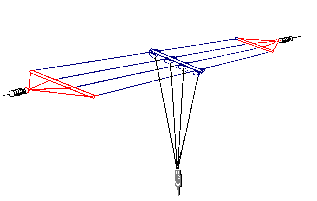
Joe should have pretty good coverage of the east coast with his fine antenna system, shown above.
Please note that, at present, the 'crossband activity' is planned for Friday evening only since Saturday night's CW Sweepstakes Contest will make HF listening more difficult.
All stations will either call CQ or run “VVV” marker beacons while listening on their respective HF receive (QSX) frequencies, which will be included in the CQ or marker beacon message.
Also know that it is completely legal for U.S. and VE amateurs to contact Canadian amateurs via the crossband mode. Unfortunately, it is not possible to contact those stations that may be operating in the Experimental Service and not using an amateur radio callsign.
For additional information, please see the ARRL's description of the event.
Remember that you don't need a fancy antenna to listen on 630m. One of your HF antennas, fed as a 'longwire', will probably do the job....even better if you can tune it to resonance.
I will blog another reminder just before the event. We all hope that you can be there!