Archive for the ‘antennas’ Category
 SMA Failure
 July 2nd, 2010 |
  Author:
 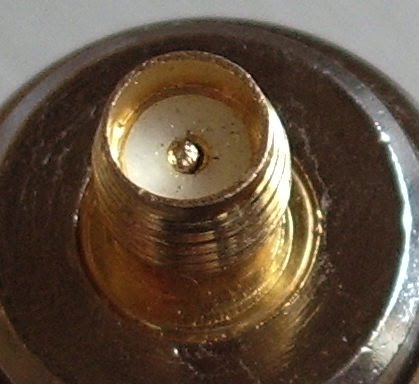 I’d heard about the famous fragility of the SMA connectors used on modern hand-helds but today I got bitten by it. I was using my RigExpert antenna analyzer to check the resonance of the stock antenna supplied with the VX-8GR (which I found to be rather broad) and thought I would check the antenna supplied with the Kenwood TH-F7E for comparison. That was sharper, but the SWR was high – the best match was at 160MHz. As I was unscrewing the antenna from the SMA to BNC adapter I heard a snap. When the antenna came off I saw that the centre pin was still in the socket of the adapter. Damn!
These SMA sockets are not meant for constant swapping of antennas. The centre pin is thin and fragile, and to make things worse the pin rotates with the antenna as you screw or unscrew it, subjecting it to a twisting action that must eventually cause metal failure. All it takes is for the female to be a bit tight, if you’ll pardon the expression, and the result could be castration of the antenna.
So I’ve had it with SMA connectors. I bought two BNC to SMA adapters several months ago and the only reason I was still using the SMA antennas is that I don’t have any short BNC antennas suitable for using with the radio on my belt. But now one of those adapters will go on the VX-8GR permanently.
What’s most upsetting about this is that I’ve spoilt my TH-F7E which I was planning to sell, as the original antenna is now useless. So now I’ll have to buy a new Kenwood antenna before I can sell the radio (£24 from W&S, eek!)

Polar Bear Summer Picnic Event Jun 2010
My favorite QRP group is the Polar Bear QRP gang! We have a good time and enjoy outdoors activities and trying to connect with one another at least once a month with some kind of activity. To escape some of the heat, I got an early start on the day. I wanted to try out a new mini-bac antenna configuration and knew it would take some time to get it up into the trees. BOY WAS THAT AN UNDERSTATEMENT! It was 110 ft doublet with a 40 ft feedline that was setup as a ladder line. Not an easy one to get up single-handed. Thanks to some tall trees, was able to get it up about 40-45 feet in the pine trees. It loaded great on 40m, but was disappointing on 20m so I ended up setting up my W3EDP in an L from my 20 ft Jackite pole to a nearby cedar tree at about 35 feet. The sun chased me into the treeline where I settled in to chase bears.

Abandoned mini-back doublet feedline hangs in foreground
My xyl Connie took a picture that shows the mini-back feedline hanging in the breeze after I shifted positions and setup the W3EDP in the shade. Grrrrr!

Osprey perched right above my head…cell phone picture
Was able to work a couple of the Polar Bears, Mike W3MC in MD and Guy N7UN up in the mountains on a trail(?) in NJ. I heard VA2SG but he was at ESP level briefly then faded away. I did hear a few others working him though. WA8REI was working Guy but I could not hear him at all and ended up tail ending their QSO to connect with N7UN.
Got to work a few others through the QSB and poor signal strength on 20m including Pastor Les, K4NK in SC, KE5SBZ, Ed in TX, N1FJ in MA, and Phil W3HZZ in Atlanta so it was a nice way to spend a few hours outdoors in the heat.
Connie brought me a picnic lunch and we enjoyed the osprey and bald eagle show as they fished Lake Fredrica.

Had to drink extra coffee to copy speedy W3MC's signal

This is the life… outdoors and ham radio…making QSO's…PTL!
Antenna analyzer from China
An antenna analyzer is a very useful piece of equipment and I have never regretted buying my AA-200, though I probably wouldn’t get one now with the current model priced at £410.00. Even the basic MFJ-259B which is not exactly renowned for its quality construction will set you back £260.00. So I was interested to discover that the Chinese have entered the market with the Feature Tech AW07A which can be bought on eBay for a much more reasonable £160.00.
 The unit can measure RF impedance and SWR from 1.8 to 490MHz (making it more directly comparable to the MFJ-269B model) as well as measuring capacitance and inductance. It may be used as a non-precision signal source and frequency counter, and with the addition of an inductor may be used as a dip meter. It looks like a nice addition to any amateur’s toolkit.

QRP antenna
I bought a copy of Practical Wireless today and noticed the following in the Waters and Stanton ad inside the front page.
 It isn’t often words fail me, but three hundred quid delivered for a hand held QRP antenna?!? I guess it would perform about as well as my home-made Wonder Loop.

K4UPG Back in Action!
Many work responsibilities have kept me off the air more than I’d like lately.
But we did manage to break away for a few days with family in Tennessee over Memorial Day. It was great to have an opportunity to get together with Chuck, AF4O the Hillybilly Bear and fellow Polar Bear QRP group member. We had an opportunity to work a bit of QRP portable in the Chickasaw State Forest in West Tennessee. It is a very natural and beautiful location and Chuck took me to his special spot in a very old and interesting cemetary set deep in the very tall hickory tree forest. Wow! I believe the latest date on the grave markers was 1927 and there were many from the early and mid 1800′s. It is a lovely and isolated spot.

K4UPG running a 30m EFHW sloper from the edge of the forest cemetary
Chuck said to bring along a screen shelter and I sure was glad I did! This was also a great spot for deer flies, hornets and other interesting biting bugs!
He had a nice setup and was running a random wire on 20m which he launched by throwing an antique glass insulator from an old telephone pole over a tree branch. He has a better arm than I do… think that heavy insulator would have broken my arm!
Back at the in-laws home in Jackson, I had some time to operate deck portable and was ably assisted by my niece Chloe. Conditions were horrible, but it was fun to be outside and hearing some sweet dits and dahs for a bit.
Now I am gearing up for the next outing of the Central Florida QRP group. The weather is HOT and the summer thunderstorms are back, but life and radio must go on… cu on the air!
72,
K4UPG

AF40 downs a Mountain Dew and doesn't miss a character of CW

Chloe gives me advice on copying cw through the QRN
Satellite antenna
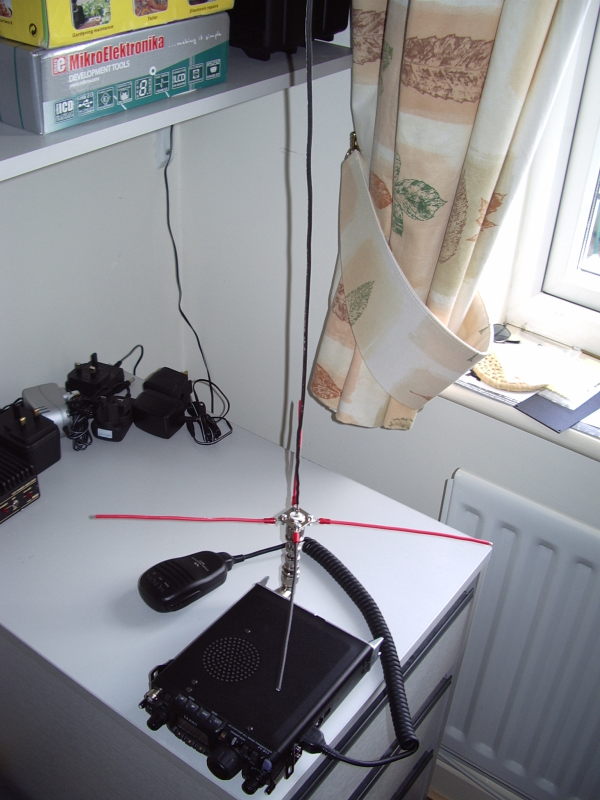 I attempted this morning to make a 5/8 wave ground plane antenna for 70cm out of some solid copper mains cable and a chassis mount SO-239 connector. I tried two designs for the radiating element with a coil at the bottom, but both gave “High SWR” from the FT-817 and were so far away from a match that there seemed no hope of getting anywhere. My SWR analyzer doesn’t go above 200MHz so that wasn’t any help in finding out what was wrong.
After these abortive attempts I decided to straighten out the coil and make a 3/4 wave ground plane instead. This gave a perfect match with barely perceptible reflected power being shown on the SWR meter.
The four radials are each 165mm (6.5in.) long and the vertical element 483mm (19in.) The radials need to be horizontal for the best match, not slanting down as they usually are for a quarter wave vertical.
Hopefully I will be able to receive satellite downlinks with this. There are no 70cm repeaters in this area and no 70cm activity that I know of so it will not be much use for anything else.

10m portable whip
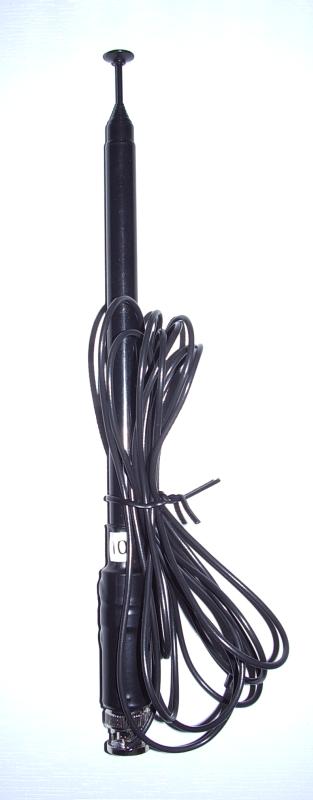 My reason for getting the Intek H-520 Plus hand-held was to try to work some Sporadic-E DX from the great outdoors. I didn’t think the supplied 18cm whip would be much good for that so I looked for the longest 10m BNC whip antenna possible. The best I could find was the AT-10 with a 4 foot telescopic whip which I believe is made by Sandpiper Antennas in Wales. It is sold by Waters and Stanton. I ordered one yesterday and it arrived in the post this morning – nice to see they can get it right sometimes.
The first thing I did with the antenna was put it on my AA-200 antenna analyzer. I was dismayed to find that the SWR on 10m was more than 10:1 and the best match was around 38MHz. I anticipated that this would be going straight back. However the instruction sheet “Getting the best out of your antenna” recommends using it with a counterpoise. I had expected to use one for best performance anyway, so I decided to try this before writing the antenna off completely.
The instruction sheet recommends a length of 6ft 5in for 10 metres, but I found that was too short as the best match was still well above 30MHz. By trial and error I eventually found a length of 7ft 6in was about right. The best SWR was still only 2:1 so I think the antenna is capable of improvement, but there is nothing else available to the best of my knowledge.
If a counterpoise is required you might think it would be a good idea for the manufacturers to provide somewhere to attach one. I tried using an alligator clip but it tended to slip off the BNC connector. In the end I managed to solder to the outer sleeve of the BNC connector using my biggest soldering iron turned up to maximum temperature so the counterpoise is now permanently attached to the antenna (until the wire breaks off, which it will probably do in the middle of a field just at the start of a massive band opening.)
Now I just need some Sporadic-E to see how far it is possible to work with a hand held radio.














