Archive for the ‘antenna’ Category
 Get a taste of the RF coming and going
 January 18th, 2016 |
  Author:
 Elecraft CP1 - A tasty RF treat
 |
| Elecraft CP1 Kit |
Couple what?
Ah, so if your new to this like me you might be asking what does a coupler do? Well it sorta listens in on the signal going out (forward) and reflected (back) and is able to send an attenuated sample of the signal to other devices. It attenuates the sample by either 20db or 30db depending on how you build the kit.The 20db version is good for signals 25 watts and less so that's the way I built it. It was easy to build but my glue under the second toroid wasn't strong enough and you can see it popped up a bit. Also the Elecraft instructions had one confusing instruction concerning mounting the toroids. The instructions say "... When wound and mounted correctly, the enamel wire will emerge from the top of each core and connect to the top hole at each inductor location". Well when you wind a toroid only one of the wires can "emerge from the top of the core" while the other comes from underneath. This confused me for a minute until I finally just went on with the install. Anyway, if you're a stickler for following instructions that one may cause a moment of pause...
The switches for the two outputs forward, reflected (J3, J4) are in the up position when they are not in use. When the switch(es) are in the up position the 50 ohm 3 watt resistor(s) take the place of the switched off output. Don't disconnect an output and leave the switch in the bottom position. I'm not sure what will happen... maybe nothing, probably a bit of a mismatch on the SWR, or maybe it could be like "Crossing the streams" in Ghostbusters. Your mileage may vary.
My uses for a coupler
My old Ten-Tec Century 21 has an analog VFO dial that gives me a good guess at where I'm at but I use an external frequency counter to give me more information. I had it sorta rigged my frequency counter to sample the signal from RF leaked on the shield but I didn't really know how much power I was sending to the counter so this coupler allows it, as well as other devices, to be safely connected to the transmitted signal.I also plan to use the coupler for IMD tests using a oscilloscope and other projects. It's handy device to have in your collection.
My confusion
But in the end - It works
Antenna faulty
It looks like my tri-band Par antenna, which should be a good match on 10m, 20m and 40m is faulty. It is a good match on 10m, but only on 20m and 40m via the ATU. Tomorrow I shall try loading it up as a long wire tuned against ground via the ATU. Somewhere I have a Sandpiper Poliakov vertical that I should erect. As I recall this has a 9:1 unun so it matches well on most HF bands via an ATU.
Even soldering on a coax is hard work these days! Oh to be fit.
At the moment I am on 630m WSPR using the earth-electrode “antenna”.

Can anybody hear me
Calling QRP CQ - Inconceivable
Amazingly my 80m Windom / OCF Dipole has 4.5:1 SWR native around 1.8 mHz and it matches easily with a tuner across the entire 160m band. That was a surprise.
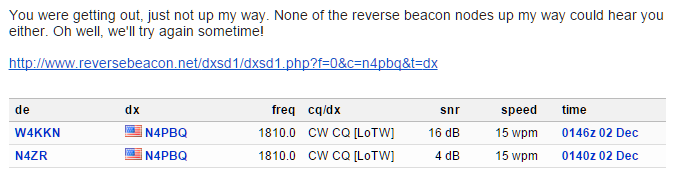
I tossed my mighty 5 watts call out at 1810 kHz not expecting much...
So how do you know if and where your signal is getting out ?
The Reverse Beacon Network
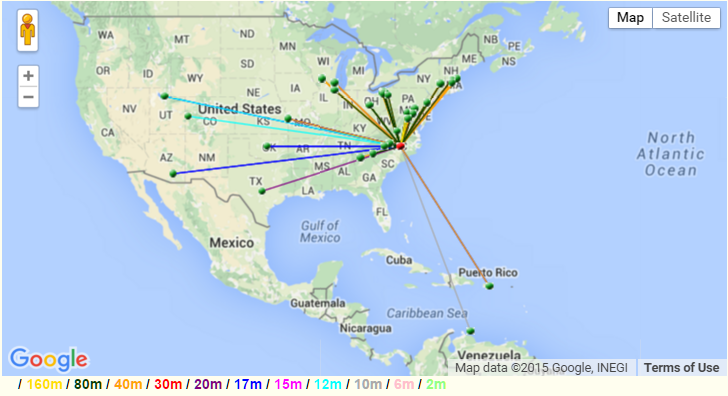 |
| Map of the last 100 reports from Reverse Beacon stations of my call sign Color coded by band |
It even includes a speedometer
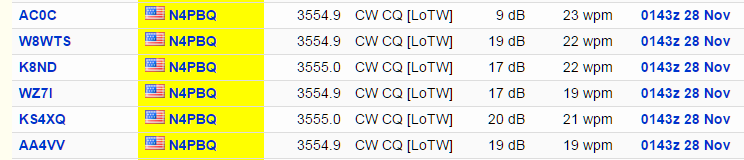 |
| My brief speed key session with N4HAY |
Summary
New antenna
My shack is fairly spartan. Just the IC7000 as a main rig. The antenna farm is equally so with all antennas in the loft bar a 2m & 70cm colinear.
Its a fairly spacious loft mind you. Enough room for a Watson 80 plus 2 dipole (Which they don’t seem to make any more) with extra elements for 30m and a 4 element 10m band yagi. But 80m is really not working for me.
So with a few hours to spare this weekend and a bit if ladder line I pulled together a W3EDP antenna. Its nothing new and a very cost effective antenna. So without going through all the detail it was either that or nothing at all for 80m. I just simply don’t have the space for a windom ( which is what I would have preferred) and G7FEK limited space antenna would have meant more stuff in the garden to annoy the XYL.
Needless to say I got the chance to try it out, firstly with the Hack Green SDR and shortly afterwards a nice QSO with Peter, G4LHI in Huntingdon.
So for a couple of hours work I can recommend the W3EDP. Noting of course the current at the end and need for a good counterpoise / earth. I can also say that even in a lash up configuration it withstood some pretty big winds here in IO84 this weekend.
So where to find out more:
 Well a simple Google will give you most of the info you need but you could do worse than invest in the the Stealth Antennas book. I have a copy of the older version,
I see the new one has a different cover, I’m not sure if there was much change in the insides between editions but there’s something in there for everyone. From ultra small weird looking things to some old favourites like loops and verticals all the way to ultra cheapo types.
Its not all good news though. The XYL isn’t happy with the wire. The Watson 80 plus 2 (whose inspiration came from the G4ILO section of this book) didn’t quite meet my expectations and I didn’t quite get the G7FEK constructed. Maybe next time.
If you’re stealthier on 80m then I’m sure I won’t be the only one who is interested in finding out how you did it. If not then lucky you for having enough garden and don’t forget to listen out for the weak signals. 
Ham Radio & PLT devices

Over the past few years and again recently I have heard a lot of chatter regarding PLT interference. Especially with Ham radio and shortwave bands. These devices plug into a power wall socket in your house and allow you to create a wired network via your mains wiring in the property. It’s a perfect solution for properties that cannot send a wireless signal from one end to another (Just like mine). It does however have a draw back. In creating a wired network these PLT devices create a lot of mains born interference and this can effectively block out any amateur radio bands.
In recent stories I have heard audio samples and read stories of how these devices can create S9+20db of noise. Thus reducing the amateur bands unusable.
I wanted to see for myself the effect of using PLT devices in my property. So I visited PC World and purchased 2 devices from NetGear. The Powerline 500 promise 500Mbit/s and this would solve a huge problem I have in my home right now, but feared for what it would do to my beloved radio.
The results were interesting and nothing what I expected. You can see my full test in the video below – but for a spoiler alert keep reading….
The moral ? – Don’t believe the hype.
Ham Radio & PLT devices
Over the past few years and again recently I have heard a lot of chatter regarding PLT interference. Especially with Ham radio and shortwave bands. These devices plug into a power wall socket in your house and allow you to create a wired network via your mains wiring in the property. It’s a perfect solution for properties that cannot send a wireless signal from one end to another (Just like mine). It does however have a draw back. In creating a wired network these PLT devices create a lot of mains born interference and this can effectively block out any amateur radio bands.
In recent stories I have heard audio samples and read stories of how these devices can create S9+20db of noise. Thus reducing the amateur bands unusable.
I wanted to see for myself the effect of using PLT devices in my property. So I visited PC World and purchased 2 devices from NetGear. The Powerline 500 promise 500Mbit/s and this would solve a huge problem I have in my home right now, but feared for what it would do to my beloved radio.
The results were interesting and nothing what I expected. You can see my full test in the video below – but for a spoiler alert keep reading….
The moral ? – Don’t believe the hype.
Rock ‘N Radio — QRP Style
Operating QRP
Can mean operating from a "Quiet Restful Place"
I had the day off today and it was a beautiful morning. I decided to spend part of it at Lake Wheeler Park in Raleigh, NC operating QRP from a stone bench under a tall oak tree. |
| rock 'n radio |
I threw a line over a tree using a throwing weight. I hit my mark the first time, untied the weight, tied on the end of the antenna, and hoisted the 31 foot end-fed up exactly where I wanted it with the feed point a couple of feet off the ground.
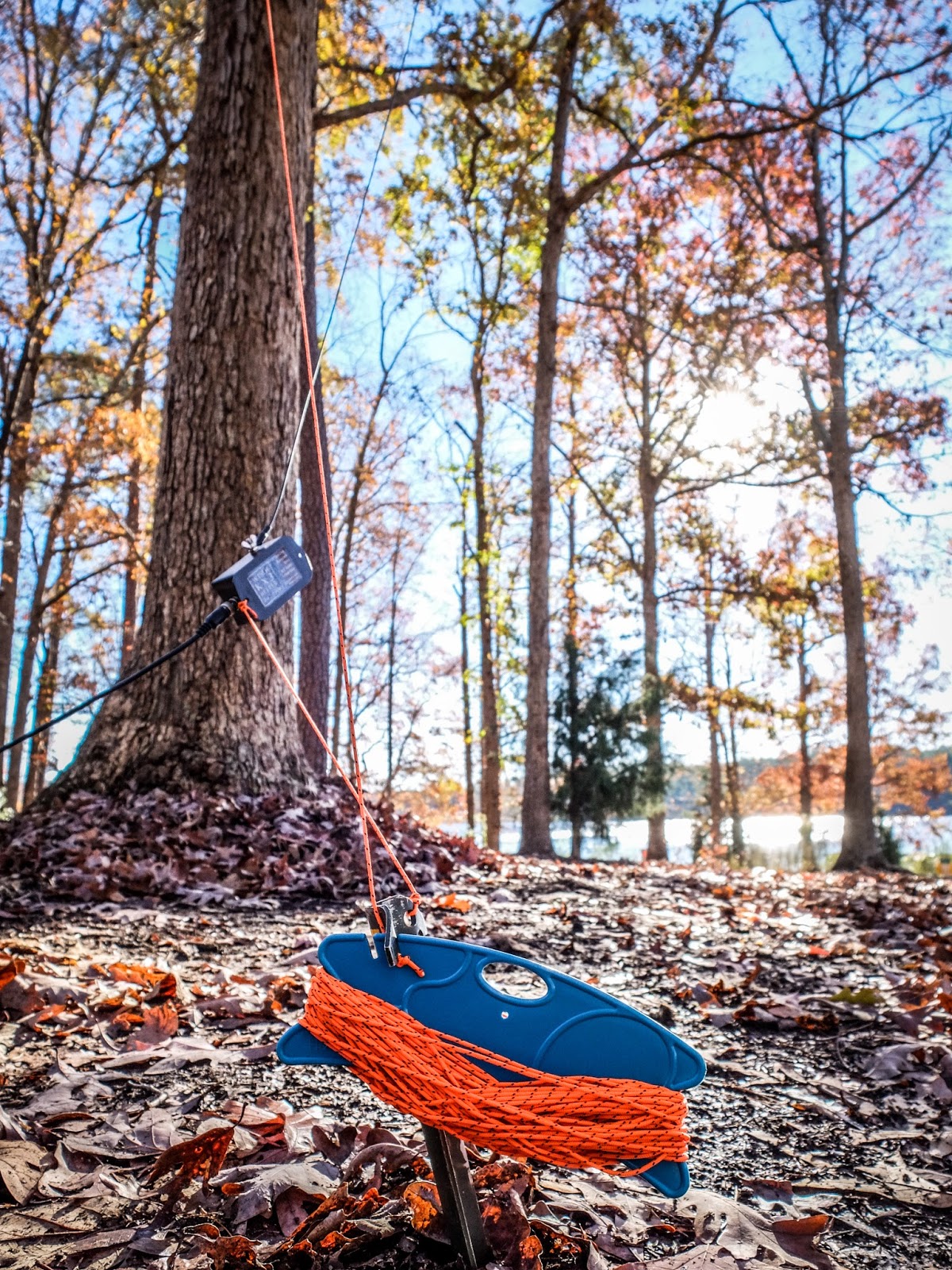 |
| 31 feet of wire end-fed by a 9:1 balun. A kite string winder holds the throwing line A metal stake with a bit of rope anchors the balun and the other end of the rope |
 |
| Another view of the end-fed with 9:1 balun, stake and coax |
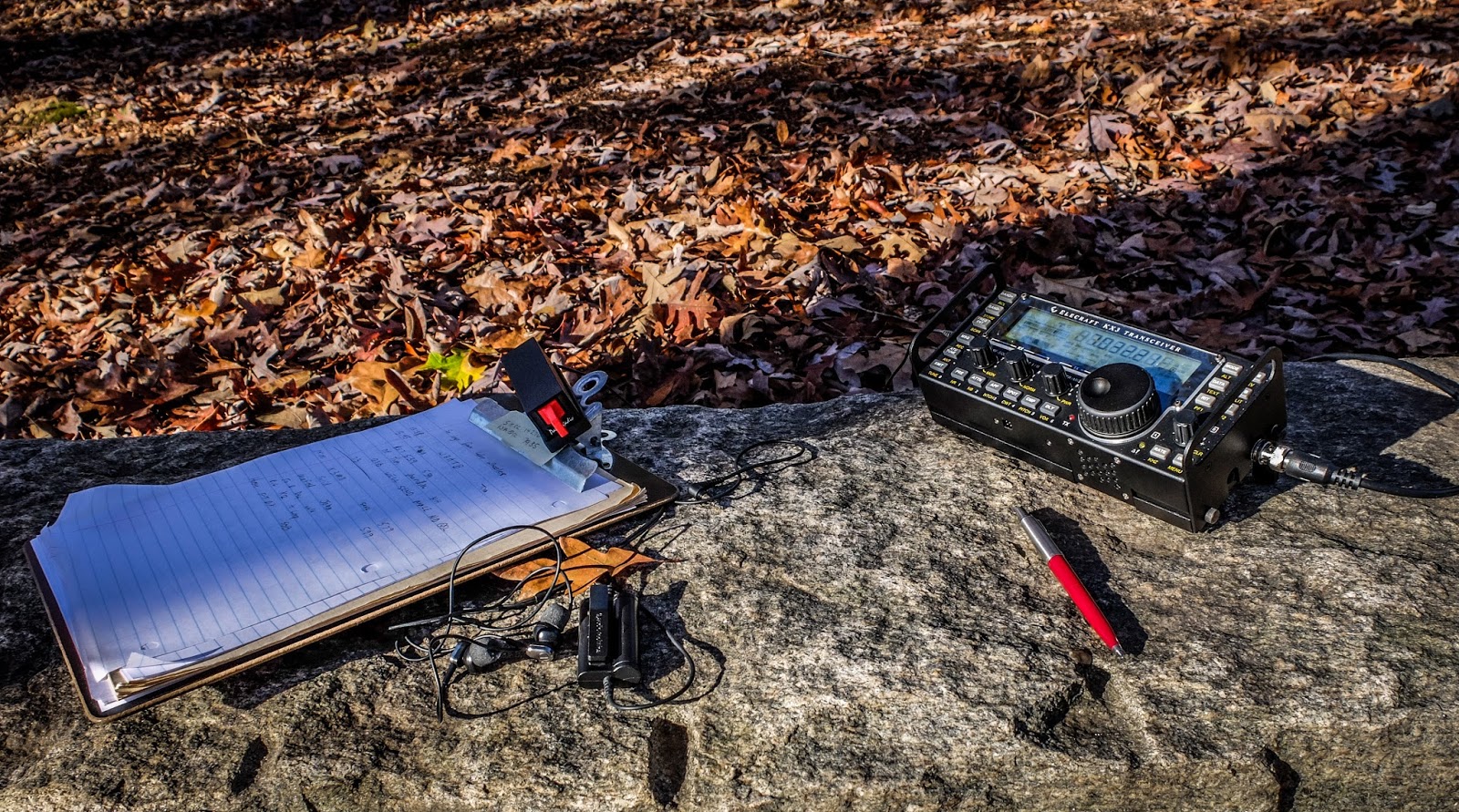 |
| QRP operating position |
I called CQ on the 20m QRP calling frequency (14.060) and had a brief QSO with a lot of QSB (fading). I didn't hear much activity that early in the morning on 20m so I dropped down to 40m and worked the QRP calling frequency (7.030) and had my call answered right away. After that QSO another station jumped in there calling for a specific station so I moved on. 40m was busy. Every time I thought I'd found an open frequency someone would jump back in or if I called QRL? I'd get an R R.
The Palm key has a clip-on, magnetic base which I use to temporarily attach it to my clipboard when I'm not sending. When I'm ready to send I simply pull it off the clipboard and hold it in my left hand. As I noted in an earlier review of the Palm Single Paddle it can be used as a straight key if you turn it on its side. The long ragchew I had on 30m was with a gentlemen who sent me his SKCC number in the first exchange so I quickly turned off the electronic keyer in the KX3's and turned the Palm Single on its side. That station sent me a nice compliment on my straight key FIST; so the little Palm Single key can serve duty as a paddle into a keyer or (in a pinch) as a straight key. I far prefer to use my Kent Hand Key if I'm operating manual key but it's too big to bring along for portable operations and I can't quite picture myself trying to hold onto the giant Kent Hand Key with one hand whilst operating it with the other like I can the Palm Single.
 |
| The Palm Single Paddle works great in portable operating positions |
 |
| What could be finer than to be in Carolina in the Mooo-oor-ning |
 |
| Enjoying the last nice days of our Fall... birds singing and morse code beeping |













